
Table of Contents
Frequently Asked Questions
What is the main difference between an embassy and a consulate?
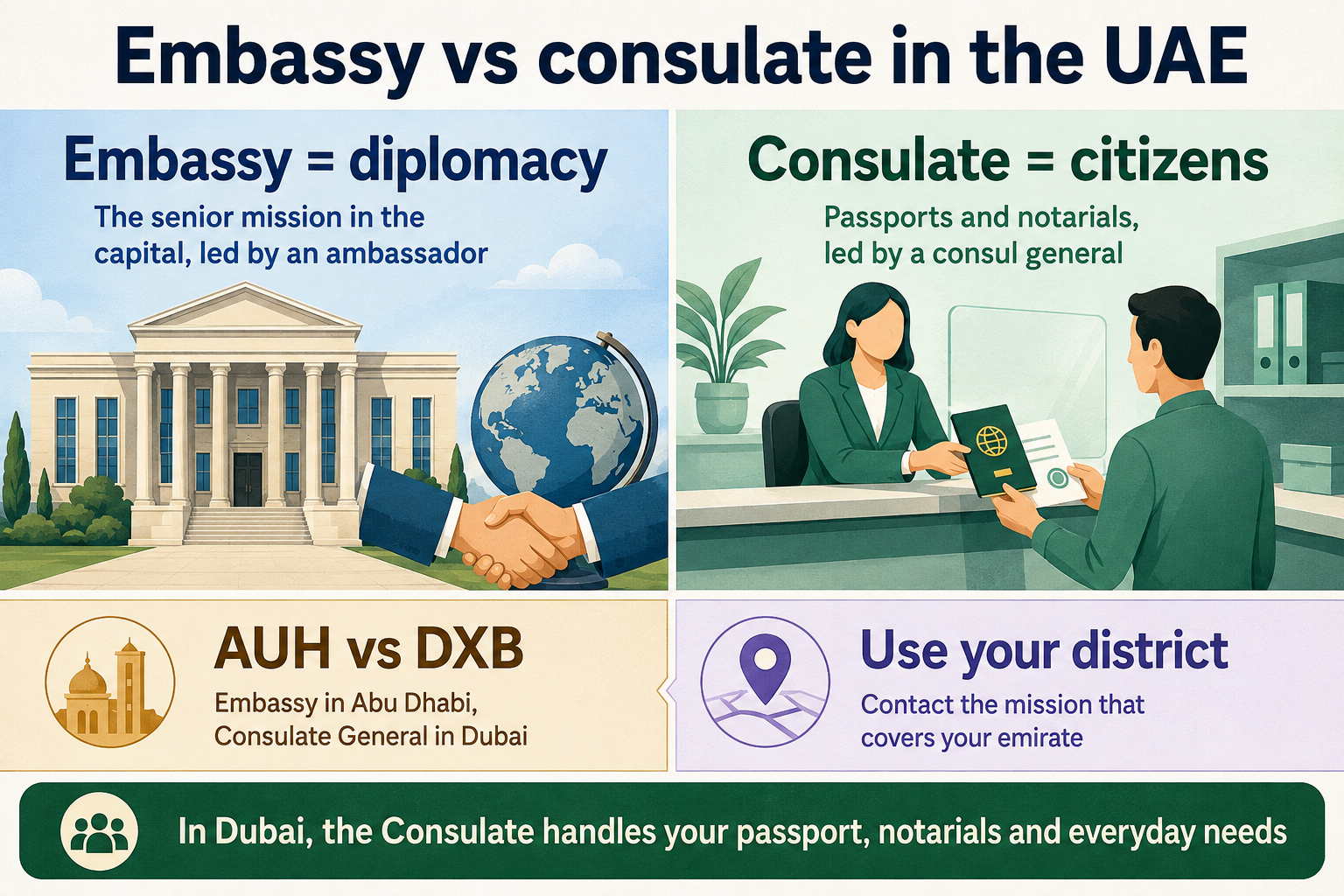
An embassy is the main diplomatic mission, usually in the capital, handling government-to-government relations. A consulate is a branch office in another city, focused on citizen services like passports and notarials. Both help citizens, but their main jobs differ.
Does the US have an embassy or a consulate in Dubai?
Dubai has a US Consulate General, not an embassy. The US Embassy is in Abu Dhabi, the capital. The Consulate General in Dubai serves US citizens in Dubai and the Northern Emirates with the full range of citizen services.
Can a consulate do everything an embassy can for citizens?
For citizen services like passports, notarials and birth records, yes. The Consulate General in Dubai provides these in full. Diplomatic and trade matters, however, sit with the Embassy in Abu Dhabi, which leads the US mission.
Which should I contact in an emergency in Dubai?
Contact the US Consulate General in Dubai, as it covers Dubai and the Northern Emirates. Use the mission that covers your location. For current contact details and emergency guidance, check the official site, ae.usembassy.gov.
Why is the US Embassy in Abu Dhabi and not Dubai?
Because Abu Dhabi is the UAE capital, where the government sits and diplomatic business happens. Dubai has a consulate general instead, serving its large population, which is the same pattern the US follows in many countries.
American Embassy vs American Consulate in the UAE: What's the Difference?
Many Americans in the UAE use the words embassy and consulate as if they mean the same thing. They do not. The difference is simple once you see it, and knowing it means you contact the right office the first time, rather than being sent across the country for the wrong one.
This guide explains what sets an embassy apart from a consulate, why the US runs both in the UAE, and which one you actually need. It is a companion to our complete guide on the US missions and our family relocation checklist.
Key Facts at a Glance
| The short answer | An embassy handles diplomacy, a consulate handles citizen services, though both help US citizens |
|---|---|
| In the UAE | The US Embassy is in Abu Dhabi, the US Consulate General is in Dubai |
| Who leads each | An ambassador leads the embassy, a consul general leads the consulate |
| Which you will use | For passports and notarials, the mission covering your emirate, usually the consulate if you are in Dubai |
| They are linked | The consulate is part of the same US mission and reports to the embassy |
The Simple Difference
At heart, the distinction is about the job each office does. One deals with countries, the other with people.
An embassy is the main diplomatic mission of one country inside another. It sits in the capital, is led by an ambassador, and handles the big relationship: politics, trade and government-to-government business.
A consulate is a branch office in another major city. It is led by a consul general, and it focuses on practical services for citizens, like passports and notarials.
Put simply, the embassy represents the United States to the UAE, while the consulate serves Americans on the ground.
How This Looks in the UAE
The UAE is a clear example of the split. The US runs one of each, in two different cities.
| Point | US Embassy, Abu Dhabi | US Consulate General, Dubai |
|---|---|---|
| What it is | The main US diplomatic mission to the UAE | A consulate general serving the northern UAE |
| City | Abu Dhabi, the capital | Dubai |
| Led by | The ambassador or chief of mission | The consul general |
| Main focus | Diplomacy, trade and government relations | Services for US citizens in its district |
| Covers | Abu Dhabi, Al Ain and the western and southern UAE | Dubai and the Northern Emirates |
[blockCTACostCalculator]
Why the US Has Both
It comes down to size and convenience. One office in the capital cannot easily serve everyone.
The embassy sits in Abu Dhabi because that is the capital, where the UAE government is based. That is where diplomatic business happens. Dubai, though, has a huge population of Americans and a major commercial centre.
Rather than make everyone travel to the capital for a passport, the US runs a consulate general in Dubai to serve the north. It is the same logic the US uses worldwide, an embassy in the capital, consulates in other key cities.
Which One Do You Actually Need?
For almost every personal task, the answer is the mission that covers where you live. This is about jurisdiction, not preference.
- Passports, notarials and birth records: Use the mission for your emirate. In Dubai, that is the Consulate General.
- An emergency: Contact the mission covering your location directly.
- Diplomatic or trade matters: These sit with the Embassy in Abu Dhabi.
- Visas for foreign nationals: These are handled by the mission's consular section, by appointment.
The key point is jurisdiction. If you live in Dubai or the Northern Emirates, you use the Consulate, even for services people assume only an embassy provides.
How This Matters for a Move
For a family relocating from the US, this distinction is practical, not academic. You will deal with the consulate, not the embassy, for the paperwork side of your move.
When you set up your life in Dubai, you may need documents notarised, like a power of attorney or a certified copy. That is a consular service, so you use the Consulate General in Dubai.
Your UAE company and residency are a separate track, handled through a free zone. A Meydan Free Zone setup gives you a license issued fully online, in under 60 minutes through Fawri, which makes you eligible for residency.
From there, mResidency takes the load off the family:
- It schedules your medical and biometrics appointments, and arranges private transport with in-centre assistance.
- It tracks each application through a digital portal, and delivers your Emirates ID to your door.
- It procures the mandatory medical insurance that UAE residency requires.
- It processes the dependant visas for your spouse and children, so the whole family becomes resident together.
The consulate certifies your US papers, and Meydan Free Zone builds the UAE side.
Conclusion
So, what is the difference? An embassy is the senior diplomatic mission in the capital, and a consulate is a citizen-services office in another city. In the UAE, that means the Embassy in Abu Dhabi and the Consulate General in Dubai. For your passport, your notarials and your day-to-day needs, you almost always want the one covering your emirate.
If you are relocating, the consulate handles your US paperwork while your company and residency run in parallel. To set up the company and residency behind your move, book a free consultation with a setup advisor at Meydan Free Zone.
[blockCTAContact]
References
- U.S. Embassy and Consulate in the UAE
- U.S. Department of State