Table of Contents
Frequently Asked Questions
Do I need third-party approval to start an Arabic gowns tailoring business?
No. Code 1410.93 does not need any third-party approval. You still need to follow Dubai Municipality workshop rules if you run a physical space, and MOHRE labour rules for your tailors and embroiderers.
Can I make men's kanduras under this license?
No. Code 1410.93 covers Arabic women's gowns only. Men's Arabic wear tailoring sits under a separate sub-code (1410.91) within the same ISIC class 1410 and needs to be added at application.
How long does setup take with Meydan Free Zone?
You can get your license in under 60 minutes via Fawri, through a fully online process. Setting up the physical workshop and hiring skilled tailors takes longer, but the trade license itself is quick.
Do I need a physical workshop, or can I work from a flexi-desk?
A flexi-desk qualifies for the license itself. Real gown tailoring, though, needs floor space for sewing machines, cutting tables, fabric storage, and private fittings. Most serious operators run a small workshop even in the early days.
Can foreigners own an Arabic gowns tailoring business in Dubai?
Yes. You get 100% foreign ownership when you set up with Meydan Free Zone, and the same is true for most mainland activities registered through DET.
Arabic Gown Tailoring Business Setup in Dubai
Abayas, kaftans, and jalabiyas are worn daily by Emirati women, and the market extends into a large expat and visitor buyer base. Weddings, Eid, National Day, family gatherings, and hotel stays all drive steady demand for well-cut traditional gowns. Activity code 1410.93 is the license that lets you make, tailor, and sell that work.
This guide covers what the code permits, the boundary you cannot cross, the jurisdiction choice, and how to get set up.
Key Stats at a Glance
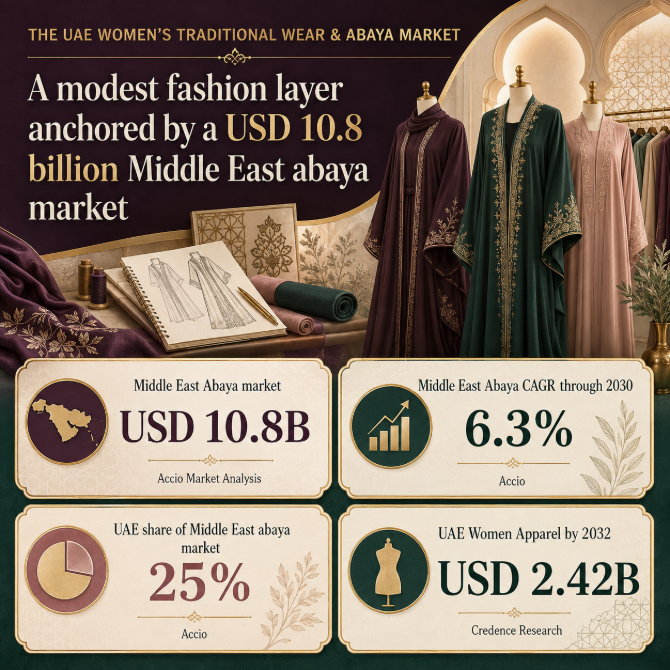
Sources: Accio Market Analysis, Credence Research, La Mode Patchouli
What This License Covers
Code 1410.93 authorises the making and tailoring of Arabic women's gowns on a custom, bespoke, and small-batch basis:
- Bespoke abaya tailoring, from classic black to modern minimalist and open styles
- Kaftan and jalabiya making in silk, chiffon, satin, and premium blends
- Wedding gown tailoring, including hand-embroidered and beaded designs
- Shayla, hijab, and headwear tailoring
- Occasion wear for Eid, Ramadan, National Day, and formal gatherings
- Alterations, adjustments, and made-to-measure work on existing garments
- Small-batch production for retail buyers, boutiques, and e-commerce brands
This is a tailoring and manufacture license. Men's Arabic wear tailoring, fabric wholesale, footwear making, and non-tailoring garment manufacture all fall outside it and need separate codes. That boundary is the one most likely to catch you out, because clients who love your abayas will ask you to make matching kanduras for the men in the family too.
Who Your Clients Will Be
- Emirati and GCC national women ordering everyday and special-occasion wear
- Brides commissioning wedding gowns and bridal party abayas
- Regional Gulf visitors buying tailored gowns during Dubai stays
- Modest fashion boutiques stocking small-batch designer abaya lines
- Retail buyers and e-commerce brands sourcing ready-to-wear traditional women's lines
- Hotels sourcing traditional uniforms for female concierge and hospitality staff
- Corporate gift buyers ordering premium abayas as gifts for VIP guests
Work is a mix of walk-in bespoke, wedding-season orders, boutique wholesale, and B2B contracts. That is a large part of why this license is workable: repeat family relationships, high margins on wedding and formal wear, and a client base that keeps coming back for seasonal and occasion pieces.
Mainland or Free Zone
This is the biggest choice you will make when setting up. Let your clients decide it, not the price.
[blockCTACostCalculator]
Step-by-Step Setup Guide
[blockAccordionSteps]
Compliance and What You Need in Place
Dubai Municipality workshop standards
If you run a physical tailoring workshop, Dubai Municipality sets rules on ventilation, fire safety, waste disposal, and staff welfare. A workshop inspection is standard before you start operating.
Fabric sourcing and customs
Most premium fabric for abayas and gowns comes from Korea, Japan, Italy, and Turkey. Set up customs clearance early, and make sure your labelling meets UAE textile import rules. Wedding-grade fabrics with hand-work often need careful documentation on origin and value.
Labour
Traditional gown tailoring runs on skilled labour, often Filipino, Indian, and Pakistani master tailors specialising in fine hand-stitching. Register your tailors correctly with MOHRE, run background checks, and keep employment contracts clear. A dispute with a master tailor mid-wedding season can shut you down.
Tax
VAT registration is required once taxable turnover passes AED 375,000, and tailoring services supplied within the UAE are standard-rated at 5%. Keep clean books from the first invoice.
Visas
Quota follows your setup. A flexi-desk typically supports one to three visas, and a dedicated workshop unlocks more, which matters when you are hiring a full team of tailors and embroiderers.
Renewal
Annual and mandatory. Non-renewal brings fines and can lead to blacklisting, which then complicates banking and any future application.
Market Opportunity
Demand is tied to the UAE's Emirati and GCC national women population, the regional visitor flow, and the deep cultural weight of the abaya, kaftan, and jalabiya in daily life and at occasions. Abayas are worn daily, not occasionally, which turns a good tailor into a repeat-business anchor for whole extended families.
The premium end of the market pays well. A wedding order for the bride's whole party often stacks up to a five-figure invoice, and hand-embroidered pieces command real premiums.
Modest fashion has also broken into international markets, opening export and e-commerce channels for UAE brands. A qualified tailor with a good client book can be trading from a small workshop and grow by adding staff as the orders arrive.
Conclusion
An Arabic gowns tailoring license under 1410.93 is a well-defined manufacturing category suited to bespoke ateliers, modest fashion brands, and small-batch producers working in one of the region's most culturally rooted markets.
Three decisions shape your setup: jurisdiction, scope clarity, and how you build your team of skilled tailors and embroiderers. Settle those at the outset and the rest follows a predictable path.
Use the cost calculator for an estimate, or speak to the Meydan Free Zone team to confirm the right activity code before you commit.
[blockCTAContact]