Table of Contents
Topic Summary
Understand What Activity Code 4721.79 Covers
This trading license lets you buy and sell food supplements including vitamins, minerals, herbs, amino acids, and specialty foods through physical stores, online platforms, or wholesale channels. The key distinction is that these products are classified as dietary supplements, not drugs, which keeps the regulatory burden relatively light.
No Third-Party Approval Required
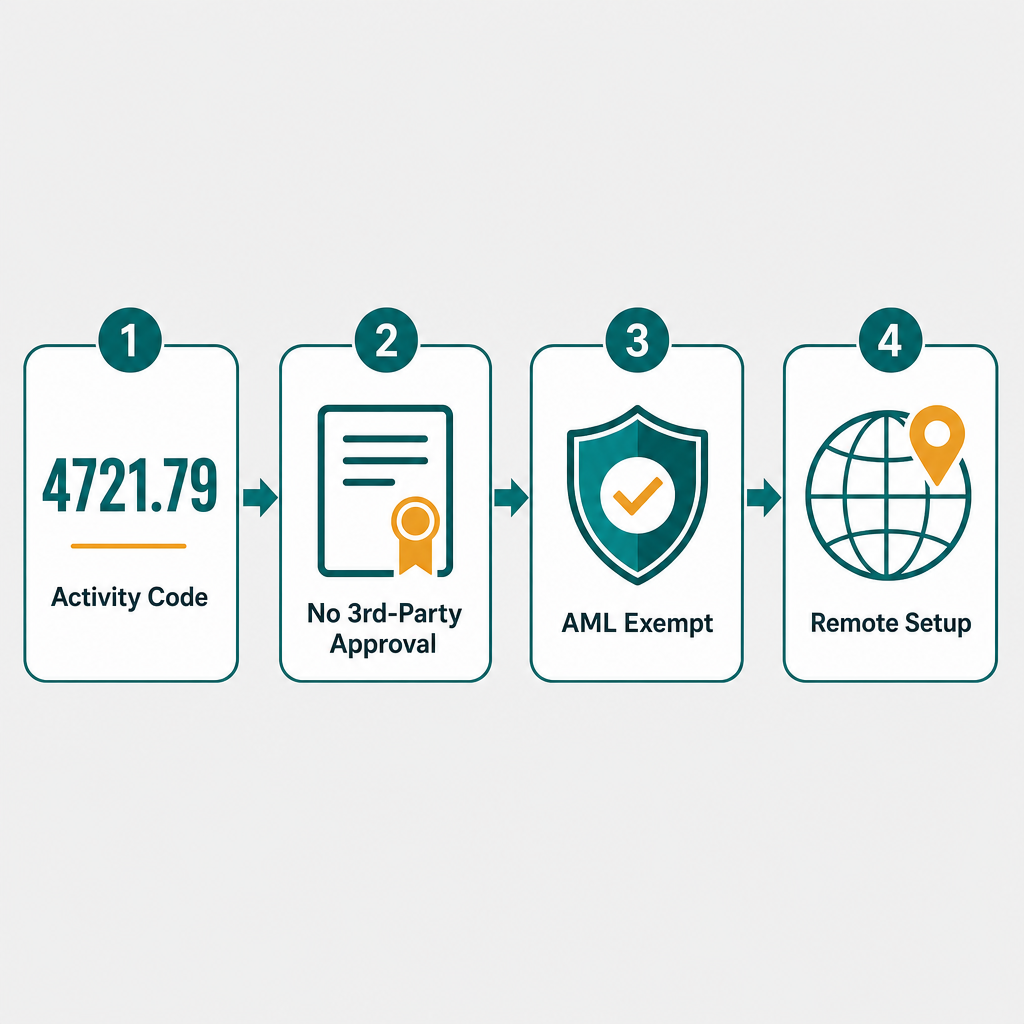
Unlike many health-related business activities in Dubai, food supplements trading under code 4721.79 does not require third-party approval on either the mainland or in a free zone. This significantly simplifies and speeds up the setup process for new traders.
Choose Between Mainland and Free Zone Setup
A mainland license suits traders focused on direct local retail sales, while a free zone setup through Meydan Free Zone supports import, e-commerce, wholesale, and re-export models with remote setup available. Both options carry the same advantage of no third-party approval for this specific activity.
Target Six High-Demand Product Segments
The tradeable product range spans vitamins and minerals, herbal and botanical extracts, sports nutrition, omega fatty acids, probiotics, and specialty functional foods like honey and herbal tonics. Vitamins and minerals represent the largest and most consistently traded segment in the market.
Tap Into a Diverse and Growing Customer Base
Dubai's population of over 3.5 million is roughly 88% expatriate, creating strong demand across varied dietary needs, health goals, and cultural preferences. Gym-goers, older residents focused on preventive health, and online shoppers all represent distinct and accessible buyer groups.
Leverage Dubai's Infrastructure for Regional Distribution
Dubai's ports, airports, and free zone network make it practical to import from international manufacturers and re-export across the Middle East, Africa, and South Asia. This infrastructure can transform a local retail operation into a regional distribution business without requiring a separate license.
Enter a Market Projected to Grow Over 7% Annually
The Middle East and Africa dietary supplements market is valued at over USD 3.5 billion and is forecast to grow at a compound annual rate exceeding 7%. Combined with one of the world's highest internet penetration rates, Dubai offers strong conditions for both physical and e-commerce supplement trading.
How to Become a Food Supplements Trader in Dubai
Dubai has more than 3.5 million residents, around 88% of them expatriates, and that mix brings a wide spread of diets, health goals and buying habits. Activity code 4721.79 is the license for supplying the supplements market that sits behind it.
This is a trading license. You buy and sell food supplements, and you can do it through shops, online, through wholesale distribution, or all three at once. This guide covers what the license allows, what sits inside the product range, how the setup works, and the compliance position, which is lighter than most people expect.
Key Stats at a Glance
What This License Covers
Code 4721.79 covers buying and selling food supplements: products containing vitamins, minerals, herbs, amino acids or other dietary substances meant to supplement a person's diet.
The defining line is that these products are not treated as drugs. Under this license you can resell supplements and foods intended to provide nutrients, including foods for people with particular conditions, and foods prepared from natural substances without the artificial additives, flavours or colours common in canned or preserved food. That covers vitamins, minerals, fibre, fatty acids, amino acids, honey and herbal tonics, plus nourishing substitutes for athletes and diet products.
In market terms the range usually breaks into six segments:
- Vitamins and minerals, the largest and most widely traded segment
- Herbal and botanical extracts such as turmeric, ashwagandha, ginseng and green tea extract
- Sports nutrition, including protein powders, pre-workout formulas, amino acids and recovery products
- Omega fatty acids and fish oils
- Probiotics, digestive enzymes and fibre products
- Speciality and functional foods, including honey, herbal tonics and products formulated for particular dietary needs
You can trade through physical stores, online platforms, wholesale channels, or a mix. That flexibility lets you test a channel cheaply before committing to it.
Who Your Clients Will Be
Your buyers are consumers and the channels that reach them:
- Health-conscious consumers across a multicultural resident base
- Gym-goers and athletes buying sports nutrition
- Older consumers buying for bone health, cognitive function, cardiovascular support and immunity
- Retailers and wholesalers who need supply rather than brands
- Online shoppers, in a market with one of the highest internet penetration rates in the world
Dubai's ports, airports and free zone infrastructure add a second layer, making it practical to import from international manufacturers and re-export across the Middle East, Africa and South Asia. That turns a local retail business into a regional distribution one if you want it to be.
Mainland or Free Zone
Neither route needs third-party approval for this activity, so nothing external gates the decision.
Meydan Free Zone suits a trader whose model is import, wholesale, online retail or re-export. Setup can be completed remotely, which matters if you have not moved yet, and fast-track licensing exists if you want to start buying stock quickly. Structure is simple: an FZE for one shareholder, an FZC where there are several.
A mainland license through the Department of Economy and Tourism is the alternative if you are selling directly into the local retail market and want unrestricted reach across the UAE. Let your clients decide it, not the price.
[blockCTACostCalculator]
Step by Step Setup Guide
- Step 1, pick your jurisdiction: Free zone for import, wholesale, e-commerce and re-export. Mainland if you are selling straight into the local retail market.
- Step 2, select the activity: Choose Food Supplements Trading, code 4721.79, from the official business activities list.
- Step 3, choose your legal structure: A Free Zone Establishment for a single shareholder, or a Free Zone Company where there are several.
- Step 4, apply for the trade license: Fast-track licensing is available if you want to begin trading as soon as possible.
- Step 5, set up remotely if you are not here yet: You do not have to be physically in Dubai to finish registration, which opens the route to international investors.
- Step 6, check your product list against Dubai Municipality rules: No third-party approval is needed for the license itself, but the business operates under municipality rules, so review them against your intended range before you import anything.
- Step 7, pick your channels: Physical retail, e-commerce, wholesale distribution, or a combination of them.
Compliance and What You Need in Place
Dubai Municipality
No third-party approval is needed to get this license. The business is still subject to Dubai Municipality rules and regulations, and that is where your product-level duties sit. Read those against your intended range before you commit to stock, not after it lands.
Supplements, not drugs
The license covers supplements and foods that are not treated as drugs. Anything crossing into pharmaceutical territory needs different licensing entirely, and product formulation is what decides which side of that line you are on. Check it per product rather than per supplier.
How you describe your products
Nothing in this license lets you present a supplement as a medicine. The distinction that defines the license should also define how you talk about the range.
Anti-money laundering
Food supplements trading is not subject to AML regulations. That is worth knowing, because plenty of UAE activities are. Designated Non-Financial Businesses and Professions do carry AML duties under standards set by the Ministry of Economy, and they report suspicious transactions through the goAML electronic system, with existing licensees already registered and new ones registering after licensing.
Your activity sits outside that regime, but knowing where the line falls matters if you later add activities.
Market Opportunity
The Middle East and Africa dietary supplements market is valued at over USD 3.5 billion and projected to grow at more than 7% a year, with the UAE taking a notable share. Rising disposable incomes, wider interest in preventive health and a growing fitness culture are the usual drivers.
Dubai's own demographics do a lot of the work. Over 3.5 million residents, roughly 88% of them expatriates, produces a market with many different dietary preferences rather than one mass taste. That favours a trader who can carry range rather than one betting on a single product.
Four trends are worth building around. E-commerce keeps taking share, helped by one of the highest internet penetration rates anywhere. Personalised nutrition is pulling demand towards tailored products at premium prices. Clean label products, free of artificial additives, hold higher prices and stronger loyalty. And sports nutrition keeps growing on the back of Dubai's investment in sports infrastructure and major events.
Conclusion
This is a simple trading license in a market with real growth underneath it, and the compliance load is lighter than most trading activities: no third-party approval, and no AML regime attached.
Two things to get right. Your product range has to stay on the correct side of the line between supplements and drugs. And your Dubai Municipality position needs checking against that range before you order stock.
Beyond that the decisions are commercial: which segments to carry, and whether you sell through shops, online, wholesale or all three. Meydan Free Zone allows remote setup and fast-track licensing if you want to be trading quickly.
[blockCTAContact]