Table of Contents
Frequently Asked Questions
What is activity code 5310.03 and what does it allow you to do
Activity code 5310.03 — Distribution and Delivery of Mail and Parcels — is the UAE business licence classification that covers the full operational chain of collecting, sorting, transporting, and delivering mail and parcels on behalf of third parties.
Under this activity, licensed operators can run B2B courier services, B2C last-mile delivery for e-commerce retailers, same-day and next-day delivery across Dubai and the UAE, and parcel sorting from a central hub or fulfilment point.
Target customers include e-commerce platforms, retail SMEs, corporate offices, and legal or financial firms requiring document delivery. Revenue models range from per-shipment retail pricing to volume-based SME contracts and SLA-driven corporate agreements.
Which regulatory authority oversees private courier businesses in the UAE
The Telecommunications and Digital Government Regulatory Authority (TDRA) is the primary federal regulator for postal and courier services in the UAE. Private courier operators must comply with the TDRA's framework for non-exclusive postal services.
This framework governs service standards, complaint handling, and operational conduct for all private operators. It is separate from the regulatory position of Emirates Post, which holds the dominant position in the national postal network.
Compliance with TDRA requirements is a foundational step before launching operations, alongside meeting the requirements of other authorities such as the RTA and FTA.
What vehicle and fleet permits are required to operate a delivery business in Dubai
Fleet operations in Dubai require vehicle permits issued through the Roads and Transport Authority (RTA). All delivery vehicles must be registered, insured, and compliant with RTA commercial vehicle standards before they can be used for courier operations.
If your business model includes motorcycle-based last-mile delivery — a common approach for same-day urban fulfilment — separate permit categories apply under RTA rules, so these cannot simply be treated the same as standard commercial vehicles.
Ensuring your fleet is fully compliant from day one avoids operational disruptions and potential fines, and is particularly important if you plan to scale vehicle numbers quickly.
When does a courier business in Dubai need to register for VAT
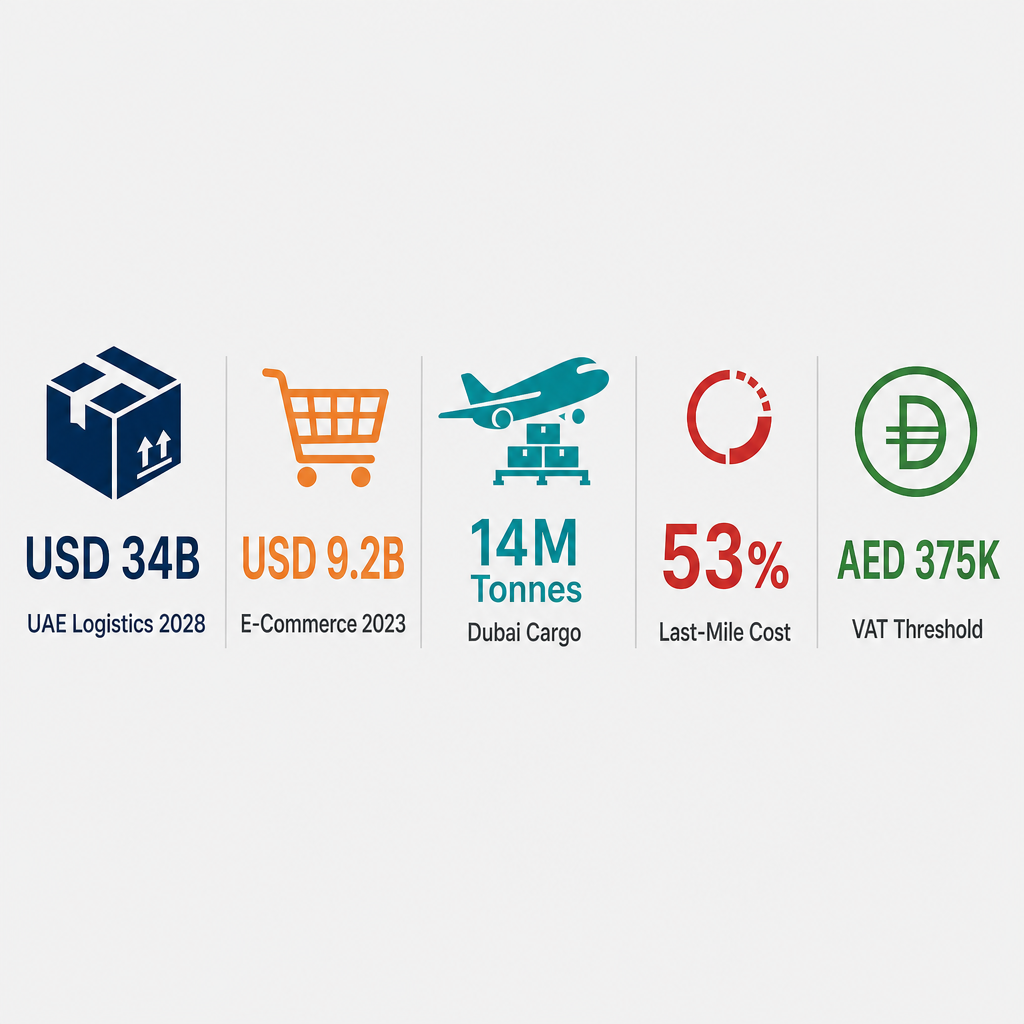
VAT registration with the Federal Tax Authority (FTA) becomes mandatory once your annual taxable turnover exceeds AED 375,000. Courier and parcel delivery services provided by private operators are generally standard-rated at 5%.
It is important to note that certain postal services supplied by Emirates Post carry VAT exemptions that do not extend to private courier operators. This means private operators must charge and account for VAT on qualifying supplies once the threshold is reached.
Planning your pricing and invoicing structure with VAT in mind from the outset — even before you hit the threshold — will simplify compliance as your business grows.
What employment compliance obligations apply to courier businesses in Dubai
If you employ staff, compliance with the Ministry of Human Resources and Emiratisation (MOHRE) is non-negotiable. Core requirements include properly structured employment contracts and registration with the Wage Protection System (WPS) for payroll processing.
Larger operators may also be subject to Emiratisation targets, which require a proportion of the workforce to be UAE nationals. The specific thresholds depend on business size and sector classification.
Free zone licences — such as those issued by Meydan Free Zone — offer a simpler employment framework for smaller teams, which can reduce administrative burden in the early stages of the business.
Why is last-mile delivery considered the most commercially valuable segment for private operators
Last-mile delivery — the final leg of a shipment's journey from a distribution hub to the end customer — accounts for up to 53% of total shipping costs, making it the single most expensive and operationally complex part of the logistics chain.
For private operators, this cost concentration translates into a high-value commercial opportunity. Businesses that can execute last-mile delivery efficiently, particularly for B2C and same-day fulfilment, can command premium pricing and build strong recurring relationships with e-commerce retailers.
Margins improve materially as route density increases, meaning operators who build concentrated delivery zones rather than spreading thinly across large geographies tend to achieve better unit economics faster.
What is the difference between a mainland licence and a free zone licence for this type of business
A free zone licence, such as one issued by Meydan Free Zone, allows full foreign ownership and typically offers a simpler setup process and employment framework, making it attractive for smaller or early-stage courier operations.
However, free zone companies face restrictions on operating directly within the Dubai mainland market. If your business model requires physical retail or collection points across Dubai — for example, walk-in parcel drop-off counters — a mainland licence may be necessary to operate those touchpoints directly without a local agent or distributor arrangement.
The right structure depends on your target customer base, operational footprint, and growth plans. Many operators start with a free zone licence and expand their structure as volume and mainland requirements grow.
How large is the UAE logistics and e-commerce market and why does it matter for new entrants
The UAE logistics market is projected to exceed USD 34 billion by 2028, driven by e-commerce growth and regional trade activity, according to Mordor Intelligence. UAE e-commerce revenue alone reached approximately USD 9.2 billion in 2023 and continues to grow year-on-year.
Dubai's infrastructure plays a central role in this growth. The emirate handles over 14 million tonnes of cargo annually through its ports and air freight network, anchored by DP World and the Ports, Customs and Free Zone Corporation (PCFC), giving it a structural advantage as a regional distribution gateway.
For new entrants, these figures signal strong and sustained demand for private courier and last-mile services, particularly as Emirates Post's network scale leaves room for faster, more flexible private operators to capture B2C and same-day delivery market share.
How to Start a Mail and Parcel Delivery Business in Dubai
People in Dubai buy a lot online, and every one of those orders has to end up at somebody's door. The last leg of that journey is the hardest part of the whole chain to get right, and it is also the part where a good operator makes real money.
This guide covers what activity code 5310.03 lets you do, who pays for it, which authorities you answer to, and how to get licensed through Meydan Free Zone. There are three regulators involved here rather than one, so it pays to know the order you deal with them in.
Key Stats at a Glance
| Activity code | 5310.03, Distribution and Delivery of Mail and Parcels |
|---|---|
| What it covers | Collecting, sorting, transporting and delivering mail and parcels for third parties |
| Main regulator | Telecommunications and Digital Government Regulatory Authority – TDRA |
| Fleet permits | Vehicle permits through the Roads and Transport Authority – RTA |
| VAT | AED 375,000 taxable turnover a year, courier services standard-rated at 5% – Federal Tax Authority |
| Logistics market | UAE logistics market set to pass USD 34 billion by 2028 – Mordor Intelligence |
| E-commerce | UAE e-commerce revenue reached about USD 9.2 billion in 2023 – Statista |
| Cargo volume | Dubai handles over 14 million tonnes of cargo a year – DP World |
| Where the cost sits | Last-mile delivery accounts for up to 53% of total shipping costs |
| Foreign ownership | 100% in Meydan Free Zone |
What This License Covers
Activity code 5310.03, distribution and delivery of mail and parcels, covers the whole chain: collecting, sorting, transporting and delivering mail and parcels on behalf of other people. It is a commercially broad license and it supports several service lines at once.
- B2B courier work, with scheduled collections and deliveries between businesses
- B2C last-mile delivery, so direct-to-customer fulfilment for online retailers
- Same-day and next-day delivery within Dubai and across the UAE
- Parcel sorting and redistribution from a central hub or fulfilment point
Emirates Post holds the dominant position in the national postal network. Private operators have taken a growing share of the courier and last-mile segment, particularly in B2C and same-day work, where speed and flexibility count for more than network size.
Who Your Clients Will Be
Your customer list runs from large platforms down to individuals sending one box.
- E-commerce platforms needing fulfilment volume
- Retail SMEs shipping their own orders
- Corporate offices with regular internal and client deliveries
- Legal and financial firms sending documents that must arrive
- Individual senders paying retail rates
Pricing follows the customer. Retail senders pay per shipment. SME accounts move onto subscription or volume-based contracts. Corporate clients sign service level agreements with guaranteed delivery windows, and they pay more for the guarantee. Margins improve sharply as route density rises, so a tight delivery zone beats a thin one spread across the emirate every time.
Mainland or Free Zone
| Factor | Mainland (DET) | Free Zone (Meydan Free Zone) |
|---|---|---|
| Who you serve | Open UAE market | B2B and contracted delivery work |
| Physical drop-off counters across Dubai | Covered by the license | May need a mainland structure to run them directly |
| Foreign ownership | Set by DET rules for the activity | 100% yours |
| TDRA and RTA rules | Apply | Apply |
| Setup route | Apply through DET | Apply online, simpler employment framework for small teams |
Let your buyers decide it, not the price. A free zone license gives you full foreign ownership and a lighter employment framework, which suits a small team at the start. If your plan includes walk-in parcel counters across Dubai, that is mainland activity and the structure has to reflect it. Plenty of operators begin in a free zone and change the structure once volume justifies it.
[blockCTACostCalculator]
Step by Step Setup Guide
- Step 1, confirm your activity scope: Check that courier, last-mile and B2B delivery all sit inside the permitted scope of 5310.03. The Meydan Free Zone team can confirm this before you commit.
- Step 2, book your trade name: Submit two or three options. Names must follow UAE conventions, so nothing offensive and no reference to government bodies.
- Step 3, prepare shareholder documents: Passport copies, the visa page or entry stamp, and a No Objection Certificate if you are currently employed in the UAE on a sponsored visa.
- Step 4, send in your license application: Fees vary by activity and package. Approval usually takes two to five working days for a clean application.
- Step 5, sort visas and workspace: Flexi-desk options suit early-stage operators. Your package sets the visa allocation, and investor and employee visas are processed through the free zone.
- Step 6, open a corporate bank account: Use your license documents. Meydan Free Zone has banking relationships that make this quicker.
- Step 7, get operational: Register the fleet with the RTA, take out commercial vehicle insurance, and put a delivery management platform in place for dispatch, tracking and proof of delivery.
Compliance and What You Need in Place
TDRA
The Telecommunications and Digital Government Regulatory Authority is the federal regulator for postal and courier services. Private operators work under its framework for non-exclusive postal services, which sets service standards, complaint handling and how you are expected to conduct operations. This is the first door to knock on, before you buy a single van.
RTA fleet permits
Every delivery vehicle needs an RTA permit, and must be registered, insured and compliant with commercial vehicle standards. If you run motorcycles for last-mile work, and most urban same-day operators do, separate permit categories apply. Do not assume a bike is treated like a van.
VAT and books
Register for VAT with the Federal Tax Authority once annual taxable turnover passes AED 375,000. Courier services are standard-rated at 5%. Note that some postal services supplied by Emirates Post carry exemptions that do not extend to private operators, so price and invoice on that basis from the start.
Staff, WPS and Emiratisation
If you employ people, MOHRE rules apply: properly structured employment contracts and Wage Protection System registration for payroll. Larger operators also face Emiratisation targets, with thresholds depending on business size and sector.
Market Opportunity
The numbers behind this trade are large and moving in one direction. The UAE logistics market is set to pass USD 34 billion by 2028 on the back of e-commerce and regional trade, and UAE e-commerce revenue alone reached about USD 9.2 billion in 2023 and keeps climbing. Dubai handles over 14 million tonnes of cargo a year through its ports and air freight network, anchored by DP World and the Ports, Customs and Free Zone Corporation, which makes the emirate a distribution gateway rather than just a destination.
The specific opening is in last mile. That final leg from hub to customer eats up to 53% of total shipping costs, which makes it the most expensive and most complicated part of the chain, and therefore the most valuable to do well. Operators who run B2C and same-day work efficiently can charge a premium and hold onto retail accounts for years. Emirates Post has the network scale, but scale is not the same as speed, and that gap is where private operators are taking share.
Conclusion
Dubai has the infrastructure, the e-commerce volume and a clear set of rules, which is a rare combination. The last-mile segment is still under-served relative to what people are ordering, and an operator with reliable service and sensible pricing can build revenue quickly.
Meydan Free Zone gives you a cost-efficient route to a license with full foreign ownership and flexible workspace. Three things decide how this goes: TDRA compliance sorted before launch, RTA permits covering every vehicle including bikes, and route density built deliberately rather than by accident. Get those right and the unit economics take care of themselves.
[blockCTAContact]










.jpeg)