Table of Contents
Frequently Asked Questions
What is activity code 4922.95 and what services does it cover
Activity code 4922.95 is the official Dubai business classification for Passengers Transport By Rented Buses. It covers contracted charter operations rather than public bus routes.
Permitted services under this code include staff shuttle programmes, airport transfers, school runs, event transport, and construction site worker movement. The activity is primarily B2B in nature, meaning you provide organised transport capacity to institutional clients on agreed commercial terms.
Why is Dubai considered a strong market for a rented bus passenger transport business
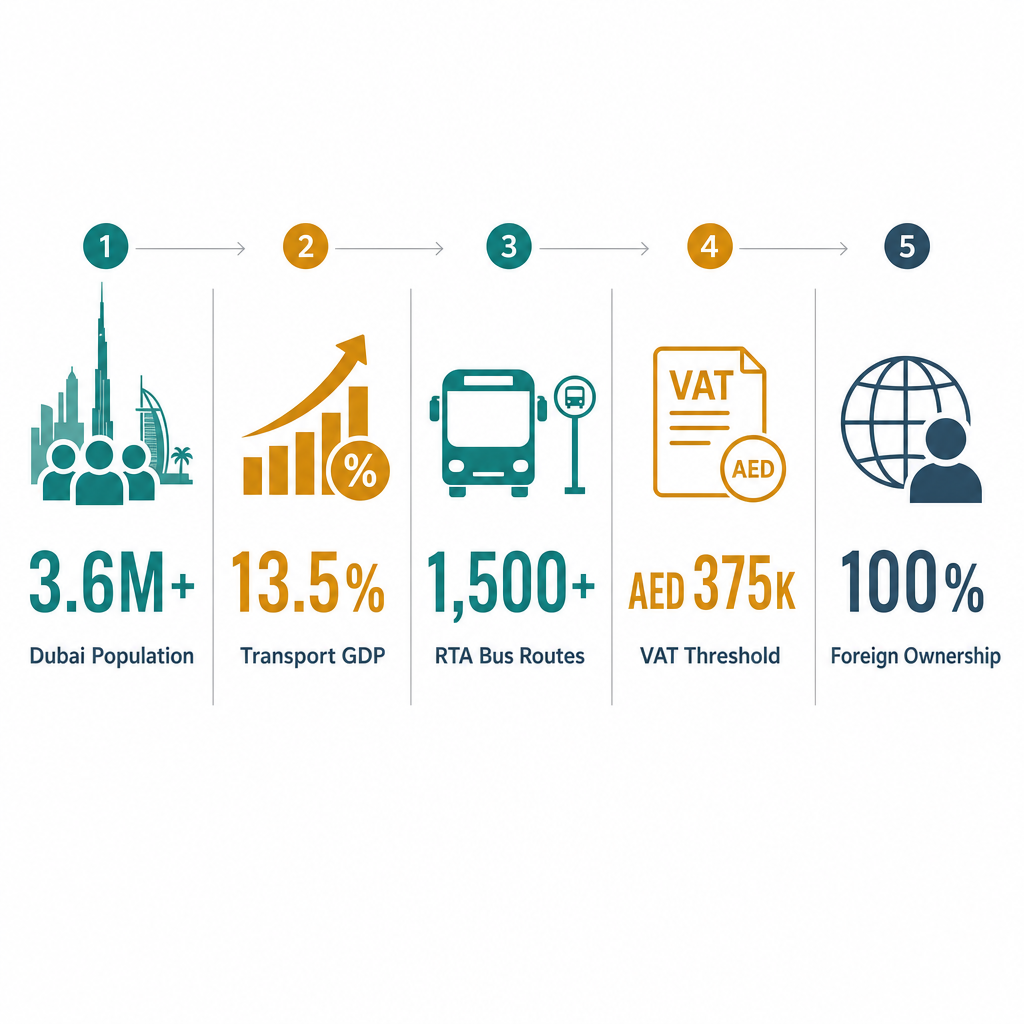
Dubai's population exceeded 3.6 million in 2023 according to the Dubai Statistics Center, and continues to grow. Population density, large-scale construction activity, and a tourism sector drawing tens of millions of visitors annually all create sustained demand for contracted and charter transport services.
The UAE transport and logistics sector contributes approximately 13.5% to GDP according to Invest in Dubai. Expo 2020's legacy infrastructure, expanded road networks, and new commercial districts continue to generate high-frequency group movement requirements, while post-2021 tourism recovery has reinforced charter and transfer volumes across the emirate.
Which free zone is recommended for licensing this business and why
Meydan Free Zone is the recommended licensing route for activity code 4922.95. It issues the trade licence that establishes your legal entity and enables commercial contracting across the UAE.
A key advantage is that Meydan Free Zone permits 100% foreign ownership, meaning international entrepreneurs can hold the business outright without requiring a local partner. The licence also allows you to sign client agreements, open UAE bank accounts, and employ staff legally.
What are the two regulatory layers that govern a rented bus transport business in Dubai
The business operates under two distinct regulatory layers. The first is the commercial entity licence, issued through Meydan Free Zone, which covers the corporate and contractual side of the business — client agreements, banking, and employment.
The second is the operational transport permit, which sits with the Roads and Transport Authority (RTA). The RTA governs fleet registration, permit classification, driver credentialling, vehicle standards compliance, mandatory commercial insurance, and periodic roadworthiness testing. Both layers must be in place before the business can operate commercially.
Who are the primary customers for a rented bus passenger transport business in Dubai
The business model is B2B by nature, targeting institutional clients rather than individual passengers. Primary customers include corporates running employee shuttle programmes, hotels managing airport transfers, event management firms, and inbound tour operators.
Other significant client segments include construction contractors moving site workers and schools requiring regular transport. These clients typically prioritise reliability and regulatory compliance over price, meaning a well-run operation with clean vehicles and credentialled drivers is well positioned to retain long-term contracts.
What does the revenue model typically look like for this type of transport business
The revenue model generally combines contract retainers with per-trip billing. Institutional clients tend to prefer monthly or quarterly arrangements that provide budget certainty, making revenue relatively predictable once anchor contracts are secured.
Fleet-lease arrangements — where a dedicated vehicle and driver are assigned exclusively to a single client — command premium rates. Entry is possible on an asset-light basis by leasing vehicles initially, with fleet ownership improving margins at scale and providing greater control over vehicle standards and scheduling.
How many buses do most operators start with and what is the recommended approach to fleet management
Most operators begin with three to five buses under lease rather than purchasing assets outright. This asset-light approach reduces upfront capital requirements and allows the business to validate its client base before committing to ownership.
Fleet acquisition becomes the recommended next step once anchor contracts are secured, as owning vehicles improves profit margins at scale and gives the operator greater control over vehicle standards, maintenance schedules, and operational reliability — all factors that matter to institutional clients.
At what revenue level does VAT registration become mandatory for this business in Dubai
VAT registration becomes mandatory once annual revenue reaches AED 375,000, as set by the Federal Tax Authority. Businesses approaching or exceeding this threshold must register and begin charging and remitting VAT accordingly.
For a B2B transport business with institutional clients on retainer contracts, this threshold can be reached relatively quickly. It is advisable to factor VAT obligations into pricing structures and financial planning from the outset, even if registration is not immediately required at launch.
How to Start a Rented Bus Passenger Transport Business in Dubai
Dubai moves a lot of people who are not driving themselves. Site workers get bussed out at dawn, hotel guests get collected from the airport, schools run their own routes, and event organisers need forty seats at a fixed time. None of that is public transport. It is contracted work, and somebody has to own the buses.
This guide covers what activity code 4922.95 lets you do, who signs the contracts, how to set up your license through Meydan Free Zone, and the RTA side that sits on top. There are two layers of approval here, and you need both before a passenger gets on board.
Key Stats at a Glance
What This License Covers
Activity code 4922.95, Passengers Transport By Rented Buses, covers contracted charter work. That means staff shuttles, airport transfers, school runs, event transport and moving construction site workers.
What it does not cover is a public bus route. You are not competing with the RTA network. You are selling organised transport capacity to institutions on agreed terms, which is a different business with different buyers.
Who Your Clients Will Be
This is a business-to-business trade. Nobody walks up and buys a seat.
- Corporates running employee shuttle programmes
- Hotels managing airport transfers
- Event management firms and inbound tour operators
- Construction contractors moving site workers, and schools
These buyers care about reliability and compliance well ahead of price. A clean fleet with credentialled drivers keeps contracts. A cheap operation that misses a pickup does not.
Money usually comes as a mix of contract retainers and per-trip billing. Institutional clients prefer monthly or quarterly arrangements because it gives them budget certainty, and it gives you income you can forecast. Fleet-lease deals, where one bus and one driver are assigned to a single client, pay the best rates of all.
You can start asset-light by leasing vehicles. Owning improves your margin at scale and gives you more control over vehicle standards and scheduling. Most operators begin with three to five buses on lease and buy once anchor contracts are signed.
Mainland or Free Zone
A free zone license lets you contract with clients anywhere in the UAE, with no restriction on where those clients sit. That covers the commercial side of this business well. A mainland license from the Department of Economy and Tourism is worth weighing if your model depends on selling into the open local market. Let your clients decide it, not the price. Either way, the RTA permit still applies.
[blockCTACostCalculator]
Step by Step Setup Guide
- Step 1, confirm your activity and license category: Pick code 4922.95 and check the license scope with the Meydan Free Zone team so it matches the services you intend to sell.
- Step 2, book your trade name and send in your setup documents: Passport copies, Emirates ID if you already live in the UAE, and a short business plan. You do not need a physical office lease to begin.
- Step 3, get your trade license and open a corporate bank account: The license is your main banking document. You need the account before you can take client payments or run payroll.
- Step 4, apply to the RTA for your transport operator permit: Register your fleet, submit driver documents and work through the credentialling process. Start this alongside your company setup, not after it, or you will sit idle waiting.
- Step 5, insure the fleet, sign your anchor contracts and start work: Commercial vehicle insurance has to be in place before any bus carries a passenger.
Compliance and What You Need in Place
Two layers, not one
Your trade license through Meydan Free Zone is the corporate layer. It lets you sign client agreements, open bank accounts and employ staff. The operational layer sits with the RTA, and it is separate. Both must be live before you trade.
RTA operator permit
Any commercial passenger transport operation in Dubai needs RTA approval. That covers fleet registration, permit grading and driver credentialling. Buses must meet RTA vehicle standards, carry mandatory commercial insurance and pass periodic roadworthiness testing.
Drivers
The rules here are specific and there is no room to move. Every driver needs a UAE-valid professional driving license, RTA-approved medical fitness certification and background clearance. That applies to everyone on your payroll, from day one.
VAT
Once annual revenue crosses AED 375,000 you must register for VAT. The Federal Tax Authority handles registration, filing and compliance. Transport services in the UAE are generally zero-rated, but the duty to register still bites once you pass the threshold, so do not read zero-rated as nothing to do.
Staff
MOHRE governs employment contracts, Wage Protection System registration and labour standards for everyone you employ. With a driver-heavy payroll this is a bigger part of your admin than it would be in most trades, so set it up properly at the start.
Market Opportunity
Dubai's population passed 3.6 million in 2023 according to the Dubai Statistics Center, and it keeps climbing. Density, large-scale construction and a tourism sector drawing tens of millions of visitors a year all translate into people who need moving in groups.
Invest in Dubai puts UAE transport and logistics at about 13.5% of GDP. The RTA runs over 1,500 public bus routes, and private charter demand sits alongside that network rather than competing with it. Schools, hotels, event organisers, logistics hubs and corporate campuses all rely on third-party operators, and that reliance is built into how they work rather than being a choice they revisit each year.
Expo 2020 left behind expanded road networks and new commercial districts that keep generating group movement. Tourism recovery since 2021 has pushed charter and transfer volumes up again across the emirate.
Conclusion
Rented bus passenger transport in Dubai is regulated but open. The demand is real, the license route through Meydan Free Zone is quick, and the RTA framework gives you a clear structure to work inside once your company exists.
The two-layer model, free zone license plus RTA operator permit, is workable and well documented. Start the RTA side early, lease before you buy, and win one anchor contract before you grow the fleet.
[blockCTAContact]