Table of Contents
Frequently Asked Questions
What does the Sound Recording and Music Publishing business activity (ISIC 5920) actually cover in Dubai
ISIC code 5920 covers a broad range of commercial operations in the audio and music sector. This includes studio recording, music production, post-production audio work, rights management, royalty administration, and the publishing of musical compositions.
There are two core functions within this activity. Sound recording relates to master rights — ownership of a specific recorded performance. Music publishing relates to composition rights — ownership of the underlying song, melody, and lyrics.
Typical business models under this licence include production houses, independent record labels, sync licensing agencies (placing music in advertising, film, and television), and music publishing administrators. Artist management sits adjacent to this activity and typically requires a separate or complementary licence classification.
Why is Dubai a commercially attractive base for a music or audio production business
Dubai offers a combination of structural advantages that make it well-suited for music and audio businesses. The city is home to over 200 live music venues, studios, and production facilities, making it the Gulf's most active audio-visual production hub. It attracts Arabic-language music production from across the Gulf and Levant, as well as South Asian content production serving large expatriate communities.
Demand is driven by multiple industries simultaneously. Streaming platforms require constant localised content, the Dubai advertising industry commissions original music and licensed tracks at scale, and the film and television production sector is actively growing with support from the Dubai Film and TV Commission.
For independent operators, Dubai's connectivity allows distribution to both Arab and international markets, while its position as a regional media capital creates consistent commercial opportunities in sync licensing and catalogue building.
What are the tax advantages of setting up a music business in Dubai
The UAE operates a zero corporate tax regime on qualifying income below the AED 375,000 threshold under current Federal Tax Authority rules. Above that threshold, the rate remains among the lowest globally, making Dubai highly competitive for rights-holding businesses that generate royalty and licensing income.
Free zone companies in Dubai can be 100% foreign-owned, meaning international founders retain full control of their business and intellectual property without requiring a local partner. This is particularly valuable for music publishing and rights management operations where ownership structure directly affects how royalties are collected and distributed.
Combined with the UAE's position as a signatory to major international IP conventions, rights holders benefit from both tax efficiency and enforceable copyright protection across borders.
What is the difference between master rights and composition rights, and why does it matter for business structure
Master rights refer to ownership of a specific recorded performance — the actual audio file or recording. These are typically held by record labels or the artist who funded the recording. Composition rights refer to ownership of the underlying song itself — the melody, harmony, and lyrics — and are managed through music publishing.
The distinction matters commercially because the two rights generate different revenue streams. Master rights generate income from streaming, physical sales, and synchronisation of the recording. Composition rights generate performance royalties, mechanical royalties, and sync fees for the composition itself.
Many modern music businesses, particularly independent labels and production companies, operate across both by signing artists and retaining both sets of rights. Understanding this split is essential when structuring contracts, registering with collecting societies, and planning how revenue will flow through the business.
What role does the Dubai Culture and Arts Authority play for music businesses
The Dubai Culture and Arts Authority serves as the relevant regulatory touchpoint for creative sector oversight in Dubai. It sets the broader policy framework within which audio and music businesses operate in the emirate.
For businesses operating under ISIC 5920, the Authority represents the government body most directly concerned with the creative economy agenda that underpins Dubai's support for the music and entertainment sector. Its remit covers cultural policy, creative industry development, and the regulatory environment for arts and media businesses.
Operators should be aware of the Authority's role when planning activities that intersect with cultural programming, live events, or content that falls under Dubai's broader media and creative sector regulations.
How does Meydan Free Zone work for licensing a sound recording or music publishing business
Meydan Free Zone is one of the licensing pathways available to founders setting up a Sound Recording and Music Publishing business in Dubai. It offers 100% foreign ownership, and licences can be issued within days, making it one of the faster routes to establishing a legal entity in the emirate.
Visa eligibility is included from the first licence package, which is relevant for founders and employees who need UAE residency as part of their setup. Free zone status also provides the structural benefits associated with operating in a designated zone, including the tax advantages applicable to qualifying income.
For music businesses specifically, the free zone structure allows founders to hold intellectual property, manage publishing rights, and enter into commercial contracts from a UAE-registered entity without the complexity of mainland licensing requirements.
What is sync licensing and why is it a significant revenue opportunity in Dubai
Sync licensing refers to the placement of music in visual media — including advertising, film, television, and online video content. A sync licence grants a content producer the right to use a specific piece of music alongside visual material in exchange for a fee paid to the rights holder.
Dubai is one of the most active advertising markets in the region, with major regional and international brands commissioning original music and licensed tracks at scale. The city also has a growing film and television production sector, supported by the Dubai Film and TV Commission, which creates consistent demand for professional audio services and licensed music.
For independent music businesses, building a catalogue with sync value — tracks that are commercially licensable for media use — represents a reliable revenue stream that is less dependent on streaming volumes and more tied to the commercial activity of the broader creative and advertising industries.
What is the scale of the music streaming market in the UAE and Middle East
The UAE is among the highest per-capita spenders on digital entertainment in the Middle East and Africa region, according to data from Statista. The music streaming segment across the Middle East and Africa continues to expand year on year, driven by a young, digitally active population and increasing smartphone and broadband penetration.
The UAE's entertainment and media market is projected to grow at a compound annual rate through the mid-2020s, with streaming, content production, and live events identified as the primary growth drivers. This creates structural demand for locally produced and regionally relevant audio content.
For music businesses, this means the opportunity is not purely cyclical. Streaming platforms require a constant supply of localised content, and the UAE's demographic profile — with significant Arabic-speaking, South Asian, and international expatriate communities — creates demand across multiple content categories simultaneously.
How to Start a Sound Recording and Music Publishing Business in Dubai
Dubai's music and entertainment sector is growing fast. The city now has the infrastructure, the licensing framework, and the regional reach to support a serious sound recording or music publishing operation. Whether you are building a studio, managing artist rights, or running a publishing catalogue, Dubai gives you a workable base for the wider GCC market.
This guide covers the license you need, where to set up, what the process looks like, and what compliance looks like once you are trading.
Key Stats at a Glance
| Sector | Sound Recording & Music Publishing |
|---|---|
| Relevant authority | UAE Media Council – uaemc.gov.ae |
| Creative sector oversight | Dubai Culture and Arts Authority – dubaiculture.gov.ae |
| Foreign ownership | 100% available via Meydan Free Zone |
| VAT registration threshold | AED 375,000 annual turnover – Federal Tax Authority |
| IP registration | Ministry of Economy – moc.gov.ae |
| Content production growth | Dubai Film and TV Commission signals rising regional spend – filmdubai.gov.ae |
What This License Covers
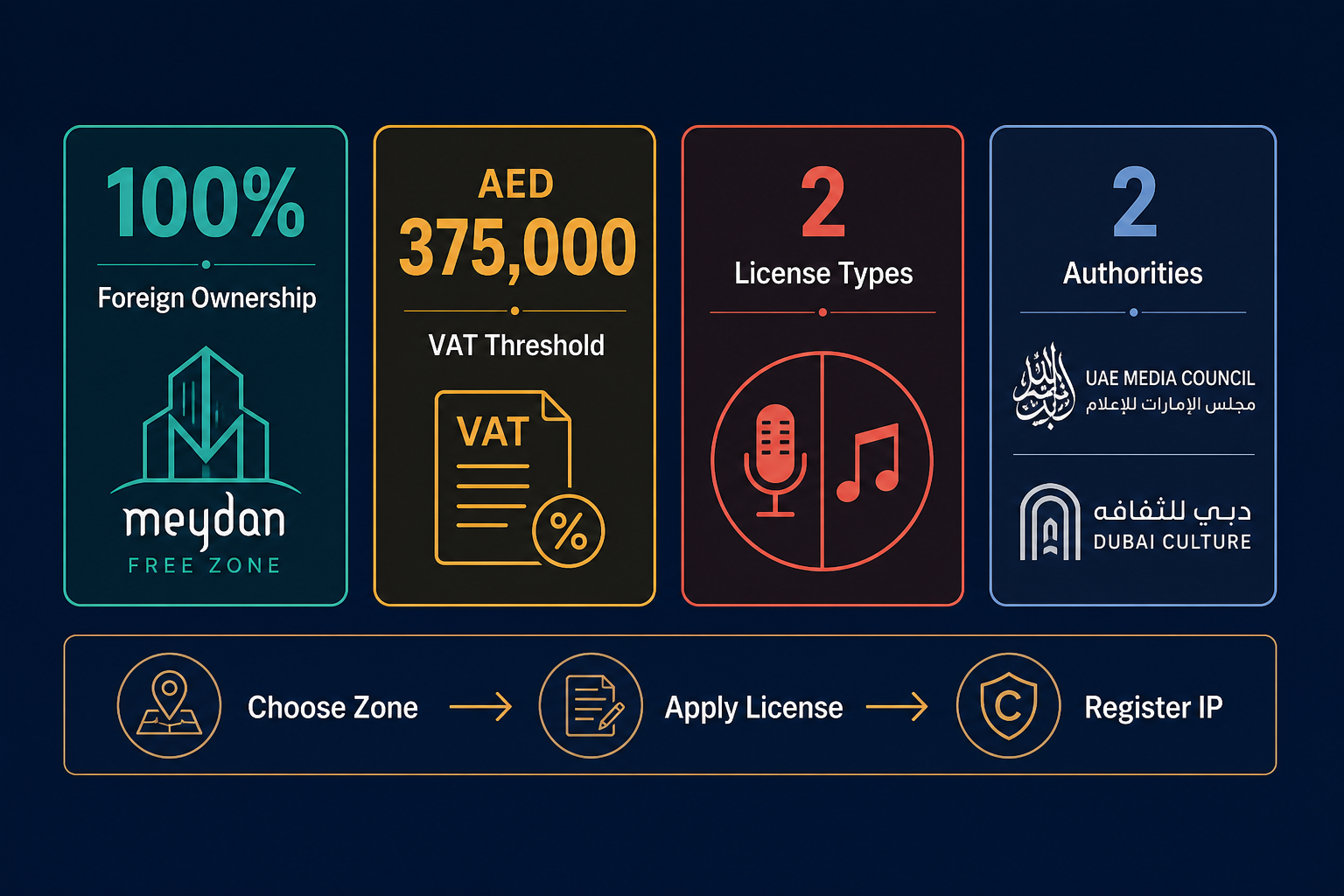
A sound recording and music publishing license in Dubai covers a broad range of activities. You can run a recording studio, produce original music, manage artist rights, handle publishing deals, and distribute content to streaming platforms or broadcasters. These are two distinct but often overlapping activities.
Sound recording covers the studio and production side. You are capturing, mixing, and mastering audio. Your clients are artists, labels, advertising agencies, film and TV producers, and content creators.
Music publishing covers rights and royalties. You own or administer the publishing rights to compositions, license them to third parties, and collect income when those compositions are used commercially. This is an asset-management business as much as a creative one.
You can hold both activities under a single license, which makes sense if you plan to record artists and then manage their publishing rights. Check the Meydan Free Zone business activities list to confirm which codes apply to your exact model before you proceed.
Two bodies play a role in this sector. The UAE Media Council oversees audio and visual content distributed in the UAE. If you are releasing music locally, your content sits within their remit. The Dubai Culture and Arts Authority supports the broader creative sector and is worth engaging early if you plan to work with local artists or cultural institutions.
Mainland vs Meydan Free Zone
This is the biggest choice you will make when setting up. Let your clients and revenue streams decide it, not the price.
| Factor | Mainland (DET) | Free Zone (Meydan Free Zone) |
|---|---|---|
| Foreign ownership | 100% in most activities | 100% guaranteed |
| Client access | Open UAE market, including government contracts | Mainly international clients and free zone entities |
| Office requirement | Physical office required | Flexi-desk options available |
| Setup speed | Moderate | Fast – often within days |
| Best suited to | Local commercial studios, UAE broadcast clients | International publishing, rights management, remote operations |
A mainland license from the Dubai Department of Economy and Tourism (DET) lets you work directly with UAE government bodies and local commercial clients. If you are pitching to UAE broadcasters, national advertising agencies, or government-linked media, mainland gives you direct access. You will need a physical office address.
Meydan Free Zone suits founders whose revenue comes from international streaming platforms, global publishing deals, or GCC-based artists who do not require a mainland contracting entity. You get 100% foreign ownership, a flexi-desk instead of a full office, and a faster setup process. You can also start a business remotely without needing to be in Dubai during the setup phase.
VAT registration duties apply in both jurisdictions. Once your annual turnover hits AED 375,000, you must register with the Federal Tax Authority. This applies whether you are on the mainland or in a free zone. Build this into your financial planning from day one.
Free Business Setup Cost Calculator
Calculate NowStep-by-Step Setup Guide
- Step 1, book your trade name: Use the DET e-Services portal for a mainland company, or the Meydan Free Zone portal for a free zone one. Your name cannot conflict with existing registered names. Use the company name check tool to confirm availability before you apply.
- Step 2, confirm your activity code: Sound recording and music publishing sit under distinct codes. Get the exact codes confirmed before you submit anything. Using the wrong code causes delays and may require a restart. The Meydan Free Zone team can confirm this for you upfront.
- Step 3, submit your setup documents: This includes passport copies for all shareholders, a business plan summary (required by some jurisdictions), and the completed application form. For Meydan Free Zone, this process is largely digital.
- Step 4, get initial approval: The relevant authority reviews your application and issues initial approval. This is not your trading license yet. It is permission to proceed to the next stage.
- Step 5, secure your office or flexi-desk: Mainland setups need a physical office with a valid tenancy contract registered with Ejari. Meydan Free Zone offers flexi-desk arrangements, which keep your overhead low while you build revenue.
- Step 6, get your license issued: Once your space is confirmed and fees are paid, your license is issued. You are now legally able to trade under your registered activities.
- Step 7, open a corporate bank account: UAE banks require your license, shareholder documents, and proof of address. This step takes longer than most founders expect. mCore includes business banking support to help you navigate the process.
- Step 8, register with the FTA if needed: If you expect to hit the AED 375,000 VAT threshold within your first year, register before you start trading. Waiting until you breach the threshold and then registering late carries penalties.
Compliance and What You Need in Place
Sound recording and music publishing sit at the intersection of content regulation, intellectual property law, and commercial contract law. Get all three right before you start trading.
UAE Media Council rules The UAE Media Council oversees audio content distributed in the UAE. If you are releasing music locally, through streaming platforms, radio, or any other channel, your content is subject to their oversight. Review their content guidelines before you release anything. This applies to both original productions and licensed content you distribute on behalf of third parties.
Intellectual property registration Your catalogue is your core asset. Register your copyrights and related rights through the Ministry of Economy. This protects your compositions and recordings from unauthorised use and gives you a legal basis to enforce your rights across the GCC. Do not wait until you have a dispute to do this. Register early and keep records of ownership for every track in your catalogue.
Contracts with artists and producers Every recording agreement, co-production deal, and distribution contract needs to reflect UAE commercial law. This includes clear terms on ownership splits, royalty rates, territory rights, and termination conditions. Verbal agreements do not hold up. Use properly drafted contracts from the start, even for small projects. If you are working with international artists, make sure your contracts specify governing law and dispute resolution jurisdiction.
Employment and Emiratisation If you hire staff in the UAE, the Ministry of Human Resources and Emiratisation (MOHRE) sets the rules on employment contracts, end-of-service benefits, and Emiratisation ratios. Free zone companies have different rules to mainland ones, but both are subject to federal labour law. Check the current Emiratisation requirements for your company size before you hire.
VAT and corporate tax VAT at 5% applies once you pass the AED 375,000 threshold. Corporate tax at 9% applies to taxable income above AED 375,000 per year, under the UAE's corporate tax framework introduced in 2023. Both are administered by the Federal Tax Authority. If you need support, mAccounting covers bookkeeping, VAT registration, and corporate tax compliance for free zone businesses.
Market Opportunity
Dubai is already a regional hub for Arabic and international music production. The infrastructure is there: recording studios, mixing engineers, distribution networks, and a growing pool of regional talent. What the market has historically lacked is professional rights management and publishing infrastructure. That gap is closing, and founders who move now are entering ahead of the curve.
Demand for licensed music is growing across multiple channels. Streaming platforms serving the MENA region need local content. Advertising agencies in Dubai, Riyadh, and Abu Dhabi need original music for campaigns. Film and TV producers need scored soundtracks and licensed tracks. Live events, which are a major part of Dubai's entertainment economy, need performance rights management.
The Dubai Film and TV Commission has been actively promoting content production in the emirate. Rising production spend means rising demand for original music and sound design. A publishing operation with a well-managed catalogue is well placed to supply this market.
GCC artists are also becoming more commercially sophisticated. Many are now actively looking for professional publishing partners who can manage their rights, pitch their music to international platforms, and collect royalties on their behalf. This is an underserved segment with real growth potential.
According to Statista, the recorded music market in the Middle East and Africa has been growing steadily, driven by streaming adoption. Dubai's position as the commercial and creative capital of the region puts it at the centre of that growth.
Conclusion
Setting up a sound recording or music publishing business in Dubai is workable if you pick the right jurisdiction, confirm your activity code early, and get your content compliance in order before you start trading. The regulatory environment is clear, the market is growing, and the infrastructure exists to support a professional operation from day one.
If your revenue comes mainly from international publishing deals and streaming platforms, Meydan Free Zone gives you the fastest and most cost-effective route in. If you need to work directly with UAE government clients or local broadcasters, a mainland license through DET is the right call. Either way, get your IP registered and your contracts in order from the start. Those two steps protect everything else you build.
Use the cost calculator to get a cost estimate, then speak to Meydan Free Zone to confirm which license structure fits your business model before you commit.
Ready to Launch Your Business in Dubai?
Let's Connect