
Table of Contents
Frequently Asked Questions
What activity code covers vehicle transport and towing in Dubai
Vehicle transport and towing businesses in Dubai operate under activity code 5221.86 — Transporting and Towing Vehicles. This code permits breakdown and accident towing, flatbed transport for prestige or damaged vehicles, and vehicle delivery for dealerships, fleet operators, and auction houses.
The permitted scope also extends to moving non-self-propelled construction equipment between sites. It does not cover vehicle repair, fuel supply, or roadside mechanical services — those activities require separate activity codes, so confirming your exact scope at the licence stage is essential.
Can I set up a vehicle towing business through Meydan Free Zone
Yes. Meydan Free Zone offers a cost-effective incorporation structure for logistics-adjacent activities, including vehicle transport and towing under activity code 5221.86. It provides access to Dubai's broader commercial ecosystem at a competitive setup cost.
However, a free zone licence alone is not sufficient for road-based operations. You will also need to obtain the relevant RTA operator approvals to legally operate towing and transport vehicles on Dubai's public roads.
What RTA approvals are required to operate towing vehicles in Dubai
The Roads and Transport Authority (RTA) administers all commercial vehicle operations on Dubai roads, including operator permits, vehicle classifications, and fleet registration. Any vehicle used commercially for towing or transport must be registered and approved through the RTA's licensing and permits framework.
Towing vehicles must meet specific technical standards set by the RTA, and drivers must hold RTA-endorsed licences appropriate to the vehicle category they operate. These approvals are required in addition to your free zone or mainland business licence.
Who are the main customers for a vehicle transport and towing business in Dubai
The primary customer base is B2B. Insurance companies are the most consistent contract source, typically requiring rapid-response towing under defined service-level agreements. Car rental firms, logistics companies, vehicle importers, dealerships, and auction houses are commercially significant secondary clients.
Construction contractors needing movement of non-self-propelled equipment between active project sites also represent a viable market segment. On-demand retail towing for individual motorists tends to carry lower margins and higher operational variability compared to contract-based work, making anchor B2B contracts the preferred foundation for a new operation.
Why are insurance companies considered the best anchor clients for a towing business
Insurance-linked towing contracts provide recurring, predictable revenue because insurers require ongoing rapid-response towing services as part of their policy obligations to policyholders. The UAE insurance market continues to expand, making this a growing and stable revenue stream.
Securing anchor contracts with insurers or fleet managers before launch stabilises cash flow and justifies early fleet investment. These contracts typically come with defined service-level agreements, which, while operationally demanding, provide the business with a reliable income baseline from day one.
How large is the market opportunity for vehicle towing and transport in Dubai
Dubai's registered vehicle count exceeds 2 million units, creating sustained baseline demand for towing and transport services. The UAE logistics and transport sector contributes approximately 13–15% of national GDP, according to Invest in Dubai, with road freight and vehicle movement services among the fastest-growing sub-sectors.
Key growth drivers include the rise of insurance-mandated towing arrangements, increased vehicle deliveries from dealerships and auction houses, and the steady movement of construction equipment across active project sites throughout the emirate.
What services are excluded from activity code 5221.86
Activity code 5221.86 is specifically scoped to the transport and towing of vehicles. It does not permit vehicle repair, fuel supply, or roadside mechanical services. Offering any of these services under the same licence would create a compliance issue.
If you intend to provide a broader roadside assistance offering that includes mechanical or fuel services, you will need to register additional activity codes covering those specific services. Clarifying your full intended scope with the licensing authority at the outset avoids regulatory complications after launch.
What are the main growth drivers for vehicle transport and towing in Dubai
Several structural trends are driving demand for professional vehicle transport and towing services in Dubai. These include the rise of insurance-mandated towing arrangements, growing vehicle deliveries from dealerships and auction houses, and continuous construction activity requiring movement of heavy, non-self-propelled equipment between sites.
Dubai's expanding registered vehicle fleet and the emirate's role as a major logistics hub further underpin long-term demand. The consistent growth of regulated towing and transport operators alongside fleet expansion and infrastructure development reflects the sector's resilience and commercial depth.
How to Start a Vehicle Transport and Towing Business in Dubai
Dubai's roads carry millions of vehicle movements a year, and something has to move the ones that stop working, get damaged or need delivering. Breakdowns, accidents, dealer deliveries and construction plant all keep towing operators busy.
This guide covers what activity code 5221.86 lets you do, who signs the contracts worth having, the RTA approvals you cannot trade without, and how to set up your license through Meydan Free Zone. One point matters more than any other here: a trade license alone does not put a truck on the road. You need RTA approval on top of it.
Key Stats at a Glance
What This License Covers
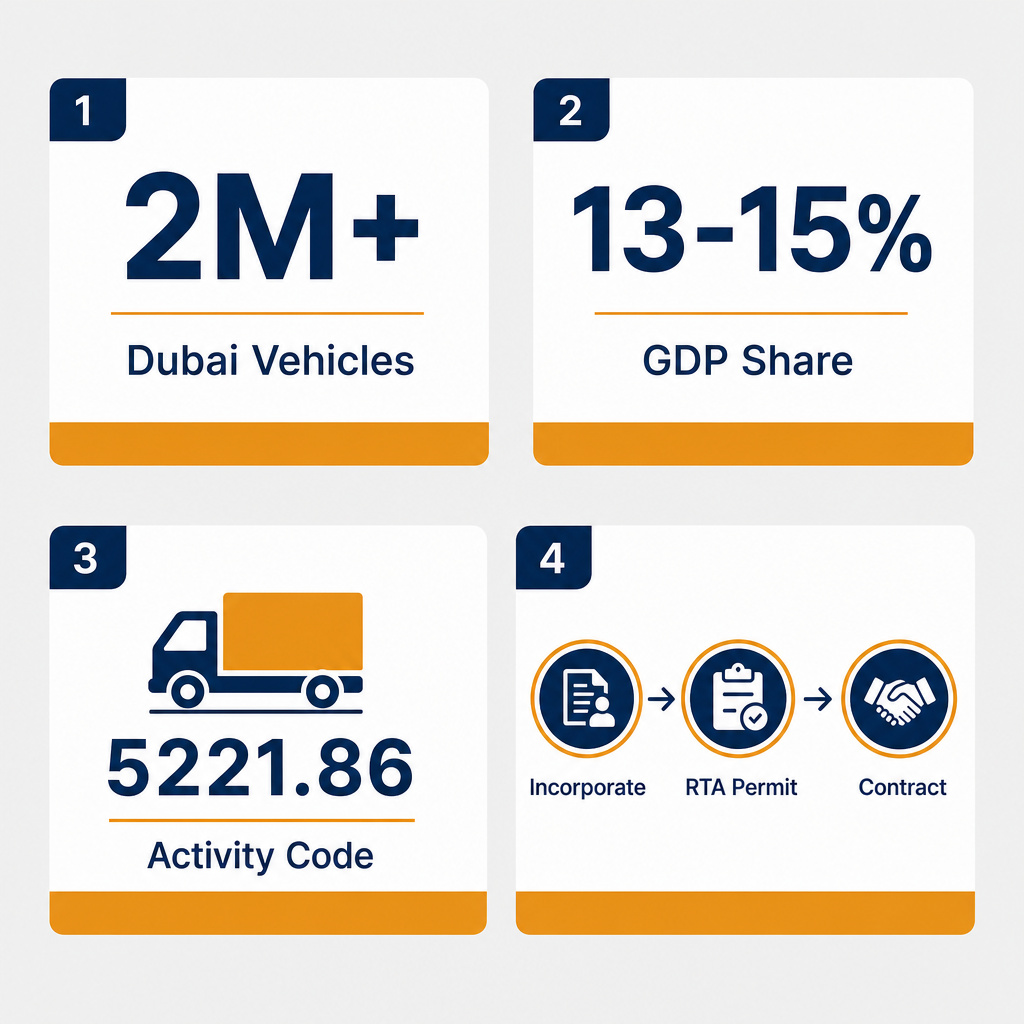
Activity code 5221.86, Transporting and Towing Vehicles, covers four kinds of work:
- Breakdown and accident towing
- Flatbed transport for prestige cars and damaged vehicles
- Vehicle delivery for dealerships, fleet operators and auction houses
- Moving non-self-propelled construction equipment between sites
Operators who would rather concentrate on two-wheelers can instead build a dedicated motorcycle towing service under its own separate licence.
What it does not cover matters just as much. Vehicle repair, fuel supply and roadside mechanical services all sit outside this code. Offer them on this license and you have a compliance problem. If you want a full roadside assistance service, add the codes that cover those jobs at the licensing stage rather than after you launch.
Who Your Clients Will Be
This is a business to business trade first and foremost.
- Insurance companies are the most consistent source of contracts. They need fast towing for policyholders and they work to defined service levels.
- Car rental firms, logistics companies and vehicle importers come next, and they send steady volume.
- Dealerships and auction houses need vehicles delivered rather than towed, which is easier work.
- Construction contractors need non-self-propelled equipment shifted between active sites.
Individual motorists calling for a tow are the least attractive end of the market. The margins are thinner and the work arrives unpredictably. Nobody here buys on a phone call, either. Insurers and fleet managers run formal processes, and they want to see you before they commit.
That is why the sensible move is to line up an anchor contract with an insurer or a fleet manager before you launch. It steadies the cash coming in and it justifies buying the trucks.
Mainland or Free Zone
A free zone license covers the trading and service side, and it is a cost-effective way in for logistics work. It does not replace RTA approval for road use. That is normal for transport businesses run from a free zone base, so plan for both from the start rather than treating the RTA step as an afterthought.
[blockCTACostCalculator]
Step by Step Setup Guide
- Step 1, confirm your activity code and package: Select code 5221.86 and match the license package to how you plan to work and how many people you will hire.
- Step 2, book your trade name: Get initial approval on a name that follows UAE naming rules and does not clash with an existing company.
- Step 3, send in your setup documents: Passport copies, shareholder details and a business plan where one is asked for. The trade license follows.
- Step 4, open a corporate bank account: Banks want your trade license, shareholder papers and in most cases a business plan or forecast.
- Step 5, apply for RTA vehicle permits and operator approvals: Run this alongside or straight after the license. No commercial vehicle goes on a Dubai road until it is done.
- Step 6, apply for visas: Your quota depends on the license type and office package you choose.
You can start and finish the setup without travelling to Dubai. Documents are handled digitally, with originals couriered where they are needed.
Compliance and What You Need in Place
RTA approvals
The RTA runs every commercial vehicle operation on Dubai roads. That covers operator permits, vehicle classes and fleet registration. Your towing vehicles have to meet the technical standards the RTA sets, and your drivers need RTA-endorsed licenses for the class of vehicle they handle. These approvals sit on top of your business license, not instead of it.
Scope of your license
Code 5221.86 is scoped to transport and towing. Repair, fuel and roadside mechanical work need their own codes. Get your full intended scope confirmed with the licensing authority at the outset. Sorting a permit gap after you have signed a contract is expensive and slow.
VAT and books
Register for VAT with the Federal Tax Authority once your taxable turnover passes AED 375,000 a year. Contract towing volume builds quickly, so most operators cross that line early. Keep clean records from your first invoice.
Staff
Drivers, dispatchers and operations staff all fall under Ministry of Human Resources and Emiratisation rules. That means proper contracts, end-of-service provisions and Emiratisation targets where they apply to you.
Market Opportunity
The base demand is simply the size of the fleet. Dubai has over 2 million registered vehicles, and every one of them is a potential job at some point. The number of regulated towing and transport operators has grown steadily alongside that fleet and the emirate's infrastructure build-out.
The wider sector is substantial. UAE logistics and transport contributes roughly 13% to 15% of national GDP, and road freight and vehicle movement services are among its fastest-growing parts.
Three drivers keep the work coming: insurance-mandated towing arrangements, rising vehicle deliveries from dealerships and auction houses, and constant construction activity that needs heavy equipment moved between sites. The UAE insurance market keeps expanding, which makes insurance-linked towing a recurring earner rather than a one-off.
Conclusion
Vehicle transport and towing is a regulated business that asks a lot operationally, but it comes with contract-driven demand that does not dry up. Fleet growth, insurance cover and construction activity all keep it fed.
The RTA layer is the part you cannot work around. Get your license scope right first, secure an anchor contract before you buy trucks, and treat the RTA permits as part of the launch rather than a step to sort out later. Do that and you can trade from day one instead of waiting on approvals.
[blockCTAContact]