
Table of Contents
Frequently Asked Questions
What does activity code 7912.97 — Outbound Tour Operator — actually cover
Activity code 7912.97 covers the organisation, packaging, and sale of travel arrangements to destinations outside the UAE. This includes designing and selling itineraries, managing group tours, facilitating visas, and coordinating ground transport and accommodation abroad.
The licence also extends to handling corporate travel programmes and multi-city business delegation itineraries, making it suitable for both leisure and B2B operators.
Why is Dubai considered a strong base for an outbound tour operator
Dubai combines several commercial advantages in one location. Its expatriate population of over 3.6 million people includes large South Asian, Arab, and European communities with consistent demand for international travel to their home regions.
UAE residents rank among the world's highest outbound travel spenders on a per-capita basis, meaning operators can access substantial existing demand without needing to create it. Emirates, flydubai, and Air Arabia collectively connect Dubai to over 200 destinations, providing direct commercial infrastructure for any outbound business.
Who are the primary target customers for an outbound tour operator in Dubai
The core customer base spans three main groups: leisure travellers (particularly UAE-based expatriates), GCC nationals, and corporate clients. Expatriates from South Asia, the Arab world, and Europe drive high-volume demand across corridors including the Indian subcontinent, Southeast Asia, East Africa, and Southern Europe.
GCC nationals — Saudi, Kuwaiti, and Qatari travellers in particular — represent a separate high-value segment, often seeking premium or bespoke itineraries booked through Dubai-based operators. Corporate travel management is a reliable B2B revenue line, covering visa coordination and multi-city business travel.
What types of travel products offer the strongest margins for Dubai-based outbound operators
The mass-market package model faces increasing pressure from online booking platforms, so the clearer commercial opportunity lies in curated, high-margin travel. This includes luxury safaris, tailored cultural tours, multi-destination honeymoon packages, and managed group pilgrimages.
Corporate travel management — particularly for business delegations requiring visa coordination and complex multi-city routing — is another strong B2B revenue stream that is less exposed to direct online competition.
What regulatory framework applies to outbound tour operators in Dubai
Outbound tour operations fall under tourism-related activity licensing in Dubai. The Department of Economy and Tourism sets the overarching framework for tourism businesses operating in the emirate.
Operators should also be aware of additional registration requirements for specific travel categories, most notably Hajj and Umrah packages, which are subject to separate regulatory oversight. A free zone licence through Meydan Free Zone is noted as an appropriate structure, particularly for B2B and digitally focused business models.
How large is the outbound tourism market in the UAE and GCC
The UAE outbound tourism market is projected to grow steadily through 2030, driven by rising disposable incomes and expanding air connectivity. The UAE consistently ranks among the world's highest per-capita outbound tourism spenders.
According to Mordor Intelligence, the broader Middle East travel and tourism market is on a sustained growth trajectory, with outbound segments outperforming regional averages in several GCC markets.
Can a foreign national own an outbound tour operator business in Dubai
Yes. Dubai's regulatory environment supports foreign ownership, which is one of the reasons it is commercially attractive for international entrepreneurs looking to enter the outbound travel market.
Setting up through a free zone such as Meydan Free Zone is a common route, as free zones typically offer 100% foreign ownership alongside streamlined licensing processes suited to service-based businesses like tour operations.
What high-volume travel corridors should an outbound operator in Dubai consider focusing on
The most commercially active corridors from Dubai reflect the composition of the UAE's resident population. The Indian subcontinent, Southeast Asia, East Africa, and Southern Europe are consistently high-volume routes driven by expatriate demand for travel to home regions.
For GCC national clients, premium and bespoke itineraries to long-haul destinations tend to perform well. Inbound tourists extending their trips into regional or global packages represent a smaller but growing niche that operators can layer onto their core offering.
How to Start an Outbound Tour Operator Business in Dubai
Most travel businesses in Dubai focus on bringing people in. An outbound operator does the opposite: you sell trips to people who already live here, and there are millions of them with money to spend and family abroad to visit.
This guide covers what activity code 7912.97 permits, who buys, which trips actually make money, the rules that apply, and how to set up through Meydan Free Zone.
Key Stats at a Glance
What This License Covers
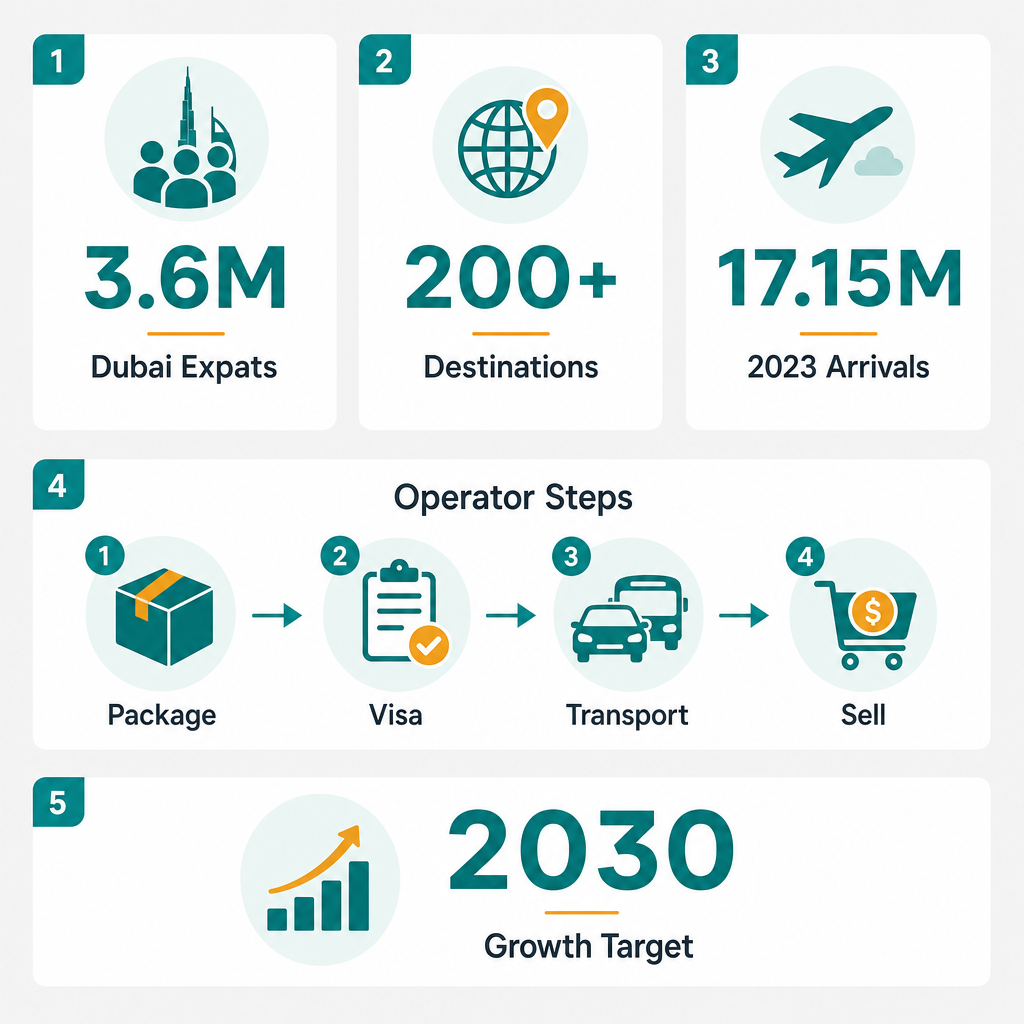
Activity code 7912.97 covers arranging, packaging and selling travel to destinations outside the UAE. In practice that means:
- Designing and selling itineraries
- Running group tours
- Helping travellers with visas
- Arranging ground transport and accommodation abroad
- Managing corporate travel programmes and multi-city business trips
So the license stretches from a family holiday package to a business delegation touring four cities in a week.
Who Your Clients Will Be
Three groups, each buying for different reasons.
Residents are the volume. South Asian, Arab and European expatriates travel regularly, and the busiest routes reflect that: the Indian subcontinent, Southeast Asia, East Africa and Southern Europe. These people are going home, and they go often.
GCC nationals are the value. Saudi, Kuwaiti and Qatari travellers frequently book through Dubai operators, usually for premium or bespoke itineraries where the margin is better.
Corporate clients are the steady income. Business travel means visa coordination and complicated multi-city routing, which is real work that online booking sites do not handle well.
There is a smaller niche too: inbound tourists who extend their Dubai trip into a regional or global package.
How the Money Works
Be honest about where the margin is. Mass-market packages are squeezed hard by online booking platforms, and competing there is a losing game for a new operator. The money sits in curated travel: luxury safaris, tailored cultural tours, multi-destination honeymoons, managed group pilgrimages. Corporate travel management is the other strong line, because it is a service rather than a product.
Mainland or Free Zone
In practice most outbound operators in the UAE work through digital and referral channels and never open a shopfront at all. A flexi-desk covers the registered office requirement at entry level.
[blockCTACostCalculator]
Step-by-Step Setup Guide
- Step 1, confirm your activity and book your name: Set code 7912.97 as your main activity and check your chosen trade name is not already registered.
- Step 2, choose your legal structure: Most SME founders set up a Free Zone LLC. It works for one shareholder or several, and UAE banks and suppliers recognise it.
- Step 3, submit your application: Passport copies for all shareholders, a short business plan summary, and shareholder details. The process is largely digital and you do not need to be present for the initial application.
- Step 4, get your license and open banking: Once approved you receive your trade license. Use it to open a corporate bank account and apply for your investor visa and any staff visas.
- Step 5, handle operational registrations: Register with the relevant tourism bodies if you plan to sell regulated travel categories, and start any IATA process once your license is in hand.
Compliance and What You Need in Place
Tourism licensing
Outbound tour operations sit under tourism-related activity licensing, and the Department of Economy and Tourism sets the framework in Dubai. Some categories carry extra registration requirements, and Hajj and Umrah packages are the clearest example. Check before you advertise anything in that category.
Tax
International travel packages are generally treated as zero-rated exports of services under UAE VAT rules, which means you do not charge VAT to the end customer. Confirm your own position with a qualified adviser and check current guidance from the Federal Tax Authority, because the treatment depends on how your packages are built.
IATA accreditation
This is not a licensing requirement. It matters only if you want to issue airline tickets yourself rather than through a consolidator, and it needs a financial bond and compliance with IATA agency standards. Most early-stage operators work through accredited consolidators until the volume justifies the cost.
Insurance and staff
Professional indemnity insurance, staff visas and a registered office address are all standard.
Market Opportunity
The demand is already here, which is the single best thing about this business. You are not creating a travel habit, you are serving one that exists. Millions of residents with strong ties abroad, high spending per head, and airlines flying to more than 200 destinations from one airport.
Mordor Intelligence reports the wider Middle East travel and tourism market growing steadily, with outbound segments beating regional averages in several GCC markets. Rising incomes and expanding air connectivity are expected to keep that going through 2030.
Start-up costs stay low. A flexi-desk license covers your address, one or two consultants can handle early volume, and WhatsApp, Instagram and referrals do most of the selling. Your real early spending goes on marketing and on building supplier contracts with overseas ground operators. The Invest in Dubai portal has more on free zone structures across the emirate.
Conclusion
An outbound tour operator license is simple to get and the market behind it is solid. Activity 7912.97 covers everything from package holidays to corporate travel management, and Meydan Free Zone offers a cost-effective way in with full foreign ownership and no minimum capital.
High-spending residents, excellent air links and growing appetite for premium trips make the conditions favourable. The rules are manageable and a digital-first model keeps your early costs down.
Speak to the Meydan Free Zone team to confirm activity eligibility, get a cost estimate, and start your application.
[blockCTAContact]