
Table of Contents
Topic Summary
Understand What the License Actually Covers
A fire extinguishing materials trading license lets you buy and sell suppression inputs like foam concentrates, CO2 cylinders, dry powder, and system components. You are supplying the materials, not installing systems, though you can work closely with contractors who do.
Know Your Buyers Before You Set Up
Your core customers include civil defence contractors, facility management firms, construction developers, and industrial operators. Demand is non-discretionary because UAE Civil Defence codes legally require fire suppression equipment in all commercial, residential, and industrial builds.
Choose Between Mainland and Free Zone Carefully
A mainland license gives you direct access to government tenders and local contractors but costs more and requires a physical office. Meydan Free Zone offers 100% foreign ownership, zero corporate tax on qualifying income, and faster setup, but selling into the UAE mainland requires a local distributor or dual-license arrangement.
Meydan Free Zone Suits International and GCC-Focused Traders
If your primary customers are overseas buyers or GCC-based clients, Meydan Free Zone is the more efficient and cost-effective structure. Setup can be completed within days of submitting complete documentation, with entry costs starting from AED 12,500.
Follow the Setup Steps in the Right Order
Begin by checking your trade name availability on the Meydan Free Zone portal, then confirm the correct activity code for fire extinguishing materials trading. Getting the activity code right from the start avoids delays and ensures your license accurately reflects what you can legally trade.
Factor VAT Registration Into Your Business Plan
Once your taxable turnover exceeds AED 375,000, VAT registration with the Federal Tax Authority becomes mandatory. Goods are subject to the standard 5% VAT rate, so building this into your pricing and invoicing from day one keeps you compliant as you scale.
How to Start a Fire Extinguishing Materials Trading Business in Dubai with Meydan Free Zone
Fire safety equipment is a regulated, non-discretionary purchase across the UAE. Developers, facility managers, and industrial operators have to buy it. That creates steady demand, and the compliance requirements around it keep casual competitors out.
This guide covers the license, the setup steps, and what you need in place to trade fire extinguishing materials through Meydan Free Zone.
What This License Covers and Who Buys From You
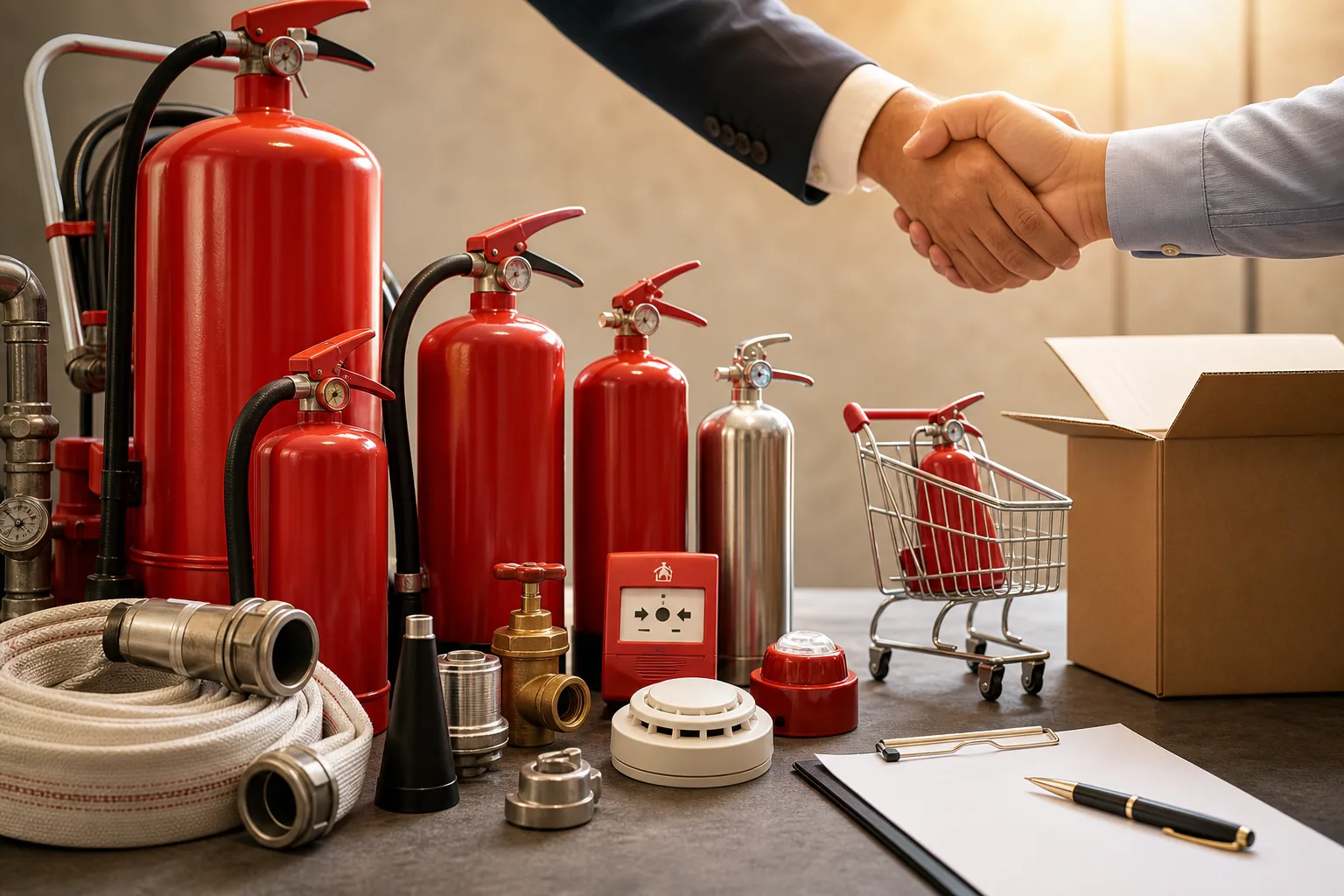
A fire extinguishing materials trading license lets you buy and sell the physical products used in fire suppression. That covers extinguishing agents, foam concentrates, dry powder, CO2 cylinders, suppression system components, and related materials. You are trading the inputs, not installing the systems, though you can structure your business to work closely with contractors who do.
Your buyers sit in a few clear segments. Civil defence contractors need certified materials to fulfil their project obligations. Facility management firms restock and maintain suppression systems across commercial buildings. Construction developers specify and procure fire safety equipment at the fit-out stage. Hospitality groups and industrial operators run large estates that need regular maintenance supply.
Demand holds because it has to. UAE Civil Defence codes mandate fire suppression equipment in all commercial, residential, and industrial builds. Nobody is buying this on a discretionary basis. That regulatory floor is what makes the business workable even when construction activity slows.
Key Stats at a Glance

| Activity | Fire Extinguishing Materials Trading |
|---|---|
| Jurisdiction | Meydan Free Zone, Dubai |
| Foreign ownership | 100% – Invest in Dubai |
| Corporate tax | 0% on qualifying free zone income |
| VAT registration threshold | AED 375,000 taxable turnover – Federal Tax Authority |
| VAT rate on goods | 5% standard rate |
| Minimum setup cost | From AED 12,500 – see Dubai Trade License from AED 12,500 |
Mainland vs Meydan Free Zone: Which Setup Works for You
This is the biggest choice you will make when setting up. Let your clients decide it, not the price.
A mainland license issued through the Dubai Department of Economy and Tourism (DET) lets you work directly with UAE government tenders and local contractors. No distributor in the middle. If your main buyers are UAE-based construction firms or facility management companies running government contracts, mainland access matters. The trade-off is higher setup costs, a physical office requirement, and a more involved registration process.
Meydan Free Zone gives you 100% foreign ownership, no corporate tax on qualifying income, a faster setup, and a lower cost to enter. You can be operational within days of submitting complete documents. The constraint is that selling goods into the UAE mainland requires either a local distributor or a dual-license arrangement. That adds a layer if your primary market is domestic.
| Factor | Mainland (DET) | Free Zone (Meydan Free Zone) |
|---|---|---|
| Client access | Open UAE market, including government tenders | Mainly international clients; mainland needs a distributor |
| Foreign ownership | 100% in most activities | 100% |
| Corporate tax | Standard UAE corporate tax applies | 0% on qualifying free zone income |
| Office requirement | Physical office required | Flexi-desk options available |
| Setup speed | Typically longer | Days once documents are complete |
| Entry cost | Higher | Lower |
If you are re-exporting to the GCC or serving international buyers, Meydan Free Zone is the cleaner choice. If your order book is mostly UAE domestic, think carefully about how you will handle mainland distribution before you commit to a free zone setup.
Free Business Setup Cost Calculator
Calculate NowHow to Set Up Your Business with Meydan Free Zone
The process is direct. Here is what it looks like in order:
- Step 1, book your trade name: Use the Company Name Check tool on the Meydan Free Zone portal to confirm availability before you go further.
- Step 2, select your activity code: Confirm the fire extinguishing materials trading code is on your license before you submit. You can check the full Business Activities List on the Meydan Free Zone portal.
- Step 3, choose your license package: mCore covers lean setups with a single activity and a small visa allocation. mPlus suits businesses that need more activities, more visas, or extra support services from day one.
- Step 4, submit your documents: You will need passport copies, proof of address, and a no-objection letter if you are currently on a UAE residence visa sponsored by another employer. Some banks also ask for a business plan at the account-opening stage, so it is worth preparing one early.
- Step 5, get your license: Once documents are complete and payment is confirmed, Meydan Free Zone issues your license within a few working days.
- Step 6, open a corporate bank account: Fire safety trading is a physical goods business. Banks want to see a clear supply chain, named suppliers, and an end-buyer profile. Prepare that information before you approach a bank. Meydan Free Zone's business banking support service can help you navigate this step.
- Step 7, get your visa: Apply for your investor or partner visa through Meydan Free Zone. Use mResidency for visa processing, medical fitness screening, and Emirates ID. If you are bringing family, the dependent visa service handles sponsorship applications.
You can also handle the entire setup remotely. Meydan Free Zone supports remote business setup for founders who are not yet in the UAE, which is useful if you are managing supplier relationships from outside the country while the entity is being established.
Compliance and What You Need in Place Before You Start
Fire extinguishing materials sit in a regulated product category. Get the compliance side right before you start trading, not after your first shipment arrives.
Civil Defence product approvals
Products sold in the UAE must meet UAE Civil Defence specifications and Gulf Standards Organisation (GSO) requirements. Not every product that is certified in Europe or North America automatically qualifies here. Check the product certification status with your supplier before you commit to a purchase order. Selling non-compliant materials into the UAE market is a serious issue, not just a paperwork problem.
Import and customs
Fire suppression chemicals and pressurised cylinders are controlled goods. They carry specific customs classifications, and some agents are subject to import restrictions or handling requirements. Check the Ports, Customs and Free Zone Corporation classifications before you finalise your supply chain. Getting this wrong at the port is expensive and slow to fix.
VAT registration
You must register with the Federal Tax Authority once your taxable turnover reaches AED 375,000. Trading goods is a standard-rated supply at 5%. If you are re-exporting, zero-rating rules may apply, but you need to document the export properly to support that treatment. Meydan Free Zone's mAccounting service covers VAT registration support if you need help with the process.
Storage and warehousing
Pressurised cylinders and chemical fire agents cannot sit in a standard storage unit. They need compliant warehousing that meets safety and handling standards for hazardous materials. Factor this into your cost model from day one. It is one of the real barriers to entry in this business, and it is also one of the reasons that established traders hold their position once they have the infrastructure in place.
Staff and visas
Your visa allocation depends on the package you choose with Meydan Free Zone. If you are hiring staff to manage warehouse operations or handle logistics, plan your visa numbers before you finalise your package. Use mAssist for administrative support and mResidency for visa processing once you are ready to bring people on.
Market Opportunity and Why the UAE Is a Workable Base
The UAE construction pipeline remains active. Large-scale commercial, hospitality, and industrial projects continue to move through planning and build phases, each one requiring fire suppression equipment at the fit-out stage. That creates a rolling demand cycle that does not depend on any single project or client.
Re-export potential adds another dimension. Dubai's port infrastructure, managed through DP World, makes it a practical hub for distributing fire safety materials across the GCC and into broader regional markets. If your supply chain is set up to move volume, the UAE is a strong base for serving Saudi Arabia, Kuwait, Oman, and beyond, without needing a separate entity in each country.
The global fire suppression market is tracked as a growth sector by research firms including IMARC Group and Mordor Intelligence, driven by tightening building codes and rising safety standards in emerging markets. The UAE sits at the intersection of that global trend and a regional construction market that consistently outpaces most comparable economies.
Meydan Free Zone's location gives you access to Dubai's logistics corridors without the overhead of a large physical operation at the start. You can run a lean trading entity, use third-party compliant warehousing, and scale your physical footprint as your order book grows.
Conclusion
Fire extinguishing materials trading is a regulated, operationally specific business with real and consistent demand in the UAE. The compliance requirements around product certification, import classification, and storage are not trivial, but they are manageable once you understand them. They also work in your favour once you are set up, because they keep the market from filling up with underprepared competitors.
Meydan Free Zone gives you a fast, cost-effective entry point with 100% ownership. The setup process is simple once your activity code and compliance requirements are clear. Use the Cost Calculator to get a breakdown of your license and package costs, then speak to the Meydan Free Zone team to confirm your activity code and start your application.
Ready to Launch Your Business in Dubai?
Let's ConnectCompliance
THIRD-PARTY APPROVAL
This activity requires pre-approval from the DCD (Dubai Civil Defence) before a business license can be issued by Meydan Free Zone.
ANTI-MONEY LAUNDERING COMPLIANCE
This business activity is exempt from AML compliance requirements.
References
- Invest in Dubai
- Federal Tax Authority (FTA)
- Ports, Customs and Free Zone Corporation (PCFC)
- DP World
- IMARC Group
- Mordor Intelligence