





Table of Contents
Topic Summary
A Market Backed by Serious Spending Power
Female Emiratis spend 43% of their income on shopping, three times more than expatriates, creating consistent demand for custom womenswear. The UAE also accounts for 56% of the entire GCC luxury market, with fashion growing 11% in Q1 2025.
One Licence Covers a Wide Range of Work
Activity code 1410.95 covers everything from bespoke abayas and occasion wear to zardozi embellishment, beadwork, and garment alterations under a single licence. If the garment is cut, stitched, and embellished for a specific client, you are in scope.
The Clientele Spans Every Cultural Tradition
With 88.5% of the UAE population being expatriate, your potential clients bring South Asian, Arab, African, and Western fashion traditions, each with its own embroidery heritage. That diversity means demand for everything from lehengas to monogrammed corporate blouses rarely slows.
Modest Wear Is a Category in Its Own Right
Abayas, kaftans, jalabiyas, and shaylas represent a distinct and commercially significant segment within ladies tailoring. Established studios like Lamis Abaya and Gulf and Moroccan Tailoring demonstrate the standalone viability of this niche.
Embroidery Alone Is a Scalable Business
The global embroidery market is projected to reach USD 2.62 billion by 2033, driven by demand for personalised and embellished apparel. Specialists offering threadwork, sequin, or computerised embroidery can serve couture houses, boutiques, and corporate clients at volume.
Know What Falls Outside Your Licence
The activity excludes fur garments, rubber or plastic apparel, leather sports gloves, safety clothing, and the repair of wearing apparel. Understanding these boundaries keeps your operations compliant and your business clearly positioned.
Meydan Free Zone Offers a Practical Entry Point
Setting up through a free zone like Meydan gives tailors, embroidery specialists, and fashion designers a structured path to licensing without requiring a local sponsor. This is particularly relevant for skilled craftswomen looking to formalise a made-to-measure offering.
How to Start a Ladies Wears Tailoring & Embroidery Business in Dubai with Meydan Free Zone
According to Business Research Insights¹, the global embroidery market is projected to reach USD 2.62 billion by 2033, driven largely by rising demand for personalised and embellished apparel. But unlike ready-to-wear, tailoring and embroidery is where personalisation meets craft, and in the UAE, that craft runs deep. From hand-embroidered abayas in Satwa to computerised threadwork for corporate clients, ladies tailoring and embroidery combines cultural tradition with commercial scale. Female Emiratis spend 43% of their income on shopping , three times more than expatriates, as reported by Emirates Woman².
The demand cuts across cultures, calendars, and dress codes.
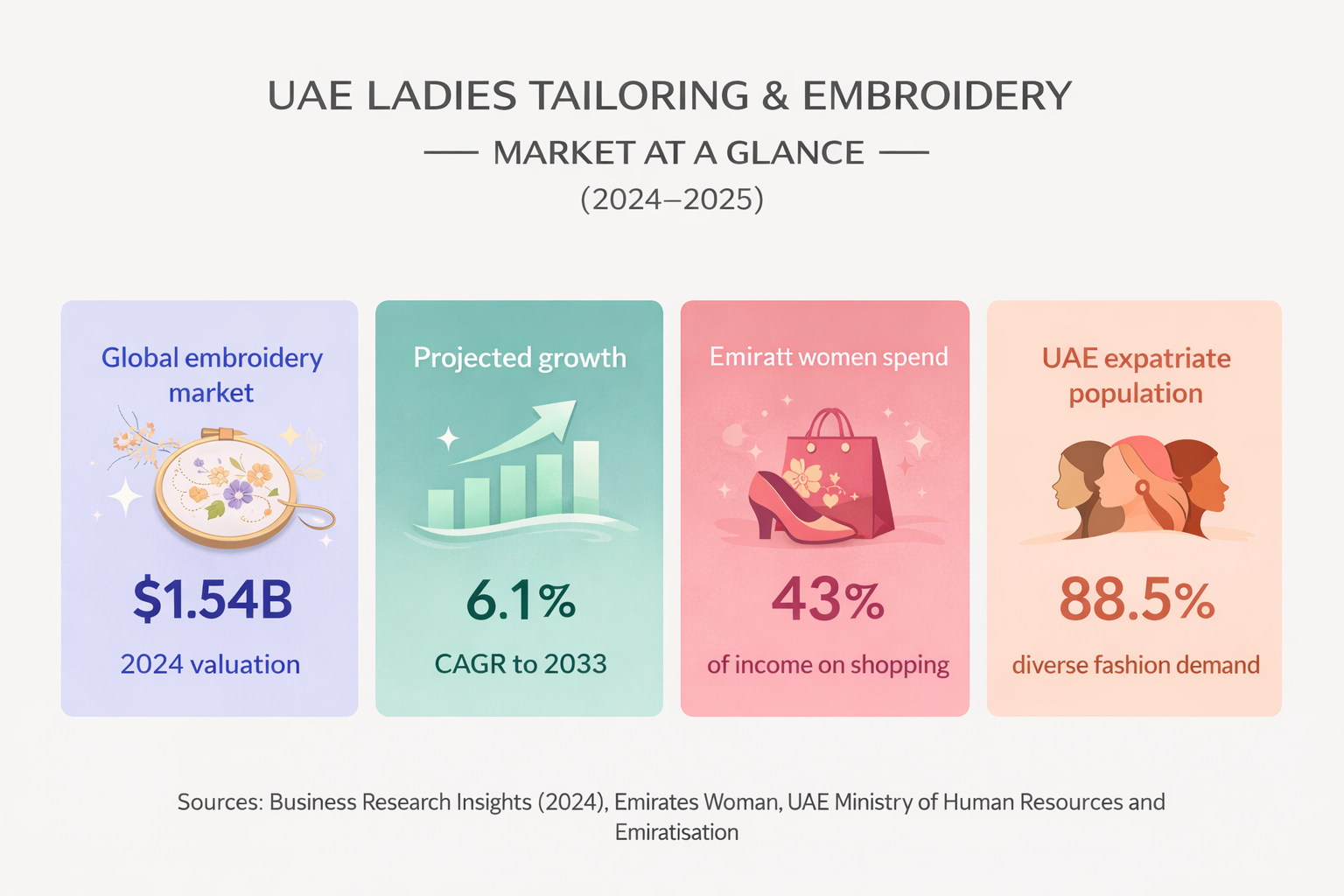
The UAE's population is 88.5% expatriate, according to the Ministry of Human Resources and Emiratisation³, creating a clientele that spans South Asian, Arab, African, and Western fashion traditions, each with its own embroidery heritage. The Chalhoub Group⁴ reports that the UAE accounts for 56% of the entire GCC luxury market, and luxury fashion in the region grew 11% in Q1 2025. Whether the brief is a zardozi-embellished lehenga for a South Asian bride, a hand-stitched jalabiya for Eid, a beadwork evening gown for a gala, or monogrammed corporate blouses at volume, the work in this market never dries up.
Who is this for?
1410.95 - Ladies Wears Tailoring & Embroidery
Under this activity, you are in the business of custom tailoring and embroidery for women, measuring, cutting, fitting, finishing, and embellishing garments to individual client specifications. This covers bespoke dresses, blouses, skirts, suits, abayas, kaftans, and all forms of decorative needlework including hand embroidery, machine embroidery, beadwork, and appliqué.
There are limits to what this activity covers. It excludes the manufacture of wearing apparel of fur skins (except headgear), footwear, wearing apparel of rubber or plastics not assembled by stitching but merely sealed together, leather sports gloves and sports headgear, safety headgear (except sports headgear), fire-resistant and protective safety clothing, and the repair of wearing apparel.
In practice: if the garment is cut, stitched, and embellished for a specific client, you're in scope. Mass manufacturing, retail, and men's tailoring are each a different business.
Third-Party Approval:
No third-party approval is required for this business activity.
Anti-Money Laundering Compliance:
This business activity is exempt from AML compliance requirements.
Reference
¹ Business Research Insights - Embroidery Market Size, Share, Forecast, 2033
² Emirates Woman / Shedd - Women's Shopping Habits in the UAE Revealed
³ Wikipedia - Demographics of the United Arab Emirates (citing UAE Federal Competitiveness and Statistics Authority data, 88.5% expatriate population as of 2024)