
Table of Contents
Frequently Asked Questions
What is Activity Code 7120.78 and what does it cover
Activity Code 7120.78 refers to Materials Fire Resistance Testing Services, classified under the ISIC category of Technical Testing and Analysis. It is a licensed laboratory function — not a consultancy role — with direct regulatory consequences for building approvals and public safety in Dubai.
Services under this licence include fire resistance testing of structural components, cladding systems, facade assemblies, fire doors, partitions, and penetration seals. Laboratories operating under this code also issue compliance certificates that support building permit applications and insurance underwriting.
Who needs a Materials Fire Resistance Testing Services licence in Dubai
This licence is required by anyone operating or establishing an accredited fire resistance testing laboratory in Dubai. This includes testing laboratory operators, independent engineers setting up specialist facilities, and international firms expanding their testing services into the Gulf region.
The client base for such facilities spans real estate developers, main contractors, government infrastructure projects, and product manufacturers seeking certification before bringing materials to market. Because testing outcomes directly influence Dubai Civil Defence approvals, clients have no discretion about whether to test — it is a regulatory requirement.
Which regulatory authorities oversee fire resistance testing laboratories in Dubai
Three key bodies govern this activity. Dubai Civil Defence sets the fire safety standards laboratories must align with, including the UAE Fire and Life Safety Code of Practice, and must approve the facility before it can operate commercially.
The Emirates National Accreditation System (ENAS) provides laboratory accreditation based on ISO/IEC 17025, which is required for test certificates to be recognised by regulators, developers, and insurers. The trade licence itself is issued by either the Dubai Department of Economy and Tourism (DED) for mainland operations or a relevant Free Zone authority.
What is ISO/IEC 17025 and why is it important for this licence
ISO/IEC 17025 is the internationally recognised standard for the competence of testing and calibration laboratories. In the context of Activity Code 7120.78, accreditation to this standard through the Emirates National Accreditation System (ENAS) is a baseline requirement — not an optional credential.
Without ENAS accreditation based on ISO/IEC 17025, a laboratory's test certificates will not be recognised by Dubai regulators, property developers, or insurers. This makes achieving and maintaining accreditation a commercial and legal necessity for any fire resistance testing facility operating in Dubai.
What physical facility requirements must a fire resistance testing laboratory meet in Dubai
This is explicitly not a desk-based operation. A dedicated testing laboratory with certified equipment, appropriate fire exposure apparatus, and qualified engineers is a baseline requirement before any commercial testing can take place.
Premises must satisfy both municipality standards and Dubai Civil Defence facility standards before approvals are granted. This means the physical setup, equipment certification, and staffing qualifications must all be in place and verified by the relevant authorities as part of the licence and accreditation process.
What is the difference between setting up on the Dubai mainland versus a Free Zone for this activity
The trade licence for Activity Code 7120.78 can be obtained either through the Dubai Department of Economy and Tourism (DED) for mainland operations or through a Free Zone authority such as Meydan Free Zone. The choice of jurisdiction has practical consequences beyond the licence itself.
Mainland registration allows broader access to UAE government tenders and public sector contracts, which represent a significant portion of the market for fire resistance testing given the volume of government infrastructure development. Free Zone registration may offer other commercial or operational advantages, but the impact on client access and facility requirements should be carefully evaluated before a decision is made.
What types of materials and components are tested under this licence
Fire resistance testing under Activity Code 7120.78 covers a wide range of construction and industrial materials. Structural components and load-bearing elements are tested, as are composite panels, insulation materials, cladding systems, and facade assemblies — all of which are critical given Dubai's high-rise construction environment.
The scope also includes fire doors, partitions, and penetration seals, which are evaluated against recognised fire exposure standards. Testing outcomes for these products directly influence building permit approvals and regulatory sign-off from Dubai Civil Defence, making certified results essential for developers and manufacturers alike.
Is the licence setup process sequential and can any steps be skipped
The licence setup process for a Materials Fire Resistance Testing Services facility in Dubai is strictly sequential — each stage depends on the completion of the one before it. According to the regulatory framework, no steps can be shortcut or reordered.
This means jurisdiction selection, facility establishment, equipment certification, staffing, and authority approvals — including from Dubai Civil Defence and ENAS — must all be completed in the correct order. Attempting to operate commercially before each approval stage is completed would result in non-compliant test certificates that would not be accepted by regulators, developers, or insurers.
Materials Fire Resistance Testing Services License in Dubai
Dubai's construction sector keeps growing, and its fire safety codes are among the strictest in the region. That combination creates steady, reliable demand for accredited materials fire resistance testing. The businesses that hold the right license, and the right accreditation, are well placed to serve that demand.
This guide covers what the license covers, who your clients will be, how to choose between mainland and free zone setup, and what you need in place before you start.
Key Stats at a Glance
| License type | Materials Fire Resistance Testing Services |
|---|---|
| Issuing authority (free zone) | Meydan Free Zone |
| Issuing authority (mainland) | Dubai Department of Economy and Tourism (DET) |
| Regulatory oversight | Dubai Civil Defence |
| Accreditation body | Emirates National Accreditation System (ENAS) |
| Foreign ownership | 100% permitted – Invest in Dubai |
| Market context | UAE construction sector remains one of the most active in the GCC – Mordor Intelligence |
What This License Covers

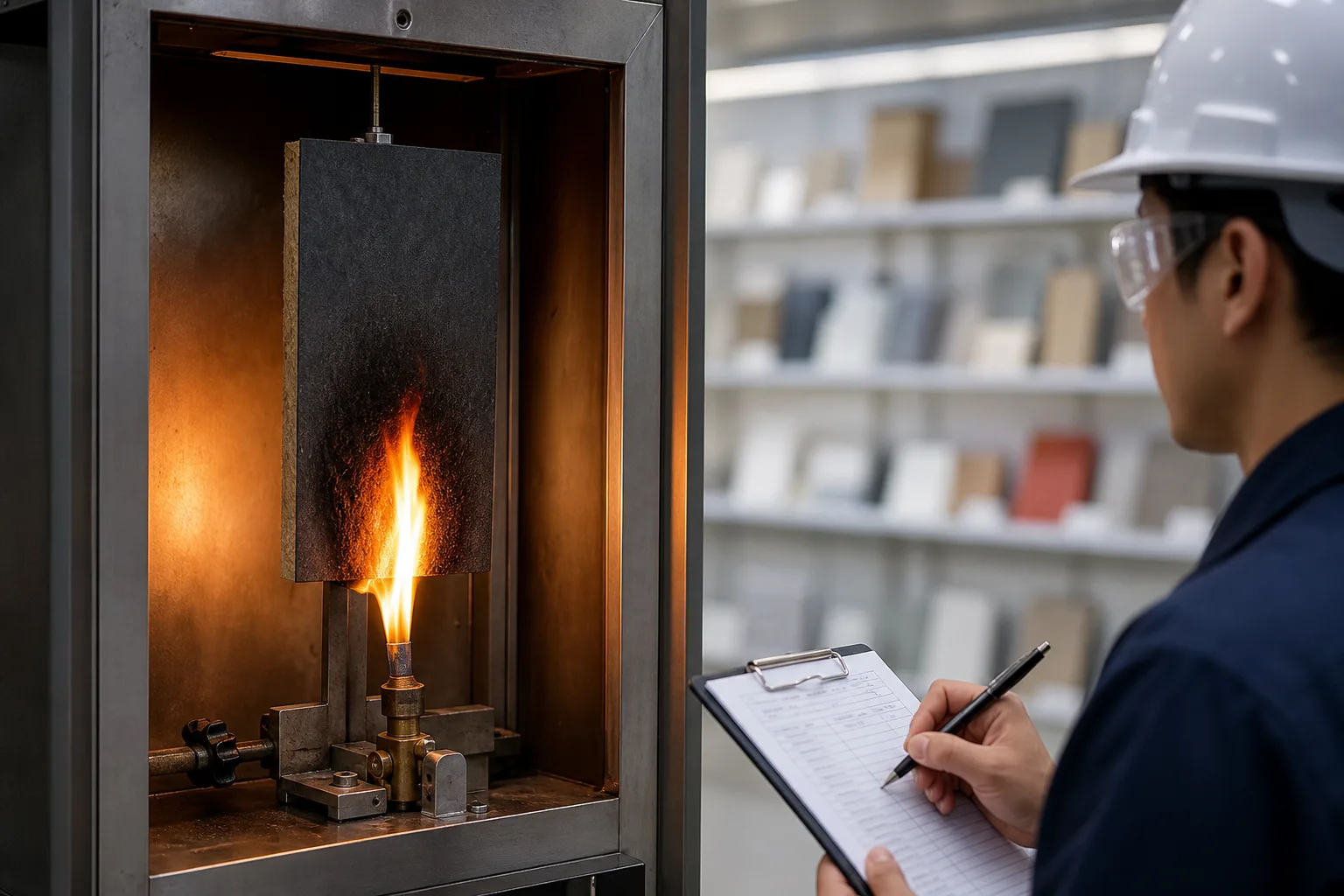
A materials fire resistance testing services license lets you run a laboratory that tests building materials for their ability to resist fire. That covers structural materials, insulation products, cladding systems, and fire-protective coatings. You test them, measure how they perform, and issue rated reports that developers, contractors, and regulators rely on.
The types of tests you carry out include furnace testing, flame spread assessment, smoke density measurement, and load-bearing fire resistance under heat. Each test follows defined standards, mostly ISO-based, and the results feed directly into project approvals and product certification.
Two bodies matter here. Dubai Civil Defence sets the rules on what tests are required, what standards apply, and which labs are approved to carry out the work. DET or Meydan Free Zone issues the trade license that lets you operate commercially. You need both in place before you open your doors to clients.
This is not a general testing activity. The scope is specific, the standards are technical, and the clients need reports that carry legal weight. That means your setup, your staff, and your equipment all have to meet defined requirements from day one. See the Meydan Free Zone business activities list to confirm the exact activity code for your application.
Who Your Clients Will Be
The main client groups are property developers, main contractors, architects, fit-out companies, and importers of building materials. All of them need fire resistance certificates at some point in a project cycle, and most of them need them repeatedly.
Government and semi-government projects are a significant source of work. Before approvals are granted on major builds, third-party fire resistance reports from an accredited lab are a standard requirement. Nobody signs off on a government project without them.
Manufacturers and product suppliers are another steady client base. A cladding manufacturer or insulation importer who wants to sell into the UAE or wider GCC market needs certified test data to back their product claims. They come to accredited labs to get that data, and they come back every time they launch a new product or enter a new market.
Procurement here is formal. Clients run approved vendor lists. They want to see your ENAS accreditation before they send you a sample. Once you are on their list and they trust your reports, you get repeat work on long-term contracts. Nobody here buys testing services on a phone call.
Mainland vs Free Zone: Which Setup Works for You
This is the most important structural decision you will make. Get it right early, because changing later is costly.
A mainland license from DET gives you direct access to government tenders and lets you work with any client across the UAE without restriction. Most fire resistance testing firms serving local developers, contractors, and government projects choose mainland for exactly this reason. If your core market is UAE-based construction projects, mainland is the practical choice.
A Meydan Free Zone license works well if your business model is focused on testing imported materials, serving international manufacturers who need GCC market certification, or operating as part of a group with international entities. The free zone structure also gives you 100% foreign ownership and a simpler setup process.
The table below sets out the key differences plainly.
| Factor | Mainland (DET) | Free Zone (Meydan Free Zone) |
|---|---|---|
| Client access | Open UAE market, including government contracts | Mainly international clients and importers |
| Foreign ownership | 100% permitted in most activities | 100% permitted |
| Office requirement | Physical lab premises required | Flexi-desk available for admin; lab premises still needed for operations |
| Government tenders | Direct access | Restricted without a mainland entity |
| Setup speed | Longer due to Civil Defence pre-approval | Faster for the license itself |
One point worth noting: whatever jurisdiction you choose, you still need Dubai Civil Defence pre-approval and ENAS accreditation before you can issue legally recognised test reports. The license structure does not change those technical requirements.
Free Business Setup Cost Calculator
Calculate NowHow to Set Up: Step-by-Step
The setup process has more steps than a standard trade license because of the Civil Defence pre-approval requirement. Plan for it and do not try to shortcut it.
- Step 1, book your trade name: Use the DET e-Services portal for a mainland company, or the Meydan Free Zone portal for a free zone one. Check your company name availability before you submit to avoid delays.
- Step 2, choose your jurisdiction: Confirm whether mainland or free zone fits your client base and how you work. This drives everything that follows.
- Step 3, get initial approval: Submit your application with your proposed activity and business details. Both DET and Meydan Free Zone issue an initial approval before the full license.
- Step 4, apply for Dubai Civil Defence pre-approval: This is a mandatory step. Civil Defence reviews your proposed lab setup, equipment list, and qualified personnel before the license can be issued. Do not skip this or leave it until after you have signed a lease.
- Step 5, secure lab premises: Your facility must meet Civil Defence standards for a fire testing laboratory. This includes the right space for furnace equipment, ventilation, safety systems, and storage of test samples. Get the premises approved as part of the Civil Defence process.
- Step 6, apply for ENAS accreditation: The Emirates National Accreditation System accredits testing laboratories. Without ENAS accreditation, your reports have no legal standing. Start this process early because it takes time.
- Step 7, submit final documents and pay fees: Once Civil Defence pre-approval is in hand and your premises are confirmed, submit your full application with all supporting documents and pay the license fee.
- Step 8, get the license issued: The license is issued once all approvals are cleared. Do not take on client work or issue any test reports before this point.
If you want to handle the setup without being in Dubai, remote business setup is possible for the free zone license elements, though the Civil Defence inspections and lab setup will need someone on the ground.
Compliance and What You Need in Place
The license gets you the right to operate. Compliance keeps you operating. The two are not the same thing.
ENAS accreditation
This is non-negotiable. The Emirates National Accreditation System accredits laboratories that issue test reports used in regulatory and commercial decisions. Without it, your reports carry no legal weight, and no serious client will use them. Accreditation covers your testing methods, your equipment calibration, your staff competence, and your quality management system. It is reviewed on a regular cycle, so you maintain it continuously, not just at setup.
Qualified staff
You need licensed fire safety engineers or materials testing specialists on your payroll. These are not roles you can fill with general technicians. Civil Defence and ENAS both look at your team's qualifications as part of their review. Staff credentials need to match the scope of tests you are accredited to carry out.
Equipment
Furnaces and testing rigs must meet the ISO and UAE fire test standard specifications relevant to each test type. Equipment must be calibrated, maintained, and documented. ENAS assessors check calibration records. Out-of-calibration kit means your results are not valid, and your accreditation is at risk.
Ongoing duties
Annual license renewal with DET or Meydan Free Zone is standard. Civil Defence carries out inspections of accredited labs, and you need to be ready for them. Test records must be kept in a way that supports audit, both by ENAS and by clients who may query results. VAT registration is required once your turnover crosses the threshold set by the Federal Tax Authority. Corporate tax duties also apply, so make sure your accounting is in order from the start.
Market Opportunity
Dubai's construction pipeline is large and active. Major infrastructure projects, residential towers, commercial developments, and hospitality builds all need fire resistance testing at multiple stages. That is not a one-off cycle. Testing is required when materials are specified, when products are imported, when buildings are handed over, and when existing structures are refurbished.
The GCC market adds another layer. Manufacturers across the region use UAE-accredited labs to certify products for export. An ENAS-accredited lab in Dubai can serve clients in Saudi Arabia, Qatar, and beyond without those clients needing local testing facilities of their own.
The barrier to entry is real. Setting up a compliant fire testing lab takes capital, time, and technical expertise. That is exactly what keeps the market from being flooded. Once you are accredited, on approved vendor lists, and trusted by major clients, the work is consistent and the relationships are long-term.
According to Mordor Intelligence, the UAE construction sector continues to show strong activity, driven by government infrastructure spending and private real estate development. Fire safety compliance sits at the centre of that activity, and accredited testing services are a direct beneficiary.
Conclusion
A materials fire resistance testing license in Dubai puts you inside a regulated, high-demand supply chain that feeds directly into the UAE's construction and real estate sector. The setup process has real steps and real costs. Civil Defence pre-approval, ENAS accreditation, and compliant lab premises all take time and investment. But once you are accredited and on approved vendor lists, the work is consistent and the client relationships tend to run for years.
The businesses that do this well are the ones that treat compliance as an asset, not a burden. Your accreditation is your product. Protect it.
Talk to Meydan Free Zone about the right license structure for your testing business and get a clear cost estimate before you commit.
Ready to Launch Your Business in Dubai?
Let's ConnectReferences
- Invest in Dubai
- Federal Tax Authority (FTA)
- Mordor Intelligence
- Dubai Department of Economy and Tourism (DET) e-Services