
Table of Contents
Frequently Asked Questions
What does the Mining & Mines Equipment Engineering Services licence (activity code 7110.70) actually permit
Activity code 7110.70 falls under ISIC Division 71 – Architectural, Engineering and Related Technical Consultancy. It permits engineering consultancy, design, inspection, and technical advisory services related to mining equipment and mine infrastructure.
Permitted activities include equipment selection and procurement advisory, site feasibility studies, mine planning support, maintenance engineering contracts, equipment commissioning, and third-party inspection and compliance reporting for mining assets.
Importantly, this is an engineering and advisory licence only. It does not authorise physical extraction or mining operations, and it is not a mining concession of any kind.
What types of mining equipment and infrastructure fall within the scope of this licence
The licence covers a wide range of surface and underground mining equipment, making it suitable for both generalist engineering consultancies and narrowly focused technical specialists.
Equipment types within scope include drills, conveyors, crushers, hoisting systems, ventilation systems, and processing plant machinery. Mine infrastructure consultancy — such as structural, geotechnical, and mechanical engineering support — is also covered.
The activity code is broad enough to accommodate a full-service engineering consultancy or a single-discipline technical specialist operating across multiple project types.
Who is this licence best suited to
This licence is designed for operators whose work has a direct technical connection to mining assets. It is not appropriate for generalist consultancies without a mining or heavy industrial focus.
Ideal licence holders include engineering firms serving mining clients across Africa, Central Asia, or the MENA region using Dubai as a regional base; OEM representatives and distributors of heavy mining equipment who need an engineering services wrapper alongside a trading activity; and independent consultants in mineral processing, geotechnical, or mechanical engineering.
Project management companies supporting mine development, expansion, or decommissioning projects are also well suited to this activity code.
Should I set up on the Dubai mainland or in a free zone such as Meydan Free Zone
The right jurisdiction depends on where your clients are and how you intend to operate. Meydan Free Zone suits lean engineering consultancies that work primarily with international clients and do not require a physical presence on UAE government project sites.
Dubai mainland is required if you need to execute projects directly on UAE soil, bid for local government contracts, or engage in activities that require a UAE-registered entity without free zone restrictions on local trading.
Free zone setup is typically faster — 3–7 working days — while mainland incorporation usually takes 2–4 weeks. Neither jurisdiction imposes a mandatory minimum share capital in most cases.
What is the step-by-step process for obtaining this licence
The setup process is straightforward, especially through a free zone. First, choose your jurisdiction (free zone or mainland) and confirm that activity code 7110.70 is approved under it. Then reserve your trade name.
Next, prepare your incorporation documents: passport copies, a CV or professional profile of the engineering principals, and a brief business plan summary. Submit your application and pay the licence fee — initial free zone approval typically arrives within 3–5 working days.
After approval, secure office space (a flexi-desk satisfies most free zone engineering setups; mainland requires an Ejari-registered tenancy contract). Finally, collect your licence certificate, open a corporate bank account, and confirm your visa quota allocation. You should also check whether professional registration bodies require additional credentials depending on your scope of work.
Why is Dubai a practical operational base for mining equipment engineering services rather than just a holding structure
Dubai's value for this sector goes beyond corporate structuring. The emirate offers direct flight connectivity to key mining markets including Nairobi, Johannesburg, Almaty, and Riyadh, making it genuinely practical for engineers and consultants who travel frequently to project sites.
Dubai is also positioning itself as a regional hub for industrial and engineering services, with supporting infrastructure including free zones, banking access, and a growing network of GCC, African, and Central Asian business relationships concentrated in one location.
For firms targeting the GCC, Africa, and Central Asia simultaneously, a Dubai base reduces travel complexity, supports client-facing operations, and provides a credible, internationally recognised corporate address.
Is there a minimum share capital requirement for this licence
In most free zone jurisdictions in Dubai, including Meydan Free Zone, there is no mandatory minimum share capital for a professional or engineering services licence under activity code 7110.70.
This makes the licence accessible to independent consultants and small engineering firms, not just large corporate entities. However, requirements can vary by jurisdiction, so it is advisable to confirm the specific conditions with your chosen free zone or mainland authority at the time of application.
While share capital requirements are low, professional credibility — demonstrated through the CVs and qualifications of engineering principals — plays an important role in the application process and in winning client mandates.
What commercial markets does this licence open up and how large is the opportunity
The licence targets a capital-intensive, high-demand sector spanning multiple regions. Primary target markets include the UAE, the broader GCC, Africa, and Central Asia — all regions with active mining investment and a consistent need for specialist engineering services.
Mining activity across these regions covers a wide range of commodities, from gold and copper in Africa to phosphates in the GCC and base metals in Central Asia. Engineering consultancies that can serve clients across these geographies from a single Dubai base are well positioned to capture cross-regional mandates.
The licence supports both project-based engagements — such as feasibility studies and commissioning contracts — and longer-term maintenance engineering and lifecycle advisory relationships, providing a range of revenue models for licence holders.
Mining & Mines Equipment Engineering Services License in Dubai
Dubai sits at the centre of a region with serious mining activity, and the companies that supply, maintain, and engineer the equipment behind that activity need a proper legal base to operate from. The UAE's position as a logistics and services hub for the GCC, Africa, and Central Asia makes it a natural home for engineering firms working in the extractive sector.
This page covers what the Mining & Mines Equipment Engineering Services license covers, who needs it, and how to set up in Dubai, whether on the mainland or through Meydan Free Zone.
Key Stats at a Glance
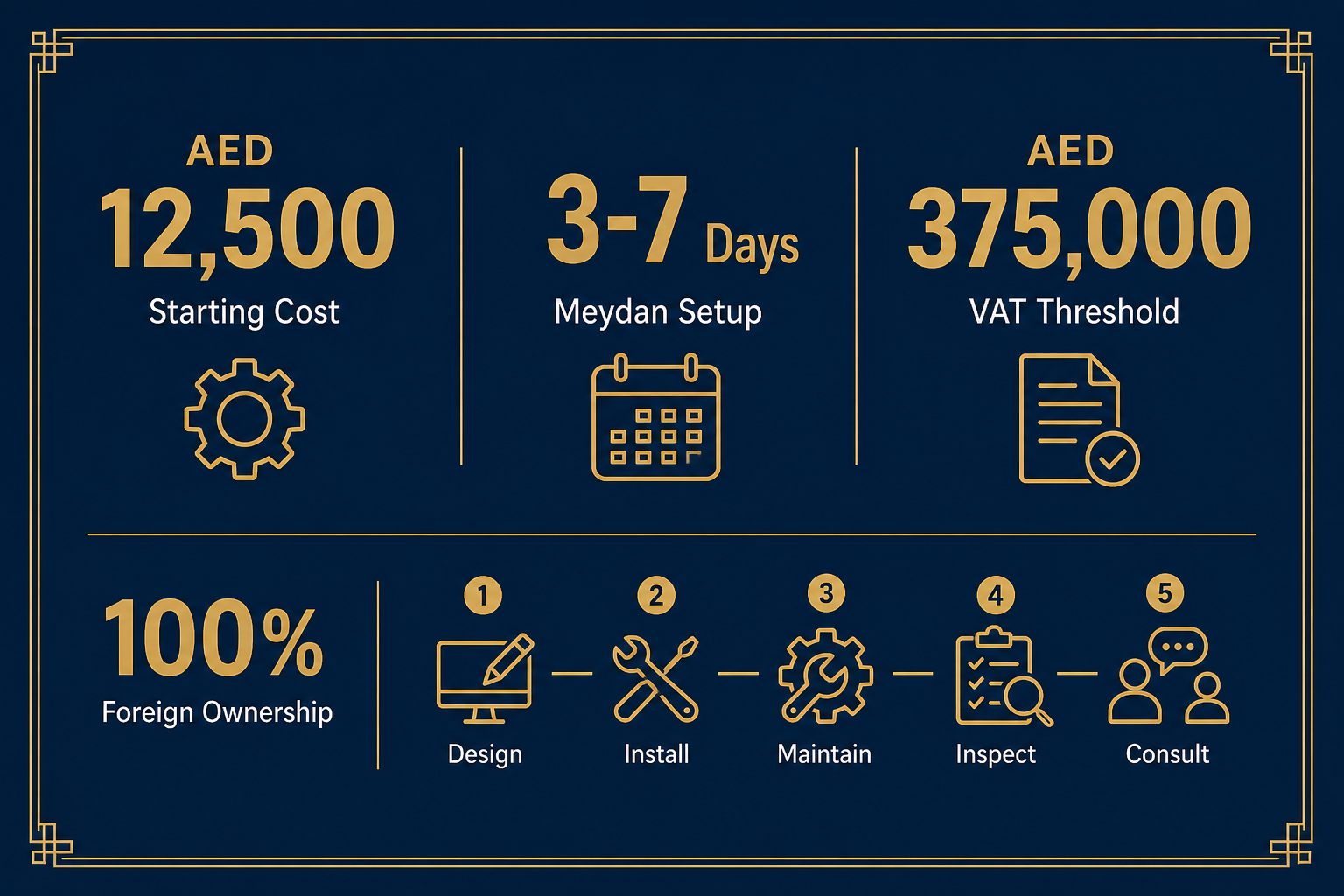
| License activity | Mining & Mines Equipment Engineering Services |
|---|---|
| Jurisdiction options | Dubai mainland (DET) or Meydan Free Zone |
| Foreign ownership | 100% permitted on both mainland and free zone |
| Typical setup timeline | 3 to 7 working days at Meydan Free Zone; 2 to 4 weeks on the mainland |
| Starting cost | From AED 12,500 at Meydan Free Zone |
| Market context | The global mining equipment market is a multi-billion dollar sector; the Middle East and Africa region is a growing share of that demand, according to IMARC Group |
| VAT registration | Mandatory once annual taxable turnover reaches AED 375,000, per the Federal Tax Authority |
What This License Covers
This license covers engineering services for mining and extraction equipment. It does not license you to run a mine or carry out extraction work. The distinction matters, and regulators will hold you to it.
In practical terms, the license lets you do the following:
- Design and specify equipment for mining and extraction operations
- Install and commission mining machinery and systems
- Maintain, repair, and overhaul mines equipment
- Inspect and test equipment for safety and performance compliance
- Provide technical consulting on mines equipment selection and deployment
- Supply spare parts and components as part of an engineering service contract
The scope is broad enough to cover most of what a specialist engineering firm would do for a mining client. It covers both surface and underground equipment, including drilling rigs, conveyors, crushing and screening systems, ventilation kit, and hoisting machinery.
Adjacent activities
Some firms operating in this space also hold related codes covering general mechanical engineering, industrial equipment trading, or technical inspection services. If your work regularly crosses into those areas, it is worth confirming with your licensing authority whether a second activity code is needed. Doing work outside your licensed scope is a compliance risk you do not need.
What this license does not cover
It does not cover the mining operation itself, mineral extraction, or the sale of extracted materials. It does not cover civil engineering work at mine sites unless you hold a separate construction or civil engineering license. If you plan to trade mining equipment as a standalone commercial activity rather than as part of an engineering service, you will need a trading license alongside this one. Keep the scope clean and your renewals will be straightforward.
Who Your Clients Will Be
The client base for this license is regional and international, not purely domestic. Dubai's value here is as a hub, not as a mining market in its own right. The UAE does not have large-scale mining operations, but it has excellent connectivity, a deep pool of engineering talent, and the legal infrastructure to support complex B2B contracts.
Regional mining operators
Saudi Arabia, Oman, and the wider GCC have active and growing extractive sectors. Saudi Arabia's mining programme under Vision 2030 is creating real demand for equipment engineering services. Operators running sites across the region often prefer to have their engineering support partner based in the UAE for logistics and contract management reasons.
Equipment manufacturers and OEMs
Global manufacturers use Dubai as a regional service and distribution base. If you hold an engineering services license, you can work as an authorised service partner for OEMs, covering installation, warranty repairs, and planned maintenance across the region. This is a workable and often stable revenue model.
Government-linked extractive bodies
Sovereign wealth vehicles and state-owned resource companies across Africa and Central Asia run procurement through UAE-registered entities. Having a Dubai license puts you on their vendor lists. Without one, you are not in the conversation.
EPC contractors
Large engineering, procurement, and construction contractors working on resource and infrastructure projects sub-contract specialist equipment engineering work. A Dubai-registered entity with the right license and professional credentials can bid for that work directly. These are long contracts, and the procurement process is formal, so getting your legal setup right before you approach them matters.
Mainland vs Meydan Free Zone
The choice between a Dubai mainland license and a free zone license comes down to one question: where are your clients, and how do they buy? Price should not drive this decision. The wrong jurisdiction for your work model will cost you more in lost contracts than you will ever save on setup fees.
| Factor | Mainland (DET) | Meydan Free Zone |
|---|---|---|
| Client access | Open UAE market, including government tenders | Mainly international and free zone clients; UAE mainland work needs a local agent or branch |
| Foreign ownership | 100% permitted | 100% permitted |
| Office requirement | Physical office required | Flexi-desk options available |
| Setup speed | Typically 2 to 4 weeks | As fast as 3 to 7 working days |
| Visa allocation | Based on office space | Flexible packages available |
| Starting cost | Higher, due to office and DET fees | From AED 12,500 |
If your work is mainly with UAE government bodies, state-owned enterprises, or local contractors, a mainland license from the Dubai Department of Economy and Tourism gives you direct access to those contracts. You will need a physical office, and the setup process takes longer.
If your clients are mostly international, OEM-based, or regional operators who do not need you to be a mainland entity, Meydan Free Zone is a faster and more cost-effective base. The Dubai Trade License from AED 12,500 is a workable entry point for an engineering services firm that is building its regional client base. You can also start a business remotely without needing to be in Dubai for the setup process.
Free Business Setup Cost Calculator
Calculate NowStep-by-Step Setup Guide
- Step 1, book your trade name: Use the DET e-Services portal for a mainland company, or the Meydan Free Zone portal for a free zone one. The name must not conflict with existing registered names. You can check your company name availability before you start.
- Step 2, confirm your activity code: Make sure the Mining & Mines Equipment Engineering Services code is approved in your chosen jurisdiction before you go further. Check the Meydan Free Zone business activities list if you are setting up in the free zone.
- Step 3, choose your jurisdiction: Use the comparison table above. This is the biggest choice you will make in the setup process. Let your clients and your work model decide it, not the fee structure.
- Step 4, prepare and submit your documents: You will need passport copies for all shareholders and directors, a completed application form, and proof of address. Some jurisdictions ask for a business plan or a description of intended activities. Meydan Free Zone keeps this simple.
- Step 5, pay your fees and receive your license: Once documents are approved and fees are paid, your license is issued. At Meydan Free Zone, this can happen within a few working days.
- Step 6, get your visa quota and apply for residency: Your license comes with a visa allocation. Apply for your own investor or partner visa first, then add staff visas as you hire. Meydan Free Zone's mResidency service covers Dubai residence services including medical fitness screening and Emirates ID.
- Step 7, open your corporate bank account: Banks in the UAE want to see your trade license, shareholder documents, and a clear description of your business activities. Engineering services firms with international clients should expect some due diligence questions on the source of funds and client base. Meydan Free Zone offers business banking support to help you through this process.
Compliance and Ongoing Duties
Professional qualifications
Engineering service providers working in the UAE are expected to hold relevant professional credentials. If your work involves safety-critical inspections or certified maintenance, clients and government bodies will ask for proof of professional body membership or recognised engineering qualifications. Make sure your team's credentials are in order before you start bidding for contracts.
VAT registration
You must register for VAT with the Federal Tax Authority once your annual taxable turnover reaches AED 375,000. Voluntary registration is available from AED 187,500. Engineering services contracts can reach these thresholds quickly. Get your VAT setup right from the start. Meydan Free Zone's mAccounting service covers VAT registration support and ongoing compliance.
Corporate tax
The UAE introduced a 9% corporate tax rate for businesses with net profits above AED 375,000. Free zone entities may qualify for a 0% rate on qualifying income, subject to conditions. Check the rules for your specific setup with a qualified adviser. Meydan Free Zone's team can point you to corporate tax services in Dubai to keep you compliant.
Staff visas and MOHRE registration
If you hire UAE-based employees, you need to register with the Ministry of Human Resources and Emiratisation (MOHRE). This covers employment contracts, wage protection, and Emiratisation duties where applicable. Get this in place before your first hire, not after.
Annual license renewal
Your trade license needs renewing every year. Missing the renewal date puts your trading status at risk and can affect your staff visas. Set a reminder well before the expiry date and make sure your documents are current. Meydan Free Zone's mAssist service can handle the administrative side of this for you.
Bookkeeping and audit
Keep clean financial records from day one. Engineering services firms working on large contracts will be asked for audited accounts by clients, banks, and sometimes regulators. Meydan Free Zone's bookkeeping services in Dubai and financial audit support are available through the mAccounting product suite.
Market Opportunity
The regional mining sector is growing. Saudi Arabia is investing heavily in mineral extraction as part of its economic diversification programme. Oman has copper and chromite operations that need ongoing engineering support. African mining markets, particularly in East and Central Africa, are expanding and often source their engineering partners from UAE-based firms because of the logistics and financial infrastructure Dubai offers.
According to IMARC Group, the global mining equipment market continues to grow, driven by demand for metals used in energy transition technologies including lithium, cobalt, and copper. Engineering firms that can service and maintain the equipment used to extract these materials are in a strong position.
Dubai's free zones give you access to this market without the overhead of a regional office network. One well-structured UAE entity, the right license, and a credible engineering team can serve clients across three continents. That is the model many firms in this space already use.
Conclusion
The Mining & Mines Equipment Engineering Services license gives you a clear, well-defined base to serve one of the region's most capital-intensive industries. The setup process is simple once you have chosen the right jurisdiction for how you work. Free zone suits international-facing operations. Mainland suits firms that need direct access to UAE government contracts.
Either way, get the activity code right, keep your professional credentials current, and stay on top of your VAT and corporate tax duties. The commercial opportunity is real. The legal setup is the easy part.
Speak to the Meydan Free Zone team to confirm your activity code, get a cost breakdown, and start the process. You can also use the business cost calculator to get an initial estimate before you make any commitments.
Ready to Launch Your Business in Dubai?
Let's ConnectCompliance
THIRD-PARTY APPROVAL
This activity requires pre-approval from the DM (Dubai Municipality) before a business license can be issued by Meydan Free Zone.
ANTI-MONEY LAUNDERING COMPLIANCE
This business activity is exempt from AML compliance requirements.