
Table of Contents
Frequently Asked Questions
What is activity code 7120.76 and what does it cover in Dubai
Activity code 7120.76 refers to Diamond & Precious Gemstones Testing Laboratory under the ISIC classification of Technical Testing and Analysis. It is the specific licence activity code used when registering a gemstone testing business in Dubai.
The scope covers scientific analysis and grading of diamonds and precious stones including rubies, sapphires, and emeralds. Services under this code include diamond grading, natural versus synthetic stone identification, treatment detection, country of origin determination, and the issuance of grading certificates and reports.
Why is Dubai a strong location for opening a gemstone testing laboratory
Dubai's position as a global commodities trading hub gives a gemstone testing laboratory immediate access to one of the world's most active diamond and jewellery markets. The DMCC alone facilitates over USD 26 billion in annual diamond trade, creating a large and concentrated client base for independent testing services.
The UAE's strategic geography allows a single laboratory to serve clients across the GCC, South Asia, East Africa, and Europe. Additional advantages include a zero personal income tax environment and strong trade connectivity, as confirmed by the Invest in Dubai platform.
The rise of lab-grown diamonds entering mainstream markets has further increased demand for reliable differentiation testing, representing a significant commercial tailwind for new entrants.
What types of clients would a precious gemstones testing laboratory serve in Dubai
The customer base for a gemstone testing laboratory in Dubai is broad and spans multiple sectors. Primary clients include wholesale diamond traders, jewellery manufacturers, and auction houses that require certified grading reports to support transactions.
Additional clients include insurance companies needing accurate valuations, customs authorities requiring origin and treatment verification, and private collectors seeking independent certification. As lab-grown stones proliferate, retailers also increasingly require testing services to maintain consumer trust.
Should I set up a gemstone testing lab on the Dubai mainland or in a free zone
Both options are available and each has distinct advantages. Mainland Dubai, licensed through the Department of Economy and Tourism (DET), provides unrestricted access to UAE-based clients without a local agent requirement under current rules, which is valuable if your primary market is domestic traders and retailers.
Free zones such as DMCC or Meydan Free Zone offer 100% foreign ownership, simplified incorporation procedures, and in some cases sector-specific infrastructure. DMCC has a dedicated gems and jewellery cluster that makes it a natural fit for this activity. Meydan Free Zone is noted as a cost-efficient option for professional and technical service activities.
The right choice depends on your target client profile, budget, and whether you need physical proximity to the DMCC trading community.
What are the key steps involved in obtaining a licence for this laboratory activity
The process begins with choosing your jurisdiction — mainland Dubai or a free zone — based on your business model and client access needs. Once decided, you reserve a trade name through the relevant authority, ensuring it complies with UAE naming conventions.
The next step is formally registering activity code 7120.76 and confirming whether any additional activities, such as jewellery valuation or consultancy, need to be added to your licence scope. Subsequent steps involve submitting incorporation documents, meeting any capital requirements set by the chosen authority, and securing approvals from relevant regulatory bodies before commencing operations.
What services are typically offered by a diamond and gemstone testing laboratory
A licensed gemstone testing laboratory typically provides a range of scientific and advisory services. Core offerings include diamond grading across the four Cs — cut, colour, clarity, and carat weight — along with identification of whether a stone is natural or synthetic.
Laboratories also conduct treatment detection, identifying processes such as heat treatment, fracture filling, and irradiation that can affect a stone's value. Country of origin determination is another key service, particularly relevant given regulations around conflict minerals. Most laboratories also issue formal grading certificates and offer consultation services to traders, retailers, and insurers.
What is driving growth in the global gemological testing and certification market
The global gemological testing and certification sector is experiencing consistent growth driven by several converging factors. Consumer trust requirements are rising as buyers demand verified certification before purchasing high-value stones, particularly in e-commerce and auction environments.
Regulatory tightening around conflict minerals has made origin certification increasingly mandatory across supply chains. Perhaps the most significant near-term driver is the rapid proliferation of lab-grown diamonds, which has created urgent demand for reliable differentiation testing to distinguish synthetic stones from natural ones. Market research firms including IMARC Group and Mordor Intelligence both document this growth trajectory.
What are the UAE naming conventions I need to follow when registering my laboratory company
When reserving a trade name for your laboratory in Dubai, the name must comply with UAE naming conventions enforced by the relevant licensing authority. Names containing offensive terms are not permitted, nor are references to political or religious bodies.
You also cannot use a name that duplicates an existing registered company name in the UAE. It is advisable to check name availability through the relevant free zone portal or the mainland Department of Economy and Tourism name reservation system before proceeding with incorporation to avoid delays.
Open a Diamond & Precious Gemstones Testing Laboratory in Dubai
Dubai moves more diamonds and coloured stones than almost anywhere else on earth, and every serious trade needs a laboratory it can trust. If you are considering setting one up, the opportunity is real, but the path to operational requires careful choices on jurisdiction, staffing, and equipment.
This guide covers what a gemstone testing license covers, who will use your services, how to choose the right jurisdiction, and what it takes to get operational.
| Activity | Diamond & Precious Gemstones Testing Laboratory |
|---|---|
| Jurisdiction options | Mainland (DET) or Meydan Free Zone |
| Foreign ownership | 100% on both tracks – Invest in Dubai |
| Key regulator | Dubai Department of Economy and Tourism (DET) for mainland; Meydan Free Zone authority for free zone |
| VAT registration threshold | AED 375,000 annual turnover – Federal Tax Authority |
| Typical setup timeline | Free zone faster than mainland for a lab activity |
What This License Covers and Who Your Clients Will Be
A diamond and precious gemstones testing laboratory license covers grading, authentication, origin testing, and the formal certification of diamonds and precious stones. It is a technical, regulated activity. It is not a trading license, and it is not a valuation business, though those activities can be added separately if your business model needs them.
The distinction matters. A testing lab issues certificates based on scientific analysis. Clients pay for independent, credible results. That independence is the product. Mixing testing with trading under the same entity can create conflicts of interest that serious clients will flag immediately.
Your core client base will include:
- Jewellery manufacturers who need stones certified before they set them
- Diamond and coloured stone traders who need documentation for re-export
- Customs brokers handling high-value shipments through Dubai
- Insurance companies assessing claims or underwriting high-value pieces
- Private collectors and high-net-worth buyers who want independent verification
- Retail jewellers who offer certification as part of their sales process
Dubai's position as a global gem trading hub creates year-round demand across all of these groups. The city handles a large share of the world's rough and polished diamond trade. Stones move through constantly, and every serious transaction benefits from a certificate that buyers and sellers on both sides of the deal can rely on. That is your market.
You can explore the full range of permitted activities on the Meydan Free Zone business activities list before you commit to a specific code.
Mainland vs Meydan Free Zone: Choosing Your Setup

This is the biggest choice you will make when setting up. Your client base should drive it, not the cost.
A mainland license through DET lets you work directly with UAE government bodies, local retail chains, and any client in the domestic market without restriction. If your lab intends to serve walk-in retail clients, local jewellery manufacturers, or UAE-based insurers, mainland gives you the broadest access.
A Meydan Free Zone setup suits labs focused on re-export trade, international diamond houses, and B2B certification work where the client relationship is commercial rather than retail. Free zone companies can still work with UAE-based clients, but the structure is better aligned to international trade flows. Setup is typically faster, office requirements are more flexible, and the cost base is lower at the start.
100% foreign ownership is available on both tracks. You do not need a local partner or sponsor on either route.
Jurisdiction Comparison Table
| Factor | Mainland (DET) | Meydan Free Zone |
|---|---|---|
| Client access | Open UAE market including government | International and B2B clients; UAE clients permitted |
| Foreign ownership | 100% permitted | 100% permitted |
| Office requirement | Physical office required | Flexi-desk options available; lab space arranged separately |
| Visa eligibility | Based on office size and activity | Packages include visa allocations |
| Setup speed | Longer due to approvals process | Faster for most lab activity codes |
| Best suited to | Retail-facing labs, government tenders | Trade-facing labs, re-export certification, international clients |
If you want to start a business remotely without travelling to Dubai for the initial setup, the Meydan Free Zone route makes that straightforward. The mainland process involves more in-person steps.
Free Business Setup Cost Calculator
Calculate NowStep-by-Step Setup Guide
- Step 1, book your trade name: Use the DET e-Services portal for a mainland company, or the Meydan Free Zone portal for a free zone one. The name must not conflict with existing registered entities. You can check your company name availability before you apply.
- Step 2, confirm your activity code: Make sure the code covers testing and certification of diamonds and precious gemstones. Check it is approved in your chosen jurisdiction before you go further. Submitting with the wrong code delays everything.
- Step 3, get initial approval: Submit your application with the required documents. For mainland, this goes through DET. For Meydan Free Zone, it goes through the free zone authority. Initial approval is not your final license, but it lets you move to the next steps.
- Step 4, fit out your lab and get your equipment: You cannot get a final license without a physical lab space that meets the requirements of the activity. Plan your space around the testing equipment you will operate. This step takes time, so start it in parallel with your approvals where possible.
- Step 5, apply for specialist approvals: Depending on the scope of testing you offer, Dubai Municipality or other relevant bodies may need to inspect and approve your lab. Check which approvals apply to your specific activity before you start fit-out, not after.
- Step 6, get your establishment card: Once your license is issued, the establishment card lets you process visas for staff. Do not skip this step before applying for employee residence visas.
- Step 7, open a corporate bank account: UAE banks apply due diligence to new accounts. Having your license, establishment card, and a clear business plan ready will speed this up. Business banking support is available through mCore if you need help navigating this.
- Step 8, apply for staff visas: Your gemologists and lab technicians will need UAE residence visas. Process these through the immigration authority once your establishment card is in place.
Free zone setup is typically faster than mainland for a lab activity. Expect a longer timeline on the mainland track due to the additional approval layers involved.
Compliance, Staffing, and What You Need in Place Before You Start
Getting licensed is one thing. Getting operational in a way that clients and regulators will accept is another. A gemstone testing laboratory has specific requirements that go beyond the license itself.
Staff and Equipment
Qualified gemologists
Your lab needs qualified gemologists. Credentials from recognised institutions, such as the Gemological Institute of America (GIA) or equivalent, are what clients and regulators will check. Unqualified staff issuing certificates is a risk to your name and potentially a regulatory problem. Hire for credentials first.
Lab technicians
Beyond gemologists, you will need trained technicians who can operate the specific instruments your lab uses. The combination of scientific grounding and instrument proficiency is what produces reliable, defensible results.
Equipment
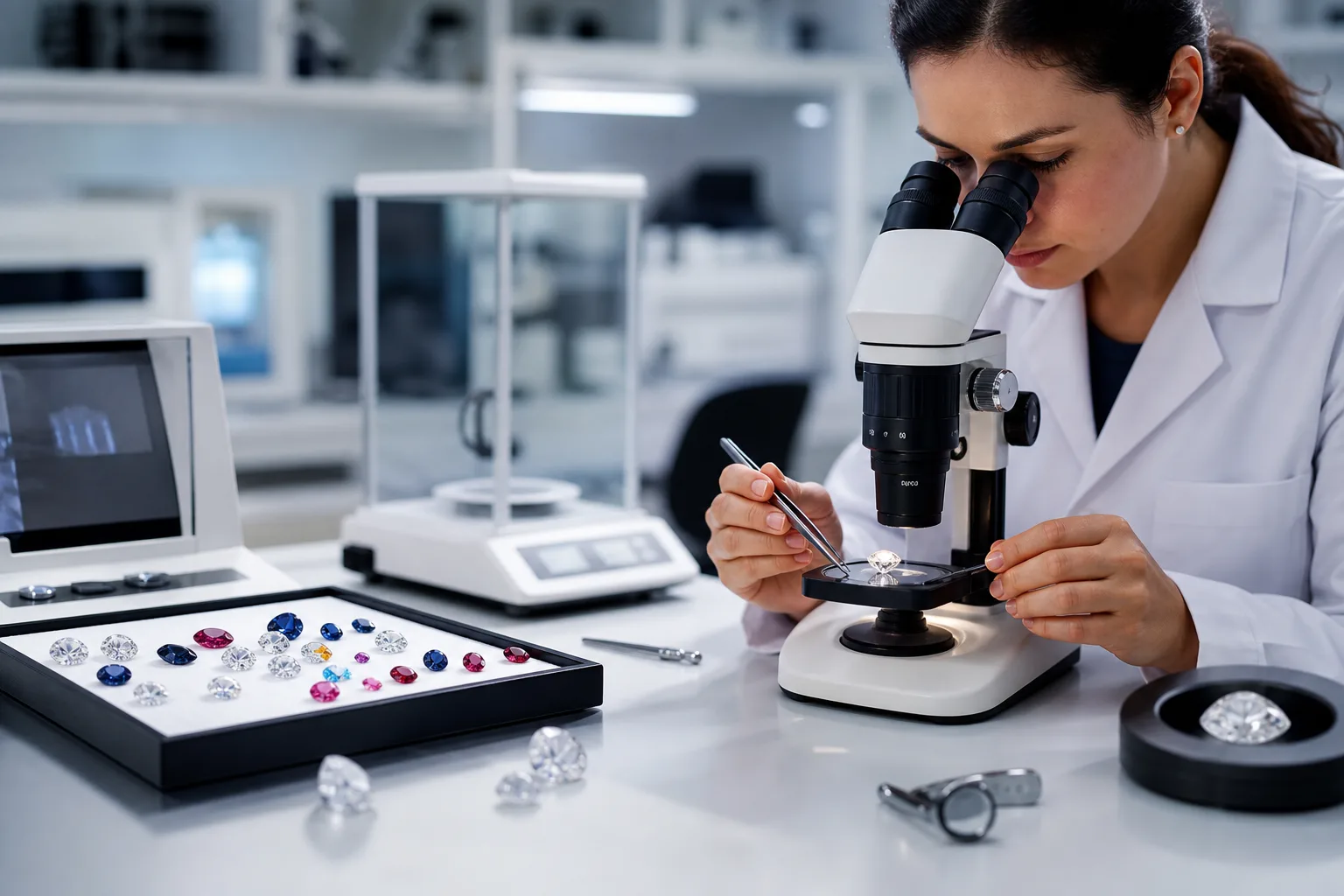
The kit you need depends on the scope of testing you offer. A full-service lab covering diamonds, coloured stones, and origin testing will need:
- Spectrometers for chemical composition analysis
- High-magnification microscopy for inclusion mapping and grading
- UV-fluorescence equipment for diamond grading and treatment detection
- Refractometers and polariscopes for coloured stone identification
- Calibrated scales and measurement tools
All equipment should meet international gemological standards. Clients who submit stones for certification will ask about your instruments and methodology. Have clear answers ready.
Ongoing Regulatory Duties
Annual license renewal
Your license needs annual renewal. Missing the renewal window leads to fines and can suspend your ability to operate. Put a renewal reminder in your calendar well before the expiry date.
VAT registration
Once your annual turnover crosses AED 375,000, you must register for VAT with the Federal Tax Authority. Testing and certification services are taxable supplies. File returns on time. Late filing attracts penalties. If you need help with VAT registration support, mAccounting can handle this for you.
Certificate records
Every certificate your lab issues needs to be stored and traceable. Clients, insurers, and customs authorities may request records long after a transaction closes. Build a records system before you issue your first certificate, not after.
Professional indemnity insurance
The law does not always mandate this for a testing lab, but the market does. Any serious client, particularly an insurer or a large trading house, will ask whether you carry professional indemnity cover before they send you stones. Get it in place before you open for business.
Corporate tax
UAE corporate tax applies to business profits above AED 375,000. Make sure your accounting is set up to handle this from day one. Corporate tax services in Dubai through mAccounting can help you stay compliant without building an in-house finance team immediately.
Market Opportunity and Why Dubai Makes Sense
Dubai's role as a re-export hub for rough and polished diamonds creates structural, ongoing demand for independent testing. Stones arrive from sub-Saharan Africa, India, Belgium, and Israel, and a large share of them move through Dubai before reaching their final market. Every one of those transactions benefits from a certificate that the next buyer in the chain can trust.
The growth in high-net-worth retail and bespoke jewellery in Dubai and the wider Gulf adds another layer of demand. Private clients buying at the top of the market want independent certification, not just a jeweller's word. That is a growing segment with real spending power.
The number of accredited independent labs in the UAE is limited. That means real barriers to entry, which work in your favour once you are established. A lab with credible credentials, good equipment, and a track record builds a reputation that is hard to replicate quickly. That is a defensible position in a market where trust is the product.
Trading corridors matter too. India is the world's largest diamond cutting and polishing centre. Belgium's Antwerp remains the global wholesale hub. Israel has a major polished diamond market. Sub-Saharan Africa produces the rough. Dubai sits at the centre of all of these routes, and that geography is not going to change.
According to IMARC Group, the global gemstone market continues to grow, driven by rising demand in Asia and the Middle East. Dubai is well placed to capture a growing share of the certification and testing work that comes with that growth.
A Dubai Trade License from AED 12,500 through Meydan Free Zone gives you a cost-effective starting point, particularly for a lab that is building its client base in the early months before revenue scales.
Conclusion
A gemstone testing laboratory in Dubai is a specialist, regulated business with a clear client base and real long-term demand. The opportunity is there, but it only works if you get the jurisdiction, staffing, and equipment right from the start. Cut corners on any of those three and the business does not hold up, because the product you are selling is credibility.
Choose your jurisdiction based on your clients. Get qualified gemologists in place before you open. Build your records and compliance systems before you issue your first certificate. And make sure your professional indemnity cover is in place before any serious client sends you stones.
Speak to the Meydan Free Zone team to confirm your activity code, get a cost estimate, and understand exactly what approvals your lab will need before you commit.
Ready to Launch Your Business in Dubai?
Let's ConnectCompliance
THIRD-PARTY APPROVAL
This activity requires pre-approval from the EIAC (Emirates International Accreditation Centre) before a business license can be issued by Meydan Free Zone.
ANTI-MONEY LAUNDERING COMPLIANCE
This business activity is exempt from AML compliance requirements.