Table of Contents
Topic Summary
Why Dubai Is Primed for This Business
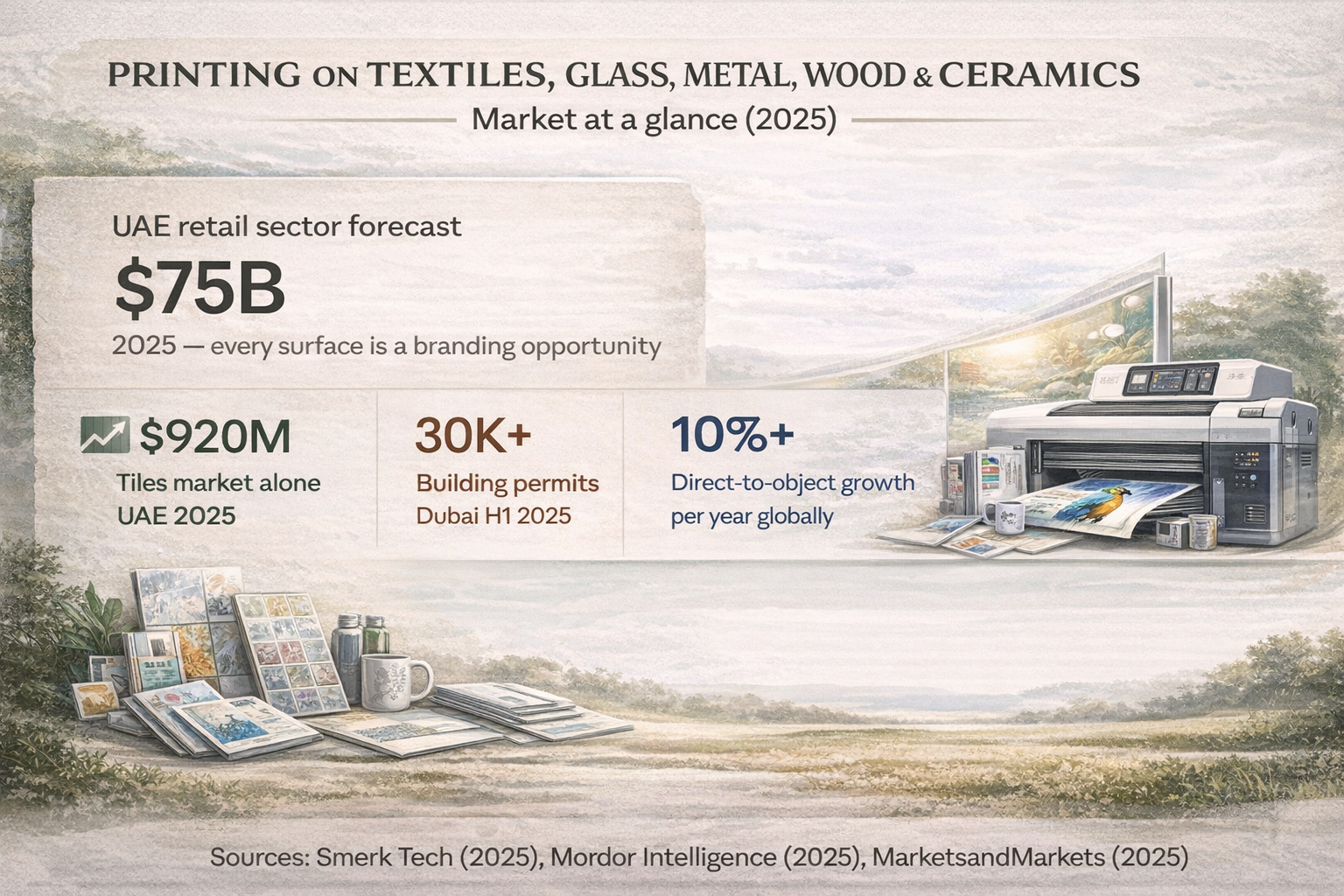
Dubai approved over 30,000 building permits in the first half of 2025 alone, driving massive demand for printed architectural glass, decorative panels, and surface cladding. The UAE's hospitality, retail, real estate, and events sectors all rely on printed surfaces that paper printing never touches.
UV-Cured Ink Opens Doors to Every Surface
UV-cured ink is the fastest-growing segment in digital printing and adheres directly to glass, metal, plastic, wood, and ceramics on contact. This technology is the backbone of direct-to-substrate printing, which is expanding globally at over 10% per year.
Ceramic Tiles Alone Are a $920M Market
Mordor Intelligence values the UAE ceramic tiles market at USD 920 million in 2025, with digital printing technology driving the patterns and textures applied to every surface. This single substrate category represents a significant revenue opportunity for new entrants.
Four Distinct Customer Segments to Target
This business activity serves industrial printers, decorative and architectural specialists, promotional product businesses, and textile printers using non-silk-screen methods. Each segment has distinct equipment needs, ink types, and end-client industries, allowing operators to specialise or diversify.
The Activity Code Covers a Wide Substrate Range
License activity 1811.02 permits printing onto textiles, plastic, glass, metal, wood, and ceramics using UV-cured, solvent-based, and latex inks, excluding only silk-screen printing on textiles and wearing apparel. This covers everything from branded corporate gifts to architectural glass panels and automotive parts.
Retail Growth Fuels Branded Surface Demand
The UAE retail sector is forecast to reach USD 75 billion in 2025, and much of what shoppers see in stores — acrylic displays, logo-etched metal signage, printed glass panels — is produced by direct-to-substrate printing. Retail expansion directly translates into sustained demand for this printing category.
Meydan Free Zone Provides the Licensing Framework
Setting up under Meydan Free Zone gives operators a clear path to licensing activity 1811.02, which formally covers direct printing onto non-paper substrates for industrial, decorative, promotional, and consumer applications. The free zone structure also supports the import of specialised inks and equipment needed for this sector.
How to Start a Printing on Textiles, Plastic, Glass, Metal, Wood & Ceramics Business in Dubai with Meydan Free Zone
Not everything that gets printed goes onto paper. The UAE retail sector is forecast to hit USD 75 billion in 2025, per Smerk Tech¹, and much of what shoppers, guests, and visitors see - branded glass panels in hotel lobbies, printed ceramic tiles in mall atriums, logo-etched metal signage on storefronts, custom graphics on acrylic displays - is produced by direct-to-substrate printing. The global direct-to-object printing sector is expanding at over 10% per year, per Markets², and UV-cured ink, the fastest-growing segment in digital printing, adheres to glass, metal, plastic, wood, and ceramics on contact³.
This is where printing meets manufacturing.
Mordor Intelligence⁴ values the UAE ceramic tiles market at USD 920 million in 2025, with digital printing technology driving the patterns and textures onto every surface. Dubai approved over 30,000 building permits in the first half of 2025 alone⁴, feeding demand for printed architectural glass, decorative panels, and surface cladding. The UAE's hospitality, retail, real estate, and events sectors all depend on printed surfaces that paper printing never touches. Whether you're printing branding onto glass bottles, custom designs onto ceramic tiles, graphics onto metal panels, or patterns directly onto fabric, this activity sits at the intersection of print technology and industrial production.
Who is this for?
1811.02 - Printing Directly Onto Textiles, Plastic, Glass, Metal, Wood And Ceramics (Except Silkscreen Printing On Textiles And Wearing Apparel)
Under this activity, you are in the business of printing directly onto textiles, plastic, glass, metal, wood, and ceramics. Unlike conventional paper printing, the substrates here are rigid, curved, heat-sensitive, or porous, and the equipment, inks, and techniques are specialised accordingly: UV-cured, solvent-based, and latex inks are commonly used depending on the surface.
This activity covers all printing methods except silk-screen printing on textiles and wearing apparel. It serves industrial, decorative, promotional, architectural, and consumer product applications.
However, there are boundaries. This activity does not cover silk-screen printing on textiles and wearing apparel, manufacture of paper articles such as binders and folders, publishing of printed matter, or photocopying of documents.
In short: if you are printing directly onto a surface that isn't paper (glass, metal, plastic, wood, ceramics, or textiles), you are in. If you are silk-screening onto fabric, printing on paper, or publishing content, that is a different business.
Third-Party Approval:
No third-party approval is required for this business activity.
Anti-Money Laundering Compliance:
This business activity is exempt from AML compliance requirements.
Reference
¹ Smerk Tech — Retail Signage Trends in UAE Malls 2025
² MarketsandMarkets (via Andresjet) — Global Direct-to-Object Printing Sector
³ SkyQuest — Digital Printing Market Trends, Opportunities, and Growth Outlook