

Table of Contents
Frequently Asked Questions
What is activity code 8549.84 and what does it permit a Traffic Awareness Institute to do
Activity code 8549.84 falls under the classification Other Education Not Elsewhere Classified and is the designated licence category for Traffic Awareness Institutes in Dubai. It authorises the holder to deliver road safety training, defensive driving programmes, hazard perception courses, and structured awareness campaigns to defined audiences.
Licensed providers can serve a wide client base including corporate fleet operators, government entities, schools, insurance companies, and court-mandated offenders completing traffic violation rehabilitation programmes. Revenue can be generated through B2B contracts, per-session fees, RTA-approved course delivery, and branded awareness campaigns commissioned by public or private sector clients.
Which authority regulates Traffic Awareness Institutes in Dubai
The Roads and Transport Authority (RTA) is the primary regulatory body for any entity delivering traffic or road safety education in Dubai. RTA approval is mandatory regardless of whether your business is registered on the mainland or in a free zone, and covers curriculum review, instructor qualification verification, and approval of delivery formats.
The trade licence itself is issued either by the Dubai Department of Economy and Tourism (DET) for a mainland entity, or by a free zone authority such as Meydan Free Zone. If courses target schools or youth programmes, the Ministry of Education may also require accreditation or notification depending on the content delivered.
Can a foreign national own 100% of a Traffic Awareness Institute in Dubai
Yes. Post-2021 reforms to the UAE Commercial Companies Law removed the local partner requirement for most commercial activities, including activity code 8549.84. Full foreign ownership is now available for this activity on the mainland as well as in free zones.
This means international entrepreneurs and investors can establish and fully own a Traffic Awareness Institute without needing a UAE national as a shareholder or sponsor, significantly reducing the complexity and cost of the setup process.
How long does it take to set up a Traffic Awareness Institute in Dubai
The typical setup timeline ranges from 3 to 8 weeks, depending on the jurisdiction chosen and the complexity of the RTA approval process. The trade licence application and the RTA approval process run in parallel rather than sequentially, so it is important to initiate both simultaneously to avoid delays.
Free zone incorporations such as through Meydan Free Zone tend to be faster and involve less administrative friction, while mainland DET registrations may take longer but provide broader market access. Budgeting additional time for RTA curriculum and instructor qualification review is strongly recommended.
What are the main differences between mainland and free zone registration for this activity
Mainland registration through the Dubai Department of Economy and Tourism gives direct access to government tenders, RTA-contracted programmes, municipal contracts, school board agreements, and court-referral programmes. This is a material commercial advantage in a sector where public sector procurement is significant.
Free zone registration, such as through Meydan Free Zone, offers faster incorporation, lower upfront costs, and full foreign ownership with less administrative friction. This structure suits businesses whose client pipeline is primarily private sector or does not depend on direct government contracting. The right choice depends on your target client base and revenue strategy.
Who are the typical clients of a Traffic Awareness Institute in Dubai
The client base for a licensed Traffic Awareness Institute is broad and commercially stable. Primary customers include corporate fleet operators managing driver compliance, government entities procuring mandatory safety training, and schools running youth road safety programmes.
Additional client segments include insurance companies incentivising safer driver behaviour and court-mandated offenders completing traffic violation rehabilitation courses. The recurring nature of compliance-driven training creates a relatively predictable revenue model once contracts are established, particularly for B2B and government clients.
Does VAT apply to traffic awareness training services in the UAE
Yes. A 5% VAT rate applies to most professional training services in the UAE, as administered by the Federal Tax Authority. Traffic awareness and road safety training delivered by a licensed institute would generally fall within the scope of taxable professional training services.
Businesses should factor VAT registration requirements and compliance obligations into their financial planning from the outset, particularly when pricing B2B contracts and government procurement proposals where VAT treatment may need to be clearly specified.
What employment compliance requirements apply when hiring instructors for a Traffic Awareness Institute
Full compliance with MOHRE (Ministry of Human Resources and Emiratisation) regulations is mandatory when hiring instructors and trainers. This includes properly structured employment contracts, visa processing through the relevant authority, and registration under the Wage Protection System (WPS).
In addition, the RTA requires instructor qualification verification as part of its approval process for any entity delivering traffic or road safety education. Ensuring instructors hold the appropriate credentials before submitting for RTA approval will help avoid delays in the overall setup and operational launch timeline.
Setup a Traffic Awareness Institute in Dubai
Dubai's road safety agenda is government-backed, RTA-regulated, and actively funded. That makes a traffic awareness institute a viable, structured business, not a niche consultancy. The demand is real, the regulatory framework is clear, and the client base spans government bodies, corporates, and schools.
This guide covers what a traffic awareness institute license covers, how to set one up in Dubai, and what compliance looks like once you are operating.
Key Stats at a Glance
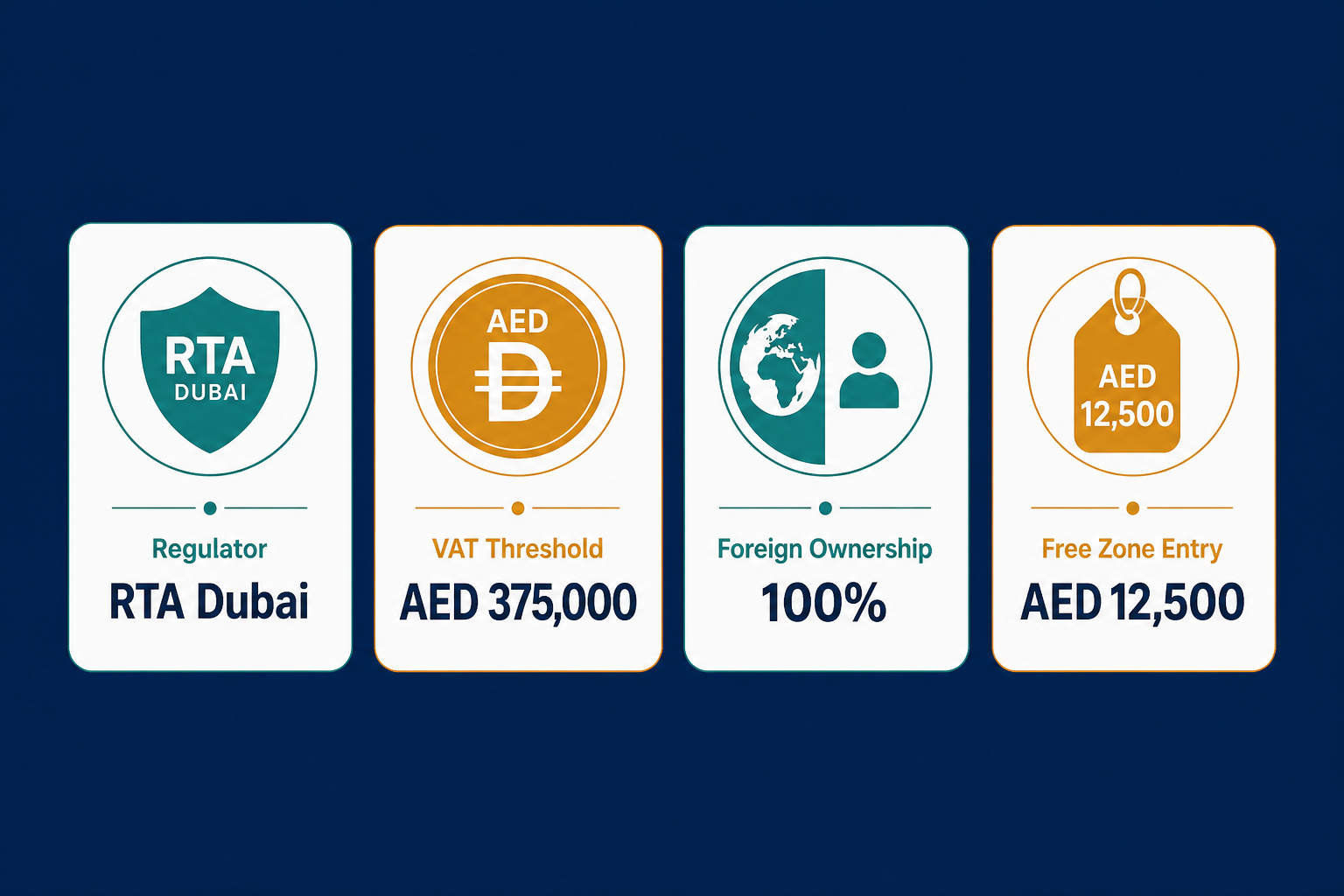
| Regulator | Roads and Transport Authority (RTA), Dubai – rta.ae |
|---|---|
| Primary license authority | Dubai Department of Economy and Tourism (DET) for mainland; Meydan Free Zone for free zone |
| Foreign ownership | 100% permitted in Meydan Free Zone and on the mainland under current UAE company law |
| VAT threshold | AED 375,000 annual taxable turnover – Federal Tax Authority (FTA) |
| Key client sectors | Government bodies, fleet operators, logistics firms, construction companies, schools |
| Applicable content rules | UAE Media Council governs published and broadcast awareness materials – uaemc.gov.ae |
What This License Covers
A traffic awareness institute license covers road safety education, driver behaviour programmes, and awareness campaigns. It is distinct from a driving school or vehicle testing operation. You are in the business of changing behaviour and communicating risk, not issuing licenses or certifying drivers in the technical sense.
The permitted activities typically include:
- Delivering road safety education programmes for individuals and groups
- Running driver behaviour workshops for corporate fleets
- Producing and distributing traffic awareness materials
- Designing and managing public or private road safety campaigns
- Consultancy to organisations on traffic risk and compliance
The Roads and Transport Authority sets the rules for anything delivered in partnership with a government body or on public infrastructure. If your programme involves public roads, school zones, or RTA-affiliated entities, you will need RTA sign-off before you start. That is a separate step from getting your trade license.
The activity code sits within the broader education and transport services category. Before you submit any application, confirm the exact code with your chosen jurisdiction. The code determines what you are legally permitted to do, and working outside it puts your license at risk. You can browse Meydan Free Zone business activities to check how this activity is listed and whether it fits your planned scope.
One practical distinction worth noting: awareness and consultancy services are not the same as accredited training delivery. If you plan to issue certificates that carry regulatory weight, such as fleet compliance certificates recognised by the RTA, you will need additional approvals beyond the standard trade license. Know which side of that line your business sits on before you apply.
Mainland vs Meydan Free Zone
This is the biggest choice you will make when setting up. Let your clients decide it, not the cost.
| Factor | Mainland (DET) | Free Zone (Meydan Free Zone) |
|---|---|---|
| Client access | Direct access to UAE government contracts and RTA tenders | Mainly private-sector and corporate clients |
| Foreign ownership | 100% permitted under current law | 100% permitted |
| Office requirement | Physical office required | Flexi-desk options available |
| Setup cost | Generally higher due to office and DET fees | Lower entry cost; trade license from AED 12,500 |
| Best suited to | Businesses targeting government bodies, schools, RTA programmes | Businesses targeting fleet operators, logistics firms, corporates |
A mainland license from the DET lets you work directly with UAE government bodies, bid on RTA tenders, and deliver programmes inside public schools. If government contracts are your core revenue, mainland is the right structure. You will need a physical office, and setup costs are higher, but the access is worth it.
Meydan Free Zone suits founders targeting private-sector clients: logistics companies, construction firms, corporate fleet operators, and private schools. You get 100% foreign ownership, a lower cost base, and flexible workspace. You can also start a business remotely through Meydan Free Zone without needing to be in Dubai for the full setup process.
Some operators set up a free zone entity first to test the market, then add a mainland branch once they have secured enough corporate revenue to justify the extra cost. That is a workable path if you are not ready to commit to a physical office on day one.
Free Business Setup Cost Calculator
Calculate NowStep-by-Step Setup Guide
- Step 1, book your trade name: Use the DET e-Services portal for a mainland company, or the Meydan Free Zone portal for a free zone one. The name must not conflict with existing registered names. Use the company name check tool to confirm availability before you commit.
- Step 2, confirm your activity code: Check the code is approved in your chosen jurisdiction before you go further. For a traffic awareness institute, the code sits within education and transport services. Getting this wrong at the start means delays and extra fees later.
- Step 3, submit your initial application: Provide your trade name, activity code, shareholder details, and passport copies. Meydan Free Zone processes this online. DET applications go through the e-Services portal.
- Step 4, sort your office space: Mainland companies need a physical tenancy agreement. Free zone companies can use a flexi-desk. Either way, you need a registered address before your license is issued.
- Step 5, get RTA approval where needed: If your programmes involve public roads, government schools, or RTA-affiliated bodies, get the RTA's sign-off before you start delivering. This is a regulatory step, not optional.
- Step 6, collect your trade license: Once initial approval, office documentation, and any regulatory NOCs are in order, your license is issued. Keep a digital and physical copy. You will need it for banking, visa applications, and client contracts.
- Step 7, open a corporate bank account: UAE banks want to see your trade license, memorandum of association, and proof of address. Free zone companies sometimes find this step slower than expected. Meydan Free Zone's business banking support service can help move the process along.
- Step 8, apply for visas: Your visa allocation depends on your license type and office space. Each shareholder and employee needs a residence visa, Emirates ID, and medical fitness clearance before they can work legally in the UAE.
Compliance and What You Need in Place
Running a traffic awareness institute in Dubai means dealing with several regulatory layers at once. None of them are complicated, but all of them need to be in place before you start.
RTA approval
Any programme you deliver in partnership with a government entity, on public roads, or inside a government school needs prior approval from the RTA. Submit your programme outline, materials, and staff credentials as part of that process. The RTA does not rubber-stamp applications, so build time into your launch plan.
Staff credentials and employment contracts
The people delivering your programmes need relevant qualifications. Road safety education, driver behaviour training, and awareness campaign work all carry an implicit expectation of expertise. The Ministry of Human Resources and Emiratisation (MOHRE) sets the rules on employment contracts. Every employee needs a MOHRE-registered contract before they start work. Check the MOHRE website for current requirements on contract registration and minimum terms.
Content and media rules
If you produce published or broadcast awareness content, the UAE Media Council oversees it. That covers printed materials, video content, social media campaigns, and anything distributed to the public. Get your content reviewed before distribution, not after. Work without the right approvals and you risk fines and damage to your name.
VAT registration
Once your annual taxable turnover reaches AED 375,000, you must register for VAT with the Federal Tax Authority. Registration below that threshold is voluntary. If you are targeting large corporate clients or government contracts, you may hit the threshold faster than you expect. The Federal Tax Authority handles registration online. Meydan Free Zone's mAccounting service covers VAT registration support if you want help managing the process.
Corporate tax
The UAE's corporate tax applies at 9% on taxable income above AED 375,000. Free zone companies may qualify for a 0% rate on qualifying income, subject to conditions. Get proper advice on this before you structure your contracts. The rules are not complex, but they do need to be applied correctly from the start.
Market Opportunity in Dubai
The RTA's road safety strategy is not a one-off initiative. It runs in multi-year cycles, with recurring tenders for awareness campaigns, school programmes, and public education work. Certified providers who build a track record with the RTA become part of a short list that is hard for new entrants to break into. Getting in early matters.
Corporate clients are the other major channel. Fleet operators, logistics firms, and construction companies all face regulatory pressure to show that their drivers are trained and compliant. A traffic awareness institute that can deliver documented, repeatable driver behaviour programmes, and issue records that satisfy an audit, has a clear commercial proposition. The demand is not discretionary. It is driven by insurance requirements, contract terms, and safety regulations.
Schools and universities are a growing segment. Road safety is entering curricula across Dubai, and private schools in particular are looking for external providers to deliver structured programmes. This is a lower-revenue channel than corporate work, but it builds profile and creates referral pathways into parent networks and community organisations.
The Dubai Statistics Center publishes data on road incidents and fatalities. That data underpins government spend in this area and gives you a factual basis for client proposals. Use it. Clients respond better to a proposal grounded in local data than to generic road safety statistics from other markets.
The overall picture is one of steady, policy-driven demand. This is not a market that spikes and crashes. Government commitment to road safety is embedded in Dubai's long-term urban strategy, and that creates a reliable base for a well-run institute.
Conclusion
A traffic awareness institute in Dubai operates inside a clear regulatory framework. The RTA sets the rules for anything touching public roads or government programmes. DET handles mainland licensing. Meydan Free Zone handles free zone setup. Both structures offer 100% foreign ownership. The right choice depends on who your clients are.
Get the activity code right, sort your RTA approvals before you start delivering, and make sure your staff contracts are MOHRE-registered. Those three steps cover most of the compliance risk. The commercial opportunity is real, and the barriers to entry, once cleared, work in your favour.
Speak to the Meydan Free Zone team to confirm the right activity code and structure for your business before you start.
Ready to Launch Your Business in Dubai?
Let's ConnectCompliance
ANTI-MONEY LAUNDERING COMPLIANCE
This business activity is exempt from AML compliance requirements.