Table of Contents
Topic Summary
Understand Exactly What License Code Covers
Activity code 4669.90 authorizes trading in construction adhesives, industrial adhesives, sealants, and specialty bonding products. It requires no third-party approval, making it one of the more straightforward trading licenses to obtain in Dubai.
Tap Into a Booming Regional Market
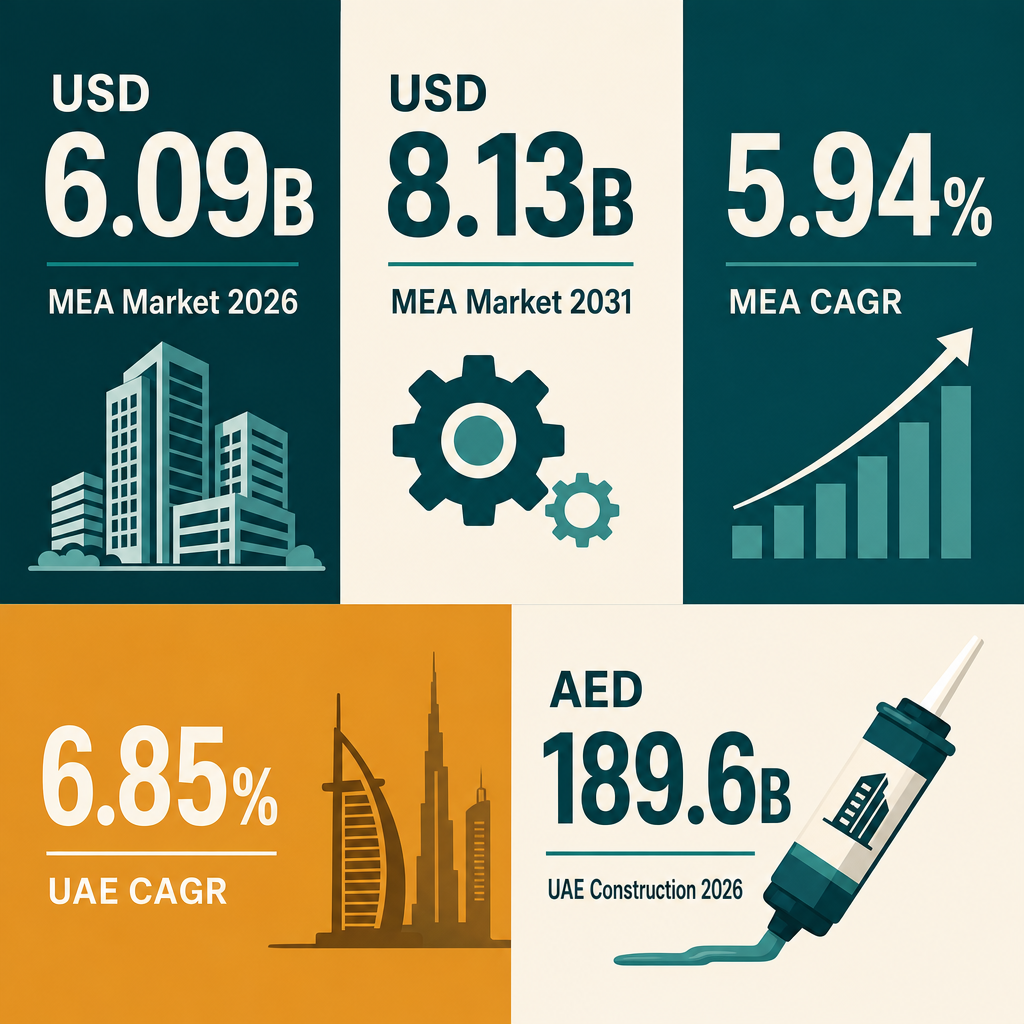
The MEA construction chemicals market is valued at USD 6.09 billion in 2026 and projected to reach USD 8.13 billion by 2031. The UAE leads regional growth at a 6.85% CAGR, backed by AED 189.6 billion in active construction value.
Know Your Three Core Product Families
The license covers construction adhesives and sealants, industrial and manufacturing adhesives like epoxies and hot-melts, and specialty products including medical-grade and aerospace-grade compounds. Each segment serves a distinct buyer profile and pricing tier.
Target the Right Clients From Day One
Main contractors, fit-out specialists, MEP firms, and industrial manufacturers are your primary buyers, with over 3,200 active UAE projects generating continuous demand. Manufacturing clients on production schedules add predictable, recurring orders that smooth your revenue.
Choose Mainland or Free Zone Strategically
A mainland DET license lets you invoice UAE contractors and manufacturers directly, while Meydan Free Zone offers 100% foreign ownership, zero corporate tax on qualifying income, and a fully digital setup process. Your choice should hinge on whether your focus is local supply or import and re-export.
Let Warehousing Drive Your Operational Setup
Adhesives are physical goods with shelf life and storage requirements, so your warehousing decision shapes logistics costs and client service levels more than the license type alone. Mainland operators can warehouse anywhere in Dubai, while free zone businesses work within or adjacent to the zone.
Leverage Meydan's Digital Process to Launch Fast
Meydan Free Zone offers a fully digital licensing process with no bureaucratic third-party approvals required for this activity. Combined with 100% ownership and tax advantages, it provides a low-friction entry point for new adhesives trading businesses.
How to Start an Adhesives Trading Business in Dubai with Meydan Free Zone
Every facade panel in Dubai is sealed with something. Every steel plate bonded to concrete, every label on a package, every circuit board in an assembly line. None of it holds together without adhesives, and somebody imports and distributes them. Activity code 4669.90 is the license for that.
This guide covers what the license allows, who buys from you, how mainland and free zone compare, and the steps to get set up. There is no third-party approval to chase here, which makes this one of the simpler trading activities to license.
Key Stats at a Glance
| Activity code | 4669.90 |
|---|---|
| Activity name | Adhesives Trading |
| What it covers | Trade in construction adhesives, industrial adhesives, sealants and specialty bonding products |
| Third-party approval | None needed for this activity |
| AML compliance | This activity is exempt |
| Regional market | MEA construction chemicals at USD 6.09 billion in 2026, reaching USD 8.13 billion by 2031 at 5.94% CAGR – Mordor Intelligence |
| UAE growth rate | 6.85% CAGR, the fastest in MEA |
| UAE construction value | AED 189.6 billion in 2026 – ATN Info |
| Active projects | Over 3,200 across the UAE |
| Foreign ownership | 100% in Meydan Free Zone, with zero corporate tax on qualifying income |
What This License Covers
Code 4669.90 lets you trade adhesives: construction adhesives, industrial adhesives, sealants and specialty bonding products.
Three product families sit inside it. Construction adhesives and sealants cover structural bonding compounds, silicone sealants and polyurethane sealants for building and infrastructure work. Industrial and manufacturing adhesives cover epoxies, polyurethanes, acrylics, cyanoacrylates and hot-melts for assembly and packaging. Specialty and technical adhesives cover medical-grade products, electronic assembly adhesives and aerospace-grade bonding compounds.
You are the importing, stocking and distributing layer. If you supply adhesives to UAE manufacturers, contractors, fit-out specialists or industrial clients, you are inside the code.
Who Your Clients Will Be
Main contractors, fit-out specialists, MEP firms, manufacturers and industrial operators.
Construction pulls the largest volume. Structural bonding for tower projects, silicone sealants for facade contractors, polyurethane sealants for interior installation work. With over 3,200 active projects across the UAE, that demand renews continuously rather than arriving in waves.
Manufacturing runs in parallel and buys differently. Automotive assembly, electronics manufacturing, packaging production and specialty product makers pull industrial epoxies, acrylics and hot-melts on production schedules rather than project ones, which smooths your order book. The specialty end is smaller in volume but higher in value, serving medical device makers, electronics assemblers and aerospace component manufacturers who buy on technical specification rather than price.
Mainland or Free Zone
| Factor | Mainland (DET) | Free Zone (Meydan Free Zone) |
|---|---|---|
| Who you can supply | UAE contractors and manufacturers directly, with no middleman | Import, re-export and B2B distribution; onshore sales need a distributor |
| Foreign ownership | Set by DET rules for the activity | 100% yours |
| Corporate tax | 9% above AED 375,000 taxable income | Zero on qualifying income, subject to the conditions |
| Licensing process | Through DET | Fully digital |
| Warehousing | Anywhere in Dubai | Within or adjacent to the zone |
A mainland license from the Department of Economy and Tourism lets you invoice UAE contractors and manufacturers directly. For a trader whose whole business is supplying local construction sites and factories, that access is the point.
Meydan Free Zone gives you the company outright, zero corporate tax on qualifying income and a fully digital licensing process. It suits an operator focused on import and re-export, or one building a distribution business serving B2B clients before scaling onshore.
Warehousing decides more than the license does. This is a physical goods business with stock that has shelf life and storage conditions, so where your inventory sits and how quickly you can get it to a site matters more than which authority issued your paperwork.
[blockCTACostCalculator]
Step by Step Setup Guide
- Step 1, confirm your activity scope: Check that code 4669.90 covers the adhesive categories you plan to carry, and add related codes now if you intend to trade adjacent chemical products.
- Step 2, choose your jurisdiction: Mainland through DET for direct onshore supply, or Meydan Free Zone for full ownership, faster setup and a digital process.
- Step 3, book your trade name: Check availability through the DET portal or the Meydan Free Zone portal, and make sure it follows UAE naming conventions.
- Step 4, submit your setup documents: Passport copies for every shareholder and director, a business plan summary, and an NOC if you hold a UAE residence visa under another sponsor.
- Step 5, arrange warehousing: Adhesives and sealants have storage conditions and shelf lives. Sort out compliant storage before you commit to a first shipment.
- Step 6, collect your trade license and open a bank account: Banks want the license, shareholder papers and a clear explanation of your supply chain.
- Step 7, register for VAT: Register with the Federal Tax Authority once taxable turnover passes AED 375,000. Voluntary registration below that line can pay off if you are recovering input tax on imports.
Compliance and What You Need in Place
No third-party approval
This activity needs no third-party approval, and it is exempt from AML compliance duties. That removes two layers other traders have to work through and is a real reason this category is quicker to get moving.
Brand authorisations
The commercial reality of adhesives wholesale is that it runs on brand authorisations with global producers such as Sika, Henkel, 3M, Bostik and Fosroc. Without one you are buying on the grey market and competing on price alone. Secure at least one authorisation before you build a sales plan around a product line.
Product certifications
UAE construction and fit-out specifications call for municipality-approved product certifications. A product without them will not get specified on a tower project, whatever its technical merits.
VOC limits
This is where the market is moving. Estidama compliance in Abu Dhabi and LEED certifications impose strict VOC limits, with formaldehyde below 0.08 ppm and TVOC under 300 micrograms per cubic metre. That pushes demand toward low-odour and eco-compliant formulations, so check the compliance profile of anything you stock before you commit to it.
Technical support
Contractors buying structural adhesives expect application support, not just delivery. Budget for someone who can answer specification questions, because that capability is what wins repeat accounts in this trade.
Market Opportunity
The regional numbers are solid. The Middle East and Africa construction chemicals market stood at USD 6.09 billion in 2026 and is set to reach USD 8.13 billion by 2031 at 5.94% CAGR, with adhesives among the priority product segments.
The UAE outpaces the region. Construction chemicals here are growing at 6.85% CAGR, the fastest in MEA, and UAE construction is projected at AED 189.6 billion in 2026. Adhesive demand scales across structural, waterproofing, fit-out and finishing phases, so a single project generates orders repeatedly rather than once.
Two forces widen the opening further. Regulation is reshaping product positioning, with Estidama and LEED VOC limits elevating demand for compliant low-odour formulations. And Operation 300bn is expanding UAE advanced manufacturing, which pulls specialty adhesive consumption in electronics, automotive and medical device production.
Conclusion
Adhesives trading under code 4669.90 is a workable, unregulated-entry trading activity sitting behind two large and growing demand engines: UAE construction and UAE manufacturing.
The licensing side is simple. No third-party approval, no AML duties, and a fully digital process through Meydan Free Zone with full foreign ownership.
Where the work actually sits is commercial. Brand authorisations, compliant product certifications, warehousing and technical application support are what separate a real distributor from a name on a license. Speak to the Meydan Free Zone team to confirm the right structure before you commit.
[blockCTAContact]