






Table of Contents
Topic Summary
Why Dubai Is a Natural Trading Hub
Dubai sits at the intersection of Brent and Dubai/Oman benchmark pricing, giving traders direct exposure to both European and regional sour grade markets. Combined with Fujairah's tanker infrastructure, UAE-based desks are well-positioned to work cargoes flowing toward Asian refiners.
Offshore Crude Trading Defined Simply
Offshore crude oil trading means buying and selling physical crude transported by tanker between producing fields and global refineries. It is distinct from onshore pipeline trade and from bunker trading, which supplies fuel to vessels rather than moving crude itself.
A Market That Is Structurally Growing
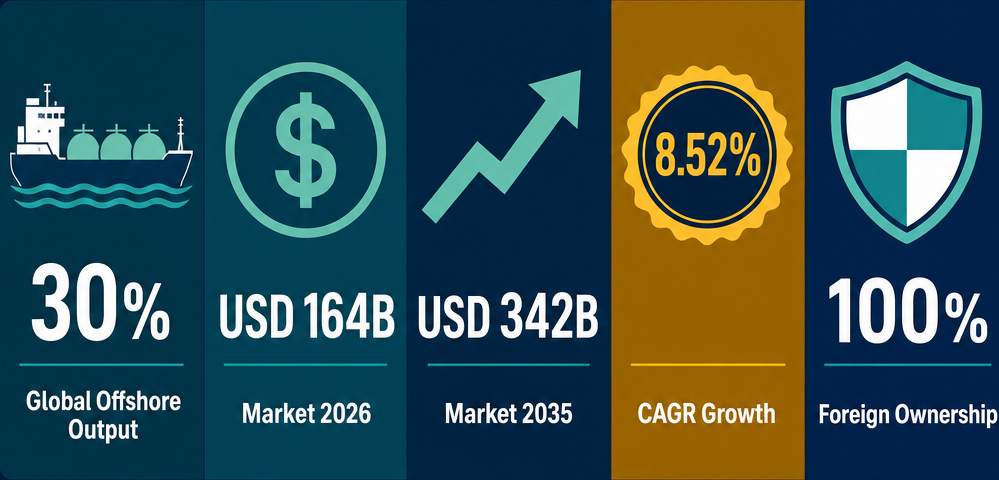
Offshore production accounts for roughly 30% of global crude output, and the global offshore oil and gas market is forecast to nearly double from USD 164 billion in 2026 to USD 342 billion by 2035. That expansion means the volume of tanker-borne barrels available to trade is increasing year over year.
Three Trader Profiles That Fit This Activity
The business model suits physical cargo traders connecting producers and refiners, benchmark and paper market traders pairing futures with physical exposure, and specialist arbitrage desks working spreads between Atlantic Basin and Asian markets. Each profile operates under the same offshore crude trading licence framework.
Meydan Free Zone Licensing Advantages
Meydan Free Zone offers 100% foreign ownership, zero corporate tax on qualifying income, and a fully digital licensing process. These features lower the administrative barrier for new entrants looking to establish a compliant UAE trading base quickly.
Ready-Made Ecosystem for New Entrants
The UAE's commodity trading ecosystem already includes established credit lines, shipbrokers, charter capacity, and counterparty networks. New trading desks arrive into a functioning market rather than building relationships from scratch.
Key Benchmarks Every Crude Trader Must Know
Brent anchors pricing for European, African, and Middle Eastern seaborne crude, while Dubai and Oman benchmarks set regional sour grade prices. Understanding how these two benchmark worlds interact is fundamental to running positions from a UAE base.
How to Start an Offshore Crude Oil Trading Business in Dubai with Meydan Free Zone
Every day, billions of dollars in seaborne crude moves between international producers and refiners. A VLCC loads Murban at Fujairah and heads east to a refinery in South Korea.
A West African cargo lifts from an FPSO offshore Angola and sails into Indian storage under a long-term off-take. Spot cargoes change hands on the Platts window with pricing tied to Brent.
Offshore crude oil trading is the buying and selling of physical crude oil transported by tanker rather than pipeline, connecting producing fields to global refineries through shipping lanes, charter markets, and benchmark pricing.
It's a distinct discipline from onshore pipeline trade, which moves barrels by land between neighbouring markets, and from bunker trading, which supplies fuel to ships rather than moving crude itself. The UAE has become a natural home for this activity, anchored by Fujairah's tanker infrastructure, Dubai and Oman benchmarks setting regional sour pricing, and a trading ecosystem that now sits alongside London, Singapore, and Geneva as a recognised global hub.
For a trader setting up in this activity, three things about the seaborne crude market matter. First, the underlying pool is large and growing.
Offshore production represents approximately 30% of global crude output according to 360 Research Reports¹, with the global offshore oil and gas market forecast to grow from USD 164 billion in 2026 to USD 342 billion by 2035 at 8.52% CAGR, meaning the volume of tanker-borne barrels available to trade is expanding structurally. Second, the UAE's tanker infrastructure gives traders direct commercial access to the flow.
Kpler² notes that 2026 Middle East supply growth is concentrated in Saudi Arabia, Iraq, and the UAE, with Fujairah and regional export infrastructure positioning UAE-based desks to work cargoes heading to Asian refiners. Third, pricing architecture is favourable to a UAE base.
Brent anchors seaborne crude pricing from Europe, Africa, and the Middle East, while Dubai and Oman anchor regional sour grades per the IEA³, giving UAE traders direct exposure to both benchmark worlds. HC Group⁴ adds that the UAE's trading ecosystem has evolved to attract hedge funds, trading houses, and alternative investment firms, meaning new entrants arrive into a market where credit lines, shipbrokers, charter capacity, and counterparty networks are already in place.
Whether you are trading physical cargoes between producers and refiners, running spot and long-term positions against Brent-linked pricing, or managing arbitrage between Atlantic Basin and Asian markets, this activity covers the seaborne crude trading layer operating from a UAE base.
Meydan Free Zone offers 100% foreign ownership, zero corporate tax on qualifying income, and a fully digital licensing process, positioning offshore crude oil traders at the centre of a market where UAE tanker infrastructure, Brent and Dubai benchmark access, and the country's evolution into a recognised commodity trading hub are generating sustained opportunities across seaborne crude trade.
Who is this for?
| Audience Segment | Profile |
|---|---|
| Physical crude traders and trading houses | |
| Benchmark and paper market traders | |
| Specialist regional and arbitrage desks | |
| Firms trading physical crude cargoes between international producers, refiners, and storage operators, managing sourcing, shipping, and delivery across offshore markets without participating in UAE domestic crude activities. | |
| Firms trading crude against Brent, WTI, Dubai, and Oman benchmarks through futures, OTC, and contract-for-difference instruments, often pairing paper positions with physical cargo exposure. | |
| Firms specialising in regional arbitrage between Middle East, Asian, European, and African markets, or in specific grades such as Murban, light sweet, or heavy crude across offshore trade flows. |
4661.96 - Offshore Crude Oil Trading
Under this activity, you are licensed to trade physical crude oil moved by tanker on the international seaborne market. Your role is to participate in the seaborne crude market from a UAE base, managing sourcing, commercial negotiation, chartering, shipping, and delivery of cargoes between international counterparties.
However, this activity has defined boundaries. It excludes wholesale of refined petroleum products such as diesel, gasoline, fuel oil, heating oil, and kerosene, each of which falls under separate sub-classes.
In short, if you are trading physical crude oil moved by tanker on the international seaborne market, you belong to this business activity.
| Category | Scope |
|---|---|
| Physical offshore crude trading | Trading of physical crude cargoes between international producers, refiners, and storage operators, including sourcing, chartering, shipping, and delivery. Trade Murban, Upper Zakum, and other regional cargoes between Fujairah and Asian refiners, or place West African and Latin American deepwater crude with European and Indian buyers. TRADER DYNAMICS Offshore crude trading is capital-intensive and relationship-driven, running on long-term contracts with producers, credit lines with banks, and charter agreements with shipping operators. The UAE's trading ecosystem increasingly attracts specialist trading houses and hedge funds building out the counterparty and logistics network new entrants rely on. |
| Paper and benchmark trading | Trading of crude oil against Brent, WTI, Dubai, Oman, and other international benchmarks through futures, swaps, and OTC derivatives. Run benchmark-based trading books against Brent and Dubai pricing, hedge physical exposure with paper instruments, or take directional positions on global crude price movements. MARKET TRENDS Kpler² reports that 2026 crude supply growth is concentrated in Middle East output, with sanctioned Russian, Iranian, and Venezuelan crude continuing to flow at deep discounts to ICE Brent and Oman and Dubai benchmarks, reshaping global trade flow dynamics and creating openings for arbitrage-focused traders. |
| Arbitrage, structured trade, and specialist activities | Arbitrage trading between regional markets, structured trade finance deals, floating storage plays, and specialist grade or route strategies across offshore crude flows. Execute East-West arbitrage between Atlantic and Asian markets, structure long-term off-take deals between producers and refiners, or run floating storage plays when contango opens up on forward curves. UAE CONTEXT HC Group⁴ notes that the UAE has evolved into a regional commodity trading hub attracting hedge funds, alternative investment firms, and diversified traders, with proximity to Gulf sovereign wealth capital and NOC activity supporting the offshore trading community. |
Third-Party Approval
No third-party approval is required for this business activity.
Anti-Money Laundering Compliance
This business activity is exempt from AML compliance requirements.
References
- ¹ 360 Research Reports. Offshore Oil and Gas Market Trend, Size & Share. 360researchreports.com
- ² Kpler. (2026, January 14). Crude oil: Top 5 market drivers in 2026. kpler.com
- ³ International Energy Agency. (2026). Oil Market Report - April 2026. iea.org
- ⁴ HC Group. The UAE's Emergence as a Commodity Trading Hub: Outlook and Implications. hcgroup.global






%20Business.webp)
