

Table of Contents
Topic Summary
Understand the License Code Before Starting
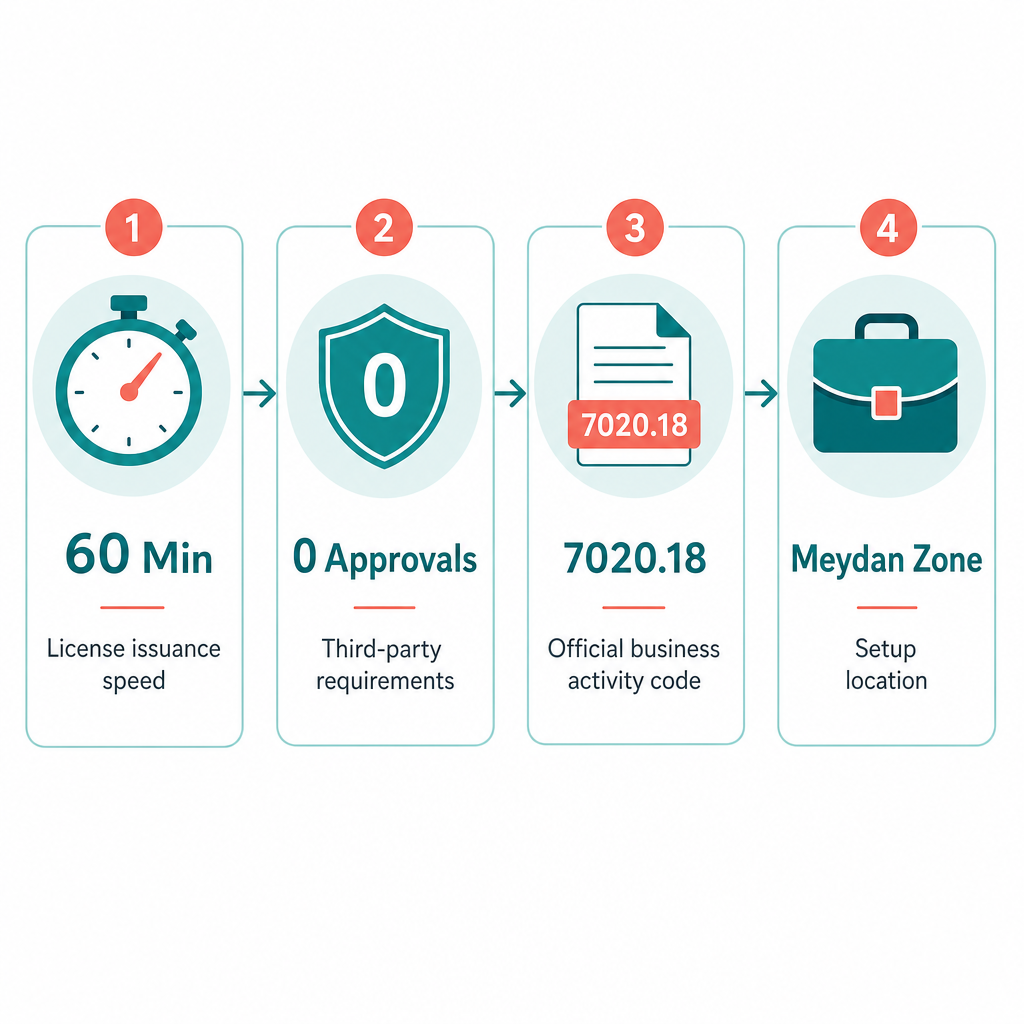
Fitness and nutrition consulting in Dubai falls under activity code 7020.18, classified as health management consulting services. This sits in management consulting rather than clinical practice, meaning no third-party approvals are required.
Know Exactly What Your License Covers
Code 7020.18 permits a broad range of services including health assessments, lifestyle coaching, meal planning, fitness programming, and wellness programme development. Both fitness and nutrition consulting qualify because they are components of overall health management.
Target the Right Client Type for Your Goals
Individual clients are the most accessible market but also the most competitive, with revenue arriving in small recurring amounts. Corporate wellness contracts offer far greater value per sale and tend to be more financially stable year-round.
Choose Between Mainland and Free Zone Wisely
A mainland DET license suits consultants working directly with corporate clients and healthcare facilities, while a free zone license through Meydan suits those working online, internationally, or with individuals. Free zone licenses can be issued in under 60 minutes and allow 100% foreign ownership.
Plan for VAT Registration Early
Once your taxable turnover exceeds AED 375,000, VAT registration with the Federal Tax Authority becomes mandatory. Building this threshold into your financial planning from the start avoids compliance surprises as your business grows.
Build Recurring Revenue, Not One-Off Sessions
The most commercially durable consulting businesses sell ongoing plans and accountability, not single sessions. Clients who buy a structured programme with coaching built in are far more valuable than those purchasing one-time consultations.
How to Become a Fitness And Nutrition Consultant in Dubai
A fitness and nutrition consultant assesses where a client's health currently sits, builds a plan around it, and coaches them through following it. In Dubai that work is licensed under activity code 7020.18, health management consulting services.
The code placement tells you something useful straight away. This sits in management consulting rather than clinical practice, and needs no third-party approvals. That makes it one of the more accessible routes into health and wellness, provided you understand where the consulting scope ends.
This guide covers what the code permits, who buys the service, how mainland and free zone compare, the setup steps, and the boundary worth checking first.
Key Stats at a Glance
What This License Covers
Code 7020.18 covers professional guidance offered to individuals, organisations or healthcare facilities to improve health and wellbeing.
The listed scope is broad:
- Health assessments
- Education on healthy lifestyle choices
- Lifestyle coaching
- Chronic disease management
- Wellness programme development
- Improving healthcare processes
Fitness and nutrition consulting sits inside that because both are components of overall health rather than separate disciplines. In practice the service lines are recognisable: fitness assessments, structured workout programmes, dietary guidance and meal planning, and the ongoing coaching that makes any of it stick. What holds them together commercially is that clients buy a plan and the accountability to follow it, not a single session.
Who Your Clients Will Be
Three buyer types sit inside this code, and they behave very differently.
Individuals
The obvious market and the most competitive. Clients buy on trust and results, revenue arrives in small recurring amounts, and retention is everything because acquisition costs more than delivery.
Organisations
The more interesting one. Wellness programme development for a company is a single sale at much larger value, contracted rather than casual, and often renewed annually inside an employee benefits budget. One corporate client can be worth dozens of individual ones, and the sales cycle rewards a consultant who talks about outcomes and participation rates rather than personal transformation.
Healthcare facilities
The most specialised, covering health assessment support and process improvement for clinics and similar operators. Fewer prospects, longer sales cycles, and a higher bar on credibility.
Most consultants start with individuals because that is where the immediate demand is. The ones who build something durable usually move weight towards organisations, because a corporate contract survives a quiet January in a way a book of individual clients does not.
Mainland or Free Zone
Because no third-party approval applies either way, this decision is simpler than it is for most healthcare-category activities. It comes down to where your clients are and how you work.
A free zone license gives 100% foreign ownership and a fast start, and a flexi-desk fits the reality of this job, where the work happens in gyms, client offices, or over video rather than in your own premises. For a consultant building an individual client base or working online, that is usually the efficient route.
Mainland becomes the answer when corporate and healthcare facility contracts are the target and those clients expect a mainland counterparty. That is a commercial judgement about your pipeline rather than a regulatory one. Let your clients decide it, not the price.
[blockCTACostCalculator]
Step by Step Setup Guide
- Step 1, confirm your activity: Register 7020.18 as your activity, and add any adjacent health, wellness or lifestyle activities at the same time if you intend to offer them. Adding later means an amendment.
- Step 2, choose your jurisdiction: Free zone for speed, full ownership and a flexi-desk. Mainland if your target clients are mainland corporates or facilities.
- Step 3, book your company name: Check availability and compliance with UAE naming rules before building anything around the name.
- Step 4, calculate your costs: Licensing fees, visa costs and service charges, worked out before you commit rather than at payment stage.
- Step 5, submit your application: The process is digital, and with no third-party approvals in the way this activity moves faster than most in the healthcare category.
- Step 6, collect your license and begin: Then handle visas, banking and workspace as follow-on steps.
Compliance and What You Need in Place
Know where the consulting scope ends
This is the one to think about properly. Code 7020.18 is a health management consulting activity needing no third-party approval, which is exactly what makes it accessible. If your intended practice would extend into regulated clinical territory, confirm the position with the Dubai Health Authority before you start rather than after a client asks. Lifestyle and wellness consulting and practising as a regulated health professional are different things, and the second has its own licensing route.
Approvals and AML
No third-party approvals apply to this activity, and it is exempt from anti-money laundering compliance rules. That is a genuinely light regulatory load, and it shortens setup considerably.
Your credentials
Not a licensing condition, but the commercial foundation of the business. This work rests on expertise in exercise science, nutrition and physiology, and on staying current with research. Clients and especially corporate buyers screen on qualifications, so treat certification as a business investment rather than a formality.
Client agreements
Put your scope, your fees and your review points in writing. In coaching relationships the disagreements that arise are almost always about what was promised over what period, and a written scope resolves them before they start.
VAT and renewal
Register for VAT once taxable turnover passes AED 375,000. License renewal is annual.
Market Opportunity
The structural attraction here is that one license reaches three separate markets, and they do not rise and fall together.
Individual demand is steady but seasonal, concentrated around new-year intentions and pre-summer, and it is the segment most exposed to clients cutting discretionary spending. Corporate wellness demand runs on a different logic entirely, because it sits in an employee benefits budget rather than a personal one and is bought for retention and productivity reasons that survive a tighter year.
Healthcare facility work adds a third stream with the longest lead time and the highest barrier, which is precisely why it is less crowded. The strategy that follows is sequencing rather than choosing: build a client base among individuals, use it to evidence results, then take that evidence to organisations where contract values are larger and revenue is contracted rather than month to month.
Conclusion
This is one of the lighter regulatory paths in the healthcare category, with no third-party approvals, no AML load, and a license that can issue quickly.
That accessibility is the opportunity and the reason to be deliberate. Low barriers mean a crowded individual market, so the consultants who build something lasting are usually the ones who move towards organisations and healthcare facilities where credentials and contracts matter more than marketing.
Before you start, get clear on where your consulting scope ends. Everything else in this setup is simple, and that one boundary is the thing worth checking properly.
[blockCTAContact]