
Table of Contents
Topic Summary
Understand What a Concession License Actually Covers
Activity code 5629.02 permits you to operate food and beverage stands, kiosks, and catering points inside sports stadiums, arenas, racecourses, and similar venues under a concession agreement. It does not cover stand-alone restaurant leases, one-off event catering, or industrial canteens, which each fall under separate activity codes.
Know the Difference Between a Concession and a Lease
A concession agreement gives you the right to serve food inside a venue for a defined period tied to the facility's event calendar, rather than a fixed retail lease. This structural distinction is what defines code 5629.02 and separates it from restaurant or catering licenses.
Tap Into a Massive and Growing Market
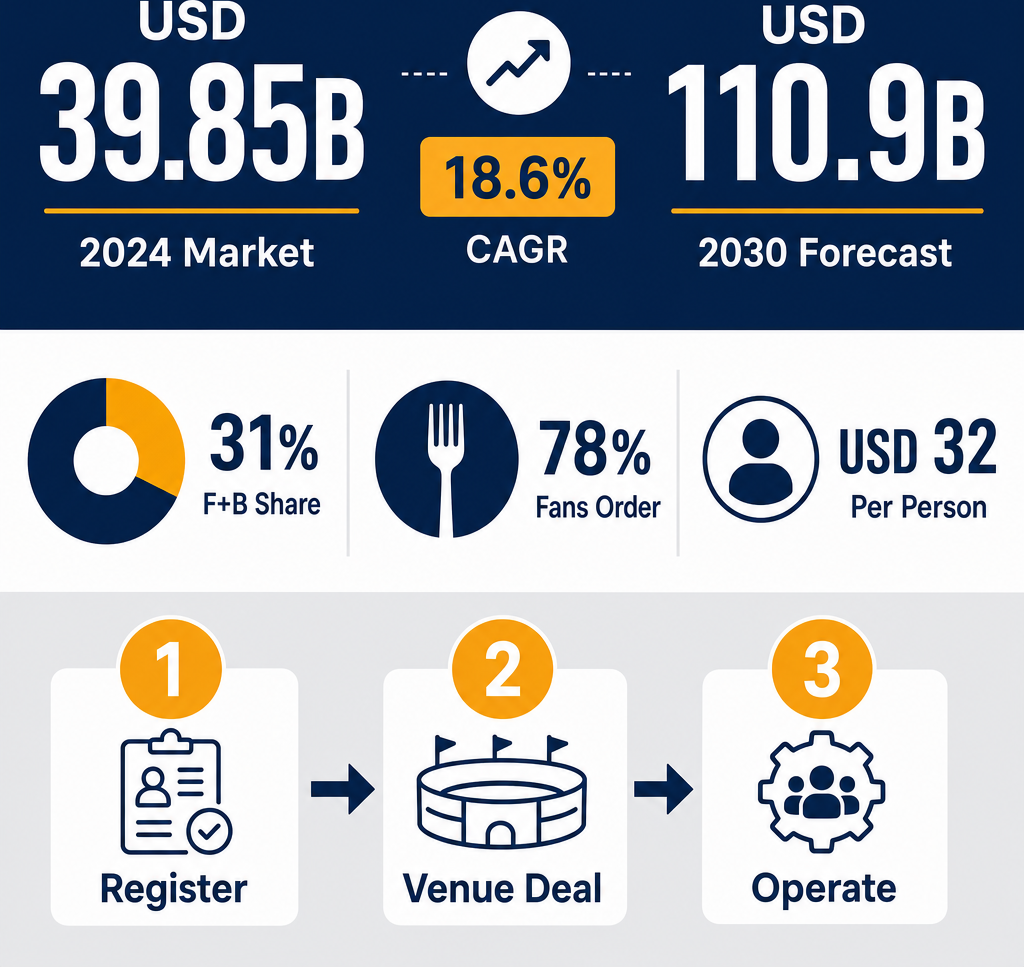
The global sports hospitality market was valued at USD 39.85 billion in 2024 and is projected to reach USD 110.9 billion by 2030 at an 18.6% CAGR. Food and beverage alone accounts for around 31% of total sports hospitality revenue, making it the largest single on-site spending category.
Target the Right UAE Venues From Day One
Dubai offers major high-capacity venues including Meydan Racecourse at 60,000 capacity, Coca-Cola Arena with 35 concession stands serving 17,000 attendees, and Etihad Arena at 18,000 capacity. Each venue type, from racecourses to multi-purpose entertainment halls, has distinct event schedules and audience profiles that shape your operational planning.
Factor In Food Safety Certification Requirements
Registering with Meydan Free Zone does not replace the requirement for Dubai Municipality food safety certification, which applies separately to any concession operating inside a Dubai venue. This certification is needed on a per-venue basis regardless of whether you operate from the mainland or a free zone.
Benefit From 100% Foreign Ownership and Tax Advantages
Setting up under Meydan Free Zone allows 100% foreign ownership with zero corporate tax on qualifying income, making it an attractive structure for international operators entering the UAE market. Free zone registration is also workable for venue concessions since the venue itself provides the operating premises.
Use Captive Audience Dynamics to Your Advantage
Unlike a street-level restaurant, a sports concession serves thousands of people in a fixed location with limited competing outlets and a predictable attendance figure known in advance. Research shows 78% of consumers ordered food on their last visit to a sports or concert venue, spending around USD 32 per person on average.
How to Start an Operation of Food Concessions at Sports and Similar Facilities Business in Dubai with Meydan Free Zone
A food concession is not a restaurant waiting for customers to walk in. It is a captive audience: thousands of people inside a venue, a limited number of serving points, and a fixed window of time in which to feed them. Activity code 5629.02 covers operating food concessions at sports stadiums, arenas, racecourses and similar facilities.
This guide covers what the license allows, who your customers are, the approval position and the steps to get set up. The structural point to grasp first is that you hold a concession agreement with the venue, not a lease on a shop.
Key Stats at a Glance
What This License Covers
Code 5629.02 covers running food and beverage concessions inside sports and similar facilities under a concession agreement with the venue operator. That spans stands, kiosks and catering points across indoor arenas, outdoor stadiums, racecourses, motorsport circuits, equestrian venues, exhibition halls and open-air amphitheatres.
The defining feature is the agreement, not the food. A concession operator works under a period-based arrangement with the facility, serving whatever events the venue hosts. That is what separates this code from its neighbours.
Four things sit outside it. Making perishable food for resale and retailing perishable food are both excluded. Industrial and workforce canteens and transport food service sit under the broader 5629.00.
One-off event catering at a venue, rather than a period-based concession, falls under 5621.00. And running a stand-alone restaurant inside a venue on an independent lease is 5610.00, because a lease is not a concession.
Who Your Clients Will Be
Arena and stadium operators
Indoor arenas and outdoor stadiums awarding exclusive or non-exclusive concession agreements covering sport, concerts and family entertainment. Attendance is known in advance, which makes forecasting unusually precise for a food business.
Racecourses and motorsport venues
Racecourses, circuits and equestrian facilities needing service across grandstands, public trackside areas and hospitality zones. Event days are fewer but larger, and the spread from general admission to hospitality is wide.
Multi-purpose entertainment venues
Exhibition halls, amphitheatres and public event spaces where the programme changes constantly. The operator has to serve a family show one night and a corporate event the next, on the same equipment.
Mainland or Free Zone
This activity has an unusual property: the venue supplies your trading space. You are not hunting for a retail unit, which removes the biggest fixed cost and the longest lead time in most food businesses.
That makes Meydan Free Zone a workable base, with 100% foreign ownership and a low fixed cost base for what is essentially an operating company plus equipment. A mainland license from the Department of Economy and Tourism is the more familiar route for venue operators awarding UAE contracts, so check what the venues you are targeting expect before you choose.
What does not change either way is food safety. Certification applies to the concession itself, venue by venue and emirate by emirate, and the venue will hold you to it as firmly as the authority does.
[blockCTACostCalculator]
Step-by-Step Setup Guide
- Step 1, target the venues before anything else: Concession agreements are the whole business. Without one, the license has nothing to attach to.
- Step 2, understand the award process: Venues run tenders and often award exclusivity for a period. Find out the cycle for each venue, because these agreements do not come up often.
- Step 3, choose your jurisdiction: Meydan Free Zone for 100% foreign ownership and a lean cost base, or mainland through DET if the venues you target expect it.
- Step 4, book your trade name: Check availability through the DET or Meydan Free Zone portal, following UAE naming conventions.
- Step 5, sort food safety certification: Dubai Municipality certification for Dubai venues, and the relevant emirate authority elsewhere. Start early, since the venue will ask before you serve.
- Step 6, build for peak service: Equipment, staffing and stock are sized for the busiest twenty minutes of an event, not for an average day.
- Step 7, set up supply and storage: Fresh, frozen and ambient stock moving into a venue on event days, with cold chain intact.
- Step 8, collect your license, open a bank account and register for VAT: Register with the Federal Tax Authority once turnover passes AED 375,000, which a busy venue crosses quickly.
Compliance and What You Need in Place
Approval position
No pre-approval from a third-party regulator is needed as a condition of the license. That is not the end of the matter, though. Food safety compliance applies separately for every venue and emirate you operate in, including Dubai Municipality certification for Dubai venues. Treat the license and the food safety file as two separate pieces of work.
Peak load is the operational risk
A concession does not fail slowly. It fails during the half-time rush, when queues outrun capacity. Equipment throughput, staffing levels and stock positioning all have to be built around the peak rather than the average.
Cold chain inside a venue
Moving perishable stock into a stadium on an event day, holding it safely for hours and serving it in bursts is harder than running a fixed kitchen. Temperature control and waste discipline decide both safety and margin.
AML and VAT
This activity is not a Designated Non-Financial Business or Profession, so AML registration and reporting do not apply to this category. Register with the Federal Tax Authority once turnover passes AED 375,000.
Market Opportunity
The category is growing fast. Global sports hospitality reached USD 39.85 billion in 2024 and is projected at USD 110.9 billion by 2030 at 18.6% CAGR, with food and beverage making up around 31% of revenue, the largest single on-site spending category.
Attendee behaviour explains why. 78% of consumers bought food on their last visit to a sports venue or concert arena, spending around USD 32 a head. Applied to a sold-out 17,000-capacity arena, that points to food and beverage spend above USD 544,000 for a single evening if average figures hold, before premium hospitality or sponsored beverage revenue.
Treat that as an illustration of scale rather than a forecast, since it depends on the assumptions holding.
The UAE has the venue base to support it. Meydan Racecourse seats 60,000 and hosts the Dubai World Cup, Coca-Cola Arena holds 17,000 with 35 concession stands, and Etihad Arena holds 18,000. Between them they run sport, concerts and family entertainment across the calendar.
Conclusion
Food concessions under code 5629.02 offer something rare in food service: a known audience, arriving at a known time, with nowhere else to buy. That is why per-head spend and conversion both run so far above a high street site.
The licensing is light. No third-party pre-approval attaches to the license, and AML does not apply, which leaves food safety certification as the compliance work that matters.
The hard part is commercial. Concession agreements are awarded infrequently and often exclusively, so the business is won at the tender rather than at the counter. Speak to the Meydan Free Zone team to confirm the right structure before you bid.
[blockCTAContact]