Table of Contents
Topic Summary
Understand Exactly What This License Covers
The retail sale of food in specialized stores covers selling defined product categories like organic produce, imported delicacies, specialty meats, and ethnic foods directly to customers. It does not include general grocery retail, food manufacturing, or on-premises food processing, which require separate approvals.
Know the Key Numbers Before You Start
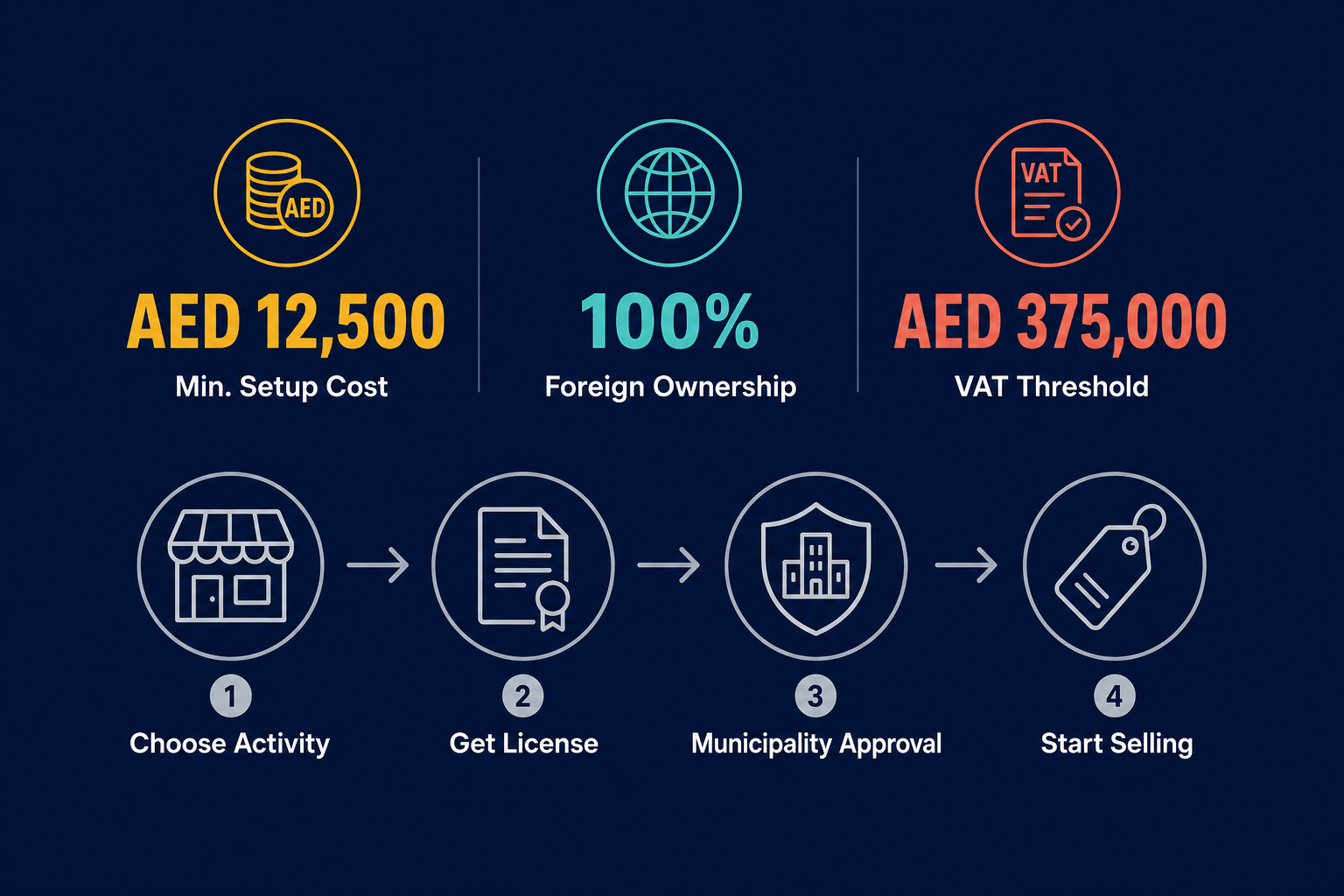
A free zone license through Meydan Free Zone starts from AED 12,500, and VAT registration is required once annual turnover exceeds AED 375,000. Foreign entrepreneurs can hold 100% ownership in both free zone and mainland setups for most food retail activities.
Identify Whether You Serve Consumers or Trade Buyers
Your customer base will likely split between end consumers seeking specialty products and trade buyers like restaurants or hotels placing bulk orders. Knowing which group drives most of your revenue shapes critical decisions around location, premises size, and business structure.
Choose the Right Jurisdiction for Your Model
A mainland setup suits walk-in retail stores that need foot traffic in residential or commercial areas, while a free zone structure works better for B2B supply, online retail, or warehouse-based operations. Free zone setups typically cost less to run and offer streamlined foreign ownership.
Factor In Dubai Municipality Compliance Early
Dubai Municipality is the key regulatory body overseeing food safety and premises approval, and food retail carries more compliance weight than most business activities in the UAE. New operators are frequently caught off guard by these requirements, so building them into your setup timeline is essential.
Tap Into Dubai's Large and Diverse Customer Base
Dubai's population of over three million residents, combined with more than seventeen million annual visitors, creates consistent demand for niche food products that mainstream supermarkets do not stock. The city's large expat community drives steady appetite for specialty items ranging from Japanese condiments to European charcuterie.
How to Start a Retail Sale of Food, Beverages and Tobacco Products Via Stalls Business in Dubai with Meydan Free Zone
Dubai's food retail sector is growing fast. Specialized food stores, think organic grocers, artisan delis, specialty importers, and ethnic food suppliers, are filling gaps that supermarkets cannot. The city's diverse population, high disposable incomes, and strong tourist footfall create steady demand for niche food products that mainstream chains do not stock.
This guide covers what the license covers, how to choose the right jurisdiction, and the exact steps to set up a retail food business in a specialized store through Meydan Free Zone. It also covers the compliance requirements that catch new operators off guard, because food retail carries more regulatory weight than most business activities in the UAE.
What This License Covers and Key Stats at a Glance
The retail sale of food in specialized stores covers businesses that sell specific categories of food products directly to customers. This includes organic produce, health foods, imported delicacies, specialty meats, dairy, confectionery, spices, and ethnic food products. The activity does not cover general grocery retail or food manufacturing. You are retailing a defined product range, not producing it.
Under this activity, you can display, store, and sell food products from a physical unit or, in certain structures, through an online channel. What you cannot do without separate approvals is process, cook, or transform food on the premises. That falls under a different activity code and triggers additional food safety requirements.
The UAE food retail market is substantial and growing. According to IMARC Group, the UAE food and grocery retail market continues to expand, driven by population growth, tourism, and rising demand for premium and specialty products. Consumer spending on specialty and health-oriented food is rising across Dubai and the wider Emirates.
| Activity | Retail sale of food in specialized stores |
|---|---|
| License type | Commercial |
| Jurisdiction options | Mainland (DET) or free zone (Meydan Free Zone) |
| Foreign ownership | 100% in free zone; 100% on mainland for most activities – Invest in Dubai |
| Key regulatory body | Dubai Municipality (food safety and premises approval) |
| VAT registration threshold | AED 375,000 annual turnover – Federal Tax Authority |
| Setup cost range | From AED 12,500 for a free zone license |
Who Your Customers Will Be
Your customer base splits into two groups: end consumers and trade buyers. Understanding which one drives most of your revenue shapes every decision you make about location, premises, and how you structure the business.
End consumers are Dubai residents, expats, and tourists looking for products they cannot find in a standard supermarket. This includes health-conscious shoppers, people sourcing food from their home country, and buyers willing to pay a premium for quality or provenance. Dubai's expat population is large and varied, and demand for specialty food products, whether Japanese condiments, European charcuterie, or organic staples, is real and consistent.
Trade buyers are restaurants, hotels, catering companies, and food service operators who prefer sourcing from a specialist rather than a general distributor. These buyers want reliability, consistent quality, and a supplier who understands the product. They tend to place larger orders and return regularly once they trust you.
Your customer profile directly affects your location decision. If you are selling to walk-in retail customers, you need a physical store in a residential or commercial area with foot traffic. That points to a mainland setup. If your model is primarily B2B, online retail, or supplying from a warehouse, a free zone structure with a storage facility can work well and costs less to run.
Dubai's population of over three million, combined with more than seventeen million annual visitors according to the Department of Economy and Tourism, means the customer base for specialty food is larger than in most comparable cities.
Mainland vs Free Zone: Which Setup Works for You
This is the most important structural decision you will make. Get it wrong and you either pay more than you need to, or you find yourself unable to trade the way you planned.
A mainland license issued through DET lets you open a physical retail store anywhere in Dubai, trade directly with walk-in customers, and supply UAE-based businesses without restriction. If your model depends on a shopfront in a mall, a high street unit, or a neighbourhood store, you need a mainland license. There is no way around this.
A free zone license through Meydan Free Zone works well if you are running an online food retail operation, supplying trade buyers, operating from a free zone commercial unit, or managing a business that you want to run remotely. You can also use a free zone structure to test the market before committing to the cost of a mainland retail unit. Remote business setup is straightforward through Meydan Free Zone, which matters if you are not yet based in the UAE.
| Factor | Mainland (DET) | Free Zone (Meydan Free Zone) |
|---|---|---|
| Retail to walk-in customers | Yes, anywhere in Dubai | Only from within the free zone |
| B2B supply to UAE businesses | Yes, direct | Yes, via a local distributor or direct in some cases |
| Online retail | Yes | Yes |
| Office or premises | Physical retail unit needed | Flexi-desk options available |
| Foreign ownership | 100% for most activities | 100% |
| Setup cost | Higher – includes tenancy and fit-out | Lower entry cost; Dubai Trade License from AED 12,500 |
| Food handling approvals | Dubai Municipality mandatory | Dubai Municipality mandatory where food is stored or handled |
Free Business Setup Cost Calculator
Calculate NowStep-by-Step Setup Guide
- Step 1, book your trade name: Use the Meydan Free Zone portal to search and book your company name. Names must not conflict with existing registered businesses and must not include restricted words. You can check your company name availability before you start the application.
- Step 2, confirm your activity code: Make sure the activity code covers your exact product range. Specialty food retail covers a broad range of categories, but some products, such as alcohol, require separate approvals and are not covered under a standard food retail activity. Check the Meydan Free Zone business activities list to confirm your code before you go further.
- Step 3, choose your package and submit your application: Meydan Free Zone offers several setup options. mCore covers the core setup needs. mPlus gives you a fuller package including support services. A flexi-desk option keeps costs low if you do not need a dedicated physical space. Submit your application through the Meydan Free Zone portal with your passport copy, visa page, and any supporting documents.
- Step 4, get your food business approvals: Once your trade license is issued, you need a food license from Dubai Municipality before you handle, store, or sell any food products. Where your product range includes health supplements or regulated food items, you may also need approval from the Ministry of Health and Prevention (MOHAP). This step takes time, so start it early.
- Step 5, open a corporate bank account: A UAE corporate bank account is needed before you can trade. Banks will ask for your trade license, shareholder documents, and a description of your business activities. Meydan Free Zone's business banking support service can help you navigate this process, which is often the slowest part of the whole setup.
- Step 6, arrange your premises or storage facility: If you are storing food products, your premises must meet Dubai Municipality standards for temperature control, hygiene, and pest management. This applies whether you are in a free zone warehouse or a mainland retail unit. Get your premises approved before you bring stock in.
A realistic timeline from application to trading is four to eight weeks. The food handling approvals from Dubai Municipality are the most common cause of delays. Start that process as soon as your trade license is issued, not after.
Compliance, Approvals, and What You Need in Place Before You Start
Food retail in the UAE is regulated more tightly than most commercial activities. The list below covers what you need before you open, not what you can sort out later.
Dubai Municipality food license
Every business that handles, stores, or retails food in Dubai needs a food license from Dubai Municipality. This is separate from your trade license. The application covers your premises, storage conditions, staff hygiene practices, and product sourcing. Inspectors will visit before the license is issued. Budget time for this, it is not a rubber stamp.
Staff food handler certificates
All staff who handle food products must hold valid food handler certificates. Dubai Municipality runs approved training programmes. This is a legal duty, not a recommendation. Keep records of all certificates and renewal dates, because inspectors check them.
Product labelling rules
All food products sold in the UAE must carry Arabic language labelling. Labels must include the product name, ingredients, country of origin, nutritional information, expiry date, and storage instructions. Where products are marketed as halal, you need valid halal certification from an approved certifying body. Imported products that do not meet UAE labelling standards cannot be sold until they are relabelled.
VAT registration
Once your annual turnover reaches AED 375,000, you must register for VAT with the Federal Tax Authority. Most food products are zero-rated for VAT purposes, but this does not remove the registration duty once you cross the threshold. You still need to file returns. If you need help with VAT registration support, Meydan Free Zone's mAccounting service can handle this for you.
Ongoing compliance
Your trade license and food license both need annual renewal. Dubai Municipality carries out periodic inspections, and you must be ready for them at any time. Keep your premises clean, your staff certificates current, your stock records accurate, and your labelling compliant. Businesses that let any of these slip face fines, suspension, or closure. The rules are enforced.
If you need ongoing support with record-keeping and financial reporting, bookkeeping services through mAccounting can keep your accounts in order and your renewal process smooth.
Market Opportunity
Dubai's food retail market rewards operators who understand what their customers want and who build supply chains that can deliver it consistently. The city's population is one of the most internationally diverse in the world. Demand for specialty, ethnic, organic, and premium food products is not a niche trend. It is a structural feature of the market.
The growth in health-conscious eating, the expansion of the UAE's hospitality sector, and the continued arrival of new expat communities all point in the same direction. Gaps in the market exist at both ends: premium imported products for high-spending residents, and affordable authentic food products for communities whose home-country staples are not stocked by mainstream retailers.
According to Statista, e-commerce in the UAE food and grocery sector has grown significantly in recent years, opening an additional channel for specialty food retailers who want to reach customers beyond a single store location. A free zone structure supports this model well.
The barriers to entry are real. Food handling approvals, labelling compliance, and the cost of suitable premises all filter out operators who have not planned properly. That is not a problem. It means the market is less crowded than it looks, and operators who set up correctly have a defensible position.
Conclusion
Specialized food retail in Dubai is a real commercial opportunity. But it carries more regulatory weight than a standard trade license. Food handling approvals, labelling rules, and municipality sign-offs all need to be in order before you open. None of this is unworkable. It just needs to be planned in the right sequence.
The choice between a mainland and free zone structure depends on your business model. Walk-in retail needs a mainland license. Online retail, B2B supply, or a warehouse-based operation can work well through Meydan Free Zone at a lower cost of entry.
Speak to the Meydan Free Zone team to confirm the right activity code for your product range and get a clear cost breakdown before you commit. Use the business cost calculator to get an initial figure, then get a detailed breakdown from the team before you make any decisions.
Ready to Launch Your Business in Dubai?
Let's Connect