
Table of Contents
Frequently Asked Questions
What does this activity cover?
It covers furnishing physical or electronic marketplaces for the buying and selling of stocks, stock options, bonds, and commodity contracts.
Who uses the marketplace?
Brokers placing client orders, institutional investors, and listed companies raising capital all use the marketplace this activity provides.
Is this the same as broking trades for clients?
No. Buying and selling securities on behalf of clients as a broker falls under a separate activity. This activity furnishes the marketplace itself.
What instruments are traded on the marketplace?
Stocks, stock options, bonds, and commodity contracts are bought and sold on the marketplace this activity provides.
Does this include managing funds?
No. Fund management falls under a separate activity, as do activities auxiliary to insurance and pension funding. This activity furnishes the trading marketplace.
Topic Summary
Understand What This Business Actually Does
A financial marketplace business operates the venue, platform, and systems that bring buyers and sellers of stocks, bonds, options, and commodity contracts together. The operator earns revenue from the trading activity its venue hosts, making liquidity and trust the core business assets.
Know the Scale of UAE Capital Markets
The Abu Dhabi Securities Exchange closed 2025 with a market capitalisation above USD 837 billion, while the Dubai Financial Market reached AED 992 billion. These figures show the depth of the market environment your business would be entering.
Identify Who Your Customers Will Be
Users of a financial marketplace include member broker firms placing client orders, institutional investors routing large trades, and listed companies relying on the venue for liquidity. Understanding this mix shapes how you design your platform and pricing.
License Under Activity Code 6610.00
The relevant UAE activity code is 6610.00, covering activities auxiliary to financial service activities excluding insurance and pension funding. This license permits your business to furnish physical or electronic marketplaces for trading stocks, options, bonds, and commodity contracts.
Choose Meydan Free Zone for Setup
Meydan Free Zone offers 100% foreign ownership, zero corporate tax on qualifying income, full profit repatriation, and a fully digital licensing process. A Dubai trade license starts from AED 12,500, making it a cost-efficient regulated base for this type of business.
Build the Right Operational Infrastructure
Day-to-day operations require real-time order matching engines, market data feeds, post-trade clearing handoffs, listing oversight, and continuous market surveillance. Running these systems reliably is what earns participant trust and drives trading volume to your venue.
Compete on Trust, Liquidity, and Reliability
In a market competing for capital, venues that win are those seen as fair, orderly, and consistently operational. The more buyers and sellers your marketplace attracts, the more it trades and the more valuable the business becomes.
How to Start an Activities Auxiliary to Financial Service Activities Business in Dubai
Stocks, bonds, and commodity contracts have to change hands somewhere. That somewhere is a marketplace, physical or electronic, where buyers and sellers meet and trades are matched, recorded, and settled. Running that marketplace is its own business, and it sits at the centre of a financial system.
Operating a financial marketplace means running the venue where stocks, bonds, and commodity contracts change hands, and the UAE's exchanges show the scale of it. The Abu Dhabi Securities Exchange ended 2025 with a market capitalisation above USD 837 billion and annual trading value of AED 385 billion, according to ADX1.
The Dubai Financial Market closed the year with a market capitalisation of AED 992 billion and AED 174 billion traded, according to the Dubai Financial Market2.
For a marketplace operator, the model is simple: the more buyers and sellers a venue brings together, the more it trades and the more it is worth.
The UAE has two main exchanges where securities and commodity contracts change hands every trading day, and the volume going through them tells the real story.
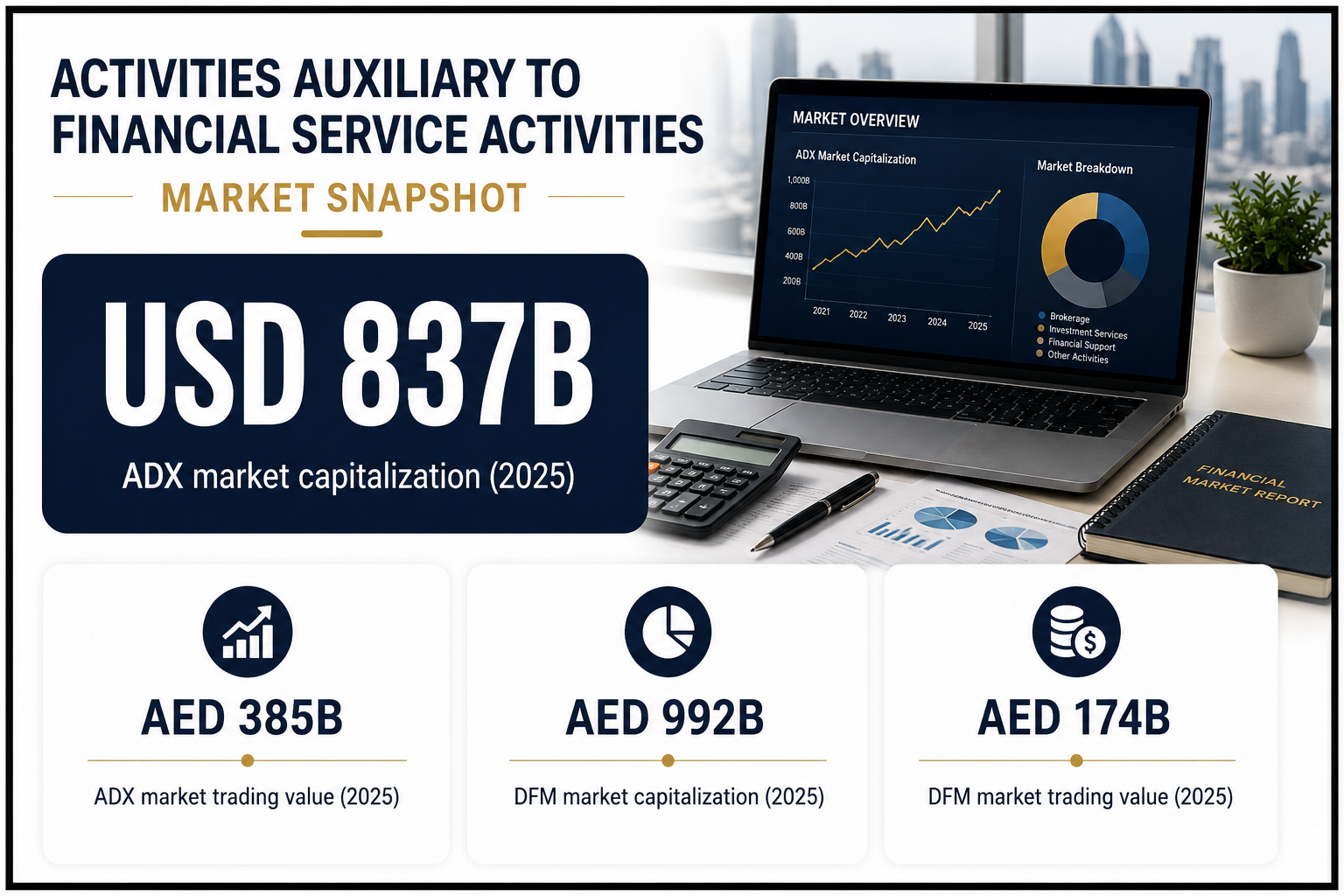
Sources: Abu Dhabi Securities Exchange (2026); Dubai Financial Market (2026).
Picture the systems behind a trading day. Orders to buy and sell stream in from brokers and institutions across the country. The marketplace matches them, records each trade, and routes it towards settlement. A surveillance team watches for irregularities while a listings team prepares a new company to join the market.
The operator earns from the activity its venue hosts, so the more trading it attracts, the stronger the business. In a market competing for capital, the venues that win are the ones that are trusted, liquid, and run without a hitch.
Whether it is a share, a bond, or a commodity contract, this activity provides the marketplace where buyers and sellers meet and trades get done.
Who is this for?
- Financial marketplace operators: Businesses furnishing venues or platforms for trading securities and commodity contracts.
- Electronic trading platform providers: Operators running electronic marketplaces that match buyers and sellers.
- Market infrastructure businesses: Firms supporting the orderly buying and selling of financial instruments.
Meydan Free Zone offers 100% foreign ownership, zero percent corporate tax on qualifying income, full profit repatriation, and a fully digital licensing process, providing a regulated and cost-efficient base from which to operate a financial marketplace business in a country building one of the region's most active capital markets.
Dubai Trade License from AED 12,500
Get Your License6610.00 - Activities auxiliary to financial service activities, except insurance and pension funding
Under this activity, your business is licensed to furnish physical or electronic marketplaces for the buying and selling of stocks, stock options, bonds, and commodity contracts.
A business in this activity furnishes the physical or electronic marketplace that lets others buy and sell financial instruments. The work centres on operating the venue, the platform, and the systems that bring buyers and sellers together and facilitate trades in stocks, stock options, bonds, and commodity contracts.
The users are mixed: brokers placing client orders, institutional investors, and listed companies raising capital. It is an infrastructure business: the operator is paid to run a fair, orderly, and reliable marketplace where trades can happen with confidence.
| Marketplace | Instruments | Users | Operations |
|---|---|---|---|
| A trading venue running on matching engines, market data feeds, and the rulebook every participant agrees to before trading. | Listed equities, options, fixed income, and commodity contracts, each with its own market structure and trading rules. | Member firms connected to the venue, institutional desks routing large orders, and issuers depending on the market for liquidity. | Real-time order matching, post-trade clearing handoff, listing oversight, and surveillance running across every session. |
| ADX MARKET CAP | ADX TRADING | DFM MARKET CAP | DFM TRADING |
| ADX market capitalisation surpassed USD 837 billion in 20251. | ADX annual trading value reached AED 385 billion in 20251. | DFM market capitalisation reached AED 992 billion in 20252. | DFM annual trading value reached AED 174 billion in 20252. |
The activity is specifically for furnishing the marketplace itself. Buying and selling securities on behalf of clients as a broker (6612) falls under a separate activity, as do other auxiliary financial activities (6619), fund management (6630), and activities auxiliary to insurance and pension funding.
The line is precise. If your business furnishes the marketplace where stocks, bonds, and commodity contracts are bought and sold, you are in.
Business Activities List
Explore Over 2,500+Third-Party Approval: No third-party approval is required for this business activity.
Anti-Money Laundering Compliance: This business activity is subject to AML compliance requirements.
Citations
1 Abu Dhabi Securities Exchange. ADX Full-Year 2025 Market Performance. Abu Dhabi Securities Exchange, 2026.
2 Dubai Financial Market. DFM Full-Year 2025 Performance. Dubai Financial Market, 2026.