Table of Contents
Frequently Asked Questions
Is a signed debt acknowledgement legally binding in the UAE?
A written, signed admission of debt is strong evidence that the obligation exists. The debtor must have legal capacity and sign voluntarily, and the amount and parties must be clear. Courts still assess the document for clarity and consent, so vague wording weakens it.
Does a debt acknowledgement need to be notarised to be valid?
Notarisation is not always required for the document to carry evidential weight. A notary verifies identities and signatures, which makes claims of forgery or lack of consent harder to sustain. Creditors who expect a dispute usually notarise the document.
Can an acknowledgement of debt include interest?
Interest can appear only if it is lawful and expressly agreed in writing. An unsupported or unclear rate invites challenge and can weaken the rest of the document. State the principal in AED and keep any additional charges specific.
Who can sign a debt acknowledgement on behalf of a company?
Only an authorised signatory can bind a company. Check the Memorandum and Articles of Association and any power of attorney before signing. For a Meydan Free Zone company, the digitally issued Business License and Memorandum and Articles of Association help confirm who holds signing authority.
What should a debt acknowledgement include?
It should name both parties in full as shown on their trade license or ID, and state the exact amount in AED in figures and words. It should also identify the origin of the debt, such as invoice numbers or a contract. Finally, it should set the repayment schedule, record default consequences and carry dated signatures.
What can a creditor do if the debtor misses a payment under the schedule?
The creditor can rely on the default clause, such as an acceleration provision making the full balance due. A formal legal notice usually comes before any court filing. The signed acknowledgement and payment records then serve as the core evidence.
Should a debt acknowledgement be written in Arabic?
A bilingual document is the safer option. Arabic is the language of the UAE courts, so an English-only document may need a certified translation if a claim is filed. Preparing both versions at signing avoids delay later.
Topic Summary
What an Acknowledgement of Debt Means in the UAE
An acknowledgement of debt is a written, signed statement in which a debtor confirms they owe a specific amount to a named creditor. It turns a disputed or informal claim into documentary evidence, and it often sets repayment terms both sides agree to follow.
Legal Weight of an Acknowledgement of Debt in the UAE
Under UAE civil law, a written admission by a debtor is strong evidence of the obligation. You may still need to prove the underlying transaction in some cases, but a signed acknowledgement can shorten a dispute and can interrupt limitation periods in the creditor's favour.
Essential Clauses to Include in a Debt Acknowledgement
A sound debt acknowledgement names both parties, states the exact AED amount, identifies the source, sets a repayment schedule, records default consequences, and carries dated signatures. Clarity on each element reduces later disputes.
How to Draft and Sign a Debt Acknowledgement
To draft one: confirm the amount with records, agree repayment terms, prepare a bilingual document, have an authorised signatory sign it, and notarise it. Keep originals and proof of delivery before any recovery action.
Notarisation and Evidence for a Debt Acknowledgement
Notarisation is not always mandatory, but it makes the acknowledgement harder to dispute. A notary verifies identities and signatures, which supports enforcement and reduces forgery claims in court.
Enforcement Risks and Common Drafting Mistakes
Acknowledgements fail when amounts are vague, signatories lack authority, terms are unlawful, or no forum is stated. Dubai Courts assess clarity and consent, so ambiguity usually favours the debtor.
Practical Application for Meydan Free Zone Companies
A Meydan Free Zone company can use a debt acknowledgement to document client balances before escalation. Its digitally issued Business License and Memorandum and Articles of Association help confirm who may sign for it.
Acknowledgement of Debt in the UAE: What It Is and What It Should Include
An unpaid invoice often stalls in a loop of reminders and verbal promises that give the creditor no legal position. Many founders assume a WhatsApp message saying "I will pay next month" is enough, but it rarely holds up in a dispute. This guide explains how an acknowledgement of debt works in the UAE, what it should include, and how to turn informal promises into evidence before you pursue recovery.
What an Acknowledgement of Debt Means in the UAE
An acknowledgement of debt is a written, signed statement in which a debtor confirms they owe a specific amount to a named creditor. It turns a disputed or informal claim into documentary evidence, and it often sets repayment terms both sides agree to follow.
Definition and Purpose
The document names the debtor, the creditor, the sum and where the debt came from. An invoice is only a demand. An acknowledgement is the debtor's own admission.
Say a Dubai trading company holds three overdue invoices. The client signs one acknowledgement covering the total, and it replaces scattered email chains.
How It Differs From a Payment Plan or Promissory Note
The acknowledgement confirms the debt exists. A payment plan sets instalments and can sit inside it. Cheques and promissory notes carry their own legal consequences, so treat them as separate instruments. A supplier might ask for post-dated cheques alongside a signed acknowledgement to secure each instalment.
Legal Weight of an Acknowledgement of Debt in the UAE
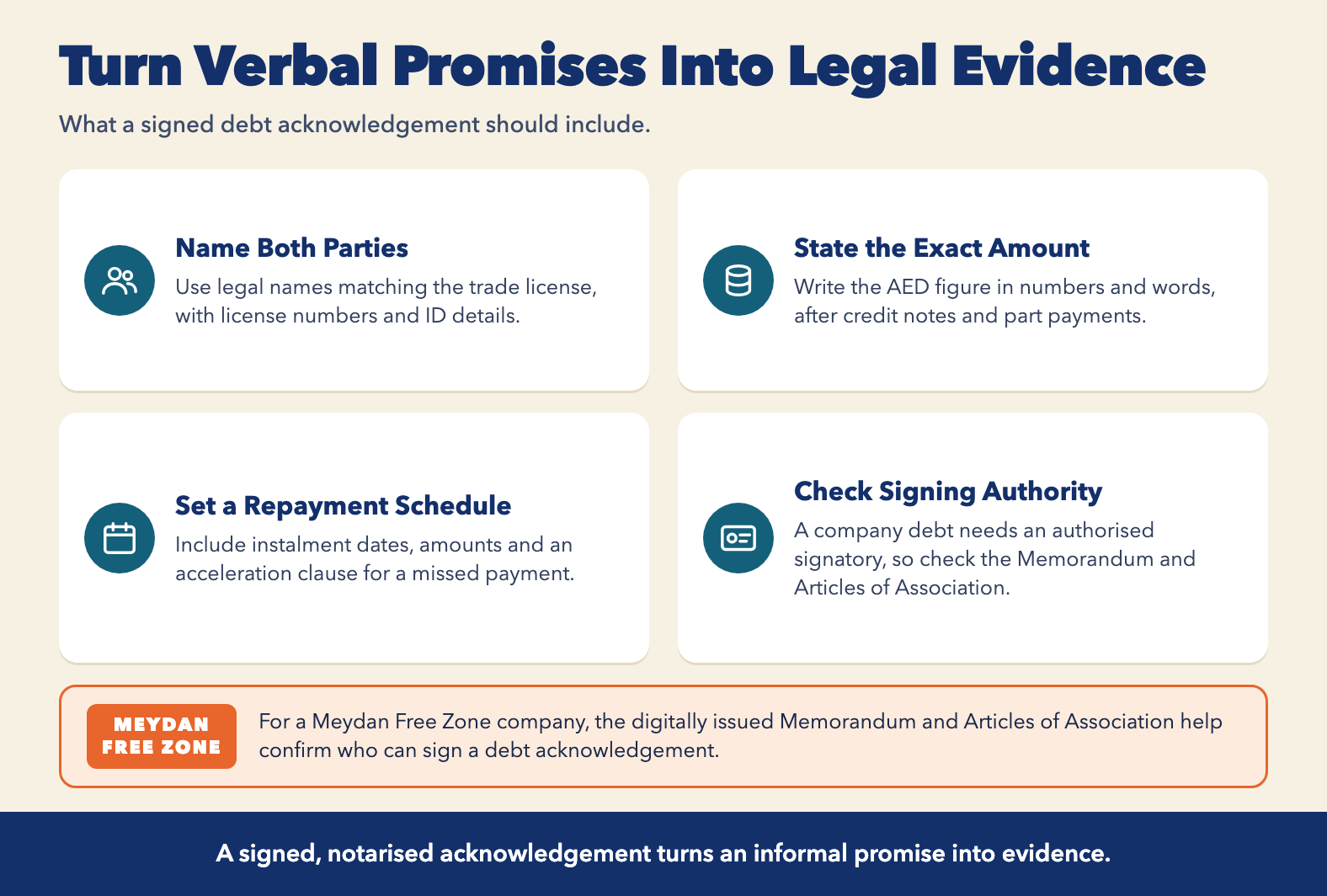
Under UAE civil law, a written admission by a debtor is strong evidence of the obligation. You may still need to prove the underlying transaction in some cases, but a signed acknowledgement can shorten a dispute and can interrupt limitation periods in the creditor's favour.
Evidentiary Value Under Civil Law
Courts look at the signature, the signer's capacity and the clarity of the amount. These sit within the general rules on obligations in the Civil Transactions Law, now Federal Decree-Law No. 25 of 2025, which replaced Federal Law No. 5 of 1985 from 1 June 2026. For background, see our guide to UAE civil law for businesses. A clear acknowledgement can spare you an argument over whether goods were delivered.
Essential Elements of a Debt Acknowledgement
| Feature | Element | What to Include |
|---|---|---|
| Parties | Identity of debtor and creditor | Legal names matching the trade license, license numbers, Emirates ID or passport details |
| Amount in AED | Exact sum owed | Figure in numbers and words, after credit notes and part payments |
| Origin of debt | Source of the obligation | Invoice numbers, supply contract or loan agreement reference |
| Repayment schedule | Dates and amounts | Instalment dates, amounts and an acceleration clause on a missed payment |
| Signatures and date | Proof of consent | Authorised signatories, signing date, signed schedules |
Effect on Limitation Periods
A signed acknowledgement can interrupt time limits. Confirm the exact period for your claim with the competent court before relying on it. A creditor nearing a deadline should secure the signature first.
Capacity and Authority to Sign
- A company debt needs an authorised signatory.
- Check the Memorandum and Articles of Association and any power of attorney.
- Personal guarantees need separate wording.
If a manager signs without authority, the document is open to challenge later.
Essential Clauses to Include in a Debt Acknowledgement
A sound debt acknowledgement names both parties, states the exact AED amount, identifies the source, sets a repayment schedule, records default consequences, and carries dated signatures. Clarity on each element reduces later disputes.
Parties, Amount and Origin of the Debt
- Full legal names and trade license numbers.
- The amount in AED, in figures and words.
- References to invoices, contract or loan.
Repayment Terms and Default Provisions
- Set instalment dates and amounts.
- Add an acceleration clause: six monthly instalments, with the full balance due after one missed payment.
- Include interest only if lawful and expressly agreed.
Governing Law, Jurisdiction and Language
State UAE law and the chosen forum. Arabic is the language of the courts, so a bilingual document avoids translation delays if a claim is filed. The principles in UAE contract law apply here as they do to any agreement.
How to Draft and Sign a Debt Acknowledgement
To draft one: confirm the amount with records, agree repayment terms, prepare a bilingual document, have an authorised signatory sign it, and notarise it. Keep originals and proof of delivery before any recovery action.
Step 1: Reconcile the Amount
- Match invoices, payments and credit notes.
- Exchange statements of account first.
- Agree the figure in writing.
Step 2: Agree Terms and Draft
- Include the essential clauses.
- Use plain language.
- Keep it to a short draft with the schedule attached.
Step 3: Sign and Notarise
- Only authorised signatories sign.
- Both parties present their trade licenses and IDs to the notary in Dubai.
- Keep the original and certified copies.
Notarisation and Evidence for a Debt Acknowledgement
Notarisation is not always mandatory, but it makes the acknowledgement harder to dispute. A notary verifies identities and signatures, which supports enforcement and reduces forgery claims in court.
Why Notarisation Strengthens Your Position
If a debtor later denies signing, the notarised record settles that point. It also undercuts claims of duress. Our guide to notarisation of documents in Dubai covers the process.
Supporting Records to Keep
- Contracts, invoices and delivery notes.
- Correspondence showing demand and response.
- Bank transfer records for each instalment.
- A file index kept with the original.
Enforcement Risks and Common Drafting Mistakes
Acknowledgements fail when amounts are vague, signatories lack authority, terms are unlawful, or no forum is stated. Dubai Courts assess clarity and consent, so ambiguity usually favours the debtor.
Drafting Errors That Weaken Claims
- Missing amounts or an unclear origin.
- Unsigned schedules.
- Party names that differ from the trade license, which can delay a claim.
When to Escalate to Formal Recovery
After two missed instalments under signed terms, send a formal legal notice before filing. Cheques issued as security carry their own consequences under UAE law, and banks process returned cheques under rules set by the Central Bank of the UAE. A licensed debt collection firm or lawyer can help if the debtor still does not pay.
Practical Application for Meydan Free Zone Companies
A Meydan Free Zone company can use a debt acknowledgement to document client balances before escalation. Its digitally issued Business License and Memorandum and Articles of Association help confirm who may sign for it.
Confirming Signing Authority
Before signing, a free zone trader should check the counterparty's authorised signatory against their license documents and Memorandum and Articles of Association.
Keeping Reconciled Records
mAccounting, part of Meydan Plus, covers bookkeeping, VAT registration support and Corporate Tax support. Clean ledgers make the debt figure defensible, and a reconciled ledger can be attached to the acknowledgement as a schedule.
Free Business Setup Cost Calculator
Calculate NowTurning Promises Into Evidence
A debt acknowledgement works when it is specific, signed by an authorised party, and backed by records. Execution matters more than theory: reconcile the figure, agree terms, notarise, and keep the file ready. For a Meydan Free Zone company, check signing authority in the digitally issued Memorandum and Articles of Association before the next overdue balance ages.
Ready to Launch Your Business in Dubai?
Let's Connect