

Table of Contents
Frequently Asked Questions
Does a dormant company in the UAE still need to prepare financial statements?
Yes. A dormant company is not automatically exempt from accounting duties. If it is a taxable person under UAE Corporate Tax, it must keep accounting records and financial statements, and it reports nil activity rather than ignoring the year.
Do free zone companies need audited accounts?
Not every free zone company does. A Qualifying Free Zone Person must prepare audited financial statements to keep its qualifying status. Other free zone companies need an audit if revenue exceeds AED 50 million, or if their free zone authority requests audited accounts.
When is the Corporate Tax return due after the financial year ends?
The Corporate Tax return is due within nine months of the end of the relevant tax period. For a company with a 31 December year end, the deadline falls on 30 September of the following year. The Federal Tax Authority sets the filing rules and penalties for late submission.
How long must a company keep its accounting records in the UAE?
Taxable persons must keep accounting records and supporting documents for seven years after the end of the tax period they relate to. This covers financial statements, invoices, bank records and contracts. The retention duty applies to free zone companies as well.
Can a sole founder use unaudited accounts for a license renewal?
It depends on the company's tax status and the licensing authority's requirements. A small taxable person below the audit threshold that is not a Qualifying Free Zone Person may use unaudited accounts. Meydan Free Zone's mAccounting offers financial audit reports for companies that need audited statements.
Who is allowed to audit a UAE company's financial statements?
Use a licensed auditor registered with the Ministry of Economy and Tourism, as the audit report must be signed by one. The auditor should be independent of whoever prepared the accounts. Appointing the auditor before year end allows the scope to be agreed early.
What happens if a company files its accounts late?
Late filing or missing records can lead to administrative penalties from the Federal Tax Authority. It can also delay license renewal and prompt questions from the company's bank. The authority sets the penalty amounts, so a fixed annual accounting calendar is the safest way to avoid them.
Do banks in the UAE ask for financial statements from small companies?
Yes. Banks commonly request recent financial statements during periodic account reviews, regardless of company size. Having signed year-end accounts ready makes these reviews faster, although it does not guarantee any bank decision.
Topic Summary
What Annual Financial Statements Include
Annual financial statements are a company's year-end accounts: a statement of financial position, a profit and loss statement, and supporting notes. Companies subject to Corporate Tax must prepare them, and certain entities must have them audited. Free zone and mainland companies are both covered, with different audit triggers.
Who Must Prepare Annual Financial Statements in the UAE
Every taxable person under UAE Corporate Tax must keep financial statements and records, including free zone companies. Regulated entities face extra reporting duties. Dormant companies and small founders are not automatically exempt, so legal form and tax status decide the obligation.
Corporate Tax Rules That Drive Financial Statement Requirements
UAE Corporate Tax ties financial statements to the tax return. Taxable persons must keep accounts for the retention period. Audited statements are needed for Qualifying Free Zone Persons and above a revenue threshold. The Federal Tax Authority publishes the rules.
Audited or Unaudited Statements for Founders
The choice depends on tax status, revenue, legal form and any licensing authority requirement. Qualifying Free Zone Persons and companies above the revenue threshold need an audit by a registered auditor. Smaller taxable persons may file unaudited accounts.
Five Steps to Prepare Annual Financial Statements
Close the books at year end, reconcile bank and VAT records, draft the statements, appoint an auditor if required, then use the final accounts for the tax return and license renewal. Starting early prevents delays.
How Annual Financial Statements Apply to a Meydan Free Zone Company
A Meydan Free Zone company is a free zone entity, so Corporate Tax registration and record-keeping apply, and Qualifying Free Zone Person status requires audited statements. Under the Meydan Free Zone Companies and Licensing Regulations (clause 42.1), a company must also provide audited accounts within 30 days if the Authority requests them.
Penalties and Risks of Missing Requirements
Missing obligations can bring Corporate Tax administrative penalties, delayed license renewal and bank queries. The Federal Tax Authority sets penalty amounts. A fixed annual calendar is the most reliable safeguard. See also penalties for non-compliance in the UAE.
Who Must File Annual Financial Statements in the UAE
Annual accounts usually become urgent at the worst moment, when a bank asks for them, a renewal falls due or the Federal Tax Authority (FTA) sends a notice. Many founders assume a small or dormant company can skip them, while others assume every company needs an audit. This guide explains which UAE companies must prepare annual financial statements, when an audit applies, and how to plan the yearly cycle.
What Annual Financial Statements Include
Annual financial statements are a company's year-end accounts: a statement of financial position, a profit and loss statement, and supporting notes. Companies subject to Corporate Tax must prepare them, and certain entities must have them audited. Free zone and mainland companies are both covered, with different audit triggers.
What the Statements Contain
The set includes the balance sheet, the income statement and notes on accounting policies. They follow accounting standards suited to the company's size and type. Preparing the accounts is separate from submitting them to an authority.
Take a consulting company with two shareholders. Revenue was modest, but at year end it still needs a complete set of accounts.
Preparing Versus Filing
Taxable persons keep the statements to support the Corporate Tax return, and the Federal Tax Authority can ask for them. Free zone authorities may request accounts at renewal. Banks may ask independently.
Say a founder prepares accounts for the bank but forgets the tax return needs the same figures. Two sets of numbers then have to be reconciled under pressure.
Who Must Prepare Annual Financial Statements in the UAE
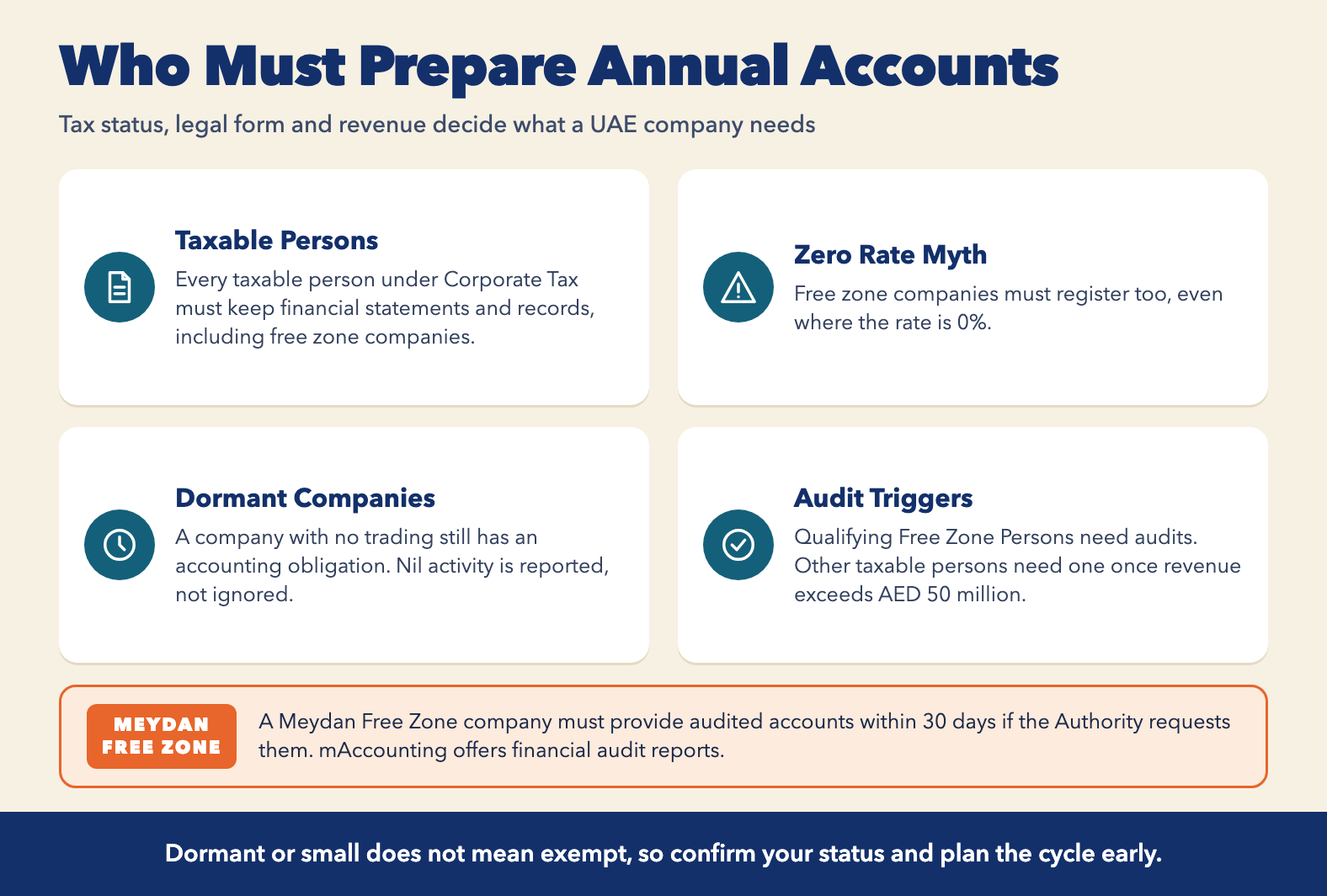
Every taxable person under UAE Corporate Tax must keep financial statements and records, including free zone companies. Regulated entities face extra reporting duties. Dormant companies and small founders are not automatically exempt, so legal form and tax status decide the obligation.
Taxable Persons Under Corporate Tax
Resident juridical persons are taxable persons under Federal Decree-Law No. 47 of 2022 and must register for Corporate Tax. Free zone companies must register too, even where the rate is 0%. A free zone trader who assumes 0% means no accounts is mistaken. Under the rules the Federal Tax Authority (FTA) administers, the record-keeping duty still applies in full.
Regulated and Listed Entities
- Public joint stock companies report under Capital Market Authority (CMA), formerly the Securities and Commodities Authority rules.
- Banks and insurers report to the Central Bank of the UAE.
- Most SME founders sit outside these regimes, but should confirm their company type first.
Dormant Companies and Holding Structures
A company with no trading still has an accounting obligation. Nil activity is reported, not ignored. A holding company with one investment and no revenue still produces year-end accounts, because owners and banks review them.
Corporate Tax Rules That Drive Financial Statement Requirements
UAE Corporate Tax ties financial statements to the tax return. Taxable persons must keep accounts for the retention period. Audited statements are needed for Qualifying Free Zone Persons and above a revenue threshold. The Federal Tax Authority publishes the rules.
When an Audit Becomes Mandatory
Qualifying Free Zone Persons must prepare audited statements. Other taxable persons need an audit once revenue exceeds AED 50 million, under Ministerial Decision No. 84 of 2025, which replaced Ministerial Decision No. 82 of 2023 for tax periods from 1 January 2025. A free zone company targeting the 0% qualifying rate should budget for an audit from year one.
Audited or Unaudited: When Each Applies
| Feature | Audited statements | Unaudited statements |
|---|---|---|
| Qualifying Free Zone Person status | Required to claim the qualifying rate | Not accepted for this status |
| Revenue above the published audit threshold | Required above AED 50 million | Not available once revenue passes this level |
| Regulated or listed entity | Standard expectation under sector regulators | Rarely suitable |
| Small taxable person below threshold | Optional, useful for bank or investor requests | Generally acceptable for the tax return |
| Dormant company with no activity | Only if an authority or lender asks | Nil-activity accounts are usually enough |
Record Retention and Filing Timing
The return is due within nine months of the financial year end. Records must be kept for seven years after the tax period. A company with a 31 December year end should plan its audit around the 30 September deadline. Late filing triggers administrative penalties. A company compliance calendar keeps these dates visible.
Audited or Unaudited Statements for Founders
The choice depends on tax status, revenue, legal form and any licensing authority requirement. Qualifying Free Zone Persons and companies above the revenue threshold need an audit by a registered auditor. Smaller taxable persons may use unaudited accounts.
Choosing a Registered Auditor
Appoint a licensed, registered auditor who is independent of whoever keeps your books. Agree the scope before year end. A founder who appoints an auditor in the final quarter, not after year end, avoids most rework.
Cost Expectations for an Audit
Auditors quote fees based on size and complexity, so no single figure applies. Treat the audit as a recurring cost. A two-person company can budget it alongside its license renewal.
Five Steps to Prepare Annual Financial Statements
Close the books at year end, reconcile bank and VAT records, draft the statements, appoint an auditor if required, then use the final accounts for the tax return and license renewal. Starting early prevents delays.
- Close and reconcile. Match bank, VAT and payroll records. Apply invoice cut-off dates.
- Draft the statements. Use consistent accounting policies. The founder reviews unusual balances.
- Appoint an auditor if required. Confirm the need from your tax status, then share drafts and records.
- Approve. A manager or shareholder signs, and signed copies are archived with supporting records.
- Use the final accounts. Apply them to the tax return and renewal.
How Annual Financial Statements Apply to a Meydan Free Zone Company
A Meydan Free Zone company is a free zone entity, so Corporate Tax registration and record-keeping apply, and Qualifying Free Zone Person status requires audited statements. Under the Meydan Free Zone Companies and Licensing Regulations (clause 42.1), a company must also provide audited accounts within 30 days if the Authority requests them.
What Meydan Free Zone Provides
mAccounting, part of Meydan Plus, covers bookkeeping, VAT registration support and Corporate Tax support. It also offers financial audit reports, which must be prepared and signed by a licensed auditor registered with the Ministry of Economy and Tourism.
Free Zone Versus Mainland Obligations
Corporate Tax is federal and applies to both. Licensing and renewal sit with Meydan Free Zone, not the Dubai Department of Economy and Tourism (DET), so confirm any accounts needed for renewal with Meydan Free Zone.
Free Business Setup Cost Calculator
Calculate NowPenalties and Risks of Missing Requirements
Missing obligations can bring Corporate Tax administrative penalties, delayed license renewal and bank queries. The Federal Tax Authority sets penalty amounts. A fixed annual calendar is the most reliable safeguard. See also penalties for non-compliance in the UAE.
Tax and Licensing Consequences
A company that reaches renewal without signed accounts may face delays if its licensing authority asks for them. Late returns and missing records both attract penalties.
Banking and Investor Scrutiny
Banks request accounts during periodic reviews, often within a set window. Investors and buyers expect clean year-end accounts. Good records help, but they guarantee no bank outcome.
Next Steps
The duty to produce annual financial statements follows tax status, legal form and licensing authority, while revenue above AED 50 million triggers an audit. Map your financial year end, confirm whether an audit applies to your tax status, and set the accounting calendar before the next renewal or tax deadline. For a Meydan Free Zone company, that calendar should also allow for the 30-day window to provide audited accounts if the free zone authority requests them.
Ready to Launch Your Business in Dubai?
Let's Connect