

Table of Contents
Frequently Asked Questions
Can a foreigner buy an existing company in Dubai?
Yes, foreign nationals can buy a company in Dubai. In a free zone, ownership can be 100% foreign, subject to the free zone authority approving the transfer. On the mainland, the licensing authority and the activity rules decide whether the buyer can hold the shares. Check the Memorandum and Articles of Association first, because it may require partner consent for any transfer.
Do liabilities transfer when a company changes ownership in the UAE?
In a share transfer, the legal entity stays the same, so debts, disputes, unfiled returns and tax exposure stay with it and pass to the buyer in practice. An asset purchase moves only the selected assets and leaves obligations with the old entity. A written sale agreement with warranties and a liability indemnity protects the buyer under either route.
Is it cheaper to buy a business or start a new one in Dubai?
Starting new is usually cheaper upfront, because it involves only license, registration and visa fees. Buying adds the purchase price, valuation, legal review and transfer fees, plus any liabilities found later. Seller pricing and advisory fees are estimates, not fixed costs. Buying pays off only when customers, contracts or assets justify the extra spend.
What documents should a seller provide before a company sale?
Ask for the trade license, the Share Register and the Memorandum and Articles of Association. Request VAT and Corporate Tax filings, bookkeeping records and bank statements so you can compare them. Add lease agreements, supplier balances, employment contracts and a list of end-of-service dues. If the seller cannot supply verifiable tax and bank records, treat that as a reason to walk away.
Does a bank account stay open after a change of ownership?
Not automatically. The bank reviews the new shareholder and may run a fresh due diligence and anti-money laundering check before it keeps the account active. Banks in the UAE follow Central Bank of the UAE requirements and make their own decisions, so continued access is never assured. A new company builds its banking history from zero, and mCore at Meydan Free Zone supports business bank account applications without guaranteeing approval.
Do employee visas transfer to the buyer of a company?
Employment visas and contracts tied to the company do not move without review. In a share transfer the employer entity stays the same, but the buyer still has to confirm each visa status and contract term. Check end-of-service dues too, because the buyer may inherit them. In an asset purchase, staff are not transferred with the assets and need new arrangements.
How does Corporate Tax apply to an acquired company in the UAE?
In a share purchase, the company's Corporate Tax registration and filing history stay with the entity. Corporate Tax is 9% on taxable income above AED 375,000, according to the Federal Tax Authority. Overdue returns or unpaid penalties become the buyer's exposure, so compare filings with bank statements before agreeing a price.
Topic Summary
What It Means to Buy a Company in Dubai
To buy a company in Dubai is to acquire an existing licensed entity, either by taking over its shares or by transferring its ownership, together with its assets, contracts and liabilities. Starting new means forming a fresh entity with no history. The routes differ in speed, inherited risk and verification work.
Key Differences Between Buying and Starting New
The main differences are inherited liability, speed to trading, banking history and control over structure. A buyer gains an operating license and contracts but takes on past obligations. A new company starts slower commercially, carries no legacy exposure, and lets you set the activity and structure. If you buy a company in Dubai, you buy its past too.
Cost and Risk Mechanics of Each Route
Buying adds a purchase price, valuation and legal fees on top of transfer and licensing costs, and carries hidden-liability risk. Starting new costs license, registration and visa fees only. Corporate Tax applies to both routes: 9% on taxable income above AED 375,000, according to the Federal Tax Authority (FTA).
How to Buy a Company in Dubai: Due Diligence Steps
To buy a company in Dubai safely, confirm the licensed activity, verify ownership documents, review tax and financial records, check liabilities and staff obligations, then agree transfer terms and update the license. Each step removes risk a new company wouldn't carry.
When Starting New Makes More Sense
Starting new suits founders who want a clean legal record, a specific activity and control over structure. It works best where the target's value is mainly its license rather than customers or assets. Meydan Free Zone offers a digital setup, so a new company can be licensed quickly without inheriting liabilities.
What This Means for Your Decision
Buy when the company has customers, contracts or assets you can't replicate quickly, and its records survive due diligence. Start new when the main value is the license, or when verification would cost more than a fresh setup. Decide on verified records, not the seller's description.
Buying an Existing Dubai Company vs Starting New: Key Differences
Buying an existing company can look like a shortcut to an operating license, a bank history and a customer base. Many founders assume the benefits transfer and the past stays behind. In a share purchase, the buyer also inherits the liabilities, the tax position and any unresolved problems. This guide compares buying with starting new, covering inherited risk, cost, due diligence and when each route makes sense.
What It Means to Buy a Company in Dubai
To buy a company in Dubai is to acquire an existing licensed entity, either by taking over its shares or by transferring its ownership, together with its assets, contracts and liabilities. Starting new means forming a fresh entity with no history. The routes differ in speed, inherited risk and verification work.
Share Transfer and Asset Purchase Compared
A share transfer moves the whole legal entity to you, including liabilities and tax history. An asset purchase moves selected assets only and leaves the old entity with its obligations. Say a trading company is offered with stock and a customer list. An asset purchase lets you avoid its unpaid supplier balances, though licensing, bank accounts and employee contracts then need separate handling.
What Starting New Involves
A new entity starts with a clean legal and tax record. Fawri is Meydan Free Zone's fully digital licensing solution for single-shareholder companies, issuing a Business License in under 60 minutes. After registration, Meydan Free Zone issues the Business License, Certificate of Formation, Share Register, and Memorandum and Articles of Association digitally. A consultant can form a single-owner company this way and be licensed the same day.
Buying an Existing Company vs Starting New
| Feature | Buying an Existing Company | Starting New |
|---|---|---|
| Legal and tax history | Debts, disputes and filing gaps pass to you in a share transfer | Clean record from day one |
| Time to start trading | Customers and staff may already exist, but due diligence takes time | Fawri license in under 60 minutes, customers to be won |
| Banking relationship | Existing history, but the bank reviews the new owner | History built from zero |
| Choice of licensed activity | Fixed to the target's activity; changes need authority approval | You select the activity that fits your plan |
| Upfront cost structure | Purchase price, valuation, legal and transfer fees plus assumed liabilities | License, registration and visa fees only |
Key Differences Between Buying and Starting New
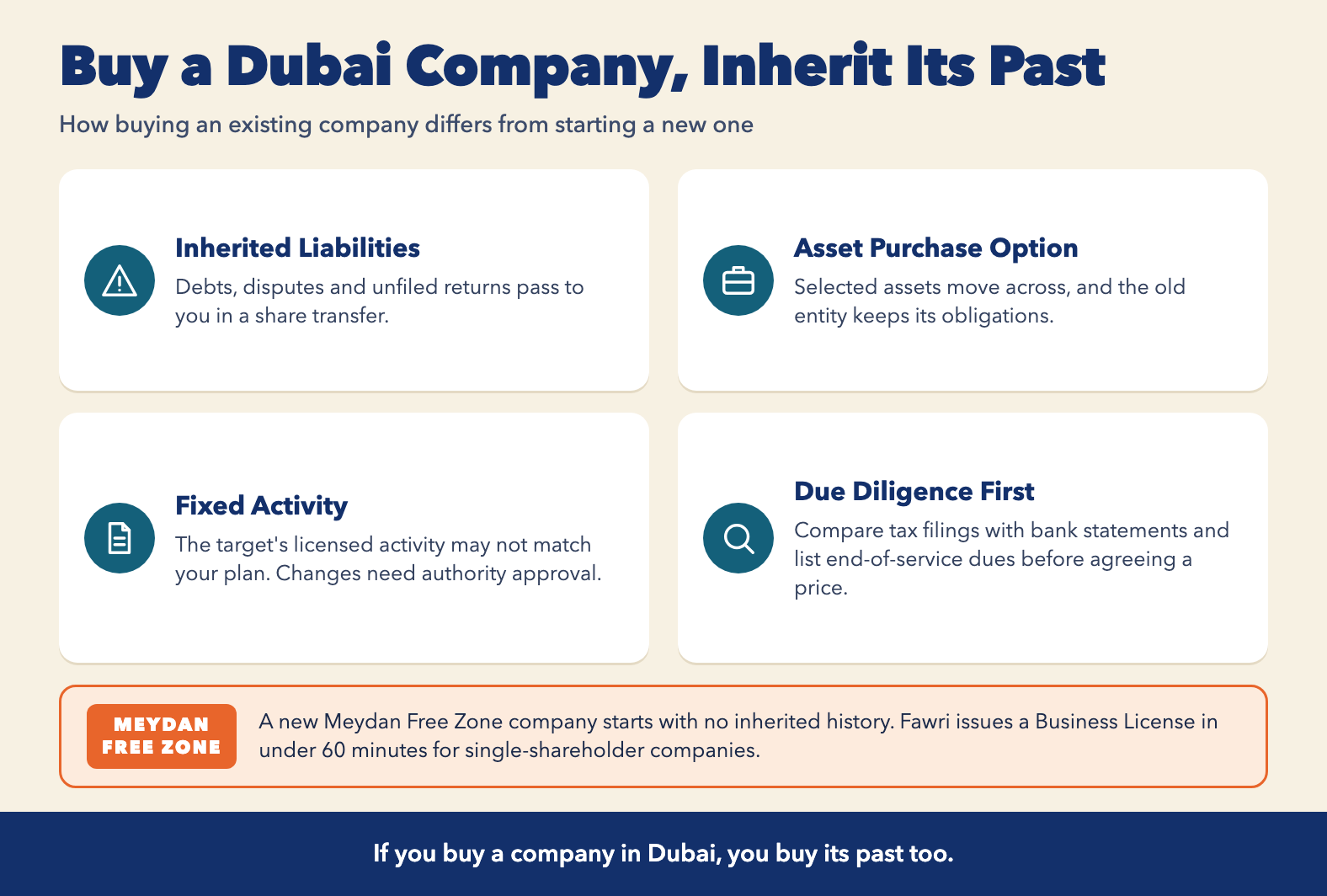
The main differences are inherited liability, speed to trading, banking history and control over structure. A buyer gains an operating license and contracts but takes on past obligations. A new company starts slower commercially, carries no legacy exposure, and lets you set the activity and structure. If you buy a company in Dubai, you buy its past too.
Liability, Licensing and Activity Fit
Inherited debts, disputes and unfiled returns pass to you in a share transfer. The licensed activity may not match your plan either. Say the target's license covers general trading, but your service activity needs a separate approval. The Dubai Department of Economy and Tourism (DET) licenses mainland companies, while the relevant free zone authority licenses free zone companies, so the approval route depends on where the target sits. If you're comparing structures, LLC vs sole establishment in Dubai covers the ownership differences.
Speed, Banking History and Staff
- Staff may stay, but visas and contracts need review and transfer.
- Bank accounts don't automatically continue after a change of owner.
- The bank runs a fresh review of the new shareholder before the account continues.
- A new company builds history from zero. Meydan Free Zone's mCore provides business bank account support, but the bank makes the final decision.
Account opening and ownership checks follow Central Bank of the UAE requirements for banks.
Cost and Risk Mechanics of Each Route
Buying adds a purchase price, valuation and legal fees on top of transfer and licensing costs, and carries hidden-liability risk. Starting new costs license, registration and visa fees only. Corporate Tax applies to both routes: 9% on taxable income above AED 375,000, according to the Federal Tax Authority (FTA).
Where Acquisition Costs Come From
- Purchase price, valuation, legal review, notarisation and transfer fees.
- Outstanding rent, supplier balances, end-of-service dues and visa obligations you may assume.
- Official fees are set by the authority. Seller pricing and advisory fees are estimates only.
One buyer priced a deal at the seller's asking figure, then added end-of-service liabilities found during review. The real cost was higher.
Tax and Compliance Exposure
In a share purchase, Corporate Tax registration status and filing history transfer with the entity. VAT registration is mandatory above AED 375,000 a year in taxable supplies. If the target crossed that threshold without registering, you inherit the penalty exposure. The Cost Calculator helps you estimate a new setup's running costs, so you can compare them against the acquisition total.
How to Buy a Company in Dubai: Due Diligence Steps
To buy a company in Dubai safely, confirm the licensed activity, verify ownership documents, review tax and financial records, check liabilities and staff obligations, then agree transfer terms and update the license. Each step removes risk a new company wouldn't carry.
Step 1: Verify the License and Ownership Records
- Check the trade license, activity and expiry with the issuing authority.
- Read the Share Register and Memorandum and Articles of Association for transfer restrictions.
- Look for partner consent clauses, which some Memoranda require for any share transfer.
Step 2: Review Financial, Tax and Bank Records
- Compare bookkeeping, VAT and Corporate Tax filings against bank statements.
- Confirm no returns are overdue and no penalties are unpaid.
- Treat receipts missing from the sales ledger as grounds to renegotiate the price.
Step 3: Check Liabilities, Staff and Contracts
- List leases, supplier balances, disputes and end-of-service dues.
- Confirm which employment visas and customer contracts transfer.
- Read tenancy terms closely, as undisclosed termination penalties do appear.
Step 4: Agree Terms, Transfer and Update the License
- Use a written sale agreement with warranties and a liability indemnity.
- Complete the ownership transfer with the licensing authority, then update bank and tax records.
- Hold back part of the price until the seller clears outstanding balances.
- Before you commit, compare other routes too, including how to find a business to invest in Dubai. Invest in Dubai publishes official guidance for investors.
When Starting New Makes More Sense
Starting new suits founders who want a clean legal record, a specific activity and control over structure. It works best where the target's value is mainly its license rather than customers or assets. Meydan Free Zone offers a digital setup, so a new company can be licensed quickly without inheriting liabilities.
Clean Structure and Digital Setup
A new entity avoids inherited tax, staff and dispute exposure. Meydan Free Zone issues company documents digitally, and visa services are priced separately from the trade license. mResidency handles residency visas, Emirates ID and medical insurance. mAccounting offers bookkeeping, VAT registration support and Corporate Tax support. A trader who needs one activity and has no use for the seller's customers gains nothing from a purchase.
Moving an Existing Company Instead
If you already own a free zone company, you can avoid a purchase altogether. Read about transferring a free zone company to Meydan Free Zone. An owner with a dormant entity can move it rather than buy another.
Free Business Setup Cost Calculator
Calculate NowWhat This Means for Your Decision
Buy when the company has customers, contracts or assets you can't replicate quickly, and its records survive due diligence. Start new when the main value is the license, or when verification would cost more than a fresh setup. Decide on verified records, not the seller's description.
A Practical Decision Test
Ask whether the value is transferable: customers, contracts, assets or only the license. Compare the full acquisition cost, including liabilities, against a new setup plus the time to win customers. A buyer who weighed purchase price and legal costs against forming a new company decided the customer list alone didn't justify it. Walk away if the seller can't provide verifiable tax and bank records.
List what you need from the target and test each item against verified records. Then compare the result with a new Meydan Free Zone company, where the Business License, Certificate of Formation, Share Register and MoA/AoA are issued digitally with no inherited history. Price the liabilities first and the license second.
Ready to Launch Your Business in Dubai?
Let's Connect