Table of Contents
Frequently Asked Questions
Can a free zone company take a mortgage on commercial property in the UAE?
Yes, a free zone company can apply for a commercial mortgage, but the bank's lending rules and the property's location decide the outcome. A Meydan Free Zone license does not change how banks lend. Whether the company can hold title depends on whether the unit sits in an area where that ownership is permitted.
How much of a property's value will a UAE bank lend to a business?
Banks lend a share of the property's independent valuation, not the agreed purchase price. For commercial property this share is usually lower than for homes. The exact limit depends on the lender, the borrower's profile and the Central Bank of the UAE's current rules. If the valuation falls below the price, the founder funds the gap in cash.
What documents does a bank ask for when financing business premises?
Banks typically ask for the trade license, constitutional documents, shareholder IDs, bank statements and audited or management accounts. They also need the sales agreement or letter of intent for the property. Meydan Free Zone issues the Business License, Certificate of Formation, Share Register and Memorandum and Articles of Association digitally, which covers the corporate documents.
Do banks require a personal guarantee on a company mortgage?
Many lenders do, especially for newer or smaller companies. Alongside the property charge, a bank may also ask for a share pledge over the borrowing company or an assignment of rental income. Terms vary by lender, so request the full security list in writing before accepting an offer.
Can a non-resident investor get finance for an office in Dubai?
Some banks lend to non-residents, but they usually apply stricter criteria and may offer a lower financing share. The investor must also be eligible to own the property in its location. Ownership is registered with the Dubai Land Department, so title eligibility should be confirmed before making an offer.
Is VAT charged when a company buys commercial property?
VAT treatment depends on the transaction, as commercial property sales and leases can be subject to VAT. Registration is mandatory above AED 375,000 a year in taxable supplies. A registered company should check recoverability with its accountant and review Federal Tax Authority guidance before completing the purchase.
What happens if a company defaults on a business property loan?
The bank can enforce its security, which includes the mortgaged property and any pledged shares or guarantees. Early settlement penalties and rate resets can add pressure before default occurs. Founders should test repayments against weaker revenue months before signing.
Is it better to lease or buy business premises in Dubai?
Buying suits businesses with stable, long-term space needs where repayments are close to or below current rent. Leasing keeps capital free for operations and allows relocation. A common route is to lease first and buy once volumes justify the commitment.
Topic Summary
What a Commercial Mortgage in the UAE Is
A commercial mortgage in the UAE is a bank loan secured against a business property, such as an office, warehouse, shop or showroom. The lender holds a charge over the asset until repayment. Banks assess the borrower's trading details and the property's value, and lend a lower share of value than for homes.
Who Regulates a Commercial Mortgage in the UAE
The Central Bank of the UAE regulates banks and sets the lending framework for mortgages. Property registration and charges are handled by the emirate's land authority, such as the Dubai Land Department in Dubai. Free zone authorities do not regulate bank lending, so a Meydan Free Zone license does not change lender rules.
How Banks Assess a Business Property Loan
Banks assess the company's trading record, audited financials, cash flow and shareholders' standing, then value the property independently. Lending is capped at a share of that valuation. Debt service cover, the age of the business and the property's income usually decide approval and pricing.
How a Commercial Mortgage Application Runs
A commercial mortgage application runs in six stages: confirm eligibility to own the property, gather company documents, request bank offers, complete valuation, sign the offer letter, then register the mortgage with the land authority. Incomplete files cause most delays.
Costs, Risks and Compliance Mechanics
Costs include the down payment, bank arrangement and valuation fees, land authority registration fees, insurance and any VAT on the transaction. Interest rates vary by lender and borrower. Official fees are set by authorities, while bank fees are negotiable, so request a written breakdown before committing.
Mortgage, Business Loan or Leasing: Which Fits
A commercial mortgage suits founders who need long-term ownership of premises. A business loan suits working capital without tying cash to property. Leasing keeps capital free. The right choice depends on cash flow, growth plans and how long you expect to use the space.
What a Commercial Mortgage Means for a Meydan Free Zone Founder
After registration, Meydan Free Zone issues the Business License, Certificate of Formation, Share Register and Memorandum and Articles of Association digitally. These are the core company documents a bank requests for a commercial mortgage in the UAE. Clean records support lender review; they don't guarantee approval.
Commercial Mortgages in the UAE: How Business Property Financing Works
Many founders assume a bank will lend against a commercial unit the way it lends against a home. It won't, because the bank underwrites the company first and the building second. This guide explains how business property financing works in the UAE, who regulates it, what it costs and how to choose between buying, borrowing and leasing.
What a Commercial Mortgage in the UAE Is
A commercial mortgage in the UAE is a bank loan secured against a business property, such as an office, warehouse, shop or showroom. The lender holds a charge over the asset until repayment. Banks assess the borrower's trading details and the property's value, and lend a lower share of value than for homes.
How It Differs From a Residential Mortgage
The bank underwrites the business and its cash flow, not only the individual. Say a trading company buys a warehouse unit: the bank reviews audited accounts and contracts, not just the founder's salary. Tenors are usually shorter and the financed share lower than in residential lending, and title is often held by a company rather than a person.
Property Types Banks Finance
- Offices, retail units, warehouses and mixed-use buildings.
- Completed, income-generating assets are easier to finance.
- A leased office floor with a signed tenant beats a vacant unit.
- Land and off-plan assets face tighter treatment.
Who Regulates a Commercial Mortgage in the UAE
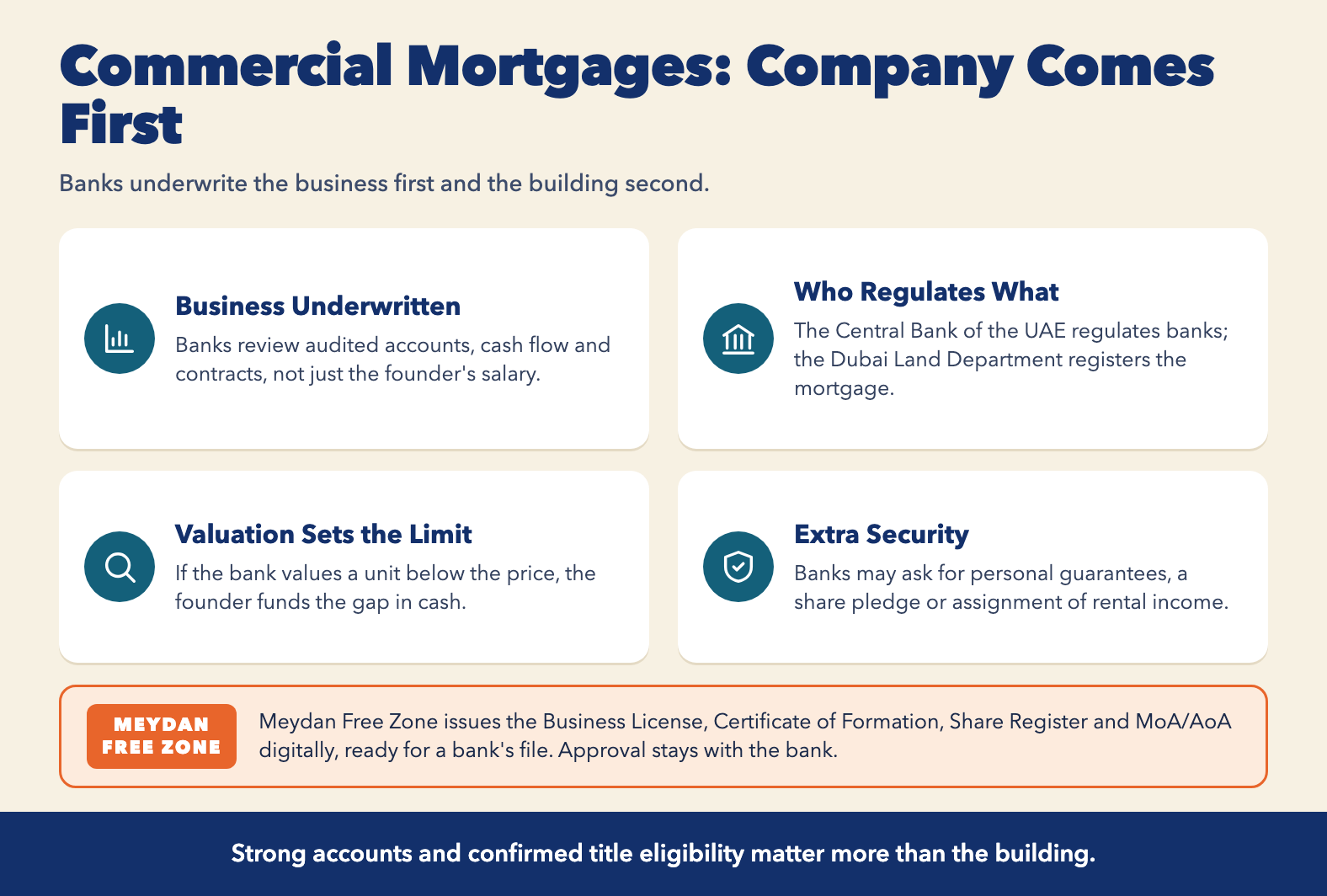
The Central Bank of the UAE regulates banks and sets the lending framework for mortgages. Property registration and charges are handled by the emirate's land authority, such as the Dubai Land Department in Dubai. Free zone authorities do not regulate bank lending, so a Meydan Free Zone license does not change lender rules.
Federal Rules and Emirate-Level Registration
A Dubai unit's mortgage is registered with the Dubai Land Department. An Abu Dhabi unit follows its own emirate's process. Registration practice is not uniform across emirates.
Where Free Zone Ownership Limits Apply
Where a company can hold title depends on freehold areas and the property's location. A founder may find the unit sits outside a freehold area, which restricts how the company holds title. Confirm title eligibility before making an offer.
How Banks Assess a Business Property Loan
Banks assess the company's trading record, audited financials, cash flow and shareholders' standing, then value the property independently. Lending is capped at a share of that valuation. Debt service cover, the age of the business and the property's income usually decide approval and pricing.
Company Strength and Trading History
- Bank statements, audited accounts and the trade license.
- Newer companies often face lower limits or extra security.
- Steady turnover matters more than headline revenue.
A two-year-old consultancy with regular invoicing meets criteria more easily than one with irregular deposits.
Valuation and Debt Service Cover
The independent valuation sets the lending base. If the bank values a unit below the agreed price, the founder funds the gap in cash. Lenders also test whether income covers repayments, and treat owner-occupied and leased assets differently.
Security Banks Ask For Beyond the Property
- Personal guarantees from shareholders.
- A share pledge over the borrowing company.
- Assignment of rental income or insurance.
How a Commercial Mortgage Application Runs
A commercial mortgage application runs in six stages: confirm eligibility to own the property, gather company documents, request bank offers, complete valuation, sign the offer letter, then register the mortgage with the land authority. Incomplete files cause most delays.
Step 1: Confirm Ownership Eligibility and Prepare Documents
- Trade license, constitutional documents and shareholder IDs.
- Audited or management accounts and bank statements.
- Sales agreement or letter of intent for the property.
Step 2: Compare Offers and Complete Valuation
Compare rates, fees, tenor and early settlement terms. Two banks may quote similar rates but differ sharply on settlement charges. The bank arranges the valuation, so request an indicative term sheet before paying fees. If you also need working capital, read how to apply for a business loan in Dubai.
Step 3: Sign, Register and Draw Down
Accept the offer letter and sign the security documents. Transfer and mortgage registration happen together at the land authority, and funds are released against title transfer.
Costs, Risks and Compliance Mechanics
Costs include the down payment, bank arrangement and valuation fees, land authority registration fees, insurance and any VAT on the transaction. Interest rates vary by lender and borrower. Official fees are set by authorities, while bank fees are negotiable, so request a written breakdown before committing.
Upfront and Recurring Costs
- The down payment is the largest cash outlay.
- Separate official fees from bank charges.
- Insurance and service charges are a recurring cost.
Founders often budget the down payment but overlook service charges and insurance.
Commercial Mortgage, Business Loan and Leasing Compared
| Feature | Commercial Mortgage | Leasing Premises |
|---|---|---|
| Upfront cash required | Down payment plus bank and registration fees | Security deposit and first rent payment |
| Ownership of the asset | Company builds equity in a title-registered asset | No ownership; the landlord keeps the asset |
| Flexibility to relocate | Low; exit means a sale and possible settlement charges | High; move at lease end |
| Security required by lender or landlord | Property charge, often guarantees or a share pledge | Usually a deposit and post-dated payments |
| Long-term cost profile | Fixed term; ownership costs continue after repayment | Rent can change at renewal; no asset at the end |
VAT and Corporate Tax Considerations
VAT registration is mandatory above AED 375,000 a year. VAT treatment of commercial property depends on the transaction, and interest and depreciation affect your Corporate Tax position. A VAT-registered company should review recoverability with its accountant against Federal Tax Authority guidance.
Key Risks Before You Sign
- Rate resets and cash-flow pressure.
- Early settlement penalties.
- Default exposes the property and any pledged shares.
Mortgage, Business Loan or Leasing: Which Fits
A commercial mortgage suits founders who need long-term ownership of premises. A business loan suits working capital without tying cash to property. Leasing keeps capital free. The right choice depends on cash flow, growth plans and how long you expect to use the space.
A logistics SME might lease first, then buy once volumes justify a warehouse. A clinic operator staying in one location for many years has a stronger case for ownership, especially when rent is close to likely repayments. If your plans touch property trading itself, see real estate business activities in the UAE.
What a Commercial Mortgage Means for a Meydan Free Zone Founder
After registration, Meydan Free Zone issues the Business License, Certificate of Formation, Share Register and Memorandum and Articles of Association digitally. These are the core company documents a bank requests for a commercial mortgage in the UAE. Clean records support lender review; they don't guarantee approval.
mCore provides business bank account support, though each bank makes its own decision. mAccounting offers bookkeeping, VAT registration support and Corporate Tax support, so a founder who keeps the books up to date can show a bank consistent numbers. The Cost Calculator helps you plan running costs before you commit.
Free Business Setup Cost Calculator
Calculate NowChoosing Your Next Step
A commercial mortgage in the UAE rewards preparation over speed. Banks lend against a clear company file, a verified title and realistic repayment cover. Review your cash flow and put your company records in order before approaching a lender. For a Meydan Free Zone company, the Business License, Certificate of Formation, Share Register and MoA/AoA are issued digitally, so the corporate part of the bank's file is ready to send.
Ready to Launch Your Business in Dubai?
Let's Connect