

Table of Contents
Frequently Asked Questions
Who can legally sign an audit report for a company in the UAE?
Only an individual auditor or audit firm that is licensed and registered with the competent UAE authority can sign an audit report. Audit practice is registered with the Ministry of Economy and Tourism. A report signed by an accountant, bookkeeper or in-house staff member is unlikely to be accepted by banks or regulators.
How do I check that an auditor is registered before appointing them?
Ask the firm for its registration and license details, then verify them with the registering authority before sharing any records. Confirm that the firm is in good standing and that the registration covers the type of audit you need. Do this before signing the engagement letter.
Does a free zone company need audited financial statements?
It depends on the company's activity, tax status and the free zone authority's rules. A Qualifying Free Zone Person must prepare and maintain audited financial statements for Corporate Tax. A Meydan Free Zone company must also submit audited statements within 30 days if the free zone requests them. Banks and lenders may ask for them when reviewing a facility, whatever the company's size.
When do audited statements become mandatory for Corporate Tax?
Audited financial statements are required for Qualifying Free Zone Persons and for taxable persons with revenue above AED 50 million. Tax groups prepare audited special purpose statements. Ministerial Decision No. 84 of 2025 sets these rules for tax periods starting on or after 1 January 2025.
Can my accountant also act as my auditor?
No. An auditor must give an independent opinion and cannot audit books they prepared. An accountant or bookkeeper who keeps your records cannot sign the audit of those same records. Banks may reject reports where independence is in doubt.
What should an engagement letter with an auditor include?
It should name the standards applied, the scope of work, the deliverables, the deadline and the fee in AED. Check whether Corporate Tax support is included or quoted separately. Treat any quoted fee as an estimate until the scope is agreed in writing.
What affects the cost of an audit in the UAE?
Fees depend on transaction volume, the number of entities and the quality of your records. Each firm quotes its own fee, and messy or late records raise the cost.
Can a Meydan Free Zone company get help with audit reports?
Yes. Meydan Free Zone offers financial audit reports through mAccounting, the Meydan Plus pillar that also covers Bookkeeping, VAT registration support and Corporate Tax support. Its service page states that each report must be prepared and signed by a licensed auditor registered with the Ministry of Economy and Tourism.
Topic Summary
What an Approved Auditor in the UAE Is
An approved auditor in the UAE is an individual or firm licensed and registered with the competent authority to issue audit opinions on a company's financial statements. Banks, regulators and free zone authorities look for reports signed by registered auditors, not by unregistered accountants or bookkeepers. That is why registration matters more than a familiar name.
Audit Requirements in the UAE for Mainland and Free Zone Companies
Audit requirements depend on company type, activity and tax status. Qualifying Free Zone Persons and taxable persons with revenue above AED 50 million must prepare and maintain audited financial statements for Corporate Tax. Banks and some licensing authorities may also request audited accounts regardless of size.
How Meydan Free Zone Companies Handle Audited Financial Statements
Meydan Free Zone offers financial audit reports through mAccounting, the Meydan Plus pillar that also covers Bookkeeping, VAT registration support and Corporate Tax support. Its service page states that a report must be prepared and signed by a licensed auditor registered with the Ministry of Economy and Tourism. Requirements vary by free zone and business activity.
How to Choose an Approved Auditor in the UAE
To choose an approved auditor, confirm their registration with the competent authority and check experience in your industry. Confirm independence, agree scope and fees in writing, and compare at least two proposals. Make sure the report format suits the bank or authority that will receive it.
Costs, Risks and Compliance Exposure
Audit fees depend on company size, transaction volume and record quality, and each firm quotes its own. The larger cost is usually a rejected report, which delays renewal, tax filing or a bank review. A non-registered auditor can force you to pay twice. The rules are strict on who signs.
Comparing Auditor Types Before You Decide
Large international firms suit complex groups and lenders that expect a known name. Mid-size local firms suit most SMEs with moderate volume. Small registered practices cost less but may lack capacity during peak periods. Choose by complexity, who will read the report, and budget. The same rules apply to all three.
What This Means for Your Decision
Treat the audit as a recurring cost to plan for, not a year-end scramble. Keep clean records, confirm what your structure requires, and verify registration before appointing any auditor. Registration and fit matter more than the firm's brand.
Choosing an Approved Auditor in the UAE for Your Company
Signed financial statements often become urgent when a bank, a regulator or a license renewal asks for them. Many founders then assume any accountant with a stamp will do, but only a registered auditor can sign a report that regulators will accept. So which auditor can you rely on, and does your company need one?
This guide explains what an approved auditor is, which audit requirements apply to your company, and how to verify and compare auditors before you appoint one.
What an Approved Auditor in the UAE Is
An approved auditor in the UAE is an individual or firm licensed and registered with the competent authority to issue audit opinions on a company's financial statements. Banks, regulators and free zone authorities look for reports signed by registered auditors, not by unregistered accountants or bookkeepers. That is why registration matters more than a familiar name.
Auditor, Accountant and Bookkeeper Compared
A bookkeeper records transactions. An accountant prepares the statements. An auditor gives an independent opinion on them and does not prepare the books being audited.
Independence is the point. Picture a trading company whose bookkeeper also signs the audit report. The bank may reject it, and the company then starts again with a registered firm.
Who Registers and Supervises Auditors
Audit practice in the UAE is registered with the Ministry of Economy and Tourism, whose Auditors Department licenses audit firms and their auditors. Auditors who act on Corporate Tax and VAT matters also deal with the Federal Tax Authority (FTA). Free zone authorities may keep their own lists of accepted auditors.
Before signing an engagement letter, ask for the firm's registration details and check them with the authority yourself.
Audit Requirements in the UAE for Mainland and Free Zone Companies
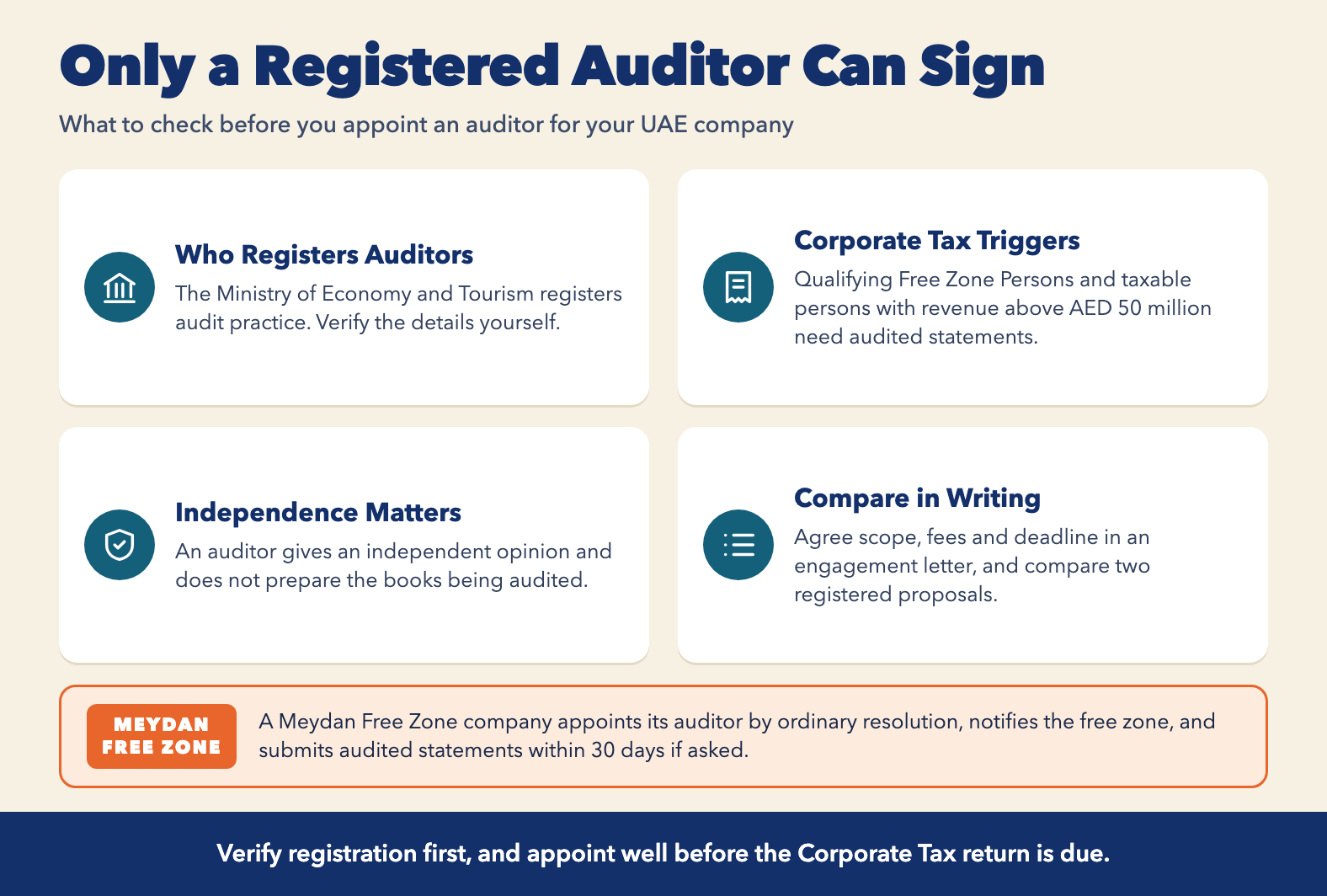
Audit requirements depend on company type, activity and tax status. Qualifying Free Zone Persons and taxable persons with revenue above AED 50 million must prepare and maintain audited financial statements for Corporate Tax. Banks and some licensing authorities may also request audited accounts regardless of size.
Corporate Tax Triggers for an Audit
- Qualifying Free Zone Persons must prepare and maintain audited statements.
- Taxable persons with revenue above AED 50 million must do the same. The Federal Tax Authority (FTA) administers Corporate Tax.
- The rules sit under Federal Decree-Law No. 47 of 2022 and Ministerial Decision No. 84 of 2025, for tax periods starting on or after 1 January 2025. Tax groups prepare audited special purpose statements.
Take a free zone trading company with qualifying income. It must prepare and maintain audited statements for each tax period, so choose the auditor well before the Corporate Tax return is due.
Free Zone, Bank and Lender Requests
Free zone authorities may ask for audited accounts at license renewal, depending on activity. Banks and lenders often ask for them when reviewing facilities. A consultancy applying for a credit facility, for example, may be asked for audited accounts even though no law requires them. Requirements vary by authority and activity.
Voluntary Audits and When They Pay Off
Audits help with investor due diligence, partner disputes and exit valuation. Two partners in a services company can use an audited profit figure to settle a profit-share disagreement. A clean audit trail also reduces friction in later bank reviews.
How Meydan Free Zone Companies Handle Audited Financial Statements
Meydan Free Zone offers financial audit reports through mAccounting, the Meydan Plus pillar that also covers Bookkeeping, VAT registration support and Corporate Tax support. Its service page states that a report must be prepared and signed by a licensed auditor registered with the Ministry of Economy and Tourism. Requirements vary by free zone and business activity.
Where mAccounting Fits
Clean books before the audit reduce fieldwork time and queries. A solo founder might keep bookkeeping with mAccounting, then hand the year-end ledger to an independent auditor. The same applies to firms using tax and audit services.
Why Free Zone Rules Differ From Mainland Rules
Don't assume mainland processes or authorities apply to a free zone company. Under the MFZ Companies and Licensing Regulations 2022, a company appoints or removes its auditor by ordinary resolution and notifies Meydan Free Zone within 15 business days. It must also submit audited financial statements within 30 days if the free zone asks for them. Check your tax status and activity first, then choose an auditor who knows free zone filings.
Free Business Setup Cost Calculator
Calculate NowHow to Choose an Approved Auditor in the UAE
To choose an approved auditor, confirm their registration with the competent authority and check experience in your industry. Confirm independence, agree scope and fees in writing, and compare at least two proposals. Make sure the report format suits the bank or authority that will receive it.
Step 1: Confirm Registration and Standing
- Ask for registration details.
- Verify them with the authority.
- Confirm good standing before sharing bank statements.
Step 2: Match Experience to Your Activity
- Trading, services and holding structures carry different risks.
- Ask about free zone and Corporate Tax experience.
- An e-commerce company needs inventory and multi-currency skills.
Step 3: Agree Scope, Fees and Timeline in Writing
- Use an engagement letter naming standards, deliverables and deadline.
- Treat quotes in AED as estimates until scope is agreed.
- Two quotes can look equal until one excludes Corporate Tax support.
Step 4: Check Independence and the Report Format
- Avoid auditors who also keep your books.
- Confirm the format suits your bank or authority.
- A report can be rejected if the auditor also prepared the accounts.
Costs, Risks and Compliance Exposure
Audit fees depend on company size, transaction volume and record quality, and each firm quotes its own. The larger cost is usually a rejected report, which delays renewal, tax filing or a bank review. A non-registered auditor can force you to pay twice. The rules are strict on who signs.
What Drives Audit Fees
- Transaction volume and number of entities.
- Record quality: messy books raise cost.
- Fees are set by the firm, so compare written quotes.
Two companies with equal revenue can receive different quotes if one has late, incomplete ledgers.
Comparison of Auditor Types
| Feature | Larger firm | Small registered practice |
|---|---|---|
| Typical client profile | Complex groups with several entities | Single-entity SMEs and solo founders |
| Capacity at peak periods | Larger teams to absorb filing season | Limited staff, so book early |
| Recognition by banks and lenders | Known name that lenders often expect | Accepted if registered, but less familiar |
| Fee level (estimate only) | Typically higher, quoted in AED per scope | Typically lower, quoted in AED per scope |
| Responsiveness and access to partners | Work often handled by managers | Direct access to the signing partner |
Risks of Appointing the Wrong Auditor
Rejected reports delay renewal, tax filing and banking. Banks read the opinion, so a weak signatory costs credibility. A company that has to re-audit a year after a bank rejects the first report pays for the work twice. The Central Bank of the UAE sets the regulatory frame banks work within.
Comparing Auditor Types Before You Decide
Large international firms suit complex groups and lenders that expect a known name. Mid-size local firms suit most SMEs with moderate volume. Small registered practices cost less but may lack capacity during peak periods. Choose by complexity, who will read the report, and budget. The same rules apply to all three.
Timing Your Appointment Around the Financial Year
Appoint before year-end so the auditor can advise on cut-off and stock counts. A company that appoints mid-year can review controls early. Peak filing periods stretch capacity everywhere. Audit firms themselves can read how audit firms in Dubai can register with Meydan Free Zone.
What This Means for Your Decision
Treat the audit as a recurring cost to plan for, not a year-end scramble. Keep clean records, confirm what your structure requires, and verify registration before appointing any auditor. Registration and fit matter more than the firm's brand.
A Practical Decision Framework
- Check tax status, then license activity, then lender needs.
- Shortlist two registered auditors.
- Compare scope in writing.
- Map tax filing, bank request and renewal onto one calendar.
Next Step for Meydan Free Zone Founders
A Meydan Free Zone company appoints its auditor by ordinary resolution and must notify the free zone, so build that step into your calendar. Confirm whether your tax status or lender requires audited statements, then compare two registered proposals before year-end.
Ready to Launch Your Business in Dubai?
Let's Connect