
Table of Contents
Frequently Asked Questions
Does a free zone company with no profit still have to submit a Corporate Tax return?
Yes. A free zone company must register for Corporate Tax and file a return for each tax period, even when it earns no profit or its income is taxed at 0%. Filing is made to the Federal Tax Authority through EmaraTax.
When is the deadline for filing a Corporate Tax return in the UAE?
The return and any tax due must be submitted within nine months of the end of the tax period. A company with a 31 December year-end therefore files by 30 September of the following year. Filing and payment share the same deadline.
Which documents should be ready before filing a Corporate Tax return?
Prepare financial statements, a reconciled trial balance, the general ledger, invoices, contracts, bank statements and payroll records. Add support for related party transactions, tax losses brought forward and any elections you plan to claim. Free zone companies should also hold evidence of the qualifying and non-qualifying income split.
Do all companies need audited financial statements to file?
No. Audited statements are required for Qualifying Free Zone Persons and for companies whose revenue exceeds AED 50 million. Other companies must still prepare accurate financial statements under the applicable accounting standards.
Where is the Corporate Tax return submitted?
The return is submitted online through the Federal Tax Authority's EmaraTax portal. Neither a free zone authority nor DET receives it. An authorised signatory or a registered tax agent can complete and submit it.
Can a company correct a return after submitting it?
Yes, a taxable person can generally correct errors in a filed return by submitting a voluntary disclosure to the Federal Tax Authority. Acting early reduces the risk of added penalties. Keep the records that support the corrected figures.
How long must a company keep the records behind its tax return?
Records must be kept for seven years after the end of the tax period they relate to. This covers ledgers, invoices, contracts, bank statements and payroll files. Missing records can make an expense or relief claim impossible to defend.
Can an accountant or representative file the return on a company's behalf?
Yes, provided the company has authorised the person through EmaraTax. The company remains legally responsible for the accuracy of the return. For Meydan Free Zone companies, mAccounting under Meydan Plus covers bookkeeping and Corporate Tax support.
Topic Summary
What a UAE Corporate Tax Return Is
A Corporate Tax return is the declaration a taxable person files with the Federal Tax Authority for each tax period. It reports taxable income, adjustments, reliefs and the tax payable. Free zone companies taxed at 0% must still register and file.
What a Corporate Tax Return in the UAE Contains
A return contains taxpayer identification details, accounting income, adjustments for non-deductible items and exempt income, elections and reliefs claimed, tax loss positions, related party disclosures, and supporting financial statements. The tax payable is calculated from these figures.
How Corporate Tax Return Filing in the UAE Works
Filing is done online through the Federal Tax Authority's EmaraTax portal within nine months of the end of the tax period. The process runs in six stages, from closing the books to paying any tax due.
Free Zone Companies and the Corporate Tax Return in the UAE
A Qualifying Free Zone Person pays 0% on qualifying income and 9% on non-qualifying income. Its return must separate the two income streams, show the de minimis test and be supported by audited financial statements.
Reliefs and Elections That Change the Return
Reliefs and elections alter the return because they must be claimed within it. The main ones are Small Business Relief for revenue up to AED 3 million, tax group formation, transfer of losses and business restructuring relief.
Common Errors That Delay a Corporate Tax Return in the UAE
The most common errors are treating a 0% company as exempt from filing, mixing personal and business expenses, missing related party disclosures, filing without reconciled accounts, and losing records. Each creates amendments or penalties.
Conclusion
A Corporate Tax return reflects how well a company kept its records during the year. The return itself takes little time when accounts are reconciled, income is classified correctly and elections are decided early.
What Goes Into a UAE Corporate Tax Return
Every UAE company must file a Corporate Tax return, even one that owes 0% tax, and missing it brings penalties. Many founders expect a short form completed once the accounts are done. In practice, the return pulls together accounting profit, tax adjustments, elections and supporting records, so weak bookkeeping shows up quickly.
This guide explains what the return contains, where each figure comes from and how to prepare, including the points that apply to free zone companies.
What a UAE Corporate Tax Return Is
A Corporate Tax return is the declaration a taxable person files with the Federal Tax Authority for each tax period. It reports taxable income, adjustments, reliefs and the tax payable. Free zone companies taxed at 0% must still register and file.
What the Return Declares to the Federal Tax Authority
The return covers one tax period, usually the financial year. Taxable income starts from accounting profit and is then adjusted under the Corporate Tax Law. Take a Dubai consulting company with a calendar financial year: it has one tax period and files one return for it.
The rate is 0% on taxable income up to AED 375,000 and 9% above that, according to the Federal Tax Authority. The Federal Tax Authority administers the tax. Your free zone authority and the Dubai Department of Economy and Tourism (DET) do not.
Who Must File and Who Is Still Required to File
Mainland companies, free zone companies and certain individuals conducting a business are taxable persons. Free zone companies must register and file even when their income is taxed at 0%. Some exempt persons still have registration or reporting duties, so confirm your position with the Federal Tax Authority. A free zone trading company with no taxable income still files a return.
Return Components and Where Each Comes From
| Feature | Return component | Source or supporting record |
|---|---|---|
| Accounting profit or loss | Starting point for taxable income | Year-end trial balance and financial statements |
| Non-deductible expenses and exempt income | Adjustments such as fines, entertainment limits and qualifying dividends | General ledger and invoices |
| Qualifying and non-qualifying income split | Separate 0% and 9% income streams for free zone companies | Revenue records tagged by customer type |
| Tax losses brought forward | Offset capped at 75% of taxable income | Prior-period returns and loss schedule |
| Related party and connected person transactions | Disclosure at arm's length value | Agreements, payroll records and market evidence |
What a Corporate Tax Return in the UAE Contains
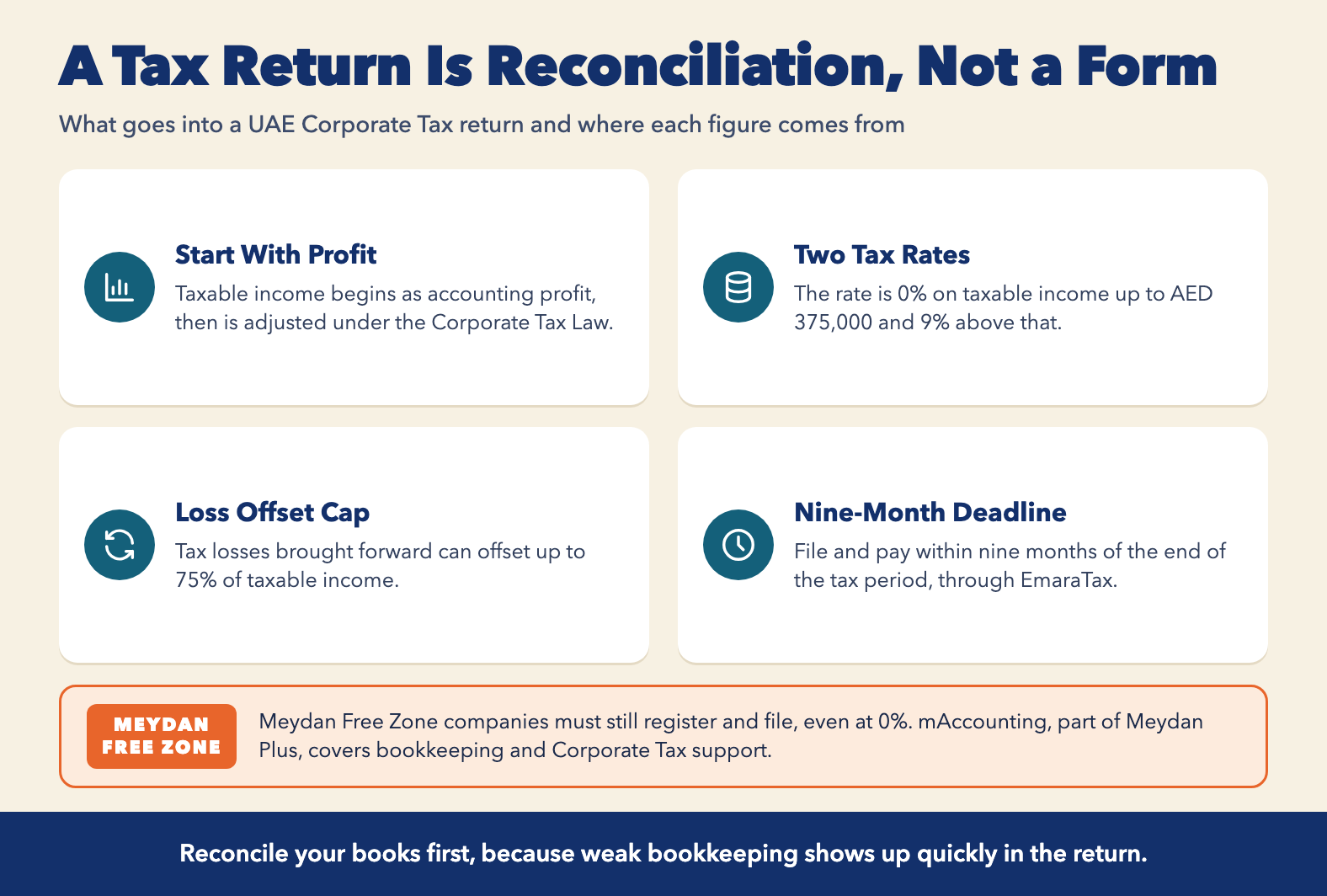
A return contains taxpayer identification details, accounting income, adjustments for non-deductible items and exempt income, elections and reliefs claimed, tax loss positions, related party disclosures, and supporting financial statements. The tax payable is calculated from these figures.
Filing the return is mostly a reconciliation exercise. The screens are simple. The work sits in the figures behind them.
Taxpayer Details and Financial Statements
- Trade name, Tax Registration Number, license details and period dates.
- Income statement and balance sheet under accounting standards.
- Audited statements for Qualifying Free Zone Persons.
- Audited statements above AED 50 million revenue.
Say a company exports figures from its bookkeeping software. It should reconcile them to the year-end trial balance before entering anything.
Tax Adjustments and Disclosures
- Non-deductible items, such as fines and capped entertainment.
- Exempt income, including qualifying dividends.
- Carried-forward losses, offset up to 75% of taxable income.
- Connected person transactions at arm's length value.
A director's salary paid to a connected person needs market evidence. Without it, the deduction is exposed.
Supporting Records the Return Relies On
Keep the general ledger, invoices, agreements, bank statements and payroll records for seven years after the tax period ends. A trader who never stored invoices cannot defend a large expense, and the deduction falls away.
How Corporate Tax Return Filing in the UAE Works
Filing is done online through the Federal Tax Authority's EmaraTax portal within nine months of the end of the tax period. The process runs in six stages, from closing the books to paying any tax due.
Six Stages From Closed Books to Submitted Return
- Close the books and finalise the financial statements.
- Adjust accounting profit to taxable income.
- Apply reliefs, elections and loss carry-forwards.
- Complete the return on EmaraTax.
- Have an authorised signatory or a registered tax agent review it.
- Submit the return and pay any tax due.
A company with a 31 December year-end files by 30 September of the following year.
Deadlines, Payment and Late Filing Consequences
Filing and payment share the same nine-month deadline. Administrative penalties apply to late filing and late payment under a Cabinet Decision, so check the current amounts on the Federal Tax Authority website. A founder who treats a nil-tax year as optional still misses the deadline, and the penalty follows.
Free Zone Companies and the Corporate Tax Return in the UAE
A Qualifying Free Zone Person pays 0% on qualifying income and 9% on non-qualifying income. Its return must separate the two income streams, show the de minimis test and be supported by audited financial statements.
Separating Qualifying and Non-Qualifying Income
The return splits revenue into qualifying income, non-qualifying income and excluded activities. The de minimis test requires non-qualifying revenue to stay within the lower of 5% of total revenue or AED 5 million. Breach it and the status is lost.
Take a Meydan Free Zone trading company selling to other free zone businesses and to one mainland customer. It should record the two streams separately from day one. The guide on qualifying vs non-qualifying income covers the classification in detail.
Records Meydan Free Zone Companies Should Prepare
Meydan Free Zone issues the Business License, Certificate of Formation, Share Register and Memorandum and Articles of Association (MoA/AoA) digitally. These support the return, alongside evidence of substance and economic activity for Qualifying Free Zone Person status.
mAccounting, part of Meydan Plus, covers bookkeeping, VAT registration support, Corporate Tax support and financial audit reports. Founders who start bookkeeping at incorporation rather than at year-end avoid a rebuild later. See the Corporate Tax support on offer.
Free Business Setup Cost Calculator
Calculate NowReliefs and Elections That Change the Return
Reliefs and elections alter the return because they must be claimed within it. The main ones are Small Business Relief for revenue up to AED 3 million, tax group formation, transfer of losses and business restructuring relief.
Small Business Relief and Its Limits
Resident persons with revenue at or below AED 3 million can elect relief for tax periods ending on or before 31 December 2026. Qualifying Free Zone Persons and members of large multinational groups cannot. A mainland-licensed consultancy with AED 2 million revenue would make the election in the return. Read the Small Business Relief guide before deciding.
Loss Relief, Tax Groups and Restructuring Elections
- Losses carry forward and offset up to 75% of taxable income.
- Tax groups file one consolidated return.
- Some elections cannot easily be reversed, so decide them before filing.
Two related companies should test whether a tax group genuinely simplifies filing before they commit.
Common Errors That Delay a Corporate Tax Return in the UAE
The most common errors are treating a 0% company as exempt from filing, mixing personal and business expenses, missing related party disclosures, filing without reconciled accounts, and losing records. Each creates amendments or penalties.
Bookkeeping and Reconciliation Gaps
- Accounting profit that does not match bank and ledger records.
- Cash-basis revenue where accrual is required.
- Owner withdrawals mixed with business expenses.
Rebuilding twelve months of entries just before the deadline rarely produces figures that hold up.
Registration and Disclosure Oversights
Late registration, missed connected person transactions and unreported changes in free zone activity are the usual causes. A founder who pays a family member without documenting a market rate creates a disclosure problem that no filing screen can fix.
Conclusion
A Corporate Tax return reflects how well a company kept its records during the year. The return itself takes little time when accounts are reconciled, income is classified correctly and elections are decided early.
Confirm your financial year-end and tax period. Decide whether the company is a Qualifying Free Zone Person or eligible for Small Business Relief. Then set up bookkeeping that supports the return before the first period closes. For a Meydan Free Zone company, mAccounting includes bookkeeping and Corporate Tax support, so the records behind the return can be kept from incorporation.
Ready to Launch Your Business in Dubai?
Let's Connect