

Table of Contents
Frequently Asked Questions
How does the Federal Tax Authority decide whether a sale is one supply or several?
The Federal Tax Authority looks at the economic substance of the transaction, not the invoice layout. If the elements are so closely linked that they form one economic supply, the sale is a composite supply taxed as one. If each element is independent and could be sold alone, they are treated as multiple supplies.
Can I charge different VAT rates on one bundled invoice in the UAE?
Yes, if the bundle contains multiple supplies with different treatments, such as a 5% element and a zero-rated export. Each element must be identifiable on the invoice with its own rate or treatment. A genuine composite supply takes a single treatment based on its principal element.
Does delivery count as a separate supply for VAT purposes?
Not usually. When delivery exists only to get the goods to the customer, it is ancillary and follows the VAT treatment of the goods. It becomes a separate supply if the customer buys it independently, for example as a standalone logistics service.
What happens if I classify a bundle incorrectly on my VAT return?
Under-charging VAT on a taxable element leads to under-declared output tax. It can also cause wrong input tax recovery. The Federal Tax Authority can then require a correction to the return and apply administrative penalties.
How should I split a single price across multiple supplies?
Allocate the price on a fair, documented basis, such as the standalone selling price of each element. Apply the correct VAT treatment to each portion. Keep the method consistent across contracts and store it with your records.
Is a software license with support a single supply for VAT?
It depends on substance. If support only works with that license and the customer cannot buy it separately, the two may form one composite supply. If support is sold on its own in your price list and has independent value, it is likely a separate supply.
Do free zone companies follow the same VAT bundling rules as mainland companies?
Yes. VAT is federal and administered by the Federal Tax Authority, so a Meydan Free Zone company applies the same classification test as any other UAE business. Designated Zone rules apply only to qualifying goods and conditions, not to every free zone sale.
Topic Summary
What a Composite Supply Is Under UAE VAT
A composite supply under UAE VAT is a transaction made up of two or more elements so closely linked they form one economic supply. The whole bundle is taxed as a single supply, using the treatment of its principal element: 5%, zero-rated or exempt.
How Multiple Supplies Differ From a Composite Supply
Multiple supplies are separate, independent supplies sold together, often for one price. Each keeps its own VAT treatment, so the price must be apportioned fairly. Unlike a composite supply, the tax is applied item by item.
Composite Supply Under UAE VAT: Where Founders Go Wrong
Founders most often treat every bundle as one supply to simplify invoicing, or split a genuine composite supply into lines. The first risks under-charging VAT on a taxable element. The second produces inconsistent rates and credit note errors.
How to Classify a Supply in Four Steps
To classify a supply, identify each element, test independence, find the principal element, then apply the correct treatment and record your reasoning. This sequence decides whether you tax one composite supply or several.
Invoicing Bundled Supplies Correctly
A tax invoice for a composite supply can show one description and one VAT amount. For multiple supplies, each element should be identifiable with its own treatment. The mandatory details still apply.
What This Means for a Meydan Free Zone Founder
A Meydan Free Zone company follows the same federal VAT rules as any UAE business, so classification still decides the VAT charged. Meydan Free Zone's mAccounting pillar, part of Meydan Plus, offers bookkeeping and VAT registration support.
Classify Before You Invoice
The VAT treatment of a bundle comes down to substance: one economic supply is taxed as one, and independent items are taxed separately. Classify first, record your reasoning, and stay consistent across contracts and credit notes.
Composite vs Multiple Supplies Under UAE VAT
Bundles such as equipment with installation, or software with support, are easy to invoice but harder to tax correctly. Many founders assume a bundle takes the rate of its main item. Others tax every line separately, and neither approach is safe.
This guide explains how composite and multiple supplies differ, how to classify a bundle and how to invoice each type.
What a Composite Supply Is Under UAE VAT
A composite supply under UAE VAT is a transaction made up of two or more elements so closely linked they form one economic supply. The whole bundle is taxed as a single supply, using the treatment of its principal element: 5%, zero-rated or exempt.
The Legal Basis in Federal Decree-Law No. 8 of 2017
VAT is governed by Federal Decree-Law No. 8 of 2017 and its Executive Regulation, Cabinet Decision No. 52 of 2017. The Federal Tax Authority (FTA) administers the rules. From 1 October 2026, Cabinet Decision No. 149 of 2026 treats interconnected components that cannot be separated as one composite supply, even when priced separately. The test looks at economic reality, not invoice layout.
Say a supplier sells an office printer and delivers it. Delivery exists only to get the printer to the customer, so it follows the printer's 5% treatment. VAT registration is mandatory above AED 375,000 in annual taxable supplies, according to the Federal Tax Authority. Our guide to VAT in the UAE covers the wider system.
Composite Supply vs Multiple Supplies Under UAE VAT
| Feature | Composite Supply | Multiple Supplies |
|---|---|---|
| Number of supplies for VAT | One supply, taxed once | Two or more supplies, taxed item by item |
| Independence of elements | Elements only make sense together | Each element could be sold alone |
| VAT rate applied | Rate of the principal element | Each element's own rate: 5%, 0% or exempt |
| Price allocation needed | No | Yes, on a fair, documented basis |
| Invoice presentation | One description and one VAT amount can work | Each element identifiable with its own treatment |
Principal and Ancillary Elements
- The principal element is the reason the customer buys.
- Ancillary elements only support or enable that purchase.
- Ancillary items take the principal element's treatment.
- A restaurant meal with table service is taxed as one supply at 5%.
How Multiple Supplies Differ From a Composite Supply
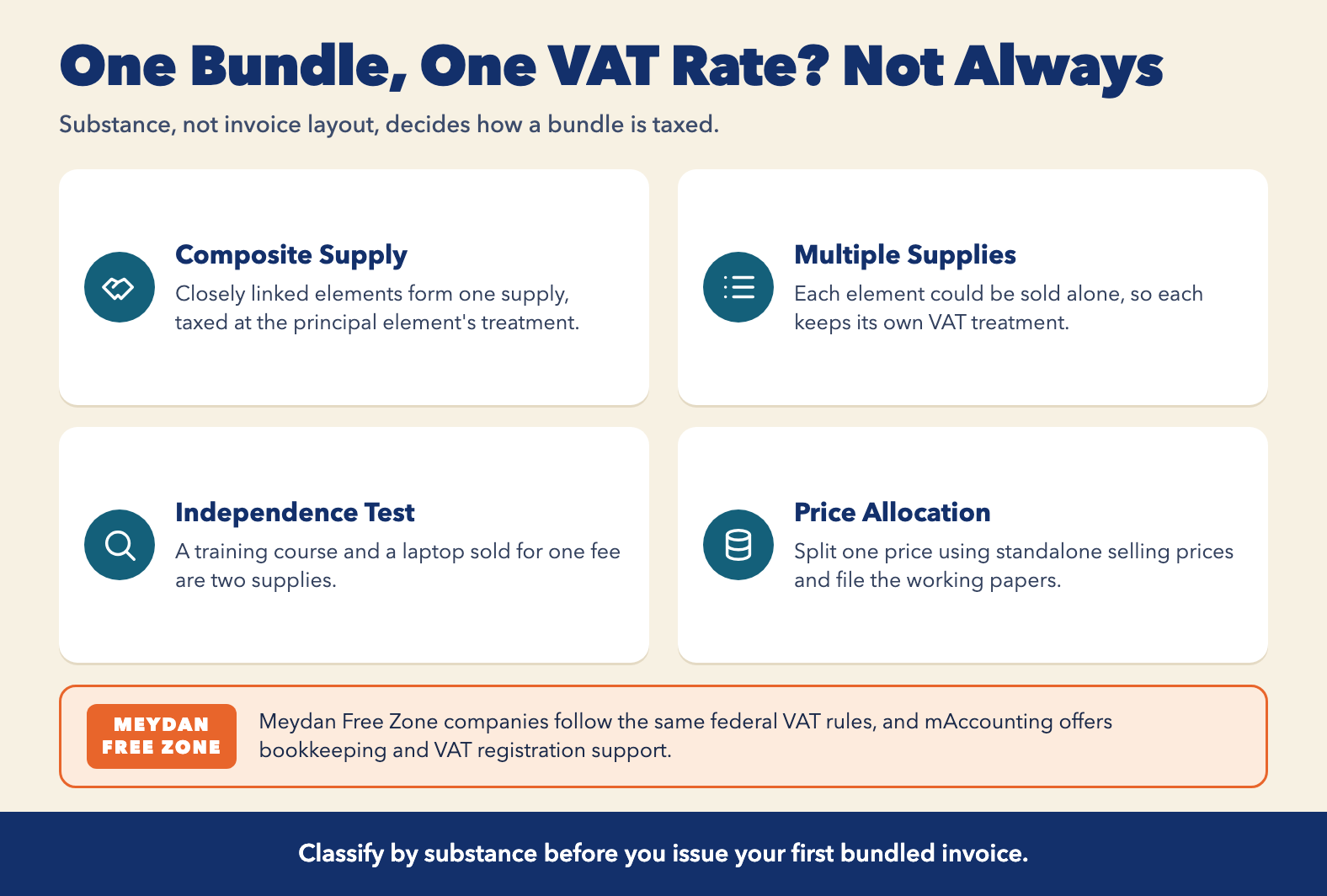
Multiple supplies are separate, independent supplies sold together, often for one price. Each keeps its own VAT treatment, so the price must be apportioned fairly. Unlike a composite supply, the tax is applied item by item.
Independence as the Deciding Test
Ask whether each element could be sold alone and still make commercial sense. A consultancy selling a training course and a laptop for one fee has two independent supplies. Bundled pricing doesn't merge them.
Apportioning One Price Across Several Supplies
- Allocate using standalone selling prices.
- Split mixed rates, such as a taxable service and an exempt residential lease.
- Keep the method consistent.
- File the working papers.
Composite Supply Under UAE VAT: Where Founders Go Wrong
Founders most often treat every bundle as one supply to simplify invoicing, or split a genuine composite supply into lines. The first risks under-charging VAT on a taxable element. The second produces inconsistent rates and credit note errors.
Letting the Invoice Decide the Treatment
Layout doesn't override substance. The FTA looks at what the customer actually receives. A software company listing a license fee and support as two lines may still have one supply if support only works with that license.
Mixing Zero-Rated and Standard-Rated Elements
Exports may qualify for 0% while local elements stay at 5%. A trader shipping goods abroad and adding local installation may need separate treatment. A wrong classification changes both output tax and input tax recovery.
How to Classify a Supply in Four Steps
To classify a supply, identify each element, test independence, find the principal element, then apply the correct treatment and record your reasoning. This sequence decides whether you tax one composite supply or several.
Step 1: List Every Element of the Sale
- Break the contract and quote into components.
- Include delivery, installation, training and support.
Step 2: Test Each Element for Independence
- Could the customer buy it separately?
- Does it have its own commercial value?
- A service plan in your price list suggests independence.
Step 3: Identify the Principal Element
- Find what the customer is really buying.
- Treat anything that only supports it, such as packaging, as ancillary.
Step 4: Apply the Rate and Document the Reasoning
- Apply 5%, 0% or exempt treatment.
- Keep a short memo with the contract.
- Tax records must be kept for five years.
Invoicing Bundled Supplies Correctly
A tax invoice for a composite supply can show one description and one VAT amount. For multiple supplies, each element should be identifiable with its own treatment. The mandatory details still apply.
Mandatory Details on the Invoice
- Supplier and customer details, TRN, date and sequential number.
- Description, taxable amount and VAT in AED.
- A bundled equipment sale can be one line at 5%.
See the UAE tax invoice requirements for the full list.
Credit Notes and Adjustments
Credit notes must follow the original classification. If a customer returns hardware but keeps a standalone support plan, only the hardware element is adjusted.
What This Means for a Meydan Free Zone Founder
A Meydan Free Zone company follows the same federal VAT rules as any UAE business, so classification still decides the VAT charged. Meydan Free Zone's mAccounting pillar, part of Meydan Plus, offers bookkeeping and VAT registration support.
Free Zone Status Does Not Change the Test
VAT is federal and administered by the FTA. Designated Zone rules apply only to qualifying goods and conditions, not every free zone sale. A hardware-and-service bundle sold to a Dubai customer is classified under the same rules.
Registration and Bookkeeping Support
Registration is mandatory above AED 375,000 and voluntary above AED 187,500. A founder with growing bundled sales should confirm treatment before the first return. Read the UAE VAT registration guide for the process.
Free Business Setup Cost Calculator
Calculate NowClassify Before You Invoice
The VAT treatment of a bundle comes down to substance: one economic supply is taxed as one, and independent items are taxed separately. Classify first, record your reasoning, and stay consistent across contracts and credit notes.
Review your current bundles against the four-step test before your next VAT return. If your company is with Meydan Free Zone, the mAccounting bookkeeping service can record each bundle the same way from the first invoice.
Ready to Launch Your Business in Dubai?
Let's Connect