Table of Contents
Frequently Asked Questions
Can an employer in the UAE treat a long-term worker as a contractor?
Only if the working reality matches a contractor arrangement. Federal Decree-Law No. 33 of 2021 describes a worker by supervision, direction and wage, not by the title in the agreement. A worker on fixed hours, a monthly retainer and company instructions is likely to be treated as an employee, whatever the contract says.
Does an independent contractor in the UAE receive end-of-service gratuity?
No. Under Federal Decree-Law No. 33 of 2021, gratuity is a statutory entitlement of full-time foreign employees with at least one year of service. A genuine contractor invoices for deliverables and has no gratuity claim. If the arrangement is really employment, the worker may claim gratuity regardless of the contract label.
Which law governs private-sector employees in the UAE?
Federal Decree-Law No. 33 of 2021, as amended, governs private-sector employment. It replaced Federal Law No. 8 of 1980. MOHRE oversees mainland private-sector employment. A Meydan Free Zone company should confirm with Meydan Free Zone which rules apply to its own staff.
Does a contractor need a license or permit to invoice a UAE company?
Yes, a contractor should hold a valid trade license or freelance permit for the activity being invoiced. Without one, the client has no assurance that the work is lawfully provided. Employers should check the license status before the first payment is made.
What happens if a worker is misclassified as a contractor?
The employer can face back claims for unpaid gratuity, leave and wages. It may also face penalties, including a fine of AED 100,000 to AED 1,000,000 for employing someone without a work permit. Disputes can reach labour authorities or the courts, where the actual working pattern carries more weight than the agreement.
Do contractors need to register for VAT in the UAE?
Registration is mandatory when annual taxable supplies exceed AED 375,000, according to the Federal Tax Authority. A VAT-registered contractor must issue tax invoices. Below that threshold, registration is not compulsory.
Can a contractor work for several clients at the same time?
Yes. Freedom to serve other clients is a mark of a genuine contractor. Heavy exclusivity terms, such as barring all other work for 12 months, point towards employment and weaken the contractor classification.
Can a free zone company hire staff on residency visas?
Yes. A Meydan Free Zone company can hire employees on residency visas. Meydan Free Zone's mResidency covers residency visas, medical fitness tests, Emirates ID, medical insurance, dependent visas and return permits. Visa services are priced separately from the license.
Topic Summary
What an Independent Contractor in the UAE Is
An independent contractor in the UAE is a self-employed person or licensed business that delivers defined work under a service agreement. The contractor controls the method, uses their own tools, invoices for results and carries their own visa, insurance and tax position.
How the UAE Classifies Workers Under Employment Law
Private-sector employment in the UAE is governed by Federal Decree-Law No. 33 of 2021, as amended. The law describes a worker as someone who works under the employer's supervision and direction in return for a wage. Status turns on how the person works, not the contract title, so calling someone a contractor removes no employer obligation if the reality is employment.
Contractor vs Employee in the UAE: Key Differences
The main differences are control, payment, benefits and sponsorship. Employees work under direction and receive a salary, gratuity and an employer-sponsored visa. Contractors set their own methods and invoice for deliverables.
Three Tests to Classify a Worker Correctly
Check three areas: who controls the work, how payment and risk are structured, and how independent the person is. The law sets no formal checklist, so treat these as practical indicators. Several answers pointing to dependence indicate employment.
Cost and Compliance Risks When Engaging an Independent Contractor in the UAE
Misclassifying an employee as a contractor can expose you to unpaid gratuity, leave and wage claims, plus penalties for missing visa or wage-system obligations. A contractor's fee may be higher, but it carries no gratuity.
What This Means for a Meydan Free Zone Employer
A Meydan Free Zone company can engage a licensed independent contractor or hire staff on residency visas. Don't assume mainland MOHRE processes apply to a free zone company. Ask Meydan Free Zone which employment rules apply to your staff before you issue contracts.
Next Steps for Employers
Classification rests on how work is controlled, paid and performed, not on the agreement's title. Map each role against the three tests. Then decide whether to hire on a residency visa or engage a licensed independent contractor. Matching the arrangement to reality reduces the risk of back claims. With Meydan Free Zone, visa services are priced separately from the license, so you can budget for each hire once you know which roles are employment.
Contractor vs Employee in the UAE: Key Differences for Employers
Staff bring visa, end-of-service and insurance costs, so engaging someone on invoice can look like the simpler choice. If the working pattern looks like employment, though, the label stops protecting anyone. How do you tell a genuine independent contractor from an employee? This article sets out the main differences, the practical tests to apply and the risks of getting it wrong.
What an Independent Contractor in the UAE Is
An independent contractor in the UAE is a self-employed person or licensed business that delivers defined work under a service agreement. The contractor controls the method, uses their own tools, invoices for results and carries their own visa, insurance and tax position.
Core Features of a Contractor Arrangement
The scope is fixed and the deliverables are defined. Picture a software consultant, licensed as a business, who builds a client's booking platform for a fixed fee and invoices on milestones. They choose their hours, method and location. The client pays invoices, not a salary.
Who Usually Works as a Contractor
- Freelancers and consultants.
- Specialist project providers.
- Holders of a freelance permit or company license.
Take a designer who works through their own Meydan Free Zone company and serves several clients at once. A valid license matters before you pay, because it shows the contractor is authorised to provide the service. It doesn't settle classification by itself. Our guide to setting up a freelancers' services business explains that route.
How the UAE Classifies Workers Under Employment Law
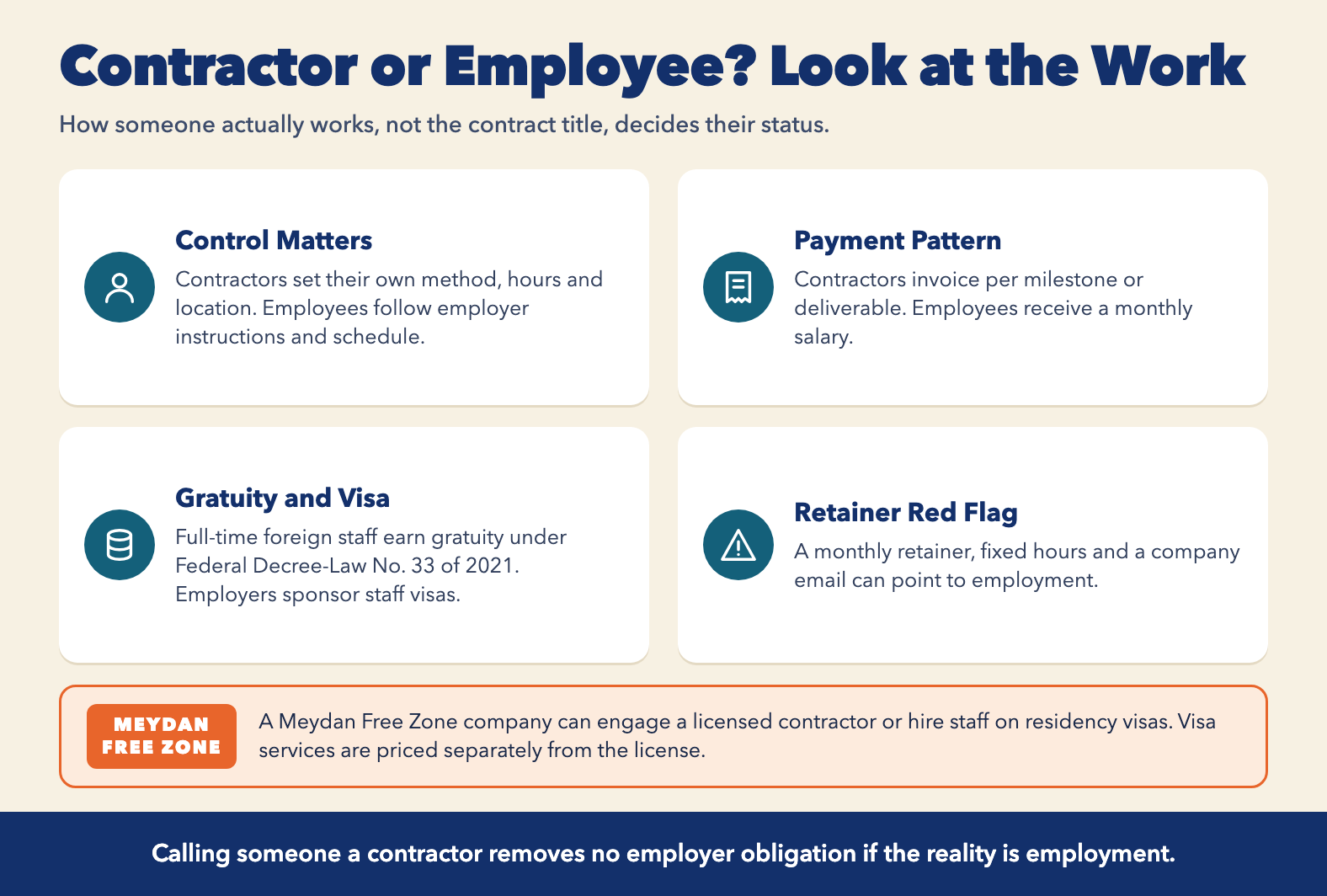
Private-sector employment in the UAE is governed by Federal Decree-Law No. 33 of 2021, as amended. The law describes a worker as someone who works under the employer's supervision and direction in return for a wage. Status turns on how the person works, not the contract title, so calling someone a contractor removes no employer obligation if the reality is employment.
Substance Over the Contract Label
A dispute is likely to turn on control, exclusivity and payment pattern. Consider a worker on a monthly retainer, fixed hours and a company email address, described as a consultant. That person is likely to be treated as an employee, whatever the agreement says.
Mainland and Free Zone Responsibilities
The Ministry of Human Resources and Emiratisation (MOHRE) oversees private-sector mainland employment. A Meydan Free Zone company handles work permits and visas through the free zone, so you shouldn't assume mainland processes apply. The UAE government portal says free zone employees are generally governed by their free zone authority's employment regulations along with Federal Decree-Law No. 33 of 2021. Confirm with Meydan Free Zone which rules apply to your staff. For background, see Dubai labour law and Meydan Free Zone.
Contractor vs Employee in the UAE Compared
| Feature | Independent Contractor | Employee |
|---|---|---|
| Control over method and hours | Sets own method, hours and location | Follows employer instructions and schedule |
| Payment basis | Invoices per milestone or deliverable | Monthly salary, paid through the Wages Protection System (WPS) on the mainland |
| End-of-service gratuity | No statutory entitlement | Full-time foreign staff entitled under Federal Decree-Law No. 33 of 2021 after one year |
| Visa and insurance responsibility | Contractor arranges own residency and cover | Employer sponsors visa and provides medical cover |
| Freedom to serve other clients | Free to work for several clients | Limited by contract and employer consent |
Contractor vs Employee in the UAE: Key Differences
The main differences are control, payment, benefits and sponsorship. Employees work under direction and receive a salary, gratuity and an employer-sponsored visa. Contractors set their own methods and invoice for deliverables.
Control, Payment and Duration
Compare a marketing manager on payroll with an agency engaged for a single campaign. The manager's role is open-ended and directed. The agency's work is project-based, and it decides how to deliver.
Entitlements, Visa and Insurance
Employees receive leave, gratuity, an employer-provided visa and medical cover. Under Federal Decree-Law No. 33 of 2021, gratuity applies to full-time foreign workers with at least one year of continuous service. It accrues at 21 days of basic wage per year for the first five years, then 30 days, capped at two years' wage. UAE nationals are covered by pension rules through the General Pension and Social Security Authority (GPSSA), and GCC nationals by the GCC pension extension system. Most employees must also subscribe to the federal unemployment insurance scheme, known as ILOE. A contractor has no such entitlement but must hold a valid license and arrange their own residency and insurance.
Where Non-Compete and Exclusivity Terms Fit
Restrictive clauses must be reasonable in scope, time and place. A contractor barred from any other client for 12 months starts to look like an employee. Read more on non-compete clauses in the UAE.
Three Tests to Classify a Worker Correctly
Check three areas: who controls the work, how payment and risk are structured, and how independent the person is. The law sets no formal checklist, so treat these as practical indicators. Several answers pointing to dependence indicate employment.
Test 1: Control Over How the Work Is Done
- Who sets hours, location and method?
- Does the worker follow internal policies?
- Example: a developer told to attend daily stand-ups and keep office hours is likely staff.
Test 2: Payment Structure and Risk
- Fixed monthly sum points to employment.
- Per-milestone invoices point to a contractor.
- A consultant who absorbs the cost of rework carries genuine risk.
Test 3: Independence, Tools and Licensing
- Freedom to serve other clients.
- Own equipment and a valid license or permit.
- Right to subcontract. A licensed consultant with their own laptop and three clients points towards contractor status.
Cost and Compliance Risks When Engaging an Independent Contractor in the UAE
Misclassifying an employee as a contractor can expose you to unpaid gratuity, leave and wage claims, plus penalties for missing visa or wage-system obligations. A contractor's fee may be higher, but it carries no gratuity.
Risks of Misclassification
Picture a worker engaged for three years on rolling invoices who later claims gratuity and leave. Disputes can reach labour authorities or courts, and the agreement's wording alone won't protect you. Federal Decree-Law No. 33 of 2021 also sets a fine of AED 100,000 to AED 1,000,000 for employing someone without a work permit.
Tax and Invoicing Obligations
- VAT registration is mandatory above AED 375,000 in annual taxable supplies, per the Federal Tax Authority.
- VAT-registered contractors must issue tax invoices.
- Companies, including free zone companies, must register for Corporate Tax. An individual trading in their own name comes into scope above AED 1 million in turnover per calendar year.
- Meydan Free Zone's mAccounting covers bookkeeping, VAT registration support and Corporate Tax support.
Drafting the Agreement Properly
Cover scope, deliverables, payment terms, IP, termination, governing law and dispute terms. A services agreement that defines milestones and allows subcontracting helps. But it supports the classification only if the actual working pattern matches. See our guide to UAE contract law clauses.
What This Means for a Meydan Free Zone Employer
A Meydan Free Zone company can engage a licensed independent contractor or hire staff on residency visas. Don't assume mainland MOHRE processes apply to a free zone company. Ask Meydan Free Zone which employment rules apply to your staff before you issue contracts.
Choosing Between Hiring and Engaging
Ongoing, directed roles suit employment. Defined projects with specialist skills suit contractors. A trading company might hire a full-time operations coordinator but engage a contractor for a one-off website build.
Visa and Accounting Support Through Meydan Plus
- mResidency: residency visas, medical fitness test, Emirates ID, medical insurance, dependent visas, return permits.
- mAccounting: bookkeeping, VAT registration support, Corporate Tax support.
- Visa services are priced separately from the license.
A founder can use mResidency for a first employee's visa and mAccounting for bookkeeping and VAT registration support. Our guide on hiring your first employee covers the sequence.
Free Business Setup Cost Calculator
Calculate NowNext Steps for Employers
Classification rests on how work is controlled, paid and performed, not on the agreement's title. Map each role against the three tests. Then decide whether to hire on a residency visa or engage a licensed independent contractor. Matching the arrangement to reality reduces the risk of back claims. With Meydan Free Zone, visa services are priced separately from the license, so you can budget for each hire once you know which roles are employment.
Ready to Launch Your Business in Dubai?
Let's Connect