

Table of Contents
Frequently Asked Questions
Do UAE holding companies pay Corporate Tax on dividends from foreign subsidiaries?
Not when the shareholding qualifies for the participation exemption under Federal Decree-Law No. 47 of 2022. The holding company must own at least 5% of the subsidiary, or have paid at least AED 4 million for it. It must also hold the stake for 12 months, and the subsidiary must be subject to a headline tax rate of at least 9%. Dividends that fail these tests are taxable at 9% above AED 375,000.
What minimum shareholding qualifies for the exemption on dividends and gains?
A holding company must own at least 5% of the shares or equity interest in the subsidiary. The alternative is an acquisition cost of at least AED 4 million. Meeting either test satisfies the ownership condition, so a 4% stake costing AED 5 million can still qualify. Ministerial Decision No. 116 of 2023 sets out the detail.
How long must a holding company keep its shares to qualify?
The holding company must hold the shares for an uninterrupted 12 months, or intend to hold them for that period. Selling a stake after 10 months can make the gain taxable at 9%. Keep acquisition dates and board approvals on file to show the holding period.
Does a holding company with only exempt income still need to register for Corporate Tax?
Yes. Every UAE holding company must register with the Federal Tax Authority, including companies whose income is exempt or taxed at 0%. Exempt income still has to be recorded in financial statements and claimed in the Corporate Tax return. A return is due within nine months of the financial year end.
Can a free zone holding company benefit from the 0% rate and the exemption together?
Yes. A Qualifying Free Zone Person can pay 0% on qualifying income, and holding shares for investment purposes is a qualifying activity. The participation exemption also applies separately to qualifying shareholdings. Non-qualifying income above the de minimis limits can remove the 0% rate, so records should show which relief covers each income stream.
Are capital losses on qualifying shareholdings deductible?
No. Where a gain on a qualifying shareholding would be exempt, a loss on that same shareholding is not deductible for Corporate Tax. This keeps the treatment consistent in both directions. Losses on shareholdings that fail the conditions need separate review.
Is withholding tax charged on dividends paid by a UAE holding company?
No. The UAE applies a 0% withholding tax rate on dividends and other payments to non-residents. Foreign countries may still withhold tax on dividends paid into the UAE company, depending on their own rules and any treaty.
What records should a holding company keep to support an exemption claim?
Keep share purchase agreements, board approvals, acquisition dates and cost evidence for each subsidiary. Add proof of the subsidiary's tax residency and headline tax rate. A shareholding schedule helps the Federal Tax Authority verify each condition. Meydan Free Zone issues the Share Register and Memorandum and Articles of Association digitally, which support the ownership evidence.
Topic Summary
What the Participation Exemption in the UAE Covers
The participation exemption removes dividends and capital gains from taxable income when they come from qualifying shareholdings. Under Federal Decree-Law No. 47 of 2022, the holding must meet ownership, holding period and subsidiary tax conditions. Income that fails the tests stays taxable at 9% above AED 375,000, with 0% below that level. For wider context, see our guide to corporate tax exemptions in the UAE.
Conditions a Holding Company Must Meet
A holding company qualifies for the participation exemption when it owns at least 5% of the subsidiary's shares or equity interest, or the acquisition cost is at least AED 4 million. It must hold the stake for 12 months, and the subsidiary must be subject to a headline tax rate of at least 9%. Ministerial Decision No. 116 of 2023 sets the detail.
Free Zone Holding Companies and the 0% Rate
A free zone holding company pays 0% Corporate Tax only as a Qualifying Free Zone Person on qualifying income. Holding shares and other securities for investment purposes is a qualifying activity under Ministerial Decision No. 229 of 2025, so income from it can be qualifying income. Other income may be taxed at 9%, and the participation exemption still applies independently to qualifying shareholdings.
Registration and Filing Duties
Every UAE holding company must register for Corporate Tax with the FTA, including exempt and 0% companies. Registration runs through EmaraTax. The participation exemption is claimed in the return, not assumed.
Structuring a Holding Company in Meydan Free Zone
A Meydan Free Zone holding structure gives you a digitally issued Business License, Share Register and Memorandum and Articles of Association in one place. It supports holding shares and receiving dividends, while tax treatment depends on meeting the participation exemption and Qualifying Free Zone Person conditions.
Common Mistakes That Cost Holding Companies the Exemption
The most common mistakes are selling before the 12-month period ends, missing the 5% or AED 4 million threshold, ignoring the subsidiary's tax rate and failing to register. Poor records also weaken an exemption claim, because the FTA can ask for evidence of each condition.
Conclusion
The participation exemption rewards holding companies that treat the conditions as an operating checklist: ownership, holding period, subsidiary tax rate and records. Map each shareholding against the conditions, confirm the license activity, and plan registration and filing before you acquire or sell a stake. In Meydan Free Zone, the Share Register is issued digitally, giving you a ready ownership record behind each claim.
Corporate Tax for UAE Holding Companies: Key Rules and Requirements
Founders often assume that holding shares in the UAE means paying no tax. In practice, the Federal Tax Authority (FTA) expects a holding company to register, file and prove that each relief applies, and the main relief only works when its conditions are met and documented. This guide covers those conditions, the free zone position and the filing duties, so you can settle the structure before you acquire or sell a stake.
What the Participation Exemption in the UAE Covers
The participation exemption removes dividends and capital gains from taxable income when they come from qualifying shareholdings. Under Federal Decree-Law No. 47 of 2022, the holding must meet ownership, holding period and subsidiary tax conditions. Income that fails the tests stays taxable at 9% above AED 375,000, with 0% below that level. For wider context, see our guide to corporate tax exemptions in the UAE.
Dividends and Profit Distributions
Dividends from a qualifying subsidiary are exempt at the level of the UAE recipient company. Say a Dubai holding company receives a dividend from a wholly owned operating subsidiary abroad. It excludes that dividend from taxable income once the conditions are met.
The income still appears in the financial statements. Exempt does not mean unrecorded.
Capital Gains on Share Disposals
Gains on selling a qualifying shareholding are exempt. Losses on the same shareholdings are not deductible, so the relief cuts both ways. Say a founder sells a 30% stake held through a holding company after 18 months: if the other conditions are met, the gain is exempt. Reorganisation gains need separate review.
Participation Exemption Conditions at a Glance
| Condition | Requirement |
|---|---|
| Minimum ownership | At least 5% of shares or equity interest |
| Alternative cost test | Acquisition cost of at least AED 4 million |
| Holding period | 12 months, held or intended to be held |
| Subsidiary tax | Headline rate of at least 9% |
| Covered income | Mainly dividends and capital gains |
Conditions a Holding Company Must Meet
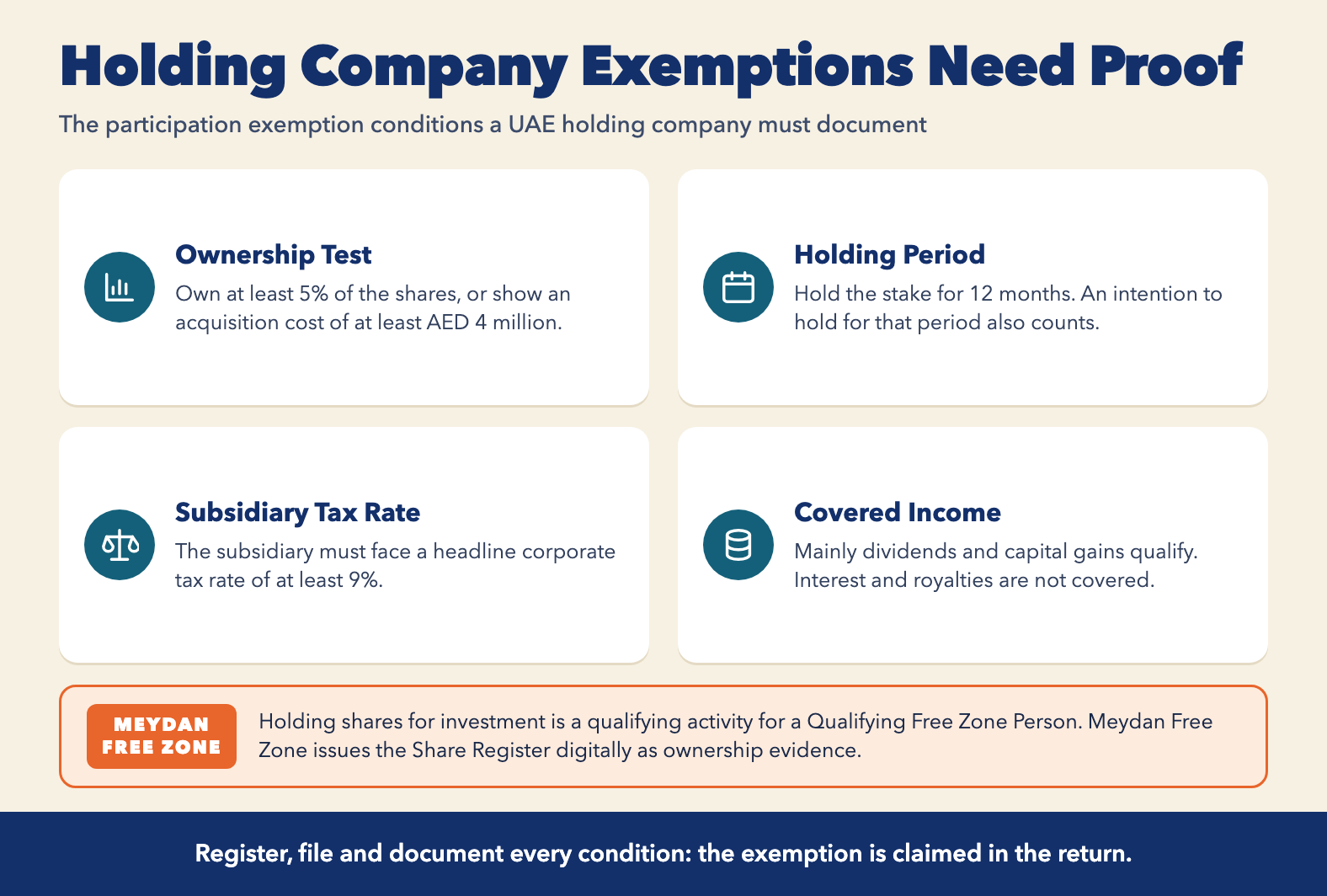
A holding company qualifies for the participation exemption when it owns at least 5% of the subsidiary's shares or equity interest, or the acquisition cost is at least AED 4 million. It must hold the stake for 12 months, and the subsidiary must be subject to a headline tax rate of at least 9%. Ministerial Decision No. 116 of 2023 sets the detail.
Ownership and Holding Period Tests
- Own at least 5%, or show a cost of AED 4 million.
- Hold the stake without interruption for 12 months.
- An intention to hold for that period also counts.
- Example: a 4% stake costing AED 5 million qualifies on cost, not percentage.
Subsidiary Tax Rate and Income Profile
The subsidiary must face a headline corporate tax rate of at least 9%. A subsidiary in a low-tax jurisdiction below that rate does not qualify, so its dividends are taxable. The law also applies an asset test to the subsidiary, so check how its assets are made up. Keep foreign tax evidence on file.
Where the Exemption Does Not Apply
- Stakes that fail any one condition.
- Income taxed through a transparent entity needs separate analysis.
- Interest and royalties are not covered.
- A loan to a subsidiary produces taxable interest income.
Free Zone Holding Companies and the 0% Rate
A free zone holding company pays 0% Corporate Tax only as a Qualifying Free Zone Person on qualifying income. Holding shares and other securities for investment purposes is a qualifying activity under Ministerial Decision No. 229 of 2025, so income from it can be qualifying income. Other income may be taxed at 9%, and the participation exemption still applies independently to qualifying shareholdings.
Qualifying Income for Holding Structures
Non-qualifying income can remove the 0% rate if it exceeds the de minimis limits. A company earning only dividends from qualifying holdings is in a simpler position. Add unrelated mainland trading income and that status is at risk. Adequate substance in the free zone is also required. Our guide on qualifying vs non-qualifying income covers the limits.
Why the Two Reliefs Work Together
The participation exemption removes income from the tax base. Qualifying Free Zone Person status protects the remaining free zone income. A holding company might report a dividend under the exemption and a service fee under its qualifying position. Your records should show which relief covers each stream.
Registration and Filing Duties
Every UAE holding company must register for Corporate Tax with the FTA, including exempt and 0% companies. Registration runs through EmaraTax. The participation exemption is claimed in the return, not assumed.
Numbered Steps From Registration to Return
- Register for Corporate Tax with the Federal Tax Authority.
- Keep shareholding records, acquisition dates and cost evidence.
- Prepare financial statements for the tax period.
- Claim the participation exemption in the return.
- File and pay within nine months of year end.
A company with a 31 December year end files by 30 September of the following year.
Records Auditors and the Authority Expect
- Share purchase agreements and board approvals.
- Evidence of each subsidiary's tax rate.
- Audited statements where Qualifying Free Zone Person status applies.
- One holding file per subsidiary, with dates, cost and tax residency proof.
Support Inside Meydan Free Zone
Meydan Free Zone's mAccounting pillar covers bookkeeping, VAT registration support and Corporate Tax support. Its Corporate Tax support covers registration and return filing, so a holding company can keep its records and first return with one provider. Support does not guarantee any outcome.
Structuring a Holding Company in Meydan Free Zone
A Meydan Free Zone holding structure gives you a digitally issued Business License, Share Register and Memorandum and Articles of Association in one place. It supports holding shares and receiving dividends, while tax treatment depends on meeting the participation exemption and Qualifying Free Zone Person conditions.
Choosing the Right Activity on the License
Match the license activity to holding and investment, and confirm it before incorporation. Adding trading changes the tax analysis. A founder with three overseas subsidiaries can license the entity for holding only and keep trading in a separate company. Our holding company license guide sets out the requirements.
Documents Issued After Registration
- Business License and Certificate of Formation.
- Share Register and Memorandum and Articles of Association.
- All issued digitally by Meydan Free Zone.
- The Share Register evidences ownership for later due diligence.
Compared with a founder holding shares personally, a free zone company adds filing duties but gives you a structured record and access to Qualifying Free Zone Person conditions.
Free Business Setup Cost Calculator
Calculate NowCommon Mistakes That Cost Holding Companies the Exemption
The most common mistakes are selling before the 12-month period ends, missing the 5% or AED 4 million threshold, ignoring the subsidiary's tax rate and failing to register. Poor records also weaken an exemption claim, because the FTA can ask for evidence of each condition.
Timing and Threshold Errors
- Selling at month 10 can make the gain taxable at 9%.
- Aggregating stakes incorrectly.
- Misreading the cost test.
Registration and Evidence Gaps
Many founders assume exempt income means no registration. A dormant holding company that skips registration because it has no taxable income still faces the AED 10,000 late registration penalty. Missing foreign tax rate evidence and having no shareholding schedule cause similar trouble.
Conclusion
The participation exemption rewards holding companies that treat the conditions as an operating checklist: ownership, holding period, subsidiary tax rate and records. Map each shareholding against the conditions, confirm the license activity, and plan registration and filing before you acquire or sell a stake. In Meydan Free Zone, the Share Register is issued digitally, giving you a ready ownership record behind each claim.
Ready to Launch Your Business in Dubai?
Let's ConnectReferences
- Federal Tax Authority (FTA), UAE, Corporate Tax guidance, 2026