Table of Contents
Frequently Asked Questions
Why do UAE banks ask so many questions about a new company?
A new company has no trading history, so the bank cannot judge it by past performance. Banks must complete customer due diligence under Central Bank of the UAE expectations. That means verifying the entity, the shareholders and the ultimate beneficial owner, and understanding the business activity and expected transactions.
Can a company with no trading history open a business bank account in the UAE?
Yes, newly formed companies open accounts regularly. The bank relies on the founders' background, the ownership structure and a clear business plan instead of financial history. A complete file with realistic transaction projections improves the position, though each bank makes its own decision.
Do non-resident shareholders affect how a bank assesses a company?
Non-resident owners can still apply, but banks usually ask more questions. A resident founder with an Emirates ID and a UAE address is easier to verify. Non-resident shareholders should be ready to explain why the company is based in the UAE and to provide proof of address and source of wealth.
What documents do banks ask for beyond the trade license?
Banks typically request the Certificate of Formation, Memorandum and Articles of Association, Share Register, shareholder passports and Emirates ID, proof of address and a business profile. Meydan Free Zone issues the Business License, Certificate of Formation, Share Register and Memorandum and Articles of Association digitally after registration. Requirements vary by bank and risk profile.
Does the licensed activity need to match the real business for bank approval?
Yes. Banks compare the activity on the license with the website, contracts and business profile. A mismatch, such as a consulting license for a goods-trading business, is a common reason for delays or rejection. Choose activities that reflect what the company will actually do.
Can a bank reject an account after the company is fully licensed?
Yes. A license confirms the company exists but does not approve it for banking. Each bank applies its own risk appetite on top of regulatory requirements. Weak documentation, unclear source of funds or high-risk activities can lead to rejection even when the license is valid.
How does source of funds affect a bank's decision?
Banks need to know where the initial capital comes from and how the owner built their wealth. Evidence can include salary records, a business sale agreement or bank statements. Unclear or unsupported funds are a major red flag and often extend the review.
Does mCore guarantee that a bank will approve an account?
No. mCore, part of Meydan Plus, provides business bank account support alongside company stamps, business cards and e-commerce setup. This helps founders prepare the application file, but the approval decision rests entirely with the bank.
Topic Summary
What Banks Check Before Opening a Business Bank Account in the UAE
UAE banks assess a newly formed company through customer due diligence. They verify the legal entity, identify shareholders and the ultimate beneficial owner (UBO), review the activity and expected transactions, and screen for financial crime risk. The decision rests on risk, not on the license alone.
How Banks Assess Shareholders and Ownership Structure
Banks identify every shareholder and the UBO, then review nationality, residency, professional background and source of wealth. Simple structures with individual shareholders clear faster. Layered ownership or unclear control slows the review, because the bank must trace each person behind the company.
Company Bank Account Requirements: Documents Banks Expect
Banks typically ask for the Business License, Certificate of Formation, Memorandum and Articles of Association, Share Register, shareholder passports and Emirates ID, proof of address, a business profile and expected transaction details. Requirements vary by bank and risk profile, so complete the file before you submit.
How the Bank Assessment Process Runs in Order
The assessment runs from initial screening and document collection to verification, business model review, compliance screening and a final decision. Banks can request more information at any stage, which extends the timeline. No timeline is guaranteed.
Red Flags That Slow or Stop a Business Bank Account in the UAE
Common red flags include inconsistent documents, vague activity, unclear source of funds, complex ownership, high-risk sectors and unrealistic projections. Slow replies to compliance queries count against you too. See why business bank account applications get rejected in the UAE for more.
How a Meydan Free Zone Structure Supports Bank Review
Meydan Free Zone issues the Business License, Certificate of Formation, Share Register and Memorandum and Articles of Association digitally, giving banks a clear corporate file. Through mCore, part of Meydan Plus (mPlus), it offers business bank account support. This helps preparation but doesn't guarantee approval.
Preparing Your Company Before You Approach a Bank
Prepare a clear ownership structure, license activities that match the real business, a written profile with realistic transaction expectations and proof of source of funds. Preparation reduces delays, though each bank decides independently.
How UAE Banks Assess a Newly Formed Company
Most founders assume the trade license is the hard part and the bank account follows. Banks see it differently: a new company has no trading history, so the bank assesses the people, the structure and the plan first. This guide explains what banks check, which documents they expect and how the review runs. It also covers how to prepare your company before you approach a bank.
What Banks Check Before Opening a Business Bank Account in the UAE
UAE banks assess a newly formed company through customer due diligence. They verify the legal entity, identify shareholders and the ultimate beneficial owner (UBO), review the activity and expected transactions, and screen for financial crime risk. The decision rests on risk, not on the license alone.
Why a License Is Not an Approval
A license proves the company exists. It doesn't prove the business is low risk. Each bank applies its own risk appetite on top of regulator expectations.
Say a consultant founder holds a valid license but can't explain who the clients are or where payments come from. The bank pauses the file, despite complete paperwork.
The Regulatory Frame Banks Work Within
Banks are licensed and supervised by the Central Bank of the UAE. Anti-money laundering and counter-terrorist financing duties drive due diligence, so the bank must understand ownership, source of funds and the purpose of the account. That's why a compliance team may ask for a shareholder chain chart: it needs the natural person behind a holding entity.
How Banks Assess Shareholders and Ownership Structure
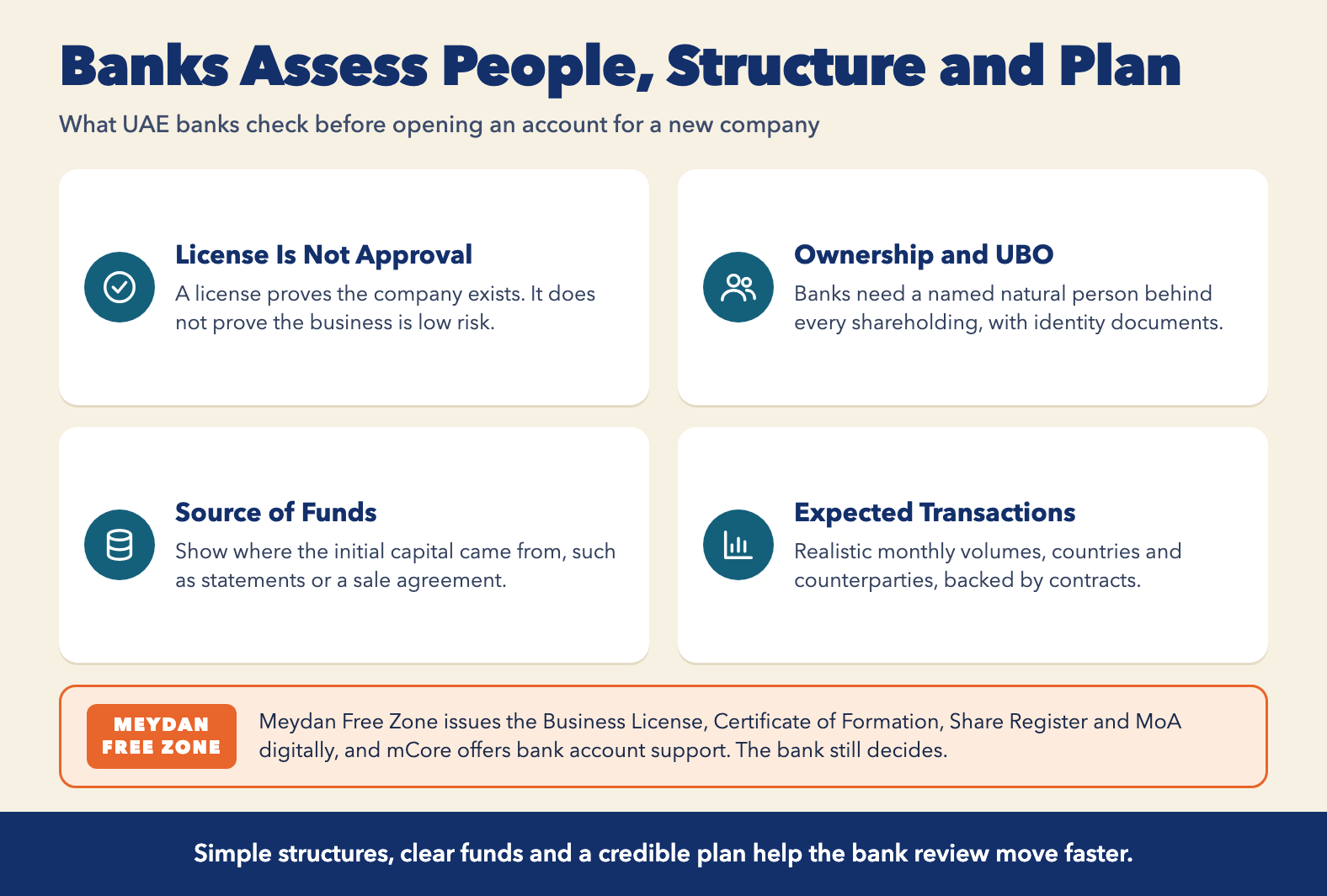
Banks identify every shareholder and the UBO, then review nationality, residency, professional background and source of wealth. Simple structures with individual shareholders clear faster. Layered ownership or unclear control slows the review, because the bank must trace each person behind the company.
Individual Shareholders Versus Corporate Shareholders
A sole individual shareholder supplies a passport and proof of address. A founder holding shares through an overseas holding company supplies registry extracts, incorporation documents and a structure chart. Each layer adds documents and review time. The free zone company structure for easy bank opening usually starts with fewer layers.
What Banks Review and Why
| Area Reviewed | What the Bank Looks For |
|---|---|
| Ownership and UBO | A named natural person behind every shareholding, with identity documents |
| Business activity | Licensed activities that match the real clients, suppliers and services |
| Source of funds | Evidence of where the initial capital came from, such as statements or a sale agreement |
| Expected transactions | Realistic monthly volumes, countries and counterparties backed by contracts |
| Compliance screening | No sanctions or adverse media matches, and no high-risk jurisdiction exposure |
Residency and Connection to the UAE
- A resident founder with an Emirates ID and a local lease is easier to verify.
- Non-resident owners can apply but face more questions.
- A clear reason for the UAE company helps the file.
Source of Funds and Source of Wealth
Source of funds explains where the initial capital comes from. Source of wealth explains how the owner built their assets. A founder who sold a previous business provides the sale agreement and proof of proceeds. Others use salary history or bank statements.
Company Bank Account Requirements: Documents Banks Expect
Banks typically ask for the Business License, Certificate of Formation, Memorandum and Articles of Association, Share Register, shareholder passports and Emirates ID, proof of address, a business profile and expected transaction details. Requirements vary by bank and risk profile, so complete the file before you submit.
Corporate Documents
- Business License, Certificate of Formation, Share Register and Memorandum and Articles of Association.
- Meydan Free Zone issues these digitally after registration.
- Lease or workspace documents showing a compliant registered address.
Personal and Business Profile Documents
- Passports, visas and Emirates ID for signatories and shareholders.
- A CV or professional profile.
- A business profile covering clients, suppliers, countries and expected monthly volumes.
Supporting Evidence for the Business Model
Contracts, quotations or invoices show real activity. A software services company, for example, shows a signed client agreement that matches its licensed activity. Your website should match too.
How the Bank Assessment Process Runs in Order
The assessment runs from initial screening and document collection to verification, business model review, compliance screening and a final decision. Banks can request more information at any stage, which extends the timeline. No timeline is guaranteed.
Step 1: Initial Screening and Onboarding
- The bank checks nationality, activity and structure against its risk appetite.
- Some activities are declined before any document is reviewed.
Step 2: Verification and Compliance Review
- Identity, UBO and address are verified.
- Sanctions and adverse media screening runs.
- A name match triggers manual review and a clarification request.
Step 3: Business Model Review and Decision
- Compliance asks about clients, suppliers and payment flows.
- Answers must match the written profile.
- Approval is followed by activation and online banking set-up.
Red Flags That Slow or Stop a Business Bank Account in the UAE
Common red flags include inconsistent documents, vague activity, unclear source of funds, complex ownership, high-risk sectors and unrealistic projections. Slow replies to compliance queries count against you too. See why business bank account applications get rejected in the UAE for more.
Mismatches Between License and Business Plan
A company licensed for consulting that describes physical goods trading to the bank creates an immediate conflict. Banks compare the website, contracts and profile against the license.
Unrealistic Projections and Poor Responsiveness
A founder who projects large monthly inflows with no client contracts invites doubt. Treat every compliance query as urgent.
How a Meydan Free Zone Structure Supports Bank Review
Meydan Free Zone issues the Business License, Certificate of Formation, Share Register and Memorandum and Articles of Association digitally, giving banks a clear corporate file. Through mCore, part of Meydan Plus (mPlus), it offers business bank account support. This helps preparation but doesn't guarantee approval.
Clean, Digitally Issued Corporate Documents
You can share the digital document set directly with the bank's onboarding team. Consistent documents mean fewer queries. Review the bank requirements for Meydan Free Zone company setup before you apply.
Where mCore Fits in Bank Account Preparation
mCore covers business bank account support, company stamps, business cards and e-commerce setup. Use it to prepare the application file before approaching a bank. The bank still makes its own decision.
Essential Services for Entrepreneurs and Startups
Explore mCorePreparing Your Company Before You Approach a Bank
Prepare a clear ownership structure, license activities that match the real business, a written profile with realistic transaction expectations and proof of source of funds. Preparation reduces delays, though each bank decides independently.
Align Activities, Structure and Story
- Choose the right activities on one license.
- Keep ownership simple where possible.
- Align the license, website and client contracts.
Compare Banks and Keep a Backup
Banks differ in appetite by sector and nationality. Compare fees and minimum balances before deciding, then apply to two banks in parallel. The World Bank publishes broader context on financial access.
Conclusion
Banks assess a new company by its people, structure and plan, not the license alone. Meeting bank account requirements means a complete file, a consistent story and realistic expectations. A Meydan Free Zone company receives its Business License, Certificate of Formation, Share Register and Memorandum and Articles of Association digitally, so the corporate part of the bank file is ready when the license is issued.
Ready to Launch Your Business in Dubai?
Let's Connect