

Table of Contents
Frequently Asked Questions
Is the end-of-service savings scheme compulsory for UAE employers?
No. The savings scheme is an optional alternative to traditional gratuity for private-sector and free zone employers. Gratuity under Federal Decree-Law No. 33 of 2021 remains the default obligation where an employer does not opt in. MOHRE publishes the current eligibility rules and framework.
How is gratuity calculated for an employee with seven years of service in the UAE?
Gratuity is based on basic wage only. The employee receives 21 days of basic wage for each of the first five years and 30 days for each year after that. For seven years, that is 105 days for years one to five plus 60 days for years six and seven, a total of 165 days of basic wage.
Do allowances count towards end-of-service gratuity?
No. Gratuity is calculated on basic salary, not on housing, transport or other allowances. Including allowances is a common error that leads to overpayment or disputed settlements. The employee must also have completed at least one year of continuous service to qualify.
What is the maximum gratuity an employee can receive in the UAE?
Total gratuity cannot exceed two years' wage. This cap is set by Article 51 of Federal Decree-Law No. 33 of 2021. It matters most for long-serving staff, whose calculated entitlement may otherwise rise above that limit.
Can an employer move existing staff from gratuity to the savings scheme?
Eligibility and transition rules are set by MOHRE, so the answer depends on the current framework. Employers can enrol all staff or only selected groups, so some start with new hires while existing staff stay on gratuity. Whatever you choose, record the treatment for each employee group in employment documents and payroll.
What happens to an employee's scheme balance when they leave the company?
The employee is entitled to the contributions and returns within 14 days of the end of employment, and can choose to leave the money invested. Because the funds are invested, the final amount can rise or fall with performance unless a capital-protected option applies. This differs from gratuity, which is calculated from final basic salary and length of service.
Who regulates the investment side of the end-of-service savings scheme?
MOHRE sets the employment framework for the scheme. The Securities and Commodities Authority approves the investment funds and handles complaints about fund providers. The employer's responsibility is to pay contributions correctly, within 15 days of the start of each month.
Topic Summary
What the End-of-Service Savings Scheme Is
The end-of-service savings scheme is an optional alternative to traditional gratuity, open to employers and employees in the private sector and free zones. Instead of a lump sum at exit, the employer pays monthly contributions into an investment fund approved by the Securities and Commodities Authority. The employee receives the contributions and returns when service ends, under rules set by the Ministry of Human Resources and Emiratisation (MOHRE).
How the Savings Scheme Differs From Traditional Gratuity
Traditional gratuity is a liability the employer calculates at exit from final basic salary. The savings scheme converts it into regular contributions invested during employment. The employer funds the benefit gradually, and the payout is no longer a single unplanned cash event. The balance follows investment performance, although a capital-protected option exists.
Cost and Cash Flow Effects for Employers
Under gratuity, cost builds as an accrual and peaks at exit. Under the savings scheme, employers pay monthly contributions of 5.83% of basic salary for staff with under five years' service and 8.33% after that. The decision is about cash flow timing, balance sheet treatment and payroll administration, not about reducing what the employee is owed.
Steps to Decide Between Gratuity and the Savings Scheme
To decide, confirm which framework covers your employees, list current gratuity exposure, compare cash flow under both models, review the scheme's investment options, and brief your payroll provider. Document the choice for each employee group so end-of-service treatment stays consistent when departures occur.
How the Scheme Applies to a Meydan Free Zone Company
The savings scheme is open to free zone employers as well as mainland ones, so a Meydan Free Zone company can consider it. Check the enrolment steps with MOHRE and your free zone authority before choosing. Meydan Free Zone's mAccounting covers bookkeeping, which helps keep contributions and gratuity accruals separate and easy to track.
Common Mistakes With End-of-Service Benefits
The most common mistakes are calculating gratuity on total pay instead of basic salary, ignoring unpaid leave in service length, failing to record accruals, and assuming the savings scheme applies automatically. Each one surfaces at exit, when the payout is already contested.
Conclusion
End-of-service benefits remain a legal obligation, whether you fund them through gratuity or the savings scheme. The better decision comes from the numbers on your own payroll, not from the scheme's headline appeal. List your employees by tenure and basic salary, compare the two models on cash flow, and confirm the applicable framework before your next hire. The scheme is open to free zone employers, so a Meydan Free Zone company can weigh it against gratuity, with mAccounting covering the bookkeeping for either model.
End-of-Service Savings Schemes in the UAE
End-of-service gratuity sits on most UAE employers' books as an unfunded liability that only falls due when someone leaves. When a long-serving hire exits, the whole payout can land in a single month. The voluntary savings scheme under Cabinet Resolution No. 96 of 2023 lets employers fund the benefit monthly instead. This guide compares both models so you can choose before you fix payroll or a hiring plan.
What the End-of-Service Savings Scheme Is
The end-of-service savings scheme is an optional alternative to traditional gratuity, open to employers and employees in the private sector and free zones. Instead of a lump sum at exit, the employer pays monthly contributions into an investment fund approved by the Securities and Commodities Authority. The employee receives the contributions and returns when service ends, under rules set by the Ministry of Human Resources and Emiratisation (MOHRE).
Gratuity Under Federal Decree-Law No. 33 of 2021
Under Article 51 of Federal Decree-Law No. 33 of 2021, gratuity is 21 days of basic wage for each of the first five years of service. It rises to 30 days for each year after that. Total gratuity cannot exceed two years' wage. It uses basic salary, not allowances, and needs at least one year of continuous service.
Say a manager earns AED 12,000 basic and leaves after seven years. Taking the daily wage as basic salary divided by 30, the common method, gives AED 400. Years one to five give 105 days (AED 42,000). Years six and seven give 60 days (AED 24,000). The payout is AED 66,000, well under the cap. For a wider employee view, see the end of service benefits Dubai guide.
Gratuity Compared With the Savings Scheme
| Feature | Traditional Gratuity | Savings Scheme |
|---|---|---|
| Funding timing | Paid at exit; nothing leaves the bank until then | Funded gradually during employment |
| Calculation basis | Final basic salary and years served (21-day and 30-day bands) | Contributions made plus investment performance |
| Employer cash flow | Irregular, with a spike at each departure | Predictable monthly outflow |
| Investment exposure | None; the amount is fixed by law | Balance follows investment performance; a capital-protected option exists |
| Payout event | Single lump sum in the final settlement | Accumulated balance released at end of service |
Where the Savings Scheme Fits
The scheme is an employer option, not a requirement imposed on every business. Employers can enrol all staff, specific groups or selected job categories. Picture a 40-person consultancy that puts new hires on the scheme while existing staff stay on gratuity. Confirm current eligibility with MOHRE before you commit.
How the Savings Scheme Differs From Traditional Gratuity
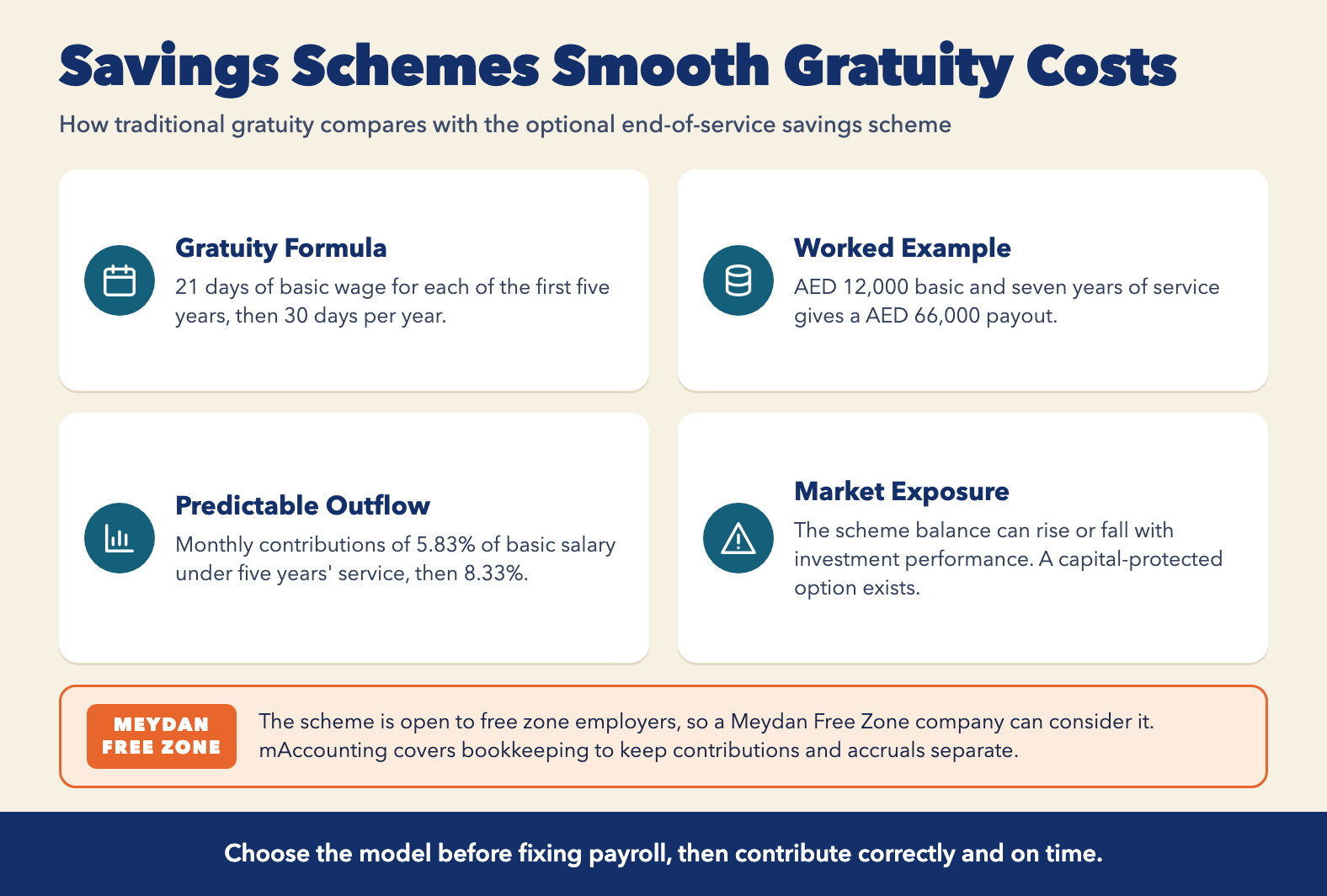
Traditional gratuity is a liability the employer calculates at exit from final basic salary. The savings scheme converts it into regular contributions invested during employment. The employer funds the benefit gradually, and the payout is no longer a single unplanned cash event. The balance follows investment performance, although a capital-protected option exists.
Funding Model and Investment Oversight
Gratuity is an accrued liability. The scheme is a funded account. The Securities and Commodities Authority approves the investment funds the scheme uses. Take two companies with identical headcount: one carries a growing accrual, the other contributes on schedule. Your job under the scheme is to pay contributions within 15 days of the start of each month.
Employee Outcomes and Employer Exposure
Gratuity follows final basic salary. The scheme follows contributions made. An employee leaving after six years could receive a different figure under each model, and market returns may push the scheme balance up or down. Disputes over unpaid end-of-service pay follow the usual labour complaint routes, described in our guide to labour disputes in Dubai.
Cost and Cash Flow Effects for Employers
Under gratuity, cost builds as an accrual and peaks at exit. Under the savings scheme, employers pay monthly contributions of 5.83% of basic salary for staff with under five years' service and 8.33% after that. The decision is about cash flow timing, balance sheet treatment and payroll administration, not about reducing what the employee is owed.
Accrual Versus Contribution Timing
Gratuity cost is irregular because it follows departures. Scheme contributions are a recurring cost inside the payroll budget. For example, a company paying AED 600,000 a year in basic salaries, all to staff with under five years' service, would contribute about AED 35,000 a year at 5.83%.
Payroll and Accounting Treatment
Record contributions accurately in payroll and the books. Salary payment compliance sits alongside end-of-service funding, so read the wage protection system guide too. A sensible founder asks the accountant to separate gratuity accruals from scheme contributions in monthly reporting. mAccounting from Meydan Free Zone covers bookkeeping, VAT registration support and Corporate Tax support.
Steps to Decide Between Gratuity and the Savings Scheme
To decide, confirm which framework covers your employees, list current gratuity exposure, compare cash flow under both models, review the scheme's investment options, and brief your payroll provider. Document the choice for each employee group so end-of-service treatment stays consistent when departures occur.
Step 1: Confirm Your Regulatory Position
- Check if staff fall under MOHRE or a free zone framework.
- Group employees by contract date and tenure.
- Separate mainland branch staff from free zone staff.
Step 2: Quantify Current Gratuity Exposure
- Calculate accruals on basic salary using the 21-day and 30-day bands.
- Flag anyone approaching five years of service.
- Build a spreadsheet showing exposure per employee.
Step 3: Compare Cash Flow and Record the Decision
- Model both options over a three-year hiring plan.
- Test it with a realistic case, such as ten hires in three years.
- Record the choice in contracts and payroll set-up.
How the Scheme Applies to a Meydan Free Zone Company
The savings scheme is open to free zone employers as well as mainland ones, so a Meydan Free Zone company can consider it. Check the enrolment steps with MOHRE and your free zone authority before choosing. Meydan Free Zone's mAccounting covers bookkeeping, which helps keep contributions and gratuity accruals separate and easy to track.
Jurisdiction and Employment Structure
Take a consultancy hiring two employees whose visas are processed through mResidency. Confirm with MOHRE and the free zone which rules govern their end-of-service benefits before choosing a model. Do not assume every mainland process applies to free zone staff.
Payroll Records and Support Services
Keep contribution and gratuity records separate and auditable. A founder reconciling payroll before an annual review will find that easier with mAccounting handling bookkeeping. The Meydan Free Zone Cost Calculator helps you estimate setup and visa costs.
Free Business Setup Cost Calculator
Calculate NowCommon Mistakes With End-of-Service Benefits
The most common mistakes are calculating gratuity on total pay instead of basic salary, ignoring unpaid leave in service length, failing to record accruals, and assuming the savings scheme applies automatically. Each one surfaces at exit, when the payout is already contested.
Calculation and Record-Keeping Errors
- Using gross pay, for example adding a housing allowance, which causes overpayment.
- Leaving accruals out of the accounts.
- Treating employee groups inconsistently.
Exit Disputes and Delayed Payment
Gratuity and other final dues must be paid within 14 days of the contract ending, and a late settlement can trigger a labour complaint. Clear documentation shortens resolution. Employers who keep a signed calculation sheet for every leaver rarely spend long defending the number.
Conclusion
End-of-service benefits remain a legal obligation, whether you fund them through gratuity or the savings scheme. The better decision comes from the numbers on your own payroll, not from the scheme's headline appeal. List your employees by tenure and basic salary, compare the two models on cash flow, and confirm the applicable framework before your next hire. The scheme is open to free zone employers, so a Meydan Free Zone company can weigh it against gratuity, with mAccounting covering the bookkeeping for either model.
Ready to Launch Your Business in Dubai?
Let's Connect