

Table of Contents
Frequently Asked Questions
Can a company correct a corporate tax return after filing it in the UAE?
Yes. A taxable person can correct a filed Corporate Tax return by submitting a voluntary disclosure to the Federal Tax Authority (FTA). The correction should state the revised figures and the reason for the error. Acting on your own initiative, before the FTA raises the issue, is treated differently from being found out.
Who receives a voluntary disclosure for Corporate Tax in the UAE?
The Federal Tax Authority receives it. Corporate Tax is a federal matter, so the disclosure is submitted through the FTA's EmaraTax portal, either by the taxable person or by a registered tax agent acting for it.
Does disclosing an error early reduce the penalty?
Timing affects how the FTA applies penalties. Different penalty rules apply to a disclosure made before an audit notice and to a correction made after the FTA raises the issue, so check the current rates with the FTA. Late payment of the additional tax can create separate penalties, so settle the revised amount promptly.
What documents should be ready before amending a corporate tax return?
Prepare the original return, the revised workings and the source records behind the error. These usually include contracts, invoices, bank statements and ledger extracts. Add a short plain explanation of how the error happened and how the tax effect was calculated.
Can a tax agent submit a disclosure on a company's behalf?
Yes. A company can appoint a tax agent registered with the FTA to submit the disclosure for it. The company remains responsible for the accuracy of the figures and for paying any additional tax and penalty due.
Does a Meydan Free Zone company file amendments with the free zone or the Federal Tax Authority?
A Meydan Free Zone company files with the Federal Tax Authority. Free zone status does not change who receives a Corporate Tax disclosure. Meydan Free Zone's mAccounting pillar covers bookkeeping, VAT registration support and Corporate Tax support, which helps keep the records a correction depends on.
How can a misclassified income error affect a free zone company's tax position?
Income treated as qualifying that should have been non-qualifying changes the taxable amount. It can also affect the 0% rate available to a Qualifying Free Zone Person on part of its profit. Restating the return may therefore increase tax payable and lead to a penalty on the difference.
What happens if the Federal Tax Authority finds an error first?
The company loses the position of having corrected the error on its own initiative. The FTA can request records, assess the additional tax and apply penalties on the difference. The company should respond with documented workings and settle any amount due by the stated deadline.
Topic Summary
What Voluntary Disclosure Means for a Filed Corporate Tax Return
Voluntary disclosure is the process a taxable person uses to tell the Federal Tax Authority about an error in a return already filed. It lets the business correct the return on its own initiative, before the authority raises the issue, and it affects how penalties are applied.
When a Corporate Tax Return Needs Amending
A corporate tax return amendment is needed when filed figures are wrong, incomplete or based on a misread rule. Typical triggers are misstated income, wrongly claimed deductions, incorrect qualifying income treatment, or an error that changes the tax payable.
How Penalties Apply to a Corporate Tax Voluntary Disclosure
Corporate Tax penalties are set by Cabinet decision, starting with Cabinet Decision No. 75 of 2023, and the FTA applies them. They are calculated on the tax difference and depend on timing. A disclosure made before an audit notice is treated differently from a correction made after one.
How to Submit a Voluntary Disclosure in Five Steps
To file a voluntary disclosure, identify the error, quantify the tax effect and prepare supporting records. Then submit through the FTA's EmaraTax portal and pay any additional tax and penalty, documenting each step so the correction can be defended later.
How the Process Applies to Meydan Free Zone Companies
Corporate Tax is a federal matter, so a Meydan Free Zone company makes its voluntary disclosure to the FTA, not the free zone. Meydan Free Zone's mAccounting pillar covers bookkeeping, VAT registration support and Corporate Tax support, which helps keep the records a correction depends on.
Preventing Repeat Errors Before the Next Filing
Preventing repeat errors means reconciling accounts every month, reviewing income classification before filing, and keeping a documented sign-off. A short internal review before each submission is cheaper than a correction and the penalty that can follow.
Conclusion
Voluntary disclosure rules reward speed and good records. Quantify the error, document it and disclose it before the FTA raises it, because timing shapes how penalties apply. Clean books and a short pre-filing review prevent most corrections.
Corporate Tax Return Amendment in the UAE: Key Rules and Requirements
A filed Corporate Tax return is not always final, and an error found later tends to cost more the longer it sits. The Federal Tax Authority (FTA) offers a formal route to correct a return, and when you use it affects how penalties apply.
This guide explains how voluntary disclosure works for Corporate Tax, when a return needs amending, and how a Meydan Free Zone company can keep the records a correction depends on.
What Voluntary Disclosure Means for a Filed Corporate Tax Return
Voluntary disclosure is the process a taxable person uses to tell the Federal Tax Authority about an error in a return already filed. It lets the business correct the return on its own initiative, before the authority raises the issue, and it affects how penalties are applied.
Definition and Legal Basis
Voluntary disclosure applies to errors found after a return has been submitted, and the FTA receives it. The legal basis is the Tax Procedures Law (Federal Decree-Law No. 28 of 2022) and its Executive Regulation, read with the Corporate Tax Law. Both have been amended since, so check the FTA website for the current rules.
Take a trading company that claims a non-deductible expense, then spots it after filing. It must correct the taxable income figure through a disclosure.
Why Founders Misread It
Two beliefs cause most delays: a filed return cannot be changed, and a disclosure invites an audit. Neither holds up. Acting before the authority does is treated differently from being found out.
Say a founder sits on an overstated deduction for a full year. The delay becomes the problem, not the original error. For wider context, see this guide to penalties for non-compliance in the UAE.
When a Corporate Tax Return Needs Amending
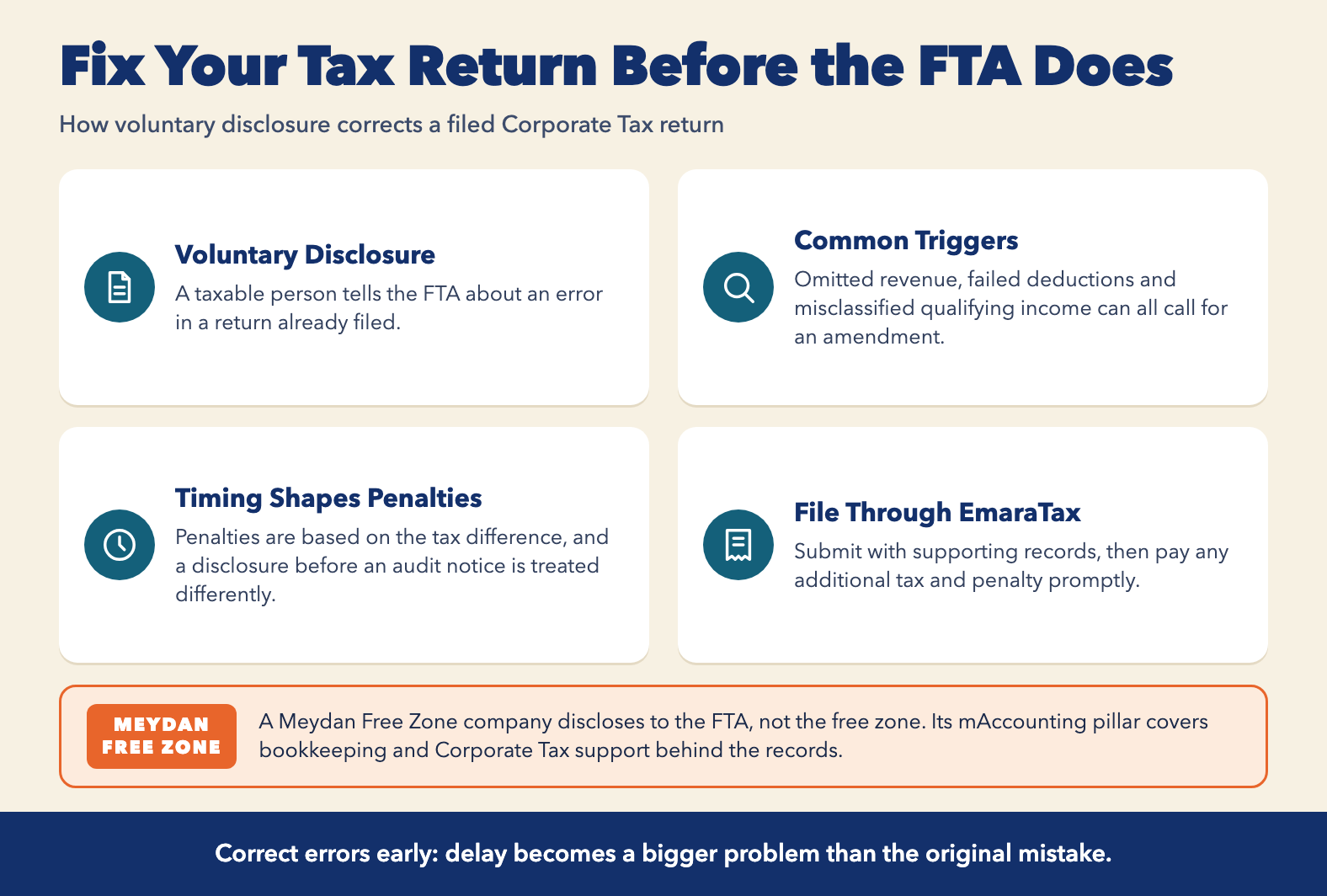
A corporate tax return amendment is needed when filed figures are wrong, incomplete or based on a misread rule. Typical triggers are misstated income, wrongly claimed deductions, incorrect qualifying income treatment, or an error that changes the tax payable.
Common Triggers for an Amendment
- Revenue omitted or booked in the wrong period.
- Expenses claimed that fail deductibility rules.
- Qualifying and non-qualifying income misclassified by a free zone entity.
- Errors in related party or transfer pricing details.
Picture a Meydan Free Zone company that treated income from a mainland customer as qualifying income. It must restate the return.
Disclosure Before and After an Audit Notice
| Feature | Disclosure Before Audit Notice | Correction After Audit Notice |
|---|---|---|
| Who starts the correction | The taxable person, on its own initiative | The FTA, through a notice or query |
| Penalty treatment | Voluntary disclosure penalty rules apply, and timing matters | Penalty rules for errors raised by the FTA apply |
| Records requested | Workings for the disputed items you chose to disclose | Scope set by the FTA, often wider |
| Control over timing | You choose when to file and prepare the evidence | Response deadlines are set by the authority |
| Commercial and reputational risk | Shows a functioning control process to banks and partners | Suggests the error was found by others, which invites scrutiny |
Errors That Do Not Need Disclosure
A routine clarification the FTA asks for is not a disclosure. A typo in a contact field is also different from an error that changes the tax payable. The rules on correcting errors with no tax effect were amended in 2026, so confirm the right route with the FTA.
Link With Qualifying Income Rules
Misclassification is the most consequential error for free zone companies. A company may exceed the de minimis limit without noticing, then have to restate the return. The guide to qualifying and non-qualifying income for UAE Corporate Tax covers the classification detail.
How Penalties Apply to a Corporate Tax Voluntary Disclosure
Corporate Tax penalties are set by Cabinet decision, starting with Cabinet Decision No. 75 of 2023, and the FTA applies them. They are calculated on the tax difference and depend on timing. A disclosure made before an audit notice is treated differently from a correction made after one.
How the Penalty Is Calculated
The base is the tax difference arising from the error, not the whole return. Penalties can combine a percentage of that difference with a monthly charge. The penalty framework was revised with effect from 14 April 2026, so use only the rates the FTA currently publishes, and work them out in AED.
Say an amendment increases tax payable by a set amount. The penalty applies to that difference alone.
Why Timing Changes the Outcome
Two companies make the same error. One discloses within weeks. The other waits for an FTA query. The first controls the timing and the narrative. The second answers on the authority's schedule.
Late payment of the additional tax can also create separate penalties, so pay promptly once you file.
How to Submit a Voluntary Disclosure in Five Steps
To file a voluntary disclosure, identify the error, quantify the tax effect and prepare supporting records. Then submit through the FTA's EmaraTax portal and pay any additional tax and penalty, documenting each step so the correction can be defended later.
- Identify and quantify the error. Reconcile the filed return to the ledger, then calculate revised taxable income and tax payable. A bookkeeping review might reveal a missed invoice from the prior period.
- Prepare supporting records. Gather invoices, contracts, bank statements and workings. Explain the cause of the error in plain terms.
- Submit through the FTA portal. Disclosure goes to the FTA through EmaraTax. A tax agent registered with the FTA can file for the company.
- Settle additional tax and penalty. Pay by the stated deadline and record the payment in the ledger.
- Keep the file. Store the original return, revised workings and payment confirmation together.
Add the review window to your company compliance calendar so late-found items get a fixed home.
How the Process Applies to Meydan Free Zone Companies
Corporate Tax is a federal matter, so a Meydan Free Zone company makes its voluntary disclosure to the FTA, not the free zone. Meydan Free Zone's mAccounting pillar covers bookkeeping, VAT registration support and Corporate Tax support, which helps keep the records a correction depends on.
Federal Authority, Not Free Zone Authority
Free zone status does not change who receives the disclosure. It can, however, change the result. A restated return that moves income into non-qualifying income can affect the 0% treatment on part of the profit. The corporate tax requirements for Meydan Free Zone companies explain the conditions.
Records and Accounting Support
Clean books shorten the time needed to quantify an error. A company with reconciled monthly books can find and fix a misposting quickly. The same files then support the disclosure.
Free Business Setup Cost Calculator
Calculate NowPreventing Repeat Errors Before the Next Filing
Preventing repeat errors means reconciling accounts every month, reviewing income classification before filing, and keeping a documented sign-off. A short internal review before each submission is cheaper than a correction and the penalty that can follow.
Controls That Reduce Amendments
- Reconcile the ledger and bank monthly.
- Track qualifying and non-qualifying income separately.
- Require a second-person review before filing.
A two-person sign-off can catch a misclassified invoice before it reaches the FTA.
Building Disclosure Into the Compliance Calendar
Schedule a review two weeks after each filing to catch late-found items. Align it with VAT and other deadlines so a voluntary disclosure never becomes an emergency.
Conclusion
Voluntary disclosure rules reward speed and good records. Quantify the error, document it and disclose it before the FTA raises it, because timing shapes how penalties apply. Clean books and a short pre-filing review prevent most corrections.
Review your last filed return against the ledger, list any differences with a tax effect, and decide whether to disclose now. At Meydan Free Zone, the mAccounting pillar covers the bookkeeping and Corporate Tax support behind that kind of review.
Ready to Launch Your Business in Dubai?
Let's Connect