

Table of Contents
Frequently Asked Questions
Do free zone companies have to meet Emiratisation targets?
Not automatically. The targets apply to establishments registered with MOHRE, and a Meydan Free Zone company is licensed by Meydan Free Zone. Confirm your position with Meydan Free Zone. The targets can apply if the business sets up a MOHRE-registered mainland entity that meets the thresholds.
Which companies need to register on Nafis?
MOHRE encourages establishments covered by the targets to use the Nafis platform to post roles, review Emirati candidates and record hires. Using it links job openings to hiring outcomes. Free zone companies can check their eligibility with Nafis before relying on its incentives.
How many Emiratis must a company with 50 employees hire?
MOHRE-registered establishments with 50 or more employees must raise the Emirati share of skilled jobs by 2% a year, split into 1% per half-year, reaching 10% by the end of 2026. The number of hires depends on your skilled-role base, not total headcount alone.
Does a mainland company with fewer than 50 employees have Emiratisation duties?
It depends on the sector. MOHRE-registered companies with 20 to 49 employees in 14 specified sectors had to hire one Emirati in 2024 and another in 2025. Check MOHRE for any requirements that apply in later years.
What happens if an employer misses the Emiratisation target?
It pays a financial contribution for each unfilled Emirati position. For companies with 50 or more employees, it started at AED 6,000 a month and rises by AED 1,000 a year until 2026. Check current amounts on the MOHRE website before budgeting.
What counts as fictitious Emiratisation?
Fictitious Emiratisation means registering Emiratis who do not genuinely work in the role. MOHRE treats it as a violation and warns employers against it. Emiratis are also asked to report fake employment schemes to MOHRE.
Which authority handles Emiratisation compliance for mainland employers?
The Ministry of Human Resources and Emiratisation (MOHRE) is the federal authority that sets targets, runs inspections and enforces penalties for mainland private employers. Nafis operates alongside MOHRE systems to support Emirati hiring. Free zone authorities run their own workforce rules.
Should employers register on Nafis before making an Emirati job offer?
Yes. Registering first keeps job postings, offers and the filed contract consistent, and avoids registering after a MOHRE notice. It also ensures the hire is recorded correctly from the first month, including wage payment under MOHRE's wage rules.
Topic Summary
What the Nafis Programme Means for Employers
Nafis is the federal programme, run by the Emirati Talent Competitiveness Council, that supports Emiratis entering private-sector careers. It offers salary support, training and career incentives, and gives employers a route to recruit Emirati talent. The Ministry of Human Resources and Emiratisation (MOHRE) encourages establishments covered by the targets to use the Nafis platform.
Emiratisation Targets MOHRE Sets for Private Employers
Under Ministerial Resolution No. 279 of 2022, MOHRE-registered establishments with 50 or more employees must raise the Emirati share of skilled jobs by 2% a year, reaching 10% by the end of 2026. Each year's target is split into 1% by 30 June and 1% by 31 December. Companies with 20 to 49 employees in 14 specified sectors had to hire one Emirati in 2024 and another in 2025.
Nafis Registration for Employers: Process and Documents
Employers set up an account on the Nafis platform, then post roles, review Emirati candidates and record hires. MOHRE encourages covered establishments to post vacancies there, because it speeds up hiring of qualified Emirati candidates.
Employer Duties When Hiring Through Nafis
Employer duties include meeting MOHRE targets on time, issuing proper contracts, registering Emirati hires for pension contributions, paying wages on time and keeping records accurate. Hires must also be genuine, because MOHRE penalises fake Emiratisation.
Penalties and Risks of Missing Emiratisation Targets
Covered establishments that miss their targets pay a financial contribution for each unfilled position. Fake Emiratisation, where hires exist on paper only, can bring fines and other penalties. Accurate records and genuine employment are the best protection.
How Emiratisation Applies to Meydan Free Zone Companies
MOHRE targets apply to establishments registered with MOHRE. A Meydan Free Zone company is licensed by Meydan Free Zone, so mainland targets should not be assumed to apply. The position follows from that scope rather than a named exemption, so confirm it with Meydan Free Zone. A MOHRE-registered mainland entity falls within the targets once it meets the thresholds.
Conclusion
Emiratisation works best when you treat it as an operating requirement, not a reaction to a MOHRE notice. Check your jurisdiction, count your skilled roles, use Nafis early and keep records clean. A Meydan Free Zone company handles staff visas through Meydan Free Zone rather than MOHRE, so confirm whether the targets apply before you set hiring plans.
Emiratisation Targets and Nafis Registration: Employer Duties
Emiratisation targets carry a recurring cost for private employers that miss them, and in some sectors they now reach teams of 20 or more. Which companies must meet them, and where does Nafis fit?
Free zone companies sit in a different position, so this guide covers the targets, Nafis registration, employer duties and penalties, and how they apply to a Meydan Free Zone company.
What the Nafis Programme Means for Employers
Nafis is the federal programme, run by the Emirati Talent Competitiveness Council, that supports Emiratis entering private-sector careers. It offers salary support, training and career incentives, and gives employers a route to recruit Emirati talent. The Ministry of Human Resources and Emiratisation (MOHRE) encourages establishments covered by the targets to use the Nafis platform.
Purpose and Scope of Nafis
Nafis aims to raise Emirati participation in private-sector jobs. It works alongside MOHRE targets and doesn't replace them. Founders often confuse Nafis incentives with the targets themselves.
Take a 60-person logistics firm. It treats Nafis as a hiring and support channel, while MOHRE sets the quota it must meet. Check current benefit amounts on the Ministry of Human Resources and Emiratisation (MOHRE) website before budgeting around them.
Who Administers It
MOHRE is the federal authority for private-sector Emiratisation, and its targets apply to establishments registered with it. A mainland employer tracks Emirati hires through MOHRE channels. Free zone authorities run their own workforce rules. For eligibility detail, read the explainer on the Nafis programme.
Emiratisation Targets MOHRE Sets for Private Employers
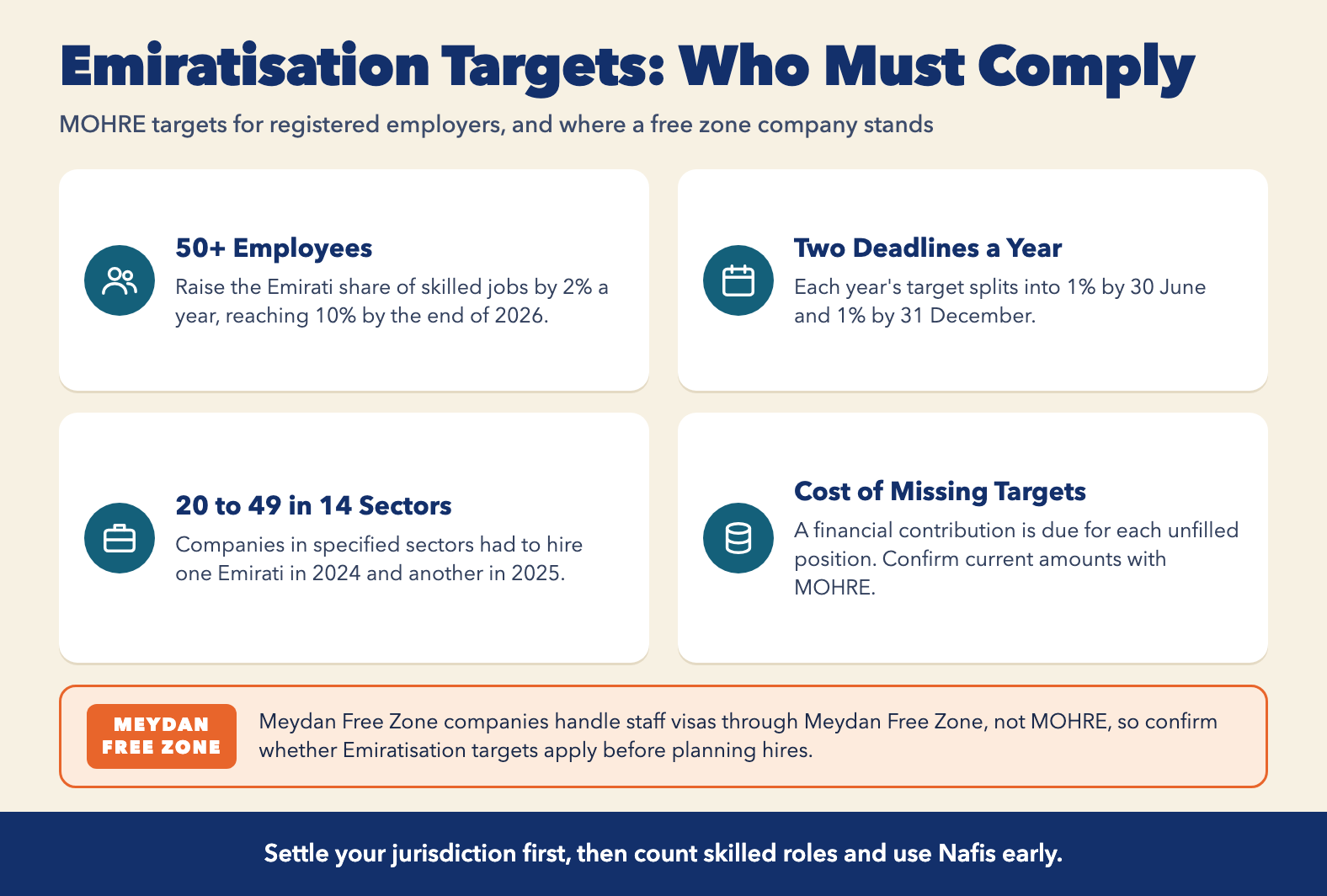
Under Ministerial Resolution No. 279 of 2022, MOHRE-registered establishments with 50 or more employees must raise the Emirati share of skilled jobs by 2% a year, reaching 10% by the end of 2026. Each year's target is split into 1% by 30 June and 1% by 31 December. Companies with 20 to 49 employees in 14 specified sectors had to hire one Emirati in 2024 and another in 2025.
Thresholds by Company Size
- 50 or more employees: 2% annual increase in skilled jobs, 1% per half-year, reaching 10% by the end of 2026.
- 20 to 49 employees: in 14 specified sectors, one Emirati hire in 2024 and another in 2025.
- Specified sectors include information and communications, finance and insurance, healthcare, construction, manufacturing and hospitality.
A 35-person IT company on the mainland still has Emirati hiring duties, even though it sits below the 50 threshold.
Which Roles Count as Skilled
Targets apply to skilled positions, not every role. An operations analyst counts toward the skilled-role base. General labour roles don't. Plan job titles and labour contracts with classification in mind, because it changes the number you owe.
Nafis Registration for Employers: Process and Documents
Employers set up an account on the Nafis platform, then post roles, review Emirati candidates and record hires. MOHRE encourages covered establishments to post vacancies there, because it speeds up hiring of qualified Emirati candidates.
What You Need Before Registering
- Valid mainland trade license and MOHRE establishment file.
- Access for an authorised signatory.
- Accurate headcount and job classification details.
An outdated signatory on the establishment card can stall registration, so fix that before you start.
Where Registration Fits in Your Hiring Cycle
Register before the first Emirati hire, not after a MOHRE notice. A founder hiring a first sales manager registers on Nafis first, then issues the offer. Keep postings and offers consistent with the contract filed. The underlying process is in the guide to hiring your first employee.
Employer Duties When Hiring Through Nafis
Employer duties include meeting MOHRE targets on time, issuing proper contracts, registering Emirati hires for pension contributions, paying wages on time and keeping records accurate. Hires must also be genuine, because MOHRE penalises fake Emiratisation.
Step 1: Confirm Your Headcount and Target
- Count employees against MOHRE thresholds.
- Identify the skilled-role base.
- Set the hiring number you owe. A company with 52 staff calculates this for the current cycle.
Step 2: Register and Post Roles
- Complete Nafis registration.
- Post roles with accurate titles and pay. An accounts role needs a realistic salary band.
- Review Emirati candidates.
Step 3: Issue Contracts and Register Hires
- Issue a compliant labour contract.
- Register the employee through MOHRE channels and with the General Pension and Social Security Authority (GPSSA) for pension contributions.
- Pay wages on time from month one, as the new salary rule sets out.
Step 4: Keep Records and Review Progress
- Retain contracts, payroll and role records.
- Review progress against target every quarter.
- Add checkpoints to your company compliance calendar.
Penalties and Risks of Missing Emiratisation Targets
Covered establishments that miss their targets pay a financial contribution for each unfilled position. Fake Emiratisation, where hires exist on paper only, can bring fines and other penalties. Accurate records and genuine employment are the best protection.
Financial Contributions for Unfilled Positions
For companies with 50 or more employees, the contribution started at AED 6,000 a month per unfilled position and rises by AED 1,000 each year until 2026. For the 20 to 49 group, MOHRE set AED 96,000 for each 2024 shortfall and AED 108,000 for each 2025 shortfall. Confirm current amounts with MOHRE, then compare them with the salary cost of an Emirati hire.
Emiratisation Obligations: Mainland Employer and Meydan Free Zone Company
| Point | Mainland Employer | Meydan Free Zone Company |
|---|---|---|
| Workforce regulator | MOHRE | Meydan Free Zone, as the licensing authority |
| MOHRE Emiratisation quota | Applies at 50+ employees, or 20 to 49 in specified sectors | Not applied automatically; confirm with Meydan Free Zone |
| Nafis registration route | Platform encouraged for covered establishments | Check eligibility with Nafis |
| Penalty exposure for unfilled positions | Financial contribution per unfilled position | No MOHRE contribution expected outside its scope |
| Effect of mainland expansion | Already within MOHRE thresholds | A MOHRE-registered mainland entity falls within the thresholds |
Fictitious Emiratisation and Wider Compliance Exposure
Registering Emiratis who don't genuinely work in the role is a violation, and MOHRE warns employers against fake Emiratisation. Wider consequences are covered in the guide to penalties for non-compliance in the UAE.
How Emiratisation Applies to Meydan Free Zone Companies
MOHRE targets apply to establishments registered with MOHRE. A Meydan Free Zone company is licensed by Meydan Free Zone, so mainland targets should not be assumed to apply. The position follows from that scope rather than a named exemption, so confirm it with Meydan Free Zone. A MOHRE-registered mainland entity falls within the targets once it meets the thresholds.
Free Zone Position Versus Mainland
Don't assume MOHRE targets bind a free zone entity. Do expect them to bind a MOHRE-registered mainland entity once headcount crosses a threshold. A Meydan Free Zone consultancy that opens a mainland branch should plan Emirati hires from that branch's headcount. Settle the position before hiring plans are fixed.
Visa and Workforce Planning With Meydan Free Zone
mResidency covers residence visas, the medical fitness test, Emirates ID, medical insurance and dependent visas. Meydan Free Zone issues the Business License, Certificate of Formation, Share Register and Memorandum and Articles of Association digitally. Voluntary Emirati hiring remains an option. Visa services are priced separately from the license, so a founder planning a team of five can budget each hire separately.
Free Business Setup Cost Calculator
Calculate NowConclusion
Emiratisation works best when you treat it as an operating requirement, not a reaction to a MOHRE notice. Check your jurisdiction, count your skilled roles, use Nafis early and keep records clean. A Meydan Free Zone company handles staff visas through Meydan Free Zone rather than MOHRE, so confirm whether the targets apply before you set hiring plans.
Ready to Launch Your Business in Dubai?
Let's Connect