

Table of Contents
Frequently Asked Questions
Since when has the dirham been tied to the US dollar?
The Central Bank of the UAE has maintained the dirham at a fixed rate to the US dollar since 1997. The rate is AED 3.6725 per US dollar. The policy has applied to dollar pricing, banking and contracts for decades.
What is the official exchange rate between the dirham and the dollar?
The official rate is AED 3.6725 per US dollar, as maintained by the Central Bank of the UAE. Banks apply this rate to AED and USD conversions. Any spread or transfer fee is added separately by the bank or exchange provider.
Does the peg protect UAE importers who buy in euros?
No. The peg fixes the dirham only against the US dollar. The euro floats against the dollar, so the AED cost of euro-priced goods still moves with the EUR/USD rate. Importers can reduce this exposure by agreeing USD or AED invoicing, or by adding price adjustment clauses to supplier contracts.
Why do UAE interest rates move after Federal Reserve decisions?
A currency peg requires the Central Bank of the UAE to keep its policy stance aligned with US monetary policy. When the Federal Reserve raises or cuts rates, UAE bank lending and deposit rates generally follow. This affects the cost of business loans, trade finance and overdrafts, especially on variable-rate facilities.
Can the Central Bank of the UAE change the peg?
The Central Bank of the UAE sets and maintains the rate, so any change would be its policy decision. The rate has stood at AED 3.6725 per US dollar since 1997. Companies should plan on that basis while keeping contracts clear on currency, because the peg does not cover other currencies.
Should a UAE company invoice clients in USD or AED?
Neither moves against the other because of the peg, so invoicing in either currency suits clients who pay in dollars or dirhams. For clients in other currencies, billing in USD or AED shifts the exchange risk to the client, but only where they agree to it.
Does the peg affect the cost of sending money abroad?
The peg fixes the AED/USD rate, but the total cost of a transfer also includes bank spreads and transfer fees. Payments in euros, pounds, rupees or yuan still depend on how those currencies move against the dollar. Comparing the full quoted cost across providers shows the real price of each payment.
How does the peg affect a free zone company's bookkeeping?
For Corporate Tax, amounts in other currencies are converted into dirhams using rates published by the Central Bank of the UAE, applied consistently through the tax period. US dollar amounts therefore convert at the pegged AED 3.6725. Meydan Free Zone's mAccounting offers bookkeeping, VAT registration support and Corporate Tax support.
Topic Summary
What the Dirham's Peg to the US Dollar Means
The UAE dirham is pegged to the US dollar at AED 3.6725 per dollar, maintained by the Central Bank of the UAE. Dollar-denominated trade carries no AED/USD movement, while other currencies still fluctuate against both.
How the Peg Works in Practice
The Central Bank of the UAE maintains the peg by holding foreign reserves, managing liquidity and aligning its policy rate with the US Federal Reserve. Banks quote AED and USD conversions at the fixed rate, so the peg runs on monetary policy, not a trading band.
How Interest Rates Follow the Peg
Because the dirham is pegged to the dollar, the Central Bank of the UAE anchors its Base Rate to the US Federal Reserve's rate on reserve balances. After the Federal Reserve raises or cuts rates, UAE lending and deposit rates generally follow. That affects business loans, trade finance and working capital costs.
Where Companies Still Face Currency Risk
The peg removes AED/USD movement but not exposure to other currencies. You still carry risk when buying, selling or paying staff in euros, pounds, rupees or yuan, and when the dollar strengthens or weakens against them.
Steps to Manage Exposure Under the Peg
To manage exposure under the peg, list your currencies, invoice in USD or AED where possible and compare bank conversion spreads. Add contract adjustment clauses and review financing after each US rate decision. None of this requires speculative hedging.
Structuring Your Company Around the Peg
A dollar peg favours companies with USD-based revenue, supplier contracts or investors. You can choose invoicing and banking currencies to match your flows. Meydan Free Zone provides digital licensing and mCore business bank account support to help set up the operating base.
Next Steps for Founders
The dirham's dollar peg gives you stable dollar pricing, but exposure to other currencies and US-driven interest rates remains. Execution matters more than theory: map your currency flows, contract carefully and arrange banking early. For a Meydan Free Zone company, mCore offers business bank account support, so banking can start alongside licensing, with the bank making the final decision.
The Dirham's US Dollar Peg: What It Means for UAE Companies
Founders often treat the dirham's link to the US dollar as background detail that needs no planning. In practice, the peg shapes pricing, borrowing costs and contract terms, because the Central Bank of the UAE holds the rate at AED 3.6725 per US dollar. This guide explains how the peg works, where currency risk remains and how to price, bank and contract around it.
What the Dirham's Peg to the US Dollar Means
The UAE dirham is pegged to the US dollar at AED 3.6725 per dollar, maintained by the Central Bank of the UAE. Dollar-denominated trade carries no AED/USD movement, while other currencies still fluctuate against both.
The Fixed Rate in Plain Terms
The rate has been in place since 1997. Say a Dubai trader invoices a US buyer in USD. The AED value books the same from quote to settlement, so margin planning on that sale is simple.
The peg covers one currency pair only. Many founders assume it protects against every currency. It doesn't.
Common Misconceptions Founders Hold
- The peg doesn't remove exposure to EUR, GBP, INR or CNY.
- It doesn't make UAE interest rates independent.
- It's a policy commitment, not a market outcome.
An importer buying from Europe still faces EUR/AED movement, because the euro floats against the dollar.
How the Peg Works in Practice
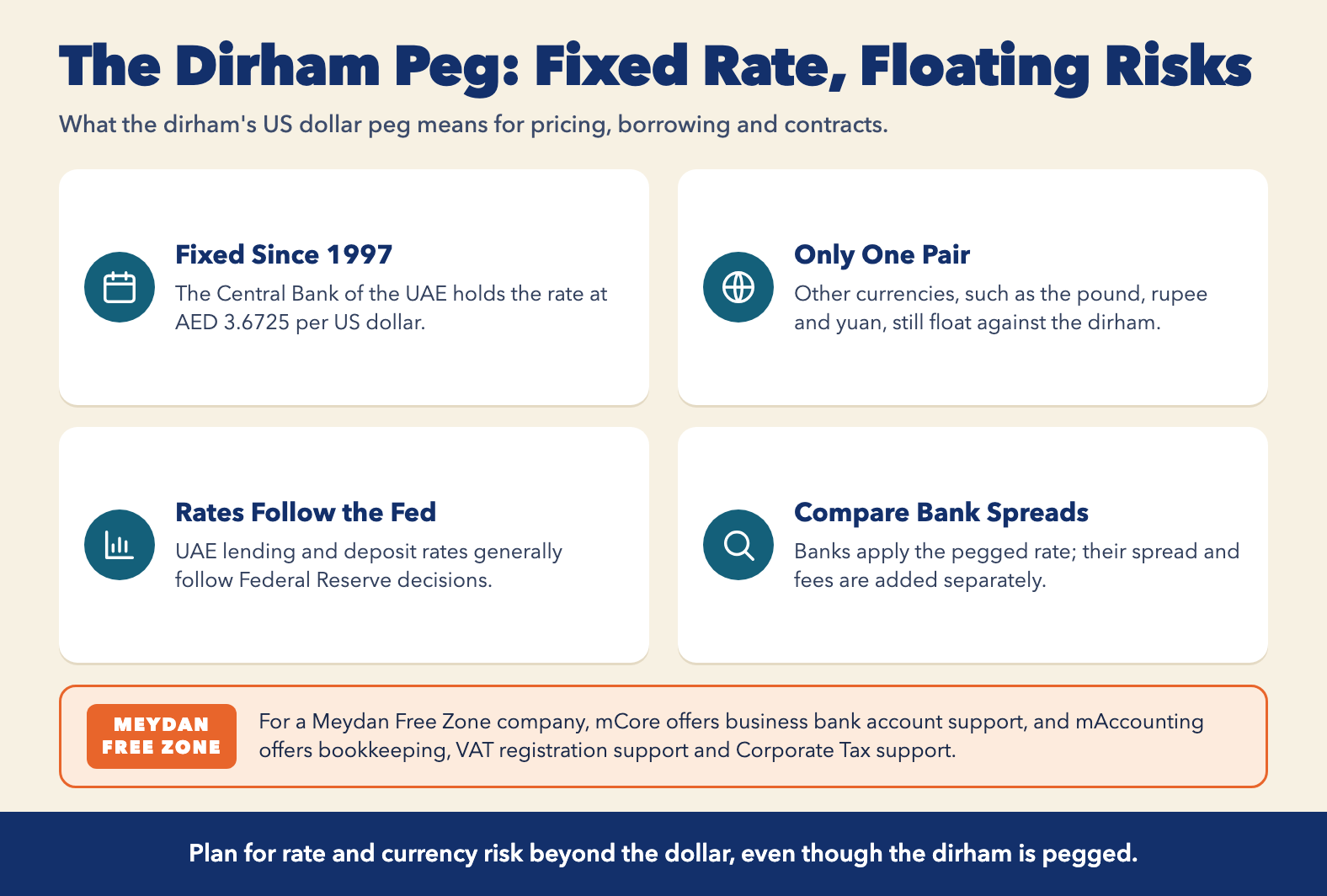
The Central Bank of the UAE maintains the peg by holding foreign reserves, managing liquidity and aligning its policy rate with the US Federal Reserve. Banks quote AED and USD conversions at the fixed rate, so the peg runs on monetary policy, not a trading band.
The Central Bank's Role
When a bank converts a USD client payment into AED, it applies the pegged rate. Its spread and fees are added separately, and those are what you should compare.
Why the Peg Has Held
Oil and gas exports are largely priced in dollars, so much of that revenue arrives in the currency the dirham is tied to. Decades of consistent policy have built the peg's credibility, and bodies such as the World Bank and the IMF publish regular assessments of the UAE economy.
How Interest Rates Follow the Peg
Because the dirham is pegged to the dollar, the Central Bank of the UAE anchors its Base Rate to the US Federal Reserve's rate on reserve balances. After the Federal Reserve raises or cuts rates, UAE lending and deposit rates generally follow. That affects business loans, trade finance and working capital costs.
Borrowing Costs for Companies
- Variable-rate facilities reprice after rate moves.
- Trade finance and overdraft costs shift.
- Fixed-rate options are worth comparing before you commit.
An SME with a variable-rate working capital facility sees repayment costs change after a US rate decision.
Currency Exposure Under the Dollar Peg
| Feature | Currency Pair | Exposure Under the Peg |
|---|---|---|
| AED/USD: fixed at 3.6725 | Dirham and US dollar | No rate movement; USD invoices keep a stable AED value |
| AED/EUR: floats | Dirham and euro | Moves with EUR/USD; European supplier costs can change between order and payment |
| AED/GBP: floats | Dirham and pound sterling | Moves with GBP/USD; UK client revenue billed in GBP varies in AED value |
| AED/INR: floats | Dirham and Indian rupee | Moves with USD/INR; affects rupee payroll and Indian supplier payments |
| AED/CNY: floats | Dirham and Chinese yuan | Moves with USD/CNY; sourcing margins shift with the rate |
Cash Management After Rate Changes
Deposit yields move in the same direction as lending rates. A holding company should review deposit terms after a policy rate cut and decide what to do with idle balances. Budget financing as a recurring cost, not a fixed one.
Where Companies Still Face Currency Risk
The peg removes AED/USD movement but not exposure to other currencies. You still carry risk when buying, selling or paying staff in euros, pounds, rupees or yuan, and when the dollar strengthens or weakens against them.
Non-Dollar Trade Exposure
A strong dollar raises import costs from non-USD suppliers. A weak dollar cuts the dirham value of non-USD revenue. A Dubai e-commerce seller sourcing from China in CNY sees margins move with USD/CNY.
Contract and Pricing Choices
- Invoice in USD or AED where the counterparty agrees.
- Add currency adjustment clauses for other currencies.
- Agree payment terms that limit the time you're exposed.
A services firm billing a UK client in USD avoids GBP volatility entirely. For cross-border payments, see the guide to international transfers USA-Dubai.
Steps to Manage Exposure Under the Peg
To manage exposure under the peg, list your currencies, invoice in USD or AED where possible and compare bank conversion spreads. Add contract adjustment clauses and review financing after each US rate decision. None of this requires speculative hedging.
Step 1: Map Your Currency Flows
- List revenue and cost currencies.
- Separate USD, AED and other currency flows.
- Identify the largest unhedged currency.
A trading company with 70% of costs in USD and 30% in EUR knows EUR is the exposure to address.
Step 2: Price and Contract Deliberately
- Prefer USD or AED invoicing.
- Include adjustment clauses.
- Shorten payment terms.
A supplier agreement with a quarterly price review for non-USD goods is a practical example.
Step 3: Compare Bank Costs and Review Financing
- Compare conversion spreads and transfer fees.
- Review variable-rate facilities after Federal Reserve decisions.
- Keep multi-currency account options in view.
Compare two quotes for the same EUR payment on total cost, not headline rate.
Structuring Your Company Around the Peg
A dollar peg favours companies with USD-based revenue, supplier contracts or investors. You can choose invoicing and banking currencies to match your flows. Meydan Free Zone provides digital licensing and mCore business bank account support to help set up the operating base.
Capital, Banking and Invoicing Choices
A US-based founder can set up a Meydan Free Zone company and invoice US clients in US dollars, while AED values stay predictable at the pegged rate. mCore supports business bank account setup, though approval remains the bank's decision. For investor context, read about a Dubai company for US investors, and for account requirements, see Dubai bank accounts for US entrepreneurs.
Planning Costs Before You Apply
The Cost Calculator shows setup costs in AED before you commit. Fawri, the fully digital licensing solution for solo entrepreneurs, issues a Business License in under 60 minutes, so a solo founder can move on to banking quickly. mAccounting offers bookkeeping, VAT registration support and Corporate Tax support.
Free Business Setup Cost Calculator
Calculate NowNext Steps for Founders
The dirham's dollar peg gives you stable dollar pricing, but exposure to other currencies and US-driven interest rates remains. Execution matters more than theory: map your currency flows, contract carefully and arrange banking early. For a Meydan Free Zone company, mCore offers business bank account support, so banking can start alongside licensing, with the bank making the final decision.
Ready to Launch Your Business in Dubai?
Let's Connect