
Table of Contents
Frequently Asked Questions
Do I charge VAT when I pass on a client's government fees in the UAE?
Not if the payment meets the disbursement conditions. You must pay as the client's agent, and the client must receive the service and authorise the payment. You must also recover the exact amount with no mark-up. If any condition fails, the recharge is a reimbursement and carries 5% VAT.
Can a mark-up still be treated as a disbursement?
No. A disbursement is recovered at the exact amount paid. Once you add a margin or handling fee, the recharge becomes part of your own supply and carries VAT. The fee or mark-up is standard rated even if the underlying cost was a genuine disbursement.
What documents prove a cost was a disbursement?
Keep three documents: the supplier's invoice or receipt in the client's name, the client's authorisation for you to pay on its behalf, and proof of your payment. These records show you acted as agent. Without them, the Federal Tax Authority can treat the cost as a reimbursement.
Is VAT due on travel costs I recharge to a client?
Usually yes. Travel booked in your name for your own team is your cost, so recharging it is a reimbursement. It forms part of the consideration for your main supply and normally carries VAT at 5%.
Can my client recover VAT on a reimbursed expense?
A VAT-registered client can recover input tax if you issue a valid tax invoice showing the VAT on the recharge. A missing VAT line or registration number can put that claim at risk. Recovery also depends on the client's own taxable activities.
How should I show disbursements on a UAE tax invoice?
List each disbursement on a separate line, outside your professional fee, and charge no VAT on it. Show reimbursements and fees on their own lines with 5% VAT. Separate lines make the treatment clear to the client and to the Federal Tax Authority.
Do free zone companies follow the same recharge rules for VAT?
Yes. VAT is a federal tax administered by the Federal Tax Authority, so a Meydan Free Zone company follows the same rules as any VAT-registered business. Registration becomes mandatory above AED 375,000 in annual taxable supplies. Meydan Free Zone offers bookkeeping and VAT registration support through mAccounting.
What happens if I treat a reimbursement as a disbursement by mistake?
You under-declare output VAT for that return period. This can lead to a correction and possible Federal Tax Authority penalties. The client's input tax claim may also fail because the invoice lacks VAT.
Topic Summary
What Disbursement and Reimbursement Mean Under UAE VAT
A disbursement under UAE VAT is a payment made as an agent on behalf of a client, where the client is the true recipient of the supply. It falls outside your VAT. A reimbursement is a recharge of your own cost, and it normally carries VAT in line with your main supply. The treatment therefore turns on the legal relationship, not the label on the invoice line. For the wider framework, see VAT in the UAE: all the details.
Why Founders Misclassify Recharged Costs
Founders misclassify recharged costs because "at cost" billing feels like a pass-through. VAT law looks at who received the supply and who the supplier invoiced, not at the margin. If the supplier invoiced you and you use the service in your own supply, the recharge is a reimbursement. That is why the call is so often wrong.
How the Federal Tax Authority Treats Disbursements
The FTA treats a cost as a disbursement only where the facts show you acted as agent. Its indicators are that the client receives the supply, is responsible for paying and authorises you to pay. The supplier's invoice should be in the client's name, and you recover the exact amount on a separate line. Treat any disbursement claim as unproven until each point is documented.
How to Document and Invoice Recharged Costs
To invoice recharged costs correctly, decide whether each cost is a disbursement or a reimbursement, show them on separate lines, and apply VAT only to reimbursements. Keep the supplier's original document. Each tax invoice must carry the mandatory details, and you report the VAT in the right return period.
Disbursement vs Reimbursement Comparison for Founders
A disbursement is paid as agent for the client and sits outside your VAT. A reimbursement is your own cost recharged and carries VAT. The difference affects invoice layout, output VAT, documents and your client's input tax recovery, so classify each cost before issuing an invoice.
What This Means for Your Meydan Free Zone Company
VAT is a federal tax administered by the FTA, so the same disbursement rules apply to a Meydan Free Zone company as to any VAT-registered business. Through mAccounting, Meydan Free Zone offers bookkeeping, VAT registration support and Corporate tax support.
Conclusion
The disbursement treatment is narrow. Only costs paid as agent, in the client's name, at exact cost and properly documented stay outside VAT. Everything else is a reimbursement and carries VAT. Review your last three client invoices, sort each recharged cost into one category and correct your invoice template before the next VAT return. For a Meydan Free Zone company, the mAccounting bookkeeping service can code each recharge the same way every time.
Disbursements vs Reimbursements Under UAE VAT
Paying costs on a client's behalf raises a quick VAT question: does the recharge carry VAT? Many founders assume anything passed on "at cost" sits outside VAT. The Federal Tax Authority (FTA) applies a narrow test, and most recharges fail it. This guide explains how to tell a disbursement from a reimbursement, and how each affects your invoices and returns.
What Disbursement and Reimbursement Mean Under UAE VAT
A disbursement under UAE VAT is a payment made as an agent on behalf of a client, where the client is the true recipient of the supply. It falls outside your VAT. A reimbursement is a recharge of your own cost, and it normally carries VAT in line with your main supply. The treatment therefore turns on the legal relationship, not the label on the invoice line. For the wider framework, see VAT in the UAE: all the details.
How the FTA Defines a Disbursement
You pay as agent, and the supplier's service goes to your client, not to you. Say a consultant pays a government fee for a client's trade license amendment, and the receipt is in the client's name. That payment is not a cost of the consultant's business. The conditions come from the VAT law and from guidance by the Federal Tax Authority, including its public clarification VATP013.
Why a Reimbursement Is Different
A reimbursement recovers a cost you incurred for your own business. It forms part of the consideration for your supply, so VAT follows the main supply, usually at the 5% standard rate. A design agency that books flights for its own team to attend a client workshop and bills the client has made a reimbursement, and 5% applies.
Why Founders Misclassify Recharged Costs
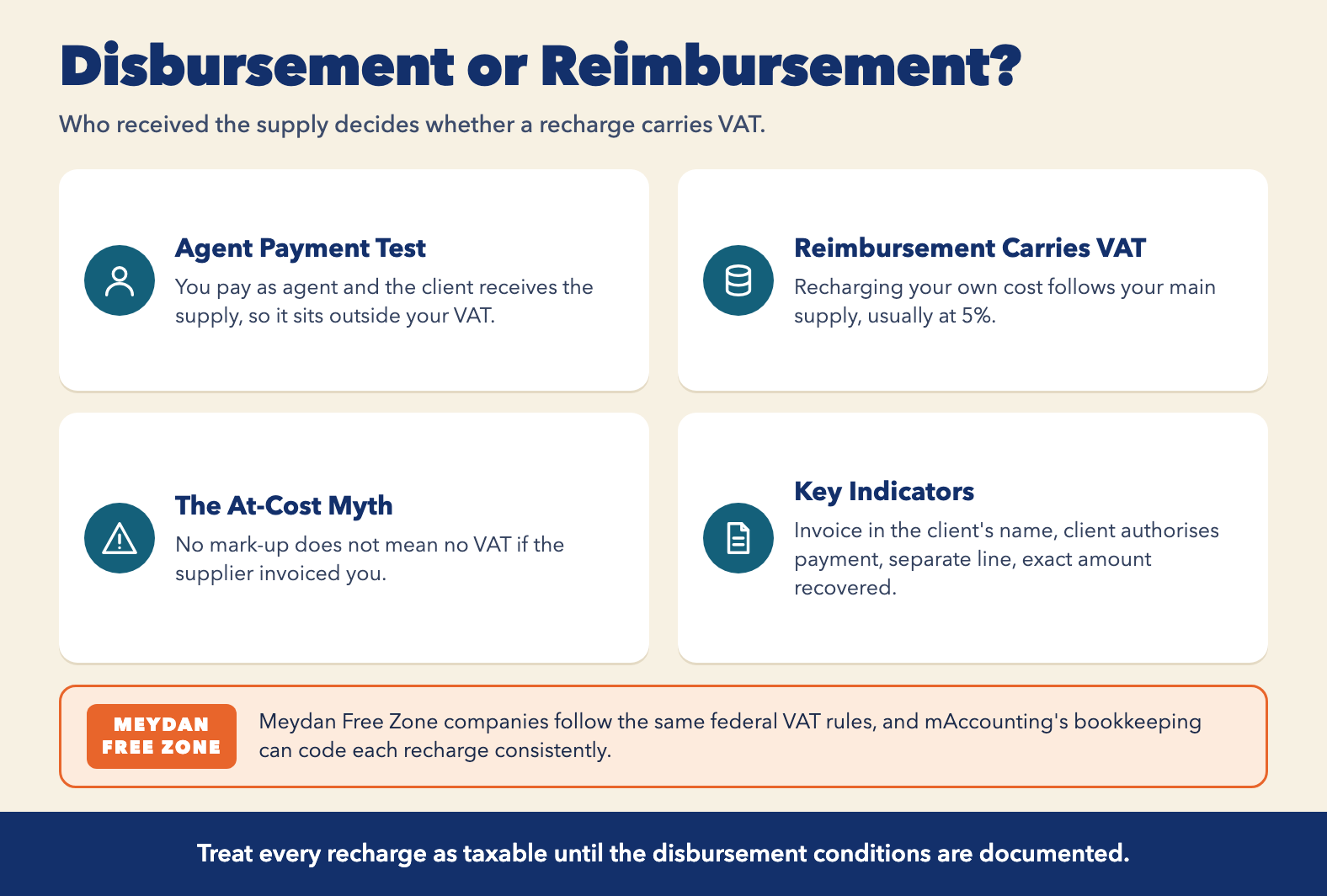
Founders misclassify recharged costs because "at cost" billing feels like a pass-through. VAT law looks at who received the supply and who the supplier invoiced, not at the margin. If the supplier invoiced you and you use the service in your own supply, the recharge is a reimbursement. That is why the call is so often wrong.
The "At Cost" Misconception
No mark-up does not mean no VAT. A freight forwarder that recharges a courier fee without VAT because there is no profit has under-charged. The courier invoiced the forwarder, so the cost is the forwarder's own.
Consequences of Getting It Wrong
- Output VAT is under-declared in the relevant return period.
- The FTA can impose administrative penalties.
- Your client's input tax claim can fail if the invoice shows no VAT.
- You absorb the 5% yourself.
How the Federal Tax Authority Treats Disbursements
The FTA treats a cost as a disbursement only where the facts show you acted as agent. Its indicators are that the client receives the supply, is responsible for paying and authorises you to pay. The supplier's invoice should be in the client's name, and you recover the exact amount on a separate line. Treat any disbursement claim as unproven until each point is documented.
Conditions for Treating a Cost as a Disbursement
- The client, not you, receives the goods or services and is responsible for paying.
- The client authorised you to pay on its behalf, ideally in writing.
- The supplier's invoice is in the client's name, and the cost sits apart from your own fees.
- You recover the exact amount, with documents held.
A corporate service provider paying a visa fee the client approved in writing meets all four.
Common Examples of Genuine Disbursements
Government fees for a client's license renewal usually qualify, as do fees paid to a third party in the client's name. The agent's own courier, printing and travel costs usually fail, because the supplier billed the agent.
How to Document and Invoice Recharged Costs
To invoice recharged costs correctly, decide whether each cost is a disbursement or a reimbursement, show them on separate lines, and apply VAT only to reimbursements. Keep the supplier's original document. Each tax invoice must carry the mandatory details, and you report the VAT in the right return period.
Numbered Process for Invoicing Each Cost
- Confirm whether you acted as agent or principal.
- Check the supplier document is in the client's name.
- List disbursements on a separate line, outside your fee.
- Add 5% VAT to reimbursements and mark-ups.
- Keep the supplier invoice, client authorisation and proof of payment.
A single invoice can show a professional fee with VAT, a reimbursed travel line with VAT, and a government fee as a disbursement with no VAT.
Disbursement vs Reimbursement Under UAE VAT
| Feature | Disbursement | Reimbursement |
|---|---|---|
| Who receives the supply | The client | You, for use in your own supply |
| Name on the supplier invoice | The client | Your business |
| VAT charged on your invoice | None, if all conditions are met | Same treatment as your main supply, usually 5% |
| Mark-up allowed | No, exact amount only | Yes, and VAT applies to the full amount |
| Documents to keep | Supplier invoice, written client authorisation, proof of payment | Supplier tax invoice and your own tax invoice to the client |
Tax Invoice Details You Cannot Skip
Your invoice needs your tax registration number, the VAT amount per line and the words "Tax Invoice". A client's finance team will reject an invoice missing the VAT line or registration number. Separate lines also support the disbursement treatment. See the UAE tax invoice requirements for the full list.
Disbursement vs Reimbursement Comparison for Founders
A disbursement is paid as agent for the client and sits outside your VAT. A reimbursement is your own cost recharged and carries VAT. The difference affects invoice layout, output VAT, documents and your client's input tax recovery, so classify each cost before issuing an invoice.
Side-by-Side Treatment
A legal services firm paying court fees in a client's name has a disbursement. The same firm's own document translation cost is a reimbursement. Same invoice, two treatments.
Why the Distinction Matters Commercially
VAT is due on a reimbursement even if the client pays late, which hits cash flow. Price your recharges with VAT from the start. A recharge priced without it leaves you absorbing 5% of the cost.
What This Means for Your Meydan Free Zone Company
VAT is a federal tax administered by the FTA, so the same disbursement rules apply to a Meydan Free Zone company as to any VAT-registered business. Through mAccounting, Meydan Free Zone offers bookkeeping, VAT registration support and Corporate tax support.
Federal Rules Apply Across Free Zones
Registration and filing are with the FTA, not the free zone authority. Registration is mandatory above AED 375,000 in annual taxable supplies. A Meydan Free Zone consultancy that registers should begin charging 5% on reimbursed costs from its registration date. Check your registration status before recharging with VAT.
Support Through mAccounting
Bookkeeping records can tag each recharged cost as a disbursement or reimbursement before the quarterly return. That coding keeps your invoices consistent. Read more on VAT filing services in Dubai.
Free Business Setup Cost Calculator
Calculate NowConclusion
The disbursement treatment is narrow. Only costs paid as agent, in the client's name, at exact cost and properly documented stay outside VAT. Everything else is a reimbursement and carries VAT. Review your last three client invoices, sort each recharged cost into one category and correct your invoice template before the next VAT return. For a Meydan Free Zone company, the mAccounting bookkeeping service can code each recharge the same way every time.
Ready to Launch Your Business in Dubai?
Let's Connect