

Table of Contents
Frequently Asked Questions
How long can an employee be seconded to another company in the UAE?
The agreement between the parties sets the duration, and a defined end date is a core feature of any secondment. Without a fixed term, the arrangement starts to look like a permanent transfer, which changes who sponsors the visa and who carries employment liability. State the start date, the end date and any extension terms in the written agreement.
Does a seconded employee need a new work permit or visa?
It depends on the jurisdiction of the host and the sponsor of record. A mainland employee working at a free zone host, or the reverse, needs the permit and visa position checked against both locations before work starts. For a Meydan Free Zone host, mResidency covers residence visa services, the medical fitness test, Emirates ID and medical insurance. Visas are priced separately from the license.
Who pays the salary and end-of-service benefits during a secondment?
The home employer usually stays legally responsible unless the parties agree otherwise in writing. In practice, the home employer pays salary and invoices the host through a recharge. The agreement should also state who bears end-of-service benefits if the secondment ends early, since this is a common source of disputes.
Can a free zone company second an employee to a mainland company?
It can be arranged, but the rules of both jurisdictions apply and one party must be clearly named as sponsor of record. Free zone employers follow their free zone authority's regulations, and mainland hosts deal with MOHRE for work permits. Confirm that the employee's permit matches the role and location at the host before the employee starts.
Is a written secondment agreement legally required?
Federal Decree-Law No. 33 of 2021 governs private-sector employment, but a written three-party agreement is the practical safeguard in every case. It records consent, duties, duration, reporting line, pay responsibility and return terms. Verbal secondments are where most unpaid allowance and end-of-service claims begin.
How is a secondment different from a permanent transfer?
A secondment is temporary and the employee has a right to return to the home employer. A transfer moves the employment relationship permanently to a new employer. The difference decides who sponsors the visa, whether service is continuous and who carries liability.
Are secondment recharges subject to VAT or Corporate Tax?
Recharges between related parties are commercial transactions, so they should be invoiced, recorded and priced on a supportable basis. The treatment depends on the entities involved, and the Federal Tax Authority administers Corporate Tax and VAT. Meydan Free Zone's mAccounting covers bookkeeping, VAT registration support and Corporate Tax support.
Topic Summary
Employee Secondment in the UAE Explained
Secondment in the UAE is a temporary arrangement where an employer sends an employee to work for another entity, usually a group company or a client. The employee keeps the original employment relationship, while the host directs daily work. A written agreement sets duration, duties, pay responsibility and return terms.
Legal Framework for Secondment in the UAE
Private-sector employment in the UAE is governed by Federal Decree-Law No. 33 of 2021. Mainland employers deal with the Ministry of Human Resources and Emiratisation (MOHRE) for work permits. Free zone employers follow their free zone authority's employment regulations alongside the federal law. Check any secondment against the rules of both the home employer's and the host's jurisdiction.
Secondment Compared With Transfer and Outsourcing
A secondment is temporary and the employee returns to the home employer. A transfer moves the employment relationship permanently. Outsourcing supplies a service or labour under a commercial arrangement, where the supplier directs the work. The difference decides who sponsors the visa and who carries liability.
Steps to Set Up a Secondment in the UAE
To set up a secondment, confirm the legal basis, obtain written consent, sign a three-party agreement, align the visa and permit with the host location, and set payroll and recharge terms. Complete each step before the employee starts at the host.
Costs, Tax, and Compliance Risks
Costs include salary, allowances, visa and insurance, and an administration recharge. Risks come from unclear sponsorship, unrecorded recharges and mismatched permits. Confirm Corporate Tax and VAT treatment with the Federal Tax Authority (FTA) before invoicing.
How Secondment Works for a Meydan Free Zone Company
A Meydan Free Zone company that hosts or sends seconded staff should settle the agreement, visa position and payroll first. Meydan Free Zone issues its Business License, Certificate of Formation, Share Register and Memorandum and Articles of Association digitally. Visas can be added when the business needs them and are priced separately from the license.
Conclusion
Secondment in the UAE works when the agreement, sponsor, permit and payroll are settled before day one. A clear three-party document and a correct visa position prevent most disputes and tax questions. Map who sponsors, who pays and who directs the work, then confirm the visa and tax position. At Meydan Free Zone, visas are added when needed and priced separately from the license, so a seconded employee's residence visa can be budgeted as its own line.
Employee Secondment in the UAE
Lending a team member to a group company or a client can look like a quick staffing fix. Many founders assume it needs no paperwork because the employee stays on the original payroll, while others treat it as a transfer. Neither is accurate. This guide explains what secondment is, how it differs from a transfer or labour supply, which rules apply and what it costs to run.
Employee Secondment in the UAE Explained
Secondment in the UAE is a temporary arrangement where an employer sends an employee to work for another entity, usually a group company or a client. The employee keeps the original employment relationship, while the host directs daily work. A written agreement sets duration, duties, pay responsibility and return terms.
What Founders Usually Assume
Founders often believe secondment needs no documents. They also confuse it with a permanent move. In practice, the home employer stays legally responsible unless the parties agree otherwise in writing.
Take a Dubai consultancy that sends a senior analyst to a client for six months with nothing in writing. Nobody owns the pay or the reporting line, and the first dispute exposes the gap.
Core Features of a Secondment
- A defined end date.
- Three parties: home employer, host entity and employee.
- The employee's consent.
- A right to return to the original role.
A group company seconding a finance manager to a newly formed Meydan Free Zone entity fits this pattern.
Legal Framework for Secondment in the UAE
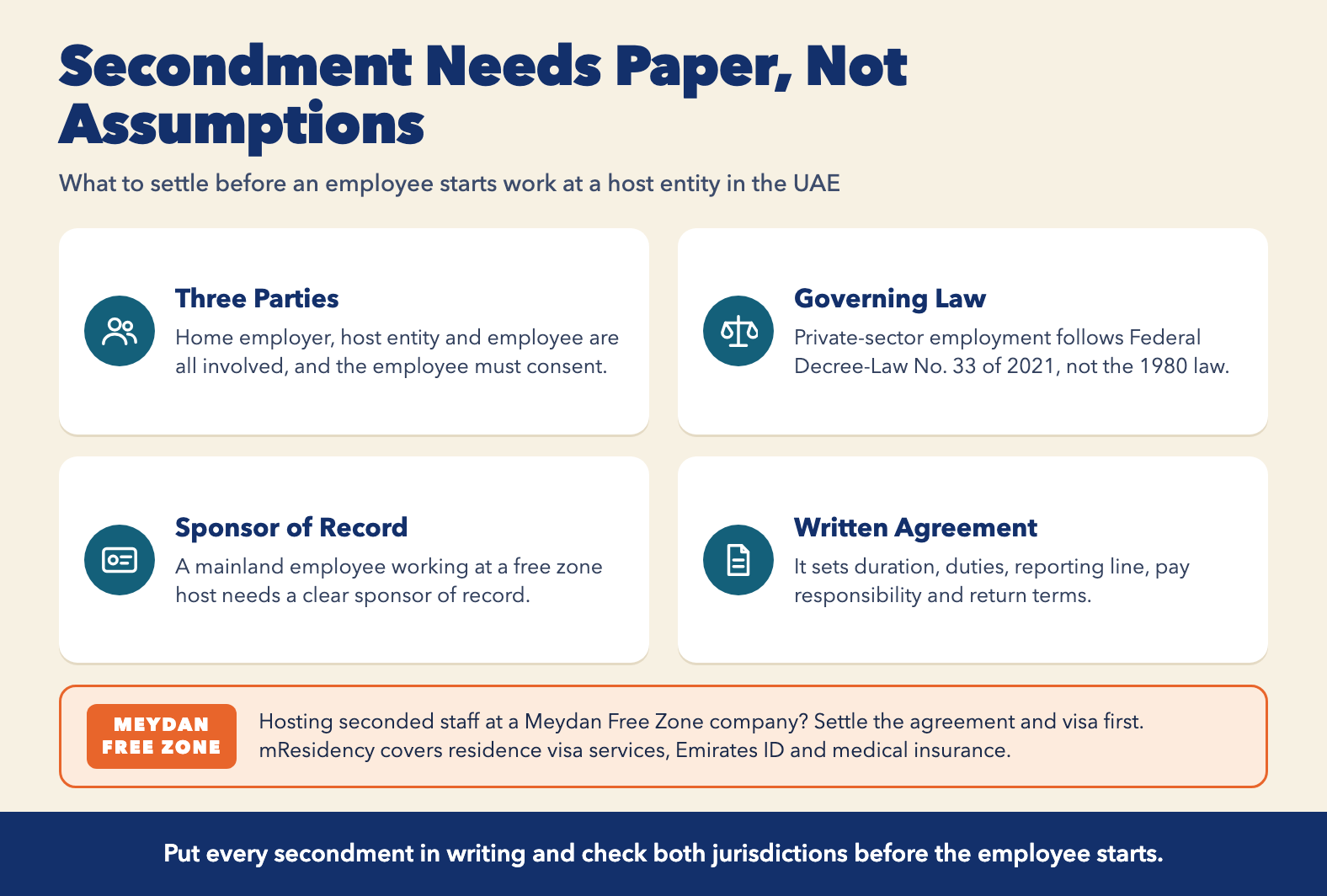
Private-sector employment in the UAE is governed by Federal Decree-Law No. 33 of 2021. Mainland employers deal with the Ministry of Human Resources and Emiratisation (MOHRE) for work permits. Free zone employers follow their free zone authority's employment regulations alongside the federal law. Check any secondment against the rules of both the home employer's and the host's jurisdiction.
What Federal Decree-Law No. 33 of 2021 Covers
This is the current law for private-sector employment, with Cabinet Resolution No. 1 of 2022 as its implementing regulation. It replaced Federal Law No. 8 of 1980. A mainland employer should check that the host's role fits the permit on file before the employee starts.
Mainland and Free Zone Responsibilities
MOHRE handles mainland work permits. Its processes do not automatically apply to a Meydan Free Zone company. When an employee sponsored on the mainland works on site at a free zone host, the arrangement needs a clear sponsor of record. For wider context, read labour law and Meydan Free Zone.
Secondment, Transfer and Labour Supply Compared
| Feature | Secondment | Permanent Transfer |
|---|---|---|
| Duration | Fixed term with an agreed end date | Open-ended with the new employer |
| Employment relationship | Stays with the home employer | Moves to the new employer |
| Visa sponsor | Usually the home employer, if the permit matches the host location | The new employer sponsors the visa |
| Pay responsibility | Home employer pays, then recharges the host if agreed | New employer pays directly |
| Return right | Employee returns to the original role | No automatic right to return |
Why the Written Agreement Matters
- Duration, duties, reporting line and pay responsibility.
- Confidentiality and restrictive terms, including non-compete clauses in the UAE.
- Return and termination terms.
Say a secondment ends early. Without a clause, the home employer and the host may each assume the other pays end-of-service benefits.
Secondment Compared With Transfer and Outsourcing
A secondment is temporary and the employee returns to the home employer. A transfer moves the employment relationship permanently. Outsourcing supplies a service or labour under a commercial arrangement, where the supplier directs the work. The difference decides who sponsors the visa and who carries liability.
Secondment vs Permanent Transfer
A regional manager moved permanently to a Dubai subsidiary has a new employer and new employment terms. One lent for a year keeps the home contract and returns afterwards. Visa sponsorship and continuity of service follow that split.
Secondment vs Labour Supply
Labour supply is a licensed commercial activity. Secondment between related entities is not a staffing business. A company that repeatedly places staff at clients for a fee should review its activity license.
Steps to Set Up a Secondment in the UAE
To set up a secondment, confirm the legal basis, obtain written consent, sign a three-party agreement, align the visa and permit with the host location, and set payroll and recharge terms. Complete each step before the employee starts at the host.
Step 1: Confirm Jurisdiction and Sponsor
- Identify whether each party is mainland or free zone.
- Confirm who holds the visa and permit.
- Record the sponsor of record in the agreement.
Step 2: Agree Terms in Writing
- Sign a three-party agreement with the employee's consent.
- Cover duties, duration, pay, benefits and return.
- Sign before the start date, with notarisation if the parties want it.
Step 3: Align Visa and Work Permit
- Check the permit matches the role and location.
- Complete the medical fitness test, Emirates ID and insurance.
- Review employment visa applications.
mResidency from Meydan Free Zone covers residence visa services, the medical fitness test, Emirates ID and medical insurance. Visas are priced separately from the trade license.
Step 4: Set Payroll and Recharge Terms
- Decide who pays salary, allowances and end-of-service benefits.
- Agree a recharge invoice from home employer to host.
- Follow MOHRE's Wage Protection System rules for mainland payroll.
Costs, Tax, and Compliance Risks
Costs include salary, allowances, visa and insurance, and an administration recharge. Risks come from unclear sponsorship, unrecorded recharges and mismatched permits. Confirm Corporate Tax and VAT treatment with the Federal Tax Authority (FTA) before invoicing.
What a Secondment Costs to Run
- Salary and benefits are a recurring cost.
- Visa, medical and insurance costs apply to the sponsoring entity.
- Budget official fees in AED and confirm them before the start date.
Corporate Tax and VAT on Recharges
Recharges between related parties are commercial transactions. Keep the agreement and pricing support on file. A group recharge invoice should sit in the host's books with that documentation. mAccounting from Meydan Free Zone covers bookkeeping, VAT registration support and Corporate Tax support.
Common Compliance Gaps
- Working for a host without a matching permit.
- No written agreement.
- Unclear pay responsibility.
An employee seconded verbally may later claim unpaid allowances. When no document says who pays, that claim is hard to defend.
How Secondment Works for a Meydan Free Zone Company
A Meydan Free Zone company that hosts or sends seconded staff should settle the agreement, visa position and payroll first. Meydan Free Zone issues its Business License, Certificate of Formation, Share Register and Memorandum and Articles of Association digitally. Visas can be added when the business needs them and are priced separately from the license.
Hosting Seconded Staff From a Group Company
The host needs a license covering the activity the employee performs. Say a foreign group opens a Meydan Free Zone entity and sends a manager for the launch phase. If the new entity sponsors the manager, mResidency handles the residence visa steps.
Decision Points Before Applying for a Business License
- Plan headcount and visa needs first.
- Compare one hired employee against a seconded one.
- Use the Meydan Free Zone Cost Calculator to estimate setup and visa costs.
- Read hiring your first employee.
Free Business Setup Cost Calculator
Calculate NowConclusion
Secondment in the UAE works when the agreement, sponsor, permit and payroll are settled before day one. A clear three-party document and a correct visa position prevent most disputes and tax questions. Map who sponsors, who pays and who directs the work, then confirm the visa and tax position. At Meydan Free Zone, visas are added when needed and priced separately from the license, so a seconded employee's residence visa can be budgeted as its own line.
Ready to Launch Your Business in Dubai?
Let's ConnectReferences
- Ministry of Human Resources and Emiratisation (MOHRE), Federal Decree-Law No. 33 of 2021 and work permit guidance
- Federal Tax Authority (FTA), UAE, Corporate Tax and VAT guidance