

Table of Contents
Frequently Asked Questions
Can an employee start work at a new company before the visa transfer is complete?
No. An employee should not work for the new employer until the new work permit is issued and the residence status is updated. Working earlier exposes both the employee and the employer to penalties for status violations. Set the start date after the permit is issued.
Does the new employer need the previous employer's consent to transfer a residence visa?
The previous employment must be cancelled or cleared before the new employer can file. In practice, this means the current employer completes the cancellation, or the employee resolves any dispute through the competent authority. Contractual terms such as notice periods also affect when the employee is free to move.
What happens to an employee's Emirates ID after moving to a new employer?
The Emirates ID is updated to reflect the new residence status and employer details. This update forms part of the final stage of the transfer, alongside the medical fitness result where required. The employee should keep the existing card valid until the update is complete.
Can an employee move from a mainland company to a free zone company in the UAE?
Yes. The mainland employment must be cancelled first, then the free zone company processes the new visa through its own free zone authority. The governing authority changes with the move, so the sequence matters. For a Meydan Free Zone company, residence visa services, the medical fitness test and Emirates ID are supported through mResidency.
Who pays the costs of an employee visa transfer, the employer or the employee?
The new employer normally bears the costs of the work permit and residence processing. These typically include government fees, medical fitness, Emirates ID and insurance. Responsibility for any cancellation-related charges depends on the contract and the circumstances of the exit.
Does a non-compete clause stop an employee from joining a competitor?
A non-compete clause does not block the visa process itself, but it can create a legal dispute with the previous employer. If the clause is enforceable, the employee may face claims or delays in obtaining clearance. Review the clause terms before the new employer files.
Is a medical fitness test required again after a change of employer?
Generally yes, where the authority requires it for the new residence issuance. The result supports the residence update and the Emirates ID renewal. The employer should confirm the requirement with the relevant authority before booking the test.
What documents does a new employer need to sponsor a resident employee?
The employer needs an active license, an establishment record in good standing, available visa allocation and a signed offer or employment contract. The employee provides a valid passport, current residence visa, Emirates ID, photograph and a medical fitness result where required. Role-specific qualification attestation may also apply.
Topic Summary
What an Employee Visa Transfer in the UAE Means
A visa transfer in the UAE moves a resident employee from one sponsoring employer to another without leaving the country. The previous employment is cancelled, the new employer obtains a work permit and the residence status is updated. The visa itself is not carried over; a new one is issued.
Which Authority Handles a Visa Transfer in the UAE
Responsibility depends on the employer's jurisdiction. Mainland private-sector transfers involve MOHRE for the work permit under Federal Decree-Law No. 33 of 2021. In Dubai, the residence visa is issued by the General Directorate of Residency and Foreigners Affairs (GDRFA Dubai), under federal rules set by the Federal Authority for Identity, Citizenship, Customs and Port Security (ICP). Free zone companies deal with their own free zone authority, so never assume mainland procedures apply to them.
Requirements for an Employee Visa Transfer
The employee must hold a valid UAE residence visa, have the previous employment cancelled or cleared, and have a signed offer or contract. A valid passport, Emirates ID and, where required, a medical fitness result are also needed. The employer must hold an active license and an establishment record with available visa allocation.
Step-by-Step Transfer Process
The process runs in four steps: agree terms and notice, cancel the previous employment, obtain the new work permit and residence update, then complete the medical fitness test, Emirates ID update and contract registration. Skipping the cancellation or permit stage stops the later steps.
Costs and Risks of a Visa Transfer
Transfer costs combine government fees, medical and Emirates ID charges, insurance and any service provider fees. Official fees are set by the relevant authority; other amounts are estimates. The main risks are timing gaps, an incomplete cancellation and contractual disputes with the previous employer.
How a Meydan Free Zone Company Handles Employee Visa Transfers
A Meydan Free Zone company processes employee visas through Meydan Free Zone, not MOHRE. mResidency, part of Meydan Plus, covers residence visa services, the medical fitness test and Emirates ID, medical insurance, dependent visas and return permits. The number of visas a company can hold depends on its license structure.
Conclusion
A visa transfer in the UAE succeeds when the cancellation, new permit and status update happen in the right order. Execution matters more than speed. Map the employee's current status and notice terms, confirm which authority applies, and plan the hire date after the permit is issued. For a Meydan Free Zone company, mResidency supports the residence visa, medical test and Emirates ID steps once the previous cancellation is cleared.
Employee Visa Transfer in the UAE: Process and Requirements
Hiring someone who already lives in the UAE looks faster than hiring from abroad, but the transfer stalls if the old cancellation, the new permit and the status change happen out of order. Many founders assume the visa simply moves with the employee; in fact, a new work permit and residence visa are issued under the new employer. This guide covers which authority handles a transfer, the requirements, the steps, the costs and risks, and how the process works for a Meydan Free Zone company.
What an Employee Visa Transfer in the UAE Means
A visa transfer in the UAE moves a resident employee from one sponsoring employer to another without leaving the country. The previous employment is cancelled, the new employer obtains a work permit and the residence status is updated. The visa itself is not carried over; a new one is issued.
Transfer Versus New Visa Issuance
A transfer applies to someone already resident in the UAE. A new visa applies to someone entering from abroad. The distinction drives your timeline. Say a Dubai trading company hires a marketing manager who is resident under another employer. The company must plan around that employer's cancellation before onboarding, because the new permit cannot start until the old one ends.
Mainland and Free Zone Transfers Compared
| Feature | Mainland Employer | Meydan Free Zone Company |
|---|---|---|
| Work permit authority | MOHRE issues the private-sector work permit | Meydan Free Zone processes the employee visa, not MOHRE |
| Residence processing | In Dubai, GDRFA Dubai issues the residence visa after the permit is approved | Residence visa services supported through mResidency |
| Governing contract rules | Federal Decree-Law No. 33 of 2021 applies | Free zones have their own employment regulations; confirm with Meydan Free Zone how Federal Decree-Law No. 33 of 2021 applies |
| Medical and Emirates ID handling | Arranged by the employer during the residence process | Medical fitness test and Emirates ID supported through mResidency |
| Key point to confirm first | Previous employment is fully cancelled | Previous cancellation is cleared and the company has visa allocation available |
Who Initiates the Transfer
The new employer leads the permit and residence process. The current employer's cancellation and the employee's contract still set the pace. An employee with a notice period and a non-compete clause needs clearance before the new employer files.
Which Authority Handles a Visa Transfer in the UAE
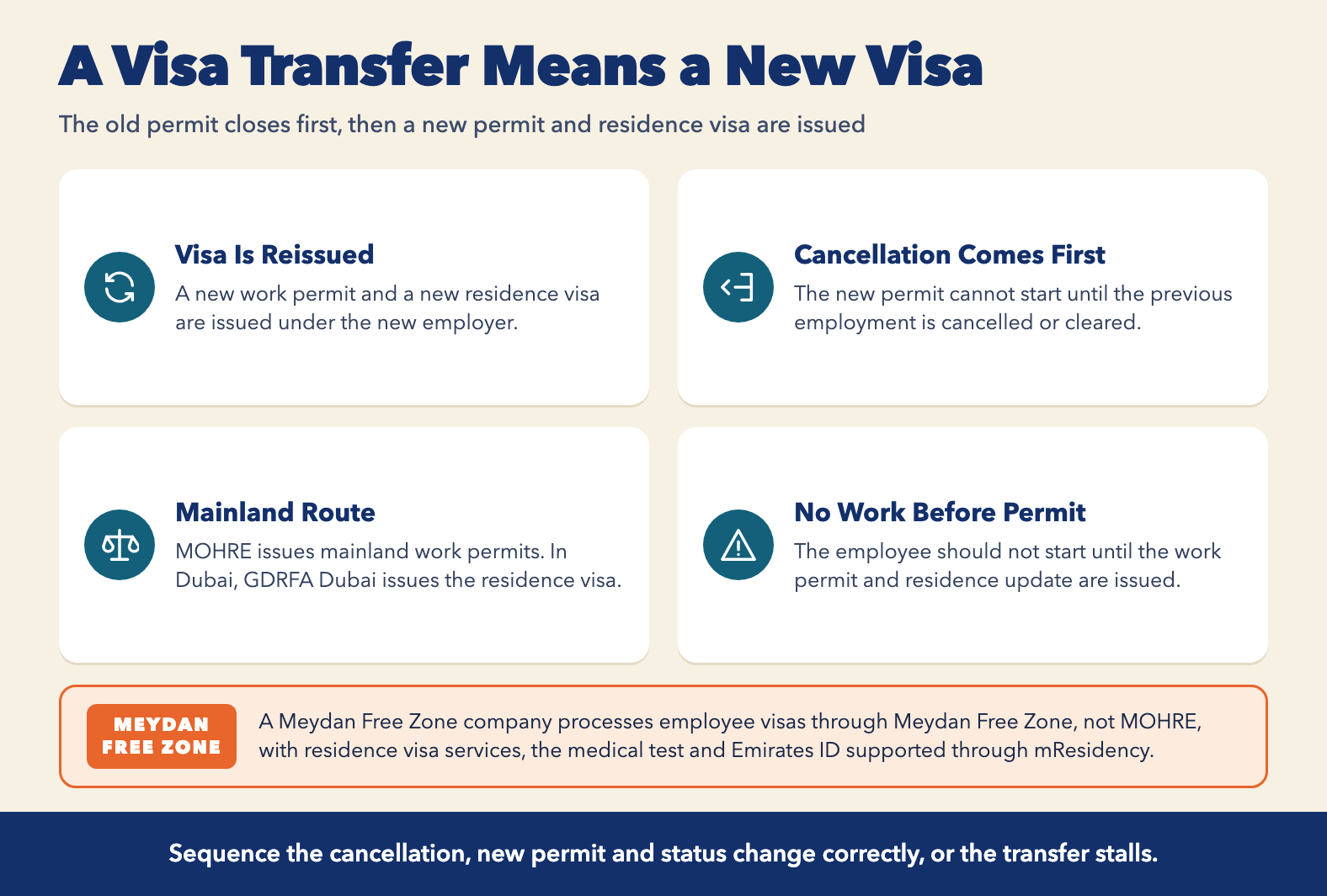
Responsibility depends on the employer's jurisdiction. Mainland private-sector transfers involve MOHRE for the work permit under Federal Decree-Law No. 33 of 2021. In Dubai, the residence visa is issued by the General Directorate of Residency and Foreigners Affairs (GDRFA Dubai), under federal rules set by the Federal Authority for Identity, Citizenship, Customs and Port Security (ICP). Free zone companies deal with their own free zone authority, so never assume mainland procedures apply to them.
Mainland Transfers Through MOHRE
MOHRE governs private-sector work permits and labour relations. Contract registration and permit steps sit with the mainland employer. A founder hiring a resident developer from a competitor files through MOHRE, not through any free zone channel.
Free Zone Transfers Through the Free Zone Authority
Free zone employers process visas through their free zone authority. A move between mainland and free zone changes the governing authority, so sequence matters. An employee leaving a mainland company needs that cancellation completed before the free zone process starts.
Requirements for an Employee Visa Transfer
The employee must hold a valid UAE residence visa, have the previous employment cancelled or cleared, and have a signed offer or contract. A valid passport, Emirates ID and, where required, a medical fitness result are also needed. The employer must hold an active license and an establishment record with available visa allocation.
Employee Documents
- Passport, current residence visa and Emirates ID.
- Passport-size photograph.
- Attested qualification, where the role needs it.
- Medical fitness result and insurance, where required.
Employer Documents and Eligibility
- Active trade license and an establishment file in good standing.
- Signed offer letter or employment contract.
- Visa allocation linked to the license and workspace arrangement.
Clearances That Delay Transfers
Unresolved cancellations cause most delays. A transfer is held if the previous cancellation was never completed. Overstay or absconding reports, outstanding fines and lapsed documents also block filing. Read the employment visa cancellation in the UAE process before you set a start date.
Step-by-Step Transfer Process
The process runs in four steps: agree terms and notice, cancel the previous employment, obtain the new work permit and residence update, then complete the medical fitness test, Emirates ID update and contract registration. Skipping the cancellation or permit stage stops the later steps.
Step 1: Agree Terms and Clear Notice
- Confirm the offer, start date and notice period.
- Check non-compete and other contractual obligations.
- Get written confirmation of the employee's release date.
Step 2: Cancel the Previous Employment
- The current employer cancels the permit and residence.
- Obtain the cancellation record.
- Confirm it is complete before the new filing.
Step 3: Issue the New Work Permit and Update Residence
- The new employer applies through the correct authority.
- Residence status is updated under the new sponsor.
- Do not start work until both are issued.
Step 4: Complete Medical, Emirates ID and Contract Registration
- Complete the medical fitness test and Emirates ID update where required.
- Register the contract and confirm insurance.
- Keep copies for your employment visa applications file.
Costs and Risks of a Visa Transfer
Transfer costs combine government fees, medical and Emirates ID charges, insurance and any service provider fees. Official fees are set by the relevant authority; other amounts are estimates. The main risks are timing gaps, an incomplete cancellation and contractual disputes with the previous employer.
Official Fees Versus Estimates
Separate government fees from provider charges in your budget. Treat only authority-published figures as fixed. Plan insurance as a recurring cost, because it renews every year for the employee.
Compliance and Timing Risks
A start date set before the permit is issued exposes both the employee and the employer. The employee should not work for the new employer until the work permit and residence update are issued, because gaps in legal status or work before permit issue can bring penalties. No single transfer period applies: timing depends on the previous cancellation, the authority and document readiness.
How a Meydan Free Zone Company Handles Employee Visa Transfers
A Meydan Free Zone company processes employee visas through Meydan Free Zone, not MOHRE. mResidency, part of Meydan Plus, covers residence visa services, the medical fitness test and Emirates ID, medical insurance, dependent visas and return permits. The number of visas a company can hold depends on its license structure.
What mResidency Covers
- Residence visa services.
- Medical fitness test.
- Emirates ID.
- Medical insurance, dependent visas and return permits.
Moving an Employee Into a Meydan Free Zone Company
The employee's mainland or other cancellation must be cleared first. Take a solo founder whose company was set up through Fawri and who hires a first employee already resident in Dubai. The founder confirms the cancellation, then files the visa. Our employment visa guide sets out the next steps.
Free Business Setup Cost Calculator
Calculate NowConclusion
A visa transfer in the UAE succeeds when the cancellation, new permit and status update happen in the right order. Execution matters more than speed. Map the employee's current status and notice terms, confirm which authority applies, and plan the hire date after the permit is issued. For a Meydan Free Zone company, mResidency supports the residence visa, medical test and Emirates ID steps once the previous cancellation is cleared.
Ready to Launch Your Business in Dubai?
Let's Connect