
Table of Contents
Frequently Asked Questions
What is a free zone in Dubai?
A free zone in Dubai is a licensed jurisdiction where a company registers with a zone authority rather than the mainland Department of Economy and Tourism. It gives you 100% foreign ownership, a registered business address, and visa eligibility — with no local partner required. The entire application runs online.
What is the difference between a free zone and a mainland company in Dubai?
A free zone company registers with its own zone authority and trades internationally or within the zone by default. A mainland company registers with the Department of Economy and Tourism and can trade directly with UAE mainland customers. Free zones remove the local partner requirement entirely; mainland companies historically required one for certain activities.
Can a free zone company sell to UAE customers?
A free zone company cannot trade directly with UAE mainland businesses or individuals without a mainland license or a registered distributor arrangement. If your primary customers are UAE residents, retailers, or government entities, a mainland license is the appropriate structure.
How long does it take to set up a free zone company in Dubai?
Standard licenses issue within about one business day. Meydan Free Zone's Fawri instant license issues in under 60 minutes for eligible solo founders. The entire application runs online — no notary appointments, no capital deposit, and no physical presence required at the license stage.
Do free zone companies pay tax in Dubai?
There is no personal income tax in Dubai. Corporate tax applies at 9% on taxable profits above AED 375,000, and every free zone company must register with the Federal Tax Authority and file returns. A qualifying free zone company that meets substance, income, and de minimis conditions can access a 0% rate on qualifying income.
Can I get UAE residency through a free zone company?
Yes. A free zone trade license makes you eligible to apply for an investor residence visa, which unlocks your Emirates ID, banking, and the ability to sign a tenancy. The visa does not come automatically — it requires a separate application, a medical fitness test, and biometrics completed in Dubai.
How much does a free zone license cost in Dubai?
Meydan Free Zone licenses start from AED 12,500 for the Regular option and AED 15,000 for the Fawri instant license. Both include a flexi desk and registered business address. Visa costs, health insurance, and banking are separate and depend on how many people you sponsor.
Topic Summary
A Licensed Jurisdiction, Not a Loophole
A free zone in Dubai is a designated business jurisdiction where companies register with a zone authority rather than the mainland Department of Economy and Tourism. It gives international founders 100% foreign ownership, a registered business address, and visa eligibility — with no local partner required.
Your Trade License Defines What You Can Invoice
The trade license is the core document. It authorises the company to operate and specifies which activity groups it can legally bill for. Meydan Free Zone offers more than 2,500 business activities across consulting, trading, technology, and e-commerce — all on one license.
Free Zone vs. Mainland: Where Your Customers Sit
Free zone companies trade internationally or within their own zone by default. Mainland companies register with the DET and can trade freely across the UAE domestic market. The decision comes down to where your customers are — not which structure sounds simpler.
The Residence Visa Unlocks Everything Else
A free zone trade license makes the holder eligible to apply for an investor residence visa. That visa triggers Emirates ID, banking access, and the ability to sign a tenancy. Residency steps require a short in-person visit to Dubai for the medical and biometrics.
Setup Is Fully Online — Banking and Tax Follow Separately
Formation is digital: choose activities, reserve a company name, submit a passport copy, pay the license fee, and receive documents by email. Standard licenses issue within about one business day. Banking and corporate tax registration are separate tracks that follow once the license is active.
Tax Applies — and Compliance Starts on Day One
There is no personal income tax in the UAE. Corporate tax applies at 9% above AED 375,000 of taxable profit, though qualifying free zone companies can access a 0% rate on qualifying income. VAT registration is mandatory above AED 375,000 in annual taxable turnover.
Choosing the Right Free Zone Comes Down to Three Things
Activity fit, visa allocation, and cost determine which free zone suits your business — not brand recognition. Meydan Free Zone suits consultants, traders, and online businesses wanting fast remote setup from AED 12,500, with a flexi desk address included and a Fawri instant license option for eligible solo founders.
What Is a Free Zone in Dubai? Benefits, Costs & Setup
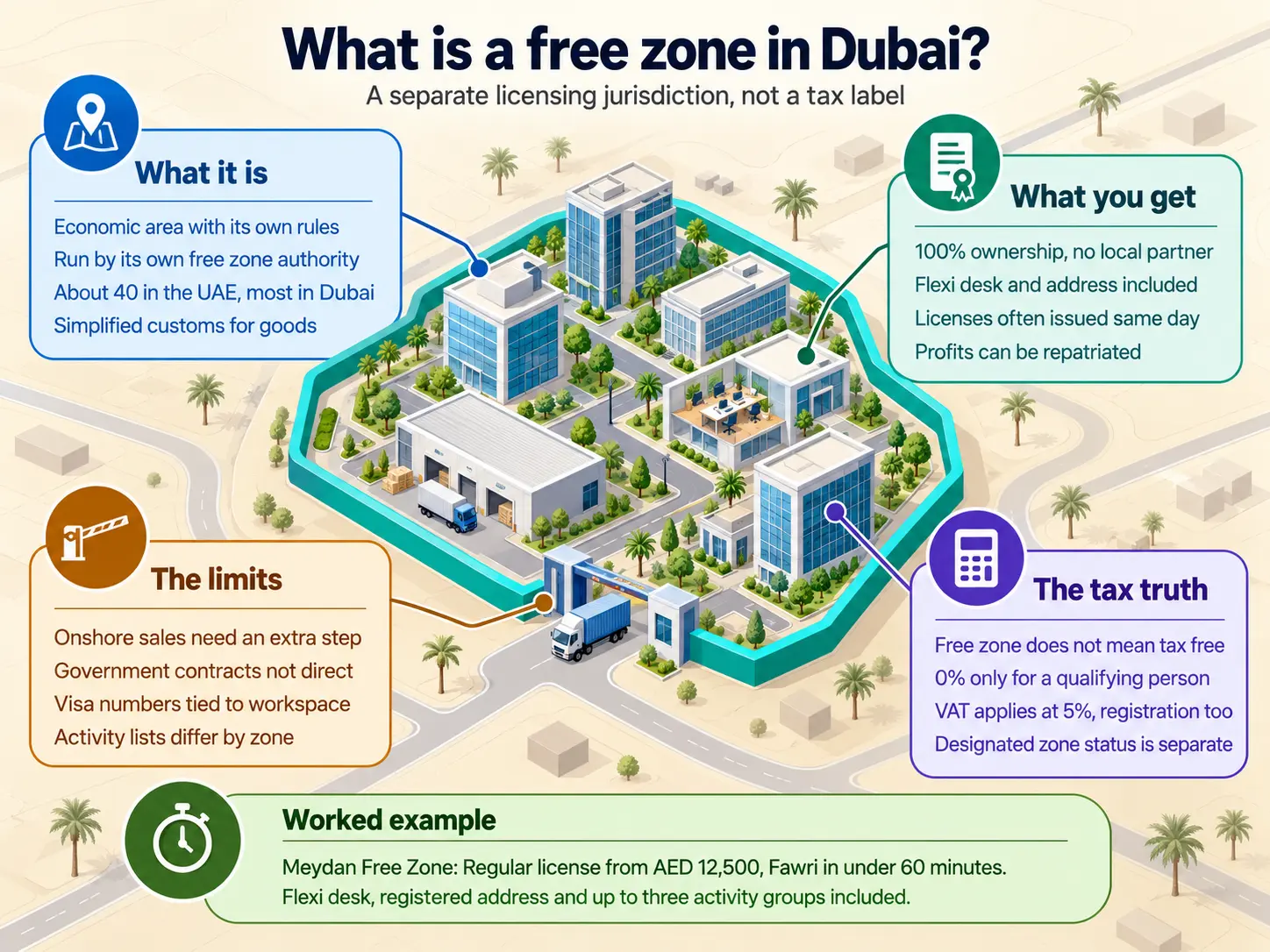
A free zone is a defined economic area that operates under its own business rules. Each one is run by its own authority, with its own licensing process, activity list, and price list. Companies registered inside a free zone can be fully owned by foreign shareholders, without a local partner.
This guide explains what a free zone actually is, how it differs from the mainland, and what the benefits and limits are. It also covers the tax rules, which are widely misunderstood. Free zone rules vary between authorities and change over time. Confirm the current position with the relevant free zone and the Federal Tax Authority before making decisions.
Key Facts at a Glance
| What it is | A defined economic area with its own business rules |
| Number in the UAE | About 40, according to the UAE government portal |
| Where most are | Dubai holds the largest concentration |
| Run by | Its own free zone authority, not the mainland department |
| Foreign ownership | 100%, with no local partner needed |
| Workspace | A flexi desk is often included in the license |
| Company forms | Free zone establishment, or free zone company |
| Corporate tax | 0% on qualifying income if conditions are met, otherwise 9% |
| VAT | 5% standard, with special goods rules in designated zones |
| Trading onshore | Needs a distributor, a branch, or a dual license |
Free Zone Meaning in Simple Terms
The original idea was about trade. A free zone is an area where goods can be brought in, stored, processed, and shipped out under simplified customs treatment. Dubai built its first zones around ports and airports for exactly that reason.
The model then broadened. Modern free zones host consultancies, media firms, technology companies, and clinics as well as traders. What they share is the structure. Each zone is a separate licensing jurisdiction with its own authority, its own rules, and its own registry of companies.
That is the core of it. A free zone is not a tax scheme or a postal address. It is a jurisdiction inside the emirate, with a regulator that issues licenses and registers companies.
Free Zone and Mainland Differences
The practical differences matter more than the legal theory.
Free Zone Compared With Mainland
| Feature | Free zone | Mainland |
|---|---|---|
| Licensing authority | The free zone authority | The emirate's economic department |
| Foreign ownership | 100% as standard | 100% in most activities since 2021 |
| Workspace | Flexi desk often included | Leased premises with registered Ejari |
| Selling to onshore customers | Requires an extra step | Direct |
| Government contracts | Generally not direct | Available |
| Setup speed | Often same day | Usually longer |
Neither is better in the abstract. The right choice depends on where your customers are.
Benefits of a Dubai Free Zone
The advantages are real, though they are often overstated in marketing material.
- Full foreign ownership. No local partner is required, and this has always been the case in free zones.
- Included workspace. Most zones bundle a flexi desk and registered address, so there is no separate lease at entry level.
- Speed. Applications are handled online and licenses can be issued quickly.
- Profit repatriation. Capital and profits can generally be transferred out without restriction.
- Customs treatment. Goods brought into a zone can be handled under simplified customs rules.
- Sector clustering. Many zones focus on one industry, which puts suppliers and customers nearby.
Meydan Free Zone is one example of the model. Its Regular license starts from AED 12,500, and the Fawri license is issued online in under 60 minutes. Both include a flexi desk, a registered address, and up to three activity groups from a list of more than 2,500.
Free Business Setup Cost Calculator
Calculate NowLimits of a Free Zone Company
An honest account has to include the constraints.
The main one concerns onshore sales. A free zone company can trade inside its own zone and internationally without difficulty. Selling directly to mainland customers requires an additional step. The usual routes are a distributor or agent, a mainland branch, or a dual license. Government contracts are generally not open to free zone companies directly.
Visa numbers are another limit. Allocation is usually tied to your license and workspace, so a flexi desk supports fewer people than a leased office. Activity lists also vary between zones, and an activity permitted in one may not be available in another.
Designated Zones and VAT
This is where precision matters, and where a lot of published guidance is wrong.
VAT applies across the UAE at 5%, in free zones as well as on the mainland. Being in a free zone does not exempt a company from VAT registration or filing. The registration threshold is the same.
A small subset of free zones are separately classified as designated zones by the Federal Tax Authority. These meet strict conditions on customs control, security, and record keeping. For certain supplies of goods, a designated zone is treated as outside the UAE for VAT purposes. The relief covers goods only. Services supplied in a designated zone remain subject to VAT in the normal way.
Free zone status and designated zone status are not the same thing. Check whether your zone holds the designation before assuming any VAT treatment.
Corporate Tax Rules for Free Zone Companies
The phrase "tax free zone" does a lot of damage. It is not accurate.
Corporate tax applies to free zone companies. A 0% rate is available, but only to a Qualifying Free Zone Person, and only on qualifying income. Other income is taxed at 9%.
The conditions run together. The company must maintain adequate substance in the UAE and derive qualifying income. It must comply with transfer pricing rules and prepare audited financial statements. Non qualifying revenue must stay within the de minimis threshold, set at the lower of AED 5 million or 5% of total revenue. Failing any condition can cost the status.
Substance is the condition most often missed. It means genuine activity in the zone, with appropriate staff, assets, and spending. This is general information only. It is not legal or financial advice. Speak to a qualified tax professional about your position.
Choosing a Free Zone in Dubai
With around 40 zones across the UAE, and the largest cluster in Dubai, the choice can feel arbitrary. A few questions narrow it quickly.
Start with your activity, since not every zone permits every activity. Then check the visa allocation you need, because that is tied to workspace. Compare the total first year cost rather than the headline license fee, and ask what renewal will cost. If you handle physical goods, ask whether the zone is a designated zone for VAT. Finally, consider location and sector, since some zones cluster an industry in one place.
Making Sense of the Options
A free zone is best understood as a separate licensing jurisdiction rather than a tax label. It gives full foreign ownership, a quick route to a license, and workspace bundled in. In exchange, reaching mainland customers takes an extra step. The 0% corporate tax rate also comes with conditions that need real substance behind them. Work out where your customers sit, check your activity is permitted, and compare total first year and renewal costs rather than headline fees. The team at Meydan Free Zone can walk you through what a free zone license actually includes.