

Table of Contents
Frequently Asked Questions
What is power of attorney in simple business terms?
A power of attorney is a formal legal document that lets one person act for another within a clearly written scope. For a Dubai business, it is the document banks, authorities, courts, and counterparties often ask for when someone other than the owner or authorised signatory needs to sign, submit, collect, or represent.
When does a Dubai business need a power of attorney?
A Dubai business usually needs a power of attorney when a founder, shareholder, or authorised signatory cannot handle a required task personally. Common examples include bank administration, Trade license amendments or renewals, property transactions, court matters, and government filings where third parties need formal proof of authority.
Who can receive power of attorney for a Dubai company?
The attorney-in-fact can be a lawyer, manager, employee, service provider, or other trusted representative. The important point is not the job title alone, but that the person is suitable for the task, properly identified in the document, and granted only the authority needed for that specific role.
What is the difference between a general and specific power of attorney?
A general power of attorney gives broader authority across multiple actions, while a specific power of attorney is limited to one transaction, asset, dispute, or filing. For most Dubai business tasks, specific authority is cleaner because it is easier to control, easier for third parties to review, and less likely to create unnecessary risk.
Can a power of attorney be used for Dubai bank matters or if it was signed outside the UAE?
Yes, a power of attorney can be used for certain bank matters, but the bank still decides what it will accept and what actions the holder can take. If it was signed outside the UAE, it often needs notarisation, legalisation, and Arabic translation before use in Dubai, so checking the receiving bank or authority first saves rework.
Topic Summary
POA Defines Real Authority
A power of attorney is a formal document that lets a named person act for your company within a written scope. The key question is not just what is power of attorney?, but whether the authority is clear enough for the bank, authority, court, or counterparty to accept.
Specific Beats Broad
For most Dubai companies, a task-specific POA is safer and more useful than broad wording. Limit it to the exact action, asset, timeline, and signatory power needed, so you keep control while the work still moves.
Use It for Bottlenecks
A Dubai business needs a POA when the owner or authorised signatory cannot be present for a time-sensitive task. Common triggers are banking follow-up, Trade license amendments or renewals, property transfers, court filings, and document collection.
Check Internal Authority First
Before granting a POA, confirm the person signing it has the power to do so under the company documents. If board approval or a shareholder resolution is needed, get that in place first, or the whole process can stall.
Format Rules Matter
A well-drafted POA can still fail if the receiving party wants different wording, notarisation, legalisation, or Arabic translation. Always verify the exact acceptance standard with the end user before signing, not after rejection.
Control Risk with Expiry
The biggest POA mistakes are overbroad powers, old identity details, stale documents, and forgotten revocations. Use narrow wording, a clear end date, and a simple authority register, so delegated power ends when the task ends.
What Is Power of Attorney? Dubai POA Guide for Business
A power of attorney is a document that lets one person act legally on behalf of another. In the UAE it is known as a wakala. It is one of the most useful documents a business owner can hold, and one of the easiest to get wrong. A badly drafted one gets rejected at the counter. A badly scoped one hands over more authority than intended.
This guide explains what a power of attorney is and the main types used in the UAE. It also covers the situations where a Dubai business actually needs one. It also covers notarisation, foreign documents, validity, and revocation. This is general information only. It is not legal advice. Speak to a qualified UAE lawyer about your own situation before signing anything.
Key Facts at a Glance
Power of Attorney Meaning in Simple Terms
A power of attorney is a formal delegation of authority. One party, the principal, authorises another party, the agent, to act in their place. The agent's actions then bind the principal as if the principal had acted personally.
That last point is why scope matters so much. A power of attorney is not a letter of introduction. It transfers real legal capacity. Anything the agent does inside the granted scope is treated as your own act. An informal signed note carries no weight here. To be accepted by UAE authorities, the document must be properly drafted and notarised.
Types of Power of Attorney Used in the UAE
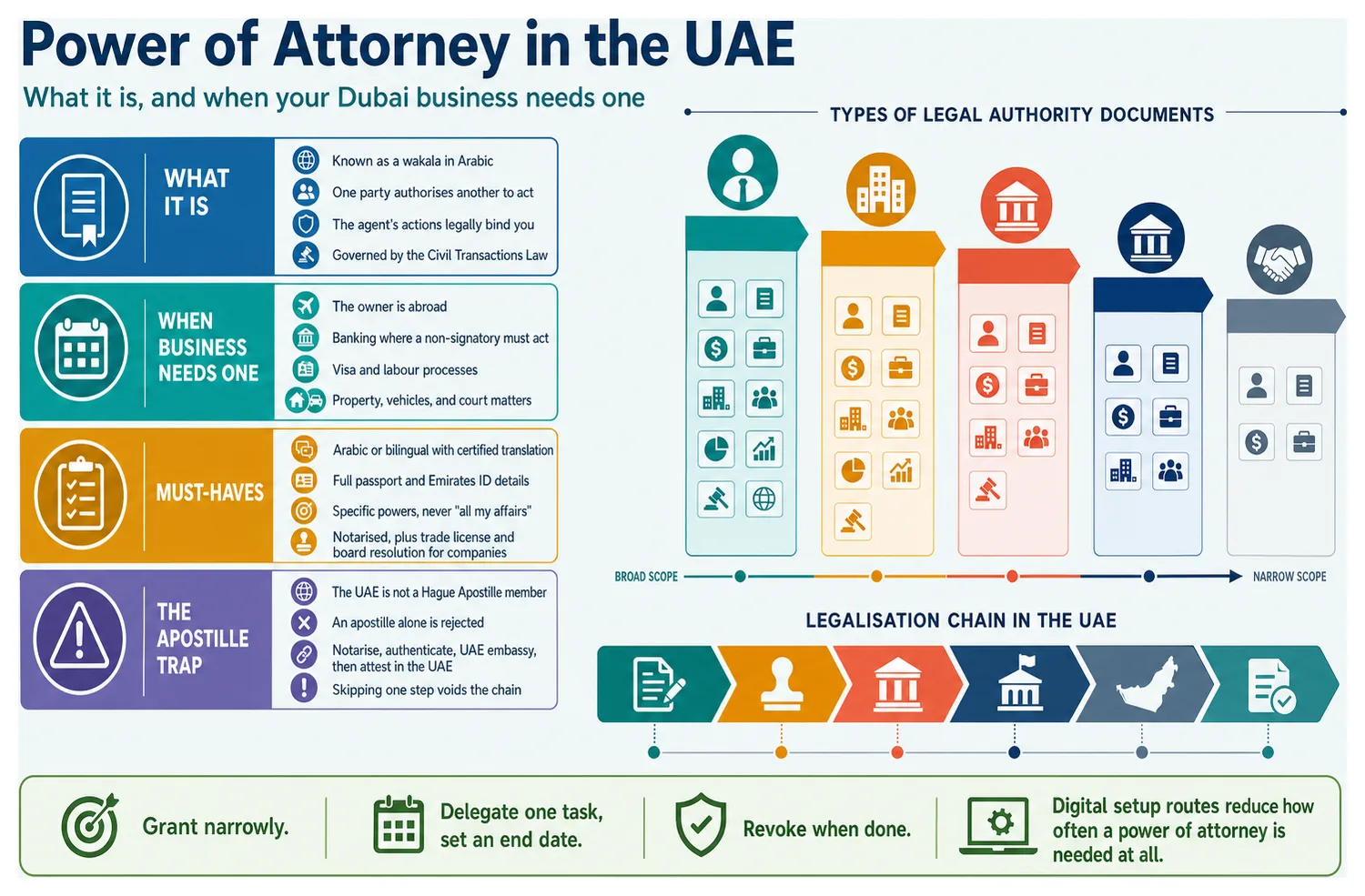
Choosing the wrong type is a common reason for rejection. Authorities look for authority that matches the task precisely.
Common Power of Attorney Types in the UAE
A general power of attorney sounds convenient. In practice it is often the weakest option. Vague wording such as "manage all my affairs" is a frequent cause of rejection. Authorities including the Dubai Land Department generally expect a special power of attorney that names the exact transaction.
When a Dubai Business Needs a Power of Attorney
Most businesses need one at a specific moment rather than permanently. The common triggers are practical.
- The owner is abroad. Someone must sign, file, or collect documents inside the UAE while the owner is overseas.
- Company setup steps. Certain formation and registration tasks may need a representative to attend on the company's behalf.
- Banking. Some banks require a documented authority before a non-signatory can operate an account.
- Visa and labour processes. Government dealings often need a named representative with proper authority.
- Property and vehicles. Buying, selling, or registering assets in the company name.
- Court matters. Appointing a licensed advocate to represent the business in proceedings.
The need has narrowed as services have moved online. Fully digital free zone setups reduce the number of steps that require someone to attend in person. Meydan Free Zone issues its Fawri license online in under 60 minutes, and supports visas through mResidency and banking through mCore. Confirm with your provider which steps still require a power of attorney, since requirements vary by bank and by authority.
Power of Attorney Requirements in Dubai
A document that meets the formal requirements moves quickly. One that does not gets sent back.
The document must identify both parties in full, with passport and Emirates ID details. It must state the granted powers clearly and specifically. It must be in Arabic, or bilingual with a certified Arabic translation prepared by a translator approved by the Ministry of Justice. The principal must have legal capacity and must sign freely.
Corporate powers of attorney carry an extra layer. Expect to provide the trade license and a board resolution showing that the signatory has the right to delegate. Without that evidence, the notary cannot confirm the company had authority to grant anything.
How to Notarise a Power of Attorney in Dubai
Notarisation is what makes the document usable. Several routes exist.
- Dubai Courts notary public. The traditional route, handled at a notary office.
- Licensed private notary. Often faster to book, with appointment based service.
- Remote e-notary. Identity is verified digitally and the signing happens by secure video call.
Fees depend on the route, the document type, and in some cases the value of the underlying transaction. Published rates change, so confirm current pricing directly with the notary before you proceed. Straightforward documents are often completed within one working day.
Issuing a Power of Attorney From Outside the UAE
This is where the most expensive mistakes happen. There is one point worth stating plainly.
The UAE is not a member of the Hague Apostille Convention. An apostille on its own has no standing before UAE authorities. Documents arriving with only an apostille are routinely rejected.
The route runs in sequence instead. The document is notarised in the country where it is signed. It is then authenticated in that country. Hague member countries use an apostille for this step. Other countries use their own foreign ministry. Next comes legalisation at the UAE embassy or consulate. Finally it is attested inside the UAE by the Ministry of Foreign Affairs. A certified Arabic translation is usually needed as well. Skipping a step invalidates the chain.
Executing the document at a UAE embassy or consulate abroad is an alternative worth asking about. It can shorten the process.
Power of Attorney Validity and Revocation
A power of attorney does not last forever, and assuming it does causes problems.
There is no single statutory validity period covering every type. In practice many are issued with a term of one or two years. Individual authorities also apply their own limits, and some banks and property authorities decline documents older than a set age regardless of the wording. Check the receiving authority's current position before relying on an older document.
Authority also ends automatically in several situations. These include completion of the stated task, expiry of any stated term, and the death or loss of legal capacity of either party. Revocation is possible at any time. It should be done formally through a notarised revocation, and every party who relied on the original must be told. Until that notice reaches them, the agent may still appear to hold authority.
Risks of a Badly Drafted Power of Attorney
The risk is not theoretical. A power of attorney is a transfer of real authority to another person.
Over-broad wording is the main danger. Granting general authority when a single task was intended leaves room for actions you never contemplated. Vague wording creates the opposite problem and gets rejected. Name spellings that differ across passport, Emirates ID, and the document itself are another frequent cause of failure at the counter.
Draft narrowly. Grant only what the task requires, state a clear end point, and revoke it once the work is done.
Getting the Document Right
A power of attorney is a practical tool, not a formality. Used well, it keeps a business moving while the owner is elsewhere. Used carelessly, it hands a stranger the keys. Decide exactly what task needs delegating, grant authority for that task alone, and set a clear end date. Confirm the receiving authority's requirements before you notarise, especially for banking and property. Choosing a setup route that keeps more steps online also reduces how often the question comes up. The team at Meydan Free Zone can explain which parts of the process are handled digitally and which are not.