
Table of Contents
Frequently Asked Questions
Can an expat founder choose who inherits shares in a Dubai company?
Often, yes. An expat founder can name beneficiaries through a will registered in the UAE, and a shareholders agreement can set transfer terms. Without a registered will, the distribution of shares may follow default succession rules that depend on nationality, religion and residence, so take legal advice.
Does a will registered in the UAE cover business shares?
A registered will can cover shares held in a UAE company, which gives clearer enforceability than a foreign will that does not mention them. The will should name the shares and the beneficiaries. It should also match the Share Register and the Memorandum and Articles of Association.
What happens to a free zone company if its sole shareholder dies?
Ownership passes according to the shareholder's registered will or the applicable succession rules. The free zone authority then updates the Share Register based on the legal documents provided. Until that happens, bank access and operations can stall, so a named successor and signatory should be agreed in advance.
Who can sign for a company if the founder is incapacitated?
Generally, only people already authorised on the company's bank mandate and corporate records can sign. Banks apply their own compliance checks before accepting a new signatory. Naming a second signatory early lets payroll and supplier payments continue without a court process.
Do successors need their own residency visa to manage the business?
A successor who lives in the UAE and works in the company needs valid residency status of their own. Owning shares does not provide a visa. Through mResidency, Meydan Free Zone supports residency visas, Emirates ID, medical insurance and dependent visas for eligible successors.
Can a shareholders agreement set the terms of a family share transfer?
Yes. A shareholders agreement can set pre-emption rights, valuation methods, buy-out terms and exit conditions for family members. It works best when the Memorandum and Articles of Association and the will are consistent with it, so the terms do not conflict.
Does a change of ownership affect a company's Corporate Tax registration?
No. Corporate Tax and VAT registrations belong to the company, not to the individual shareholder. The company must still keep its Federal Tax Authority records, returns and accounts current after the change. mAccounting from Meydan Free Zone covers bookkeeping, VAT registration support and Corporate Tax support.
When should a founder review their succession documents?
Review them after any major event, such as a birth, marriage, relocation, change of shareholders or change of signatories. A review at formation and again at each of these points keeps the will, Share Register, bank mandates and visa details aligned.
Topic Summary
What Succession Planning in the UAE Means
Succession planning in the UAE is the structured transfer of ownership, management authority and financial control from a founder to chosen successors. It covers shares, a will, shareholder terms, signatory rights, visas and tax position. The business keeps operating without court delays or family disputes if the founder exits, becomes incapacitated or dies.
UAE Legal Framework
Succession outcomes depend on the owner's nationality, religion, residence and type of asset. Federal personal status law, the Commercial Companies Law (Federal Decree-Law No. 32 of 2021) and free zone rules all apply. A registered will and a clear shareholder structure show who receives shares and who manages the company.
Meydan Free Zone Companies
In a Meydan Free Zone company, ownership changes appear in the Share Register and the Memorandum and Articles of Association. Meydan Free Zone issues both digitally after registration. Align them with a will and a shareholders agreement, and plan residency for successors who will work in the business.
Steps to Build a Succession Plan
To build a succession plan, list every asset and role, choose successors, agree transfer terms in writing, update corporate documents, register a will, and review the plan whenever circumstances change. Each step reduces the chance of a frozen company or an unplanned management gap.
Structuring Options
Families can pass a business on through direct share transfer, a shareholders agreement with defined exit terms, or a holding structure. The right choice depends on family size, asset mix and how much control the founder keeps during their lifetime.
Costs, Tax and Compliance
Succession carries legal drafting costs, notarisation charges and corporate record updates. Corporate Tax and VAT registrations stay with the company after an ownership change. Official fees differ from adviser estimates, so get written quotes early.
Decisions for Founders
Start planning succession when the company is formed, not when circumstances force it. Early decisions on shareholders, signatories and a registered will cost less than court delays or frozen accounts.
Succession Planning for a UAE Family Business: Key Points for New Businesses
A family business often looks stable until the founder steps back. In the UAE, the next generation rarely just takes over. Shares, licenses, bank signatory rights and visas follow separate rules, and one gap can freeze the company. This guide explains what succession planning covers, which documents matter most and how to build a workable plan from day one.
What Succession Planning in the UAE Means
Succession planning in the UAE is the structured transfer of ownership, management authority and financial control from a founder to chosen successors. It covers shares, a will, shareholder terms, signatory rights, visas and tax position. The business keeps operating without court delays or family disputes if the founder exits, becomes incapacitated or dies.
Ownership, Management and Control Are Separate
Owning shares does not mean running the company. Say a Dubai founder leaves shares to two children, but only the founder holds bank signatory rights. Operations stall until authority is reassigned. Plan each element on its own.
Common Misconceptions Founders Hold
- A family agreement replaces written documents. It doesn't.
- A home-country will covers UAE assets automatically. Often it needs separate recognition.
- Succession is a concern for later life only.
UAE Legal Framework
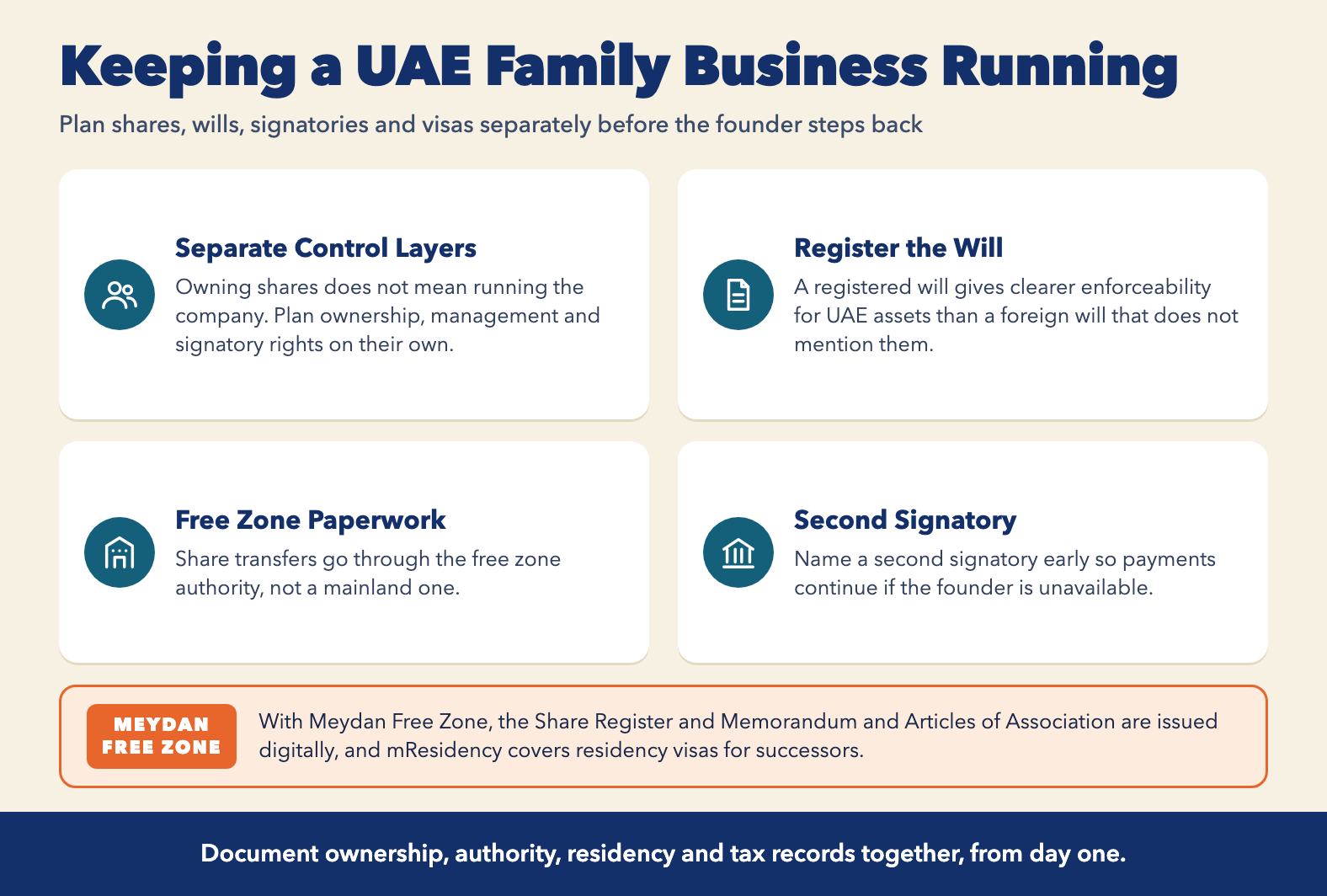
Succession outcomes depend on the owner's nationality, religion, residence and type of asset. Federal personal status law, the Commercial Companies Law (Federal Decree-Law No. 32 of 2021) and free zone rules all apply. A registered will and a clear shareholder structure show who receives shares and who manages the company.
Federal, Emirate and Free Zone Rules
The Ministry of Economy and Tourism oversees federal company law. Federal Decree-Law No. 37 of 2022 on Family Businesses lets family firms adopt a family charter and join a voluntary family business register. A free zone company follows its own authority's process for share transfers. Two siblings inheriting a free zone company must update shareholders through that authority, not a mainland one.
Wills, Registration and Notarisation
A registered will gives clearer enforceability for UAE assets. Notarisation makes documents usable locally. A non-Muslim expat founder can register a will so Dubai company shares pass as intended. Our guide to making wills in the UAE covers the process.
Why Foreign Wills Often Fall Short
- They may need recognition or translation.
- Home-country and UAE rules can conflict.
- A will naming a guardian may ignore Dubai company shares.
Meydan Free Zone Companies
In a Meydan Free Zone company, ownership changes appear in the Share Register and the Memorandum and Articles of Association. Meydan Free Zone issues both digitally after registration. Align them with a will and a shareholders agreement, and plan residency for successors who will work in the business.
Share Register and Corporate Documents
The Share Register records who owns the company. The Memorandum and Articles can set transfer terms. A founder might add a pre-agreed clause so a named child takes shares without dispute.
Residency Through mResidency
mResidency covers residency visas, Emirates ID, medical insurance and dependent visas. A daughter living abroad who takes over management needs her own residency. Visa services are priced separately from the license.
Banking Continuity Through mCore
mCore offers business bank account support. It doesn't guarantee approval. Name a second signatory early so payroll continues if the founder is unavailable.
Essential Services for Entrepreneurs and Startups
Explore mCoreSteps to Build a Succession Plan
To build a succession plan, list every asset and role, choose successors, agree transfer terms in writing, update corporate documents, register a will, and review the plan whenever circumstances change. Each step reduces the chance of a frozen company or an unplanned management gap.
Step 1: Map Assets, Roles and Authority
- List shares, accounts, licenses, visas and signatory rights.
- Identify who holds each role today.
- Check access. Some founders find they are the only person with online banking access.
Step 2: Choose Successors and Agree Terms
- Separate owners from managers. One child manages, another holds non-voting shares.
- Record terms in a shareholders agreement.
Step 3: Update Documents and Register a Will
- Align the Share Register and Memorandum and Articles.
- Register the will and complete notarisation where needed.
- Do both in the same month, so nothing contradicts.
Step 4: Review the Plan Regularly
- Review after births, marriages, relocations or ownership changes.
- Keep signatory and visa details current.
Succession Structure Options Compared
| Feature | Direct Share Transfer | Holding Structure |
|---|---|---|
| Ownership control | Each heir holds shares directly in the company | One vehicle centralises ownership and voting |
| Ease of setup | Simple: update the Share Register | Needs an extra entity and documents |
| Dispute risk | Higher when several heirs vote separately | Lower when one body sets decisions |
| Flexibility for several heirs | Limited; splitting shares fragments ownership | High; interests can be allocated within the holding |
| Ongoing administration | One entity to maintain | Two or more entities to maintain |
Structuring Options
Families can pass a business on through direct share transfer, a shareholders agreement with defined exit terms, or a holding structure. The right choice depends on family size, asset mix and how much control the founder keeps during their lifetime.
Direct Transfer Versus Holding Structure
Direct transfer is simple but exposes each heir to the company. A founder with three children can place shares in one holding vehicle to avoid fragmented ownership. See setting up a family office in Dubai for larger estates.
Shareholders Agreements as a Control Tool
- Set pre-emption, valuation and exit mechanisms.
- Use a buy-out clause so a sibling can exit at a pre-agreed valuation method.
- Settle terms early, before disputes escalate further.
Costs, Tax and Compliance
Succession carries legal drafting costs, notarisation charges and corporate record updates. Corporate Tax and VAT registrations stay with the company after an ownership change. Official fees differ from adviser estimates, so get written quotes early.
Where Costs Appear
- Legal drafting and notarisation.
- Translation. Founders often budget for will registration but miss translation of foreign documents.
- Running costs. Meydan Free Zone's Cost Calculator helps estimate setup costs.
Corporate Tax and VAT Continuity
Registrations belong to the company, not the individual. A new manager can inherit an overdue VAT return. VAT registration is mandatory above AED 375,000 in taxable supplies a year, according to the Federal Tax Authority (FTA). mAccounting covers bookkeeping, VAT registration support and Corporate Tax support.
Bank Compliance During Ownership Change
Banks review ownership changes under their own compliance rules, set within the framework of the Central Bank of the UAE. A bank may ask for updated ownership documents before accepting a new signatory. Prepare them early.
Decisions for Founders
Start planning succession when the company is formed, not when circumstances force it. Early decisions on shareholders, signatories and a registered will cost less than court delays or frozen accounts.
When to Start
Start at formation, before the first hire or bank account. Build transfer terms into the Memorandum and Articles on day one. Revisit at each major life event.
Questions to Settle Before Applying for a License
- Who holds the shares?
- Who signs for the company?
- Who holds residency to run it?
- A solo founder using Fawri, which issues a license in under 60 minutes, should name a successor before opening the first bank account.
Next Steps
A succession plan works when ownership, authority, residency and tax records are documented together. A registered will, aligned corporate documents and a named signatory protect a business better than good intentions. List your assets and roles this week, then decide who needs authority, shares or a visa if you were unavailable tomorrow. With Meydan Free Zone, the Share Register and Memorandum and Articles of Association are issued digitally, so keep them aligned with your will from the start.
Ready to Launch Your Business in Dubai?
Let's Connect