

Table of Contents
Frequently Asked Questions
Can I get a work permit in Dubai by myself?
No. A work permit must be sponsored by a licensed employer that is hiring you, and it is tied to that specific job. An individual cannot apply on their own. If you are an employee, your job offer starts the process, and your employer handles the application and the cost.
What is a temporary work permit?
It authorises someone to work for a fixed short period, from a few weeks up to a year, without issuing a full residence visa. At Meydan Free Zone it runs from AED 1,000 for 21 days to AED 3,400 for 12 months. It suits short-term projects and seasonal or trial hires.
What is the difference between a work permit and a residence visa?
The work permit authorises you to work for a specific employer, while the residence visa gives you the right to live in the UAE. For a long-term hire the two are issued together as one package. A temporary work permit is the exception, as it does not include a residence visa.
How much does a work permit cost, and who pays?
A temporary work permit runs from AED 1,000 to AED 3,400 by duration. A full employment route, including the visa, medical and Emirates ID, is roughly AED 7,500 to 8,000 at Meydan Free Zone. Under UAE labour law, the employer pays these costs, not the employee.
How does Meydan Free Zone issue work permits?
Meydan Free Zone issues work permits and employment visas directly through its own authority, not the labour ministry, so there are no ministry approvals or no-objection certificates. A license can hold up to six visa allocations, and mResidency manages the permit, medical, Emirates ID and visa steps.
Topic Summary
Know Who Starts It
The employer usually applies for the work permit in Dubai, not the worker alone. Your first action is to sign the offer and send accurate personal documents so HR can open the file without delays.
Separate Permit and Visa
A work permit gives legal work authorization, while residence steps let you live in Dubai. Understanding that split helps you track the process properly and avoid confusion when one approval arrives before the other.
Prepare Your Documents Early
Keep a valid passport, passport photos, and any required degree or professional papers ready before the process begins. Matching names, dates, and passport numbers across every record is one of the biggest speed factors.
Follow The Right Sequence
The usual order is simple: signed offer, employer submission, entry or status change, medical test, Emirates ID, and residence activation. If you miss the order, even a small issue can slow the whole case.
Watch The Key Checkpoints
Ask for clear updates at each stage: offer accepted, labor file submitted, medical booked, and Emirates ID in progress. A good process always shows the next action instead of leaving you guessing.
Plan for Costs and Delays
Government charges, medical screening, Emirates ID fees, and onboarding costs all sit around the wider permit process. Figures and timelines can change, so confirm current requirements and prices with the employer or relevant UAE authority before you proceed.
How to Get a Work Permit in Dubai: Requirements & Process
If you are hiring in Dubai, the work permit is the document that legally lets someone work for your company. Here is the point that surprises many people: an employee cannot get a work permit in Dubai on their own. The employer applies for it and sponsors it. There are also two routes to know: a temporary work permit for short-term work, and the full employment route for a long-term hire.
This guide explains what a work permit in Dubai is, the two routes to get one, what each costs, and how Meydan Free Zone issues work permits directly, in-house.
The short version is that a work permit authorises someone to work, and the route you use depends on how long you are hiring for. Here is how it works.
Key Facts at a Glance
| What it is | The document that authorises a person to work for an employer |
|---|---|
| Who applies | The employer, not the employee |
| Two routes | A temporary work permit, or a full employment visa |
| Temporary permit | For short-term work, from AED 1,000, with no residence visa |
| Good to know | Meydan Free Zone issues permits directly, through its own authority |
What a Work Permit in Dubai Actually Is
A work permit is the document that authorises a person to work for a specific employer in the UAE. It is separate from the residence visa, which gives the right to live in the country.
For a long-term hire, the work permit and residence visa come together as one package. You cannot hold a long-term work permit on its own. For short-term work, there is a standalone option: the temporary work permit, which authorises work for a fixed period without a full residence visa. Either way, the permit is tied to the employer and the specific job, and the employer applies for it.
Why the Employer Applies for It
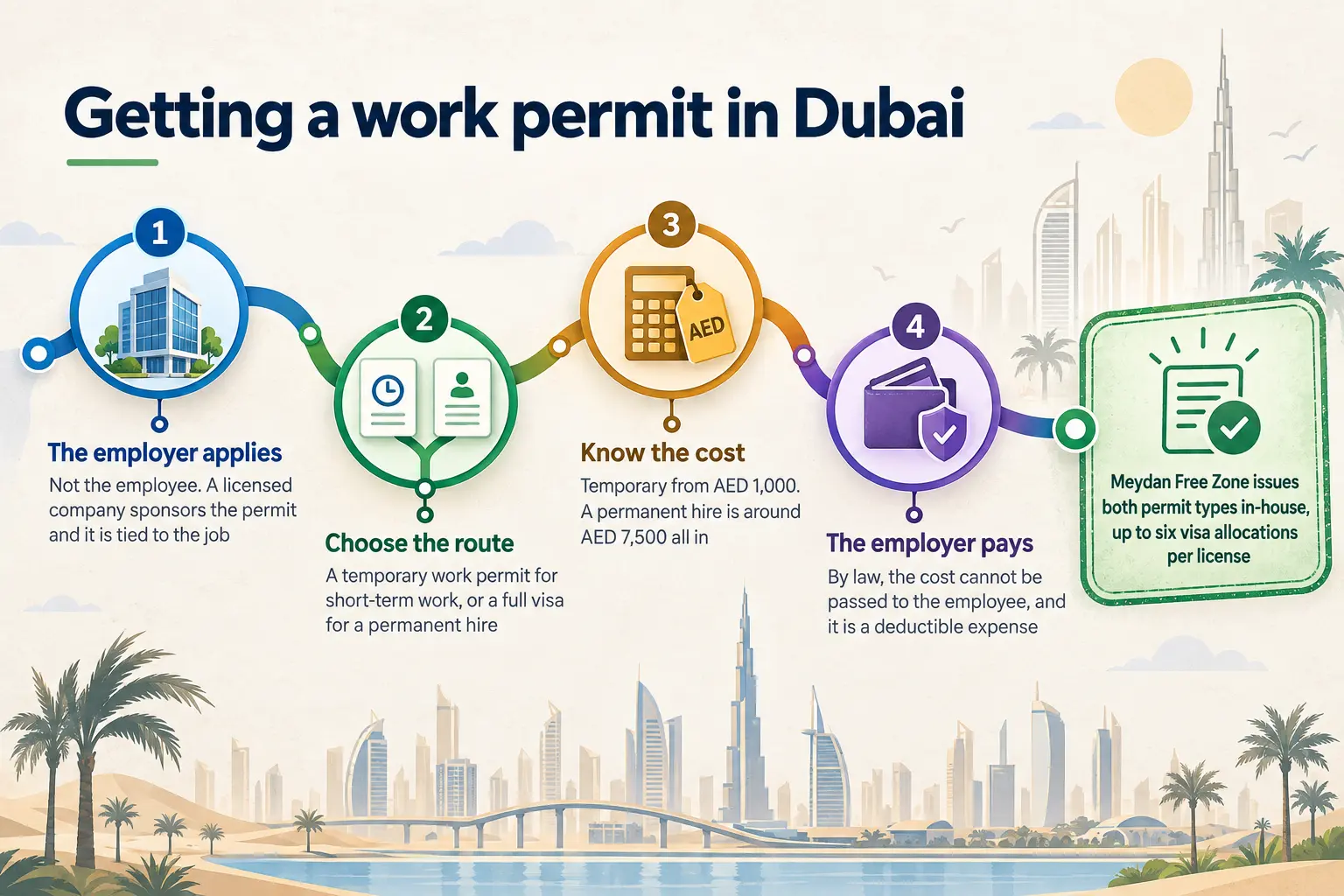
This is the point that changes everything, so it is worth being clear. A work permit is always tied to an employer.
An individual cannot apply for their own work permit. It must be sponsored by a licensed company that is hiring them. If the employment ends, the permit ends with it. For a business owner, that makes sponsoring staff your responsibility, including the costs. For an employee, your job offer is what unlocks the permit, and your employer manages the paperwork.
The Two Routes to a Work Permit
The right route depends on how long you are hiring someone for. There are two.
- The temporary work permit: This authorises work for a fixed short period, from a few weeks up to a year, without a full residence visa. It suits short-term projects, seasonal work, or trial hires.
- The full employment route: For a long-term hire, the work permit is issued as part of the employment visa, along with the residence visa, medical and Emirates ID. This is the standard route for permanent staff.
Choosing the right route saves both cost and time, so match it to the length of the role before you apply.
Free Business Setup Cost Calculator
Calculate NowDocuments You Need
Getting the paperwork right upfront is what keeps an application moving without delays. For a standard hire, the employer typically needs to provide:
- The employee's passport copy, valid for at least six months.
- A passport-size photo, meeting the standard requirements.
- The signed employment contract, in line with the free zone's rules.
- The employee's entry permit or current visa page, if they are already in the UAE.
- An attested education certificate, for roles that require one.
- The company's trade license and establishment card details.
Most standard hires need no more than this. Some roles, or some nationalities, call for extra documents or approvals, so it is worth checking the specific requirements before you submit. A complete file is the single biggest factor in a fast approval.
Temporary Work Permit Costs
If you only need someone for a short period, the temporary work permit is the simpler, cheaper route. At Meydan Free Zone, it is priced by duration.
| Temporary work permit | Cost |
|---|---|
| 21 days | AED 1,000 |
| 1 month | AED 1,350 |
| 3 months | AED 2,000 |
| 6 months | AED 2,500 |
| 12 months | AED 3,400 |
This route avoids the full residence-visa process, so it is faster and cheaper for short-term needs. When the work is longer term, the full employment route is the one to use.
The Full Employment Route
For a permanent hire, the work permit is issued together with the residence visa as one sponsored package. This follows a clear sequence.
- Confirm quota: Check the company has a visa allocation available to sponsor the hire.
- Get permit approval: Apply through your free zone authority, which issues the permit.
- Sign the contract: Issue a compliant employment contract for the employee to sign.
- Issue the entry permit: This lets the employee enter the UAE, or change status if already here.
- Complete medical and biometrics: The employee does a medical fitness test and Emirates ID biometrics in the UAE.
- Stamp the residence visa: The residence visa is finalised and the work permit is active.
This full process usually takes about two to four weeks, split between the steps before the employee arrives and those completed once they are in the UAE.
What the Employment Route Costs
For a long-term hire, here is what it costs at Meydan Free Zone, using its own figures.
| Item | Cost |
|---|---|
| Visa allocation, up to six per license | Around AED 1,850 each |
| Employment visa | AED 3,500 per employee |
| Establishment card, needed before sponsoring | AED 2,000 in year one |
| Medical and Emirates ID assistance | AED 2,250 per employee, bundled |
All in, a long-term employee works out at roughly AED 7,500 to 8,000 once the allocation, visa, medical and Emirates ID are counted. One rule matters most: under UAE labour law, the employer pays these costs, not the employee. For a business, they are legitimate, tax-deductible expenses.
How Meydan Free Zone Fits In
Here is where the free zone route gets simpler. Meydan Free Zone issues its own work permits and employment visas directly, under its own authority, rather than through the labour ministry.
- Permits issued in-house: Meydan Free Zone operates under its own jurisdiction, so there are no labour-ministry approvals and no employer no-objection certificate to chase. You sponsor staff directly through your digital dashboard.
- Both routes available: Whether you need a temporary work permit for a short project or a full employment visa for a permanent hire, both are issued through the free zone.
- Up to six visa allocations: A Meydan Free Zone license can hold up to six visa allocations, at around AED 1,850 each, even on a flexi desk.
- The process handled through mResidency: mResidency coordinates each permit, entry permit, medical, Emirates ID and visa stamping in one place.
Conclusion
A work permit in Dubai is the employer's responsibility, not the employee's. The route depends on how long you are hiring for. A temporary work permit covers short-term work from AED 1,000 with no residence visa. A long-term hire gets a work permit bundled with the residence visa for roughly AED 7,500 to 8,000. Either way, the employer sponsors and pays for it by law.
Match the route to the role, get your license and quota in place, and hiring becomes straightforward. If you are setting up a company in the UAE and plan to hire, book a free consultation with a setup advisor at Meydan Free Zone.