Table of Contents
Frequently Asked Questions
Can a business claim back VAT paid before it registered for VAT?
In some cases, yes. UAE VAT rules allow a newly registered business to recover VAT on certain goods and services bought before registration, provided they relate to taxable supplies and are supported by valid tax invoices. Different conditions apply to goods and services, so the claim should be reviewed against the Federal Tax Authority's guidance before it is entered on the first VAT return.
Which business expenses cannot be recovered as VAT in the UAE?
Input VAT cannot be recovered on entertainment expenses for non-employees, on motor vehicles made available for personal use by owners or employees, or on costs unrelated to the business. Expenses without a valid tax invoice also fail the test. Costs linked to exempt supplies are restricted as well.
What must a tax invoice show for a VAT claim to be accepted?
A valid tax invoice must show the supplier's name and Tax Registration Number, a description of the goods or services, the VAT amount in AED and your business name. Invoices that omit these details, or show a former company name, risk rejection during a Federal Tax Authority review. Credit notes must also be recorded in the correct period.
How long does a business need to keep VAT records?
VAT-registered businesses must keep invoices, contracts, customs documents and accounting records for the period set by the Federal Tax Authority, which is generally five years. Records must be complete, readable and available on request. Digital storage is acceptable if these conditions are met.
Can excess input VAT be carried forward instead of refunded?
Yes. When input VAT exceeds output VAT in a tax period, the business can carry the excess forward to offset future output VAT. Alternatively, it can request a refund through the Federal Tax Authority portal. A refund request may lead to document requests before approval.
How does the reverse charge affect VAT on overseas purchases?
Under the reverse charge, the UAE buyer accounts for VAT on certain goods and services bought from overseas suppliers. The business records the amount as output tax and, if the purchase is for taxable supplies, as input tax in the same return. The net effect is often nil, but the entries must still be made and supported by records.
Do free zone companies recover VAT in the same way as mainland companies?
Generally, yes. A Meydan Free Zone company registered for VAT follows federal VAT law and registers, files returns and claims refunds with the Federal Tax Authority. Different treatment applies only to designated zones listed by Cabinet decision, so do not assume it without checking that list.
What happens if a company claims VAT by mistake?
The company should correct the error promptly through a voluntary disclosure to the Federal Tax Authority. Delays can lead to administrative penalties if the error is found in a review first. Updating internal checks, such as invoice review before booking, helps prevent a repeat.
Topic Summary
What Input VAT in the UAE Means for Your Business
Input VAT is the VAT a VAT-registered business pays on purchases and expenses. It is usually deducted from the output VAT charged to customers, so you pay the Federal Tax Authority only the difference. Recovery depends on valid tax invoices and on the expense relating to taxable business supplies.
Business Expenses That Qualify for Input VAT in the UAE
Expenses qualify when they are incurred to make taxable supplies and are backed by a valid tax invoice in the business's name. Rent, professional fees, software, marketing, freight and office supplies are typical. Expenses linked to exempt supplies, or blocked by the VAT law, cannot be recovered.
Documents You Need to Support an Input VAT Claim
A claim needs a valid tax invoice from a VAT-registered supplier. It must show the supplier's name, Tax Registration Number (TRN), a description of the supply, the VAT amount in AED and your business name. Imports need customs documents. Keep records for five years.
Steps to Recover Input VAT on a VAT Return
Collect valid invoices, check each expense is recoverable, record the VAT, enter the amounts in the correct return boxes on the Federal Tax Authority portal, and file on time. Excess input VAT can be carried forward or claimed as a refund.
Common Input VAT Mistakes and How They Lead to Disputes
The most common mistakes are claiming without a valid tax invoice, deducting blocked expenses, missing the reverse charge entry and claiming in the wrong period. These can lead to denied claims, voluntary disclosures and administrative penalties.
Who Regulates Input VAT in the UAE
The Federal Tax Authority administers VAT across the UAE, including input tax recovery, returns and refunds. A Meydan Free Zone company registers and files with the Federal Tax Authority, not the free zone.
Conclusion
Recovering input VAT in the UAE comes down to execution: valid invoices, correct classification and timely returns. Build these habits from the first month and you protect cash flow and avoid disputed claims.
Recovering Input VAT on Business Expenses
Every business in the UAE registered for Value Added Tax (VAT) pays VAT on rent, software, freight and professional fees, and much of that tax can be claimed back. A careless approach leaves money unclaimed or exposes the claim to rejection by the Federal Tax Authority (FTA).
So which expenses qualify, and what proof do you need? This guide covers recoverable and blocked costs, the documents to keep and how to recover the tax on a return.
What Input VAT in the UAE Means for Your Business
Input VAT is the VAT a VAT-registered business pays on purchases and expenses. It is usually deducted from the output VAT charged to customers, so you pay the Federal Tax Authority only the difference. Recovery depends on valid tax invoices and on the expense relating to taxable business supplies.
Input VAT and Output VAT Compared
Output VAT is charged on your sales. Input VAT is paid on your purchases. Net VAT payable equals output VAT less recoverable input VAT, at the standard rate of 5% under Federal Decree-Law No. 8 of 2017, administered by the Federal Tax Authority.
Say a Meydan Free Zone consulting company invoices AED 10,000 plus AED 500 VAT. It pays AED 2,000 plus AED 100 VAT on software. It remits the AED 400 difference.
Recoverable and Blocked Expenses at a Glance
| Feature | Usually Recoverable | Usually Blocked or Restricted |
|---|---|---|
| Office rent and workspace | VAT on rent invoiced to the company for taxable activity | Space used for exempt supplies or private purposes |
| Professional and accounting fees | Accounting, legal and consulting fees with a valid tax invoice | Personal advice billed to an owner, not the business |
| Software and marketing | Subscriptions and advertising used to make taxable sales | Costs with no tax invoice or no business purpose |
| Entertainment for non-employees | Staff-only costs may qualify | Client dinners and hospitality are blocked |
| Vehicles available for personal use | Vehicles used solely for business, such as delivery vans | Cars available to owners or employees for personal use are blocked |
Who Can Recover It
Only businesses registered with the Federal Tax Authority can recover input VAT. Registration is mandatory above AED 375,000 a year in taxable supplies and voluntary from AED 187,500. Unregistered businesses carry VAT as a recurring cost. Say a start-up below the threshold registers voluntarily to reclaim set-up costs. Read the UAE VAT registration guide before deciding.
Business Expenses That Qualify for Input VAT in the UAE
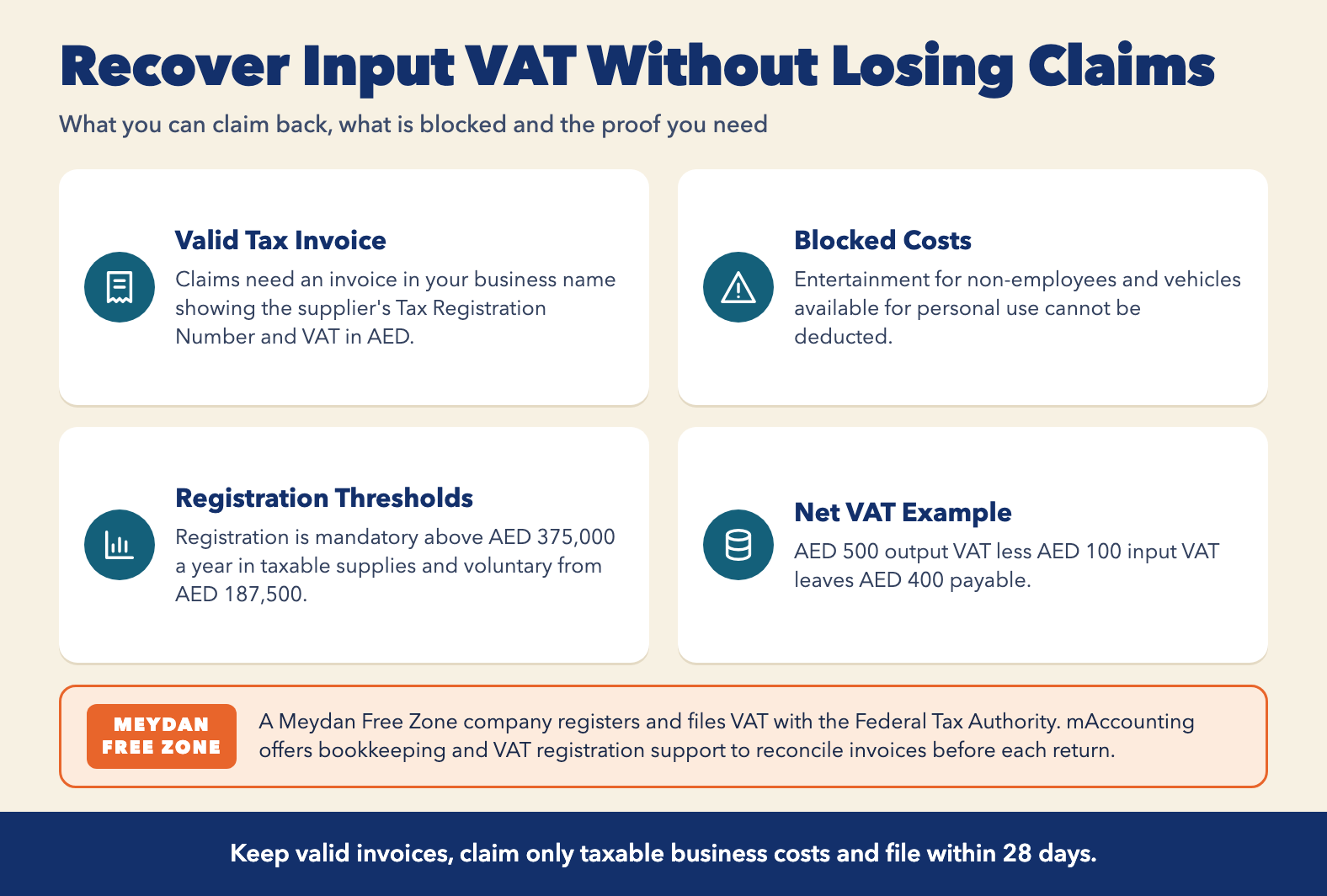
Expenses qualify when they are incurred to make taxable supplies and are backed by a valid tax invoice in the business's name. Rent, professional fees, software, marketing, freight and office supplies are typical. Expenses linked to exempt supplies, or blocked by the VAT law, cannot be recovered.
Common Recoverable Costs
- Rent and workspace costs.
- Accounting, legal and consulting fees.
- Software, advertising and freight.
- Equipment and stock used in taxable supplies.
An e-commerce trader, for instance, recovers VAT on freight and packaging invoiced to the company.
Expenses Where Recovery Is Blocked
- Entertainment for non-employees is blocked.
- Vehicles made available for personal use are blocked.
- Costs with no business purpose or no valid tax invoice fail.
A client dinner invoice is the standard case: the VAT cannot be deducted.
Mixed-Use and Partly Exempt Costs
Apportionment applies when a cost serves both taxable and exempt supplies. A landlord with taxable commercial income and exempt residential income must split shared costs using a method the Federal Tax Authority accepts. Keep records showing the basis of the split.
Documents You Need to Support an Input VAT Claim
A claim needs a valid tax invoice from a VAT-registered supplier. It must show the supplier's name, Tax Registration Number (TRN), a description of the supply, the VAT amount in AED and your business name. Imports need customs documents. Keep records for five years.
Tax Invoices and Credit Notes
Check each invoice against the UAE tax invoice requirements. An invoice missing the buyer's name can be rejected in a review. Credit notes must adjust your claim in the correct period.
Import and Reverse Charge Documents
Customs declarations support VAT paid on imports. Under the UAE VAT reverse charge, a purchase from an overseas supplier is recorded as both output and input tax. Since 1 January 2026, a Meydan Free Zone company buying foreign software no longer has to issue a self-invoice for that entry. It must still keep the supplier invoice and supporting documents.
Record Keeping Standards
- Keep invoices, payment proof and agreements together.
- Make records available on request.
- Store digitally if records stay complete and readable.
- Reconcile a monthly folder to the return.
Steps to Recover Input VAT on a VAT Return
Collect valid invoices, check each expense is recoverable, record the VAT, enter the amounts in the correct return boxes on the Federal Tax Authority portal, and file on time. Excess input VAT can be carried forward or claimed as a refund.
- Collect and check invoices. Verify the supplier TRN, match invoices to payments and reject failures before booking.
- Classify each expense. Mark recoverable, blocked and apportioned items. Use a ledger code for blocked entertainment VAT.
- Complete and file the return.Returns and any VAT due are filed within 28 days after the tax period ends, whether the period is monthly or quarterly.
- Carry forward or claim a refund.A new importer holding stock may have large input VAT and little output VAT. Request a refund on the portal, and expect document requests. Since 1 January 2026, excess refundable tax must be reclaimed within five years. See VAT refund for companies.
Common Input VAT Mistakes and How They Lead to Disputes
The most common mistakes are claiming without a valid tax invoice, deducting blocked expenses, missing the reverse charge entry and claiming in the wrong period. These can lead to denied claims, voluntary disclosures and administrative penalties.
Errors Found in Reviews
- Invoices in a former company name.
- Personal expenses booked to the business.
- Claims in the wrong period.
- Missing reverse charge entries.
A trader's claim was reduced after invoices showed the wrong legal name.
Correcting an Error
Submit a voluntary disclosure to the Federal Tax Authority as soon as you find an overclaim. Disclosing first generally costs less than an error the authority finds itself. A company that spots one in its own quarter-end review should disclose, then tighten its internal checks.
Who Regulates Input VAT in the UAE
The Federal Tax Authority administers VAT across the UAE, including input tax recovery, returns and refunds. A Meydan Free Zone company registers and files with the Federal Tax Authority, not the free zone.
Federal Tax Authority Role
Federal VAT law applies equally to mainland and free zone companies unless a designated zone treatment applies. Check the Cabinet list before assuming that status.
How Meydan Free Zone Supports VAT Compliance
mAccounting, one of the four pillars of Meydan Plus, covers bookkeeping, Corporate Tax support, VAT registration support and financial audit reports. A founder can keep bookkeeping current and reconcile invoices before each return, with records tied to the correct legal entity.
Free Business Setup Cost Calculator
Calculate NowConclusion
Recovering input VAT in the UAE comes down to execution: valid invoices, correct classification and timely returns. Build these habits from the first month and you protect cash flow and avoid disputed claims.
For a Meydan Free Zone company, mAccounting offers VAT registration support and bookkeeping, so map your expected expenses against recoverable and blocked categories before you register.
Ready to Launch Your Business in Dubai?
Let's Connect