






Table of Contents
Frequently Asked Questions
Do software subscriptions sold to customers abroad attract 5% VAT in the UAE?
Not usually. A qualifying export of services to a recipient outside the UAE can be zero-rated under Federal Decree-Law No. 8 of 2017 on VAT, provided the conditions are met. You need evidence, such as the contract, invoice, payment trail and proof that the customer is established outside the UAE. Without that evidence, the Federal Tax Authority may treat the sale as taxable at 5%.
Does a free zone software company need to register for VAT?
Yes, if it meets the thresholds. A free zone company is not outside VAT by default. Registration with the Federal Tax Authority is mandatory when taxable supplies and imports exceed AED 375,000 over the previous 12 months or are expected to in the next 30 days. Voluntary registration is available from AED 187,500.
How do I account for VAT on a foreign software subscription?
If you are VAT-registered and the foreign vendor does not charge UAE VAT, you account for it through the reverse charge. Calculate 5% on the invoice value and report it as output tax on your VAT return. You can usually claim the same amount as input tax if the purchase relates to taxable supplies. An AED 10,000 subscription, for example, creates AED 500 of output and input VAT.
Can a non-resident digital service provider be required to register for VAT in the UAE?
Yes. A foreign supplier making taxable supplies in the UAE must register if no one else, such as a VAT-registered business customer using the reverse charge, accounts for the tax. There is no registration threshold for non-residents in that situation. Registration is made with the Federal Tax Authority.
What must a tax invoice for a software sale include?
A tax invoice must show the words "Tax Invoice", your name, address and Tax Registration Number, and the customer's details. It must also carry the invoice date, a description of the service, and the amount and VAT charged. Amounts must be stated in AED. The Federal Tax Authority sets the full list of required details.
Can I recover VAT paid on software and cloud tools?
Yes, if you are VAT-registered and the purchase relates to your taxable business supplies. You need a valid tax invoice or, for reverse charge purchases, a correct record of the self-accounted tax. Input tax on personal or non-business use is not recoverable, so keep company and personal subscriptions separate.
What evidence supports zero-rating for a digital service export?
Keep the signed contract, the invoice, proof of payment and documents showing the customer is outside the UAE, such as a business address or registration details. Records support your zero-rating position if the Federal Tax Authority audits you. You must retain them for at least five years.
What happens if I register for VAT late?
The Federal Tax Authority can impose an administrative penalty for failing to register within the legal deadline. You must also account for VAT from the date you should have registered, which can leave you liable for tax you did not charge customers. Tracking revenue against the AED 375,000 threshold each month helps you register on time.
Topic Summary
What VAT on Digital Services and Software in the UAE Covers
VAT on digital services in the UAE is the 5% tax charged on electronically supplied services and software, such as subscriptions, SaaS, apps, downloads and online platforms. The Federal Tax Authority (FTA) administers it under Federal Decree-Law No. 8 of 2017. Whether it applies depends on who supplies, who receives and where the supply is deemed to occur.
Place of Supply Rules for Digital Services
Place of supply decides whether the UAE can tax a service. For telecommunication and electronic services, UAE VAT law looks at where the service is actually used and enjoyed. A supply used and enjoyed in the UAE is taxed at 5%, while a qualifying export may be zero-rated if the conditions in the Executive Regulation are met.
Reverse Charge on Imported Digital Services
When a UAE VAT-registered business buys digital services from a foreign supplier that is not registered in the UAE, the buyer accounts for the VAT through the reverse charge. Output and input tax sit on the same return, so the cash effect is often nil if the purchase is fully recoverable. See the guide to the UAE VAT reverse charge for recording detail.
Registration Thresholds and Timing
VAT registration is mandatory when taxable supplies and imports exceed AED 375,000 over the previous 12 months, or are expected to in the next 30 days. Voluntary registration is available from AED 187,500 in taxable supplies or expenses. Late registration attracts an administrative penalty from the FTA.
Steps to Apply VAT Correctly to Digital Sales
To apply VAT on digital services in the UAE correctly, classify the supply, confirm where the customer is, decide the rate, issue a compliant tax invoice, record the sale and report it. Records must be kept for at least five years.
Common VAT Mistakes on Software and Digital Sales
Common errors include charging VAT on genuine exports, skipping the reverse charge on foreign subscriptions, weak evidence of customer location, non-compliant invoices and late registration. Each can cause penalties or irrecoverable tax. A monthly review of contracts, billing settings and supplier invoices reduces these risks.
What Meydan Free Zone Companies Should Set Up
A Meydan Free Zone software company is still subject to VAT through the FTA. The mAccounting pillar of Meydan Plus covers bookkeeping, VAT registration support and Corporate Tax support, so invoicing and returns can match your activity from the start.
VAT on Digital Services and Software in the UAE
Subscriptions, software as a service (SaaS) and software licenses fall under UAE VAT just like physical goods, which surprises many founders. A sale to a customer abroad, or a license bought from a foreign vendor, can create VAT duties on both sides of the business.
So when do you charge 5%, when can you zero-rate, and when must you self-account? This guide covers the place of supply rules, the reverse charge, registration timing and the steps to invoice correctly.
What VAT on Digital Services and Software in the UAE Covers
VAT on digital services in the UAE is the 5% tax charged on electronically supplied services and software, such as subscriptions, SaaS, apps, downloads and online platforms. The Federal Tax Authority (FTA) administers it under Federal Decree-Law No. 8 of 2017. Whether it applies depends on who supplies, who receives and where the supply is deemed to occur.
Services and Software Within Scope
SaaS subscriptions, mobile apps, downloadable software, cloud hosting and online platforms are all in scope at the 5% standard rate, unless zero-rating or an exemption applies. Bespoke development is a service. Packaged software can be treated as goods or services depending on delivery.
Say a Dubai founder sells a monthly project-management subscription to UAE businesses. Once registered, she charges 5% VAT on every invoice.
VAT Treatment of Common Digital Transactions
| Transaction | Typical VAT Treatment |
|---|---|
| SaaS sold to a UAE business | 5% VAT charged on a tax invoice |
| SaaS sold to a customer outside the UAE with evidence | Zero-rated at 0% if the export conditions are met |
| Software license bought from an unregistered foreign vendor | Buyer accounts for 5% under the reverse charge |
| Cloud hosting bought from a UAE-registered supplier | Supplier charges 5%; buyer recovers it if the use is taxable |
| Software sold to a UAE consumer by a foreign supplier | Supplier may need non-resident VAT registration |
Who Administers the Tax
The FTA handles registration, returns and audits. Free zone companies are not outside VAT by default, so a Meydan Free Zone software company registers like any other taxable person. Designated Zones treat certain goods differently, but that rarely changes how services are taxed.
Place of Supply Rules for Digital Services
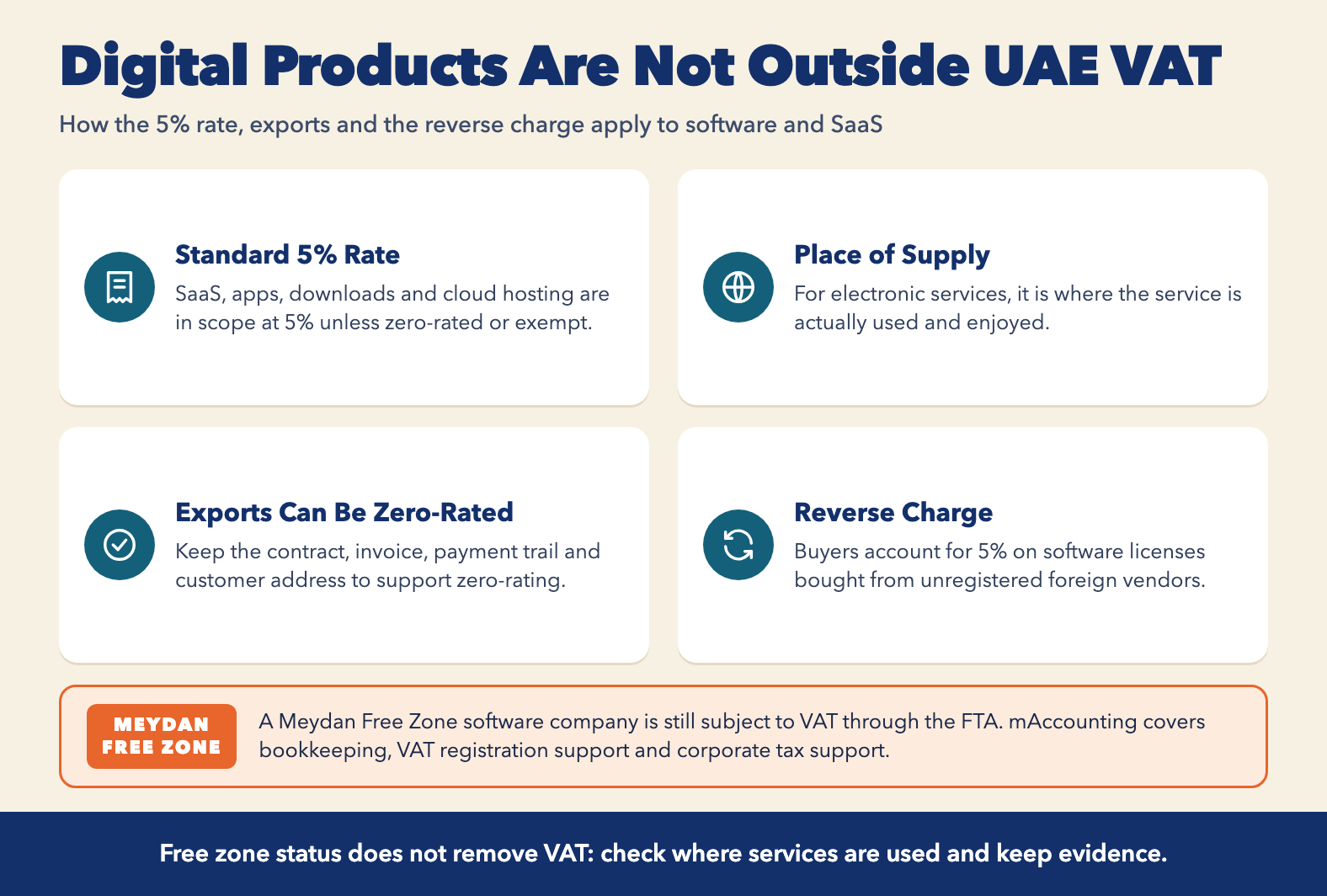
Place of supply decides whether the UAE can tax a service. For telecommunication and electronic services, UAE VAT law looks at where the service is actually used and enjoyed. A supply used and enjoyed in the UAE is taxed at 5%, while a qualifying export may be zero-rated if the conditions in the Executive Regulation are met.
Supplies to UAE Customers
An app developer in Dubai who sells annual licenses to a Sharjah retailer charges 5% VAT. You identify the customer's location, keep evidence and issue a compliant tax invoice. The UAE tax invoice requirements list every mandatory field.
Exports to Customers Outside the UAE
A SaaS firm billing a UK client keeps the contract, invoice, payment trail and customer address on file. That evidence supports zero-rating. Zero-rated supplies still count towards the registration threshold.
Business and Consumer Customers
- The UAE has no simplified overseas-seller regime for consumers.
- Foreign suppliers may need to register as non-residents.
- For non-residents, no threshold applies when no one else accounts for the tax.
- Record customer status where treatment depends on it.
Reverse Charge on Imported Digital Services
When a UAE VAT-registered business buys digital services from a foreign supplier that is not registered in the UAE, the buyer accounts for the VAT through the reverse charge. Output and input tax sit on the same return, so the cash effect is often nil if the purchase is fully recoverable. See the guide to the UAE VAT reverse charge for recording detail.
How the Reverse Charge Works
You calculate 5% on the invoice value and report it in the relevant boxes on the return. A registered Dubai agency paying AED 10,000 for a foreign design platform records AED 500 output and AED 500 input VAT. Input tax is claimable only if the purchase relates to taxable supplies.
Common Purchases That Trigger It
- Cloud hosting and advertising platforms.
- Development tools and software licenses.
- Foreign invoices showing no tax charged.
- Monthly overseas hosting invoices, kept with payment records.
Registration Thresholds and Timing
VAT registration is mandatory when taxable supplies and imports exceed AED 375,000 over the previous 12 months, or are expected to in the next 30 days. Voluntary registration is available from AED 187,500 in taxable supplies or expenses. Late registration attracts an administrative penalty from the FTA.
Mandatory and Voluntary Registration
Track reverse charge purchases alongside sales. A start-up with heavy foreign software spend may register voluntarily to recover input VAT.
Why Early Registration Matters
You have 30 days to apply once the threshold is crossed or expected. Say a developer closes a large contract: the clock starts then. Clients also often ask for a tax registration number before signing. Review VAT registration support services before you reach the limit.
Steps to Apply VAT Correctly to Digital Sales
To apply VAT on digital services in the UAE correctly, classify the supply, confirm where the customer is, decide the rate, issue a compliant tax invoice, record the sale and report it. Records must be kept for at least five years.
Step 1: Classify the Supply and the Customer
- Decide if it is software, a service or a bundle.
- Split a software and support bundle, or treat it by its principal element.
- Confirm whether the customer is in the UAE or abroad.
Step 2: Set the Rate and Issue the Invoice
- Apply 5%, or zero-rate with evidence.
- Show your Tax Registration Number (TRN), date, description and tax amount.
- State amounts in AED, with VAT shown separately.
Step 3: Record, Report and Retain
- Reflect sales and reverse charge entries in the return.
- File on the FTA portal on time.
- Keep records for five years.
Common VAT Mistakes on Software and Digital Sales
Common errors include charging VAT on genuine exports, skipping the reverse charge on foreign subscriptions, weak evidence of customer location, non-compliant invoices and late registration. Each can cause penalties or irrecoverable tax. A monthly review of contracts, billing settings and supplier invoices reduces these risks.
Billing and Evidence Gaps
- Platform defaults charge 5% on all customers.
- No proof of customer location.
- TRN missing from invoices.
Picture a SaaS founder whose billing tool applied 5% to overseas customers for a full year. Every affected invoice then needs correcting.
Purchase-Side Oversights
- Reverse charge overlooked.
- Input tax claimed on non-business use.
- Foreign tools paid on a personal card and never recorded.
What Meydan Free Zone Companies Should Set Up
A Meydan Free Zone software company is still subject to VAT through the FTA. The mAccounting pillar of Meydan Plus covers bookkeeping, VAT registration support and Corporate Tax support, so invoicing and returns can match your activity from the start.
Licensing the Right Activities
Choose software, IT or digital activities that match your actual revenue, with the right activities on one license. After registration, Meydan Free Zone issues the Business License digitally. Fawri, for solo entrepreneurs, issues a license in under 60 minutes. A solo developer should license software development before signing the first client contract.
Accounting and VAT Support
Decide registration timing before you reach the threshold. The Meydan Free Zone Cost Calculator gives an indicative set-up estimate and lets you add optional Meydan Plus services alongside your license and visas.
Free Business Setup Cost Calculator
Calculate NowConclusion
VAT on digital services in the UAE turns on three facts: where the service is used, whether you are registered, and who accounts for tax on foreign purchases. The FTA reviews what your records show, so execution matters more than theory.
Map your current and expected revenue against the AED 375,000 threshold, list your foreign software costs, and decide when to register for VAT. For a Meydan Free Zone company, mAccounting includes VAT registration support, so registration timing can be settled alongside your bookkeeping.
Ready to Launch Your Business in Dubai?
Let's ConnectReferences
- Federal Tax Authority (FTA), UAE, VAT legislation and guidance, 2026