

Table of Contents
Frequently Asked Questions
Which business assets can a lender take as security in the UAE?
Lenders commonly take security over movable assets such as inventory, machinery, vehicles, office equipment and receivables. Which assets a bank accepts depends on its own credit policy. A bank may accept vehicles but decline slow-moving stock.
Who files a security interest on the Emirates Movable Collateral Registry?
The secured creditor, usually the lender, normally files the details on the registry once a written security arrangement is signed. The borrower should check that the parties, asset description and secured amount match the signed agreement.
Does registering collateral give a lender priority over other creditors?
Registration makes the security visible to third parties and helps establish the lender's priority if the borrower defaults. A later lender who searches the register will see the existing claim. Rankings between competing creditors depend on the applicable federal law and the order of registration.
Can a Meydan Free Zone company pledge its assets to a bank?
Yes. A Meydan Free Zone company can pledge movable assets to a lender under the federal framework. Banks usually ask for the Business License, Certificate of Formation, Share Register and Memorandum and Articles of Association, which Meydan Free Zone issues digitally.
What happens to the registry entry after a loan is repaid?
The entry should be discharged once the debt is settled. If it stays active, a new lender searching the register may see an existing claim over the same assets and hesitate to lend. Borrowers should keep the discharge confirmation on file.
Can a company keep using assets that are pledged as security?
Usually yes, because most movable collateral arrangements allow the business to keep trading with the assets. The loan agreement typically restricts selling or transferring them without lender consent. It may also require insurance and accurate asset records.
Is a share pledge the same as movable collateral?
No. Movable collateral gives the lender a claim over specific business assets, while a share pledge gives a claim over the ownership shares in the company. A mortgage secures a loan against real estate. A lender may request more than one type of security for the same facility.
Topic Summary
What the Registry Is and Who Uses It
The Emirates Movable Collateral Registry is the federal electronic register where lenders record security interests over a borrower's movable assets, such as stock, receivables, equipment and vehicles. Registration makes the security visible to other creditors and helps establish priority if the borrower defaults.
Authority and Rules
The Emirates Movable Collateral Registry operates under federal law, not under any one emirate. It is run by the Emirates Integrated Registries Company (EIRC), while the Central Bank of the UAE regulates the banks that usually take this security.
How to Register a Security Interest in the Registry
A security interest is registered by agreeing a written security arrangement with the lender, describing the assets clearly, and filing the details on the Emirates Movable Collateral Registry. The secured creditor normally files. You should check that the description, parties and amount match the signed agreement.
Movable Collateral Compared With Other Security
Movable collateral secures a loan against business assets that can be moved or traded, while a share pledge secures it against ownership of the company and a mortgage secures it against real estate. The right choice depends on what the business owns and what the lender will accept.
Costs, Risks and Compliance
Borrowers carry the cost of registration fees, legal drafting and possible valuation, and they accept limits on selling or moving pledged assets. The main risks with registered movable collateral are loss of assets on default, an inaccurate description and a forgotten entry.
Meydan Free Zone Companies
A Meydan Free Zone company can pledge its movable assets to a lender under the federal framework, and the Emirates Movable Collateral Registry applies to it in the same way. Meydan Free Zone issues the Business License, Certificate of Formation, Share Register and Memorandum and Articles of Association digitally. mCore supports business bank account opening, which is where most financing starts.
Conclusion
The Emirates Movable Collateral Registry lets a business turn stock, equipment and receivables into financing, provided the security is described accurately, registered correctly and discharged on time. Execution matters more than theory.
Emirates Movable Collateral Registry: How Business Assets Secure Financing
Many founders assume a bank will only lend against property or a personal guarantee. In practice, lenders also take security over stock, receivables, equipment and vehicles, and they record it on the Emirates Movable Collateral Registry. This guide explains how the registry works, what pledging assets costs you in risk and obligations, and how it applies to a Meydan Free Zone company.
What the Registry Is and Who Uses It
The Emirates Movable Collateral Registry is the federal electronic register where lenders record security interests over a borrower's movable assets, such as stock, receivables, equipment and vehicles. Registration makes the security visible to other creditors and helps establish priority if the borrower defaults.
Movable Assets a Lender Can Take as Security
- Tangible items: inventory, machinery, vehicles, office equipment.
- Intangible items: receivables and similar rights, where the law permits.
Say a Dubai-based trading company pledges stock and receivables to support a working capital facility. The founder owns no property, yet still borrows against what the business trades.
Why a Public Record Matters to Lenders
Lenders search the register before they advance funds. A second lender that finds an existing claim over the same equipment will usually decline to lend against it. The record gives notice to third parties and supports priority between competing creditors. If you want to see the other side of this market, read about how to start a collateral management services business.
Authority and Rules
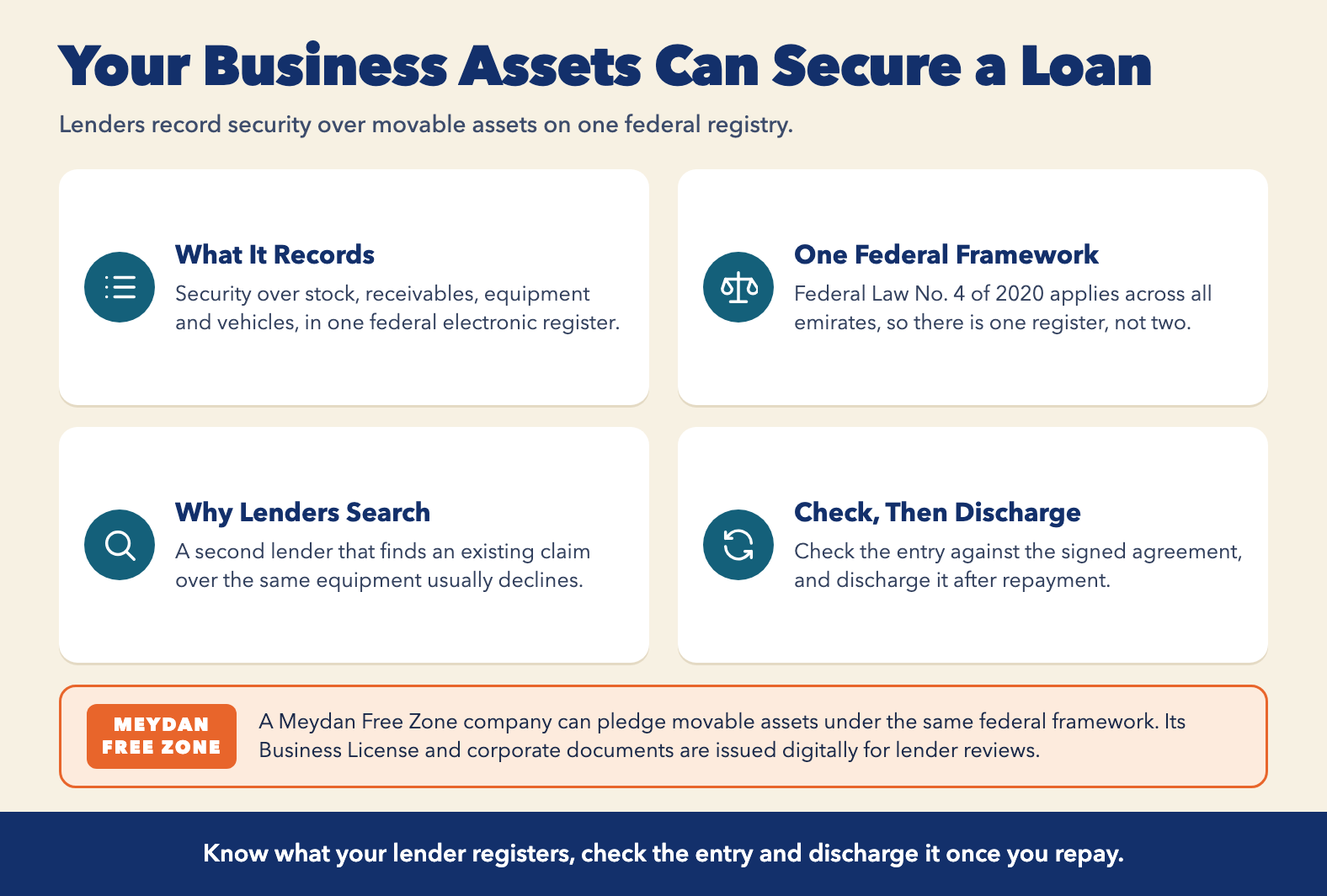
The Emirates Movable Collateral Registry operates under federal law, not under any one emirate. It is run by the Emirates Integrated Registries Company (EIRC), while the Central Bank of the UAE regulates the banks that usually take this security.
Federal Law and the Registry Operator
The framework is Federal Law No. 4 of 2020 on pledging movable assets as security for debt, with Executive Regulations issued by Cabinet Decision No. 29 of 2021. It applies across all emirates. A founder operating in Dubai with a bank in another emirate deals with one register, not two.
Where Banks and the Central Bank Fit In
Banks take the security. The Central Bank of the UAE supervises them. Each lender's credit policy decides which assets it accepts: a bank may take vehicles but decline slow-moving stock.
How to Register a Security Interest in the Registry
A security interest is registered by agreeing a written security arrangement with the lender, describing the assets clearly, and filing the details on the Emirates Movable Collateral Registry. The secured creditor normally files. You should check that the description, parties and amount match the signed agreement.
Step 1: Agree the Security Arrangement in Writing
- Name the parties, the secured obligation and the assets.
- Prefer specific descriptions, such as serial numbers for each machine.
- Use notarisation only where the law or your lender requires it.
Step 2: File the Details on the Registry
- The creditor enters the filing details.
- Check the entry against the signed agreement before you draw funds.
- Keep the registration confirmation on file.
Step 3: Amend, Renew or Discharge the Entry
- Amend the entry when assets or amounts change.
- Discharge it after repayment.
- A stale entry can block a new loan when the next lender runs a search.
Movable Collateral Compared With a Share Pledge
| Feature | Movable Collateral | Share Pledge |
|---|---|---|
| What is secured | Specific assets such as stock, receivables and equipment | Ownership of the company's shares |
| Who it suits | Founders with trading assets but no property | Owners whose main value sits in the company itself |
| Effect on trading | Limits on selling or moving the pledged assets | Daily trading continues, but control rights can shift on default |
| Public record | Recorded on the federal registry, searchable by lenders | Recorded through the share register and the pledge documents |
| Typical lender use | Working capital and equipment finance | Larger facilities, often layered with other security |
Movable Collateral Compared With Other Security
Movable collateral secures a loan against business assets that can be moved or traded, while a share pledge secures it against ownership of the company and a mortgage secures it against real estate. The right choice depends on what the business owns and what the lender will accept.
Movable Assets Versus a Share Pledge
One is an asset-level claim, the other an ownership-level claim. A founder with plenty of stock but no property will often choose asset-backed security. For the alternative, see what is share pledge in the UAE.
When a Lender Asks for More Than One Type
- Layered security is common: a bank may ask for a receivables pledge and a personal guarantee.
- Priority between claims affects what remains for later lenders.
- Negotiate the scope so you keep operating flexibility.
Costs, Risks and Compliance
Borrowers carry the cost of registration fees, legal drafting and possible valuation, and they accept limits on selling or moving pledged assets. The main risks with registered movable collateral are loss of assets on default, an inaccurate description and a forgotten entry.
Fees and Costs You Can Plan For
- Budget registry filing separately from legal drafting and valuation.
- Amendments or renewals are a recurring cost.
- Take official fee figures only from the registry, not from lenders' estimates.
Default, Enforcement and Disputes
On default, the lender can enforce against the pledged assets. If a lender and a supplier both claim the same equipment, registration and priority decide the outcome. The World Bank's work on secured transactions explains why registries reduce such disputes. Our guide to UAE civil law for business owners covers the wider rules.
Day-to-Day Obligations While Assets Are Pledged
- Insure and maintain the assets.
- Do not sell or transfer them without lender consent.
- Keep asset records accurate.
A company that sells pledged stock without consent is in breach, and that can trigger default.
Meydan Free Zone Companies
A Meydan Free Zone company can pledge its movable assets to a lender under the federal framework, and the Emirates Movable Collateral Registry applies to it in the same way. Meydan Free Zone issues the Business License, Certificate of Formation, Share Register and Memorandum and Articles of Association digitally. mCore supports business bank account opening, which is where most financing starts.
Documents a Lender Will Ask a Free Zone Company For
- Business License and Certificate of Formation.
- Share Register and Memorandum and Articles of Association.
A trading company can send these digital documents straight to a bank during a facility review.
Setting Up Banking Before You Seek Financing
Plan bank account opening alongside asset purchases. mCore support does not guarantee approval, since each bank decides on its own criteria. The Cost Calculator helps you budget running costs before you commit.
Free Business Setup Cost Calculator
Calculate NowConclusion
The Emirates Movable Collateral Registry lets a business turn stock, equipment and receivables into financing, provided the security is described accurately, registered correctly and discharged on time. Execution matters more than theory.
List your movable assets, check what a lender will accept, and agree the security terms before you sign. With Meydan Free Zone, the Business License and corporate documents are issued digitally, so they are ready when a lender reviews your facility.
Ready to Launch Your Business in Dubai?
Let's Connect