

Table of Contents
Frequently Asked Questions
Do I charge VAT when I sell my business in the UAE?
It depends on the structure of the deal. If the sale qualifies as a transfer of a going concern, it falls outside the scope of VAT and the seller does not charge 5% on the price. If it is a sale of individual assets, VAT applies in the normal way.
Does the buyer need a VAT registration number for the sale to qualify?
Yes. The buyer must be registered for VAT, or must be required to register and have applied. Ask for the buyer's tax registration number before signing. A buyer whose taxable supplies pass AED 375,000 a year must register.
Is buying the shares of a company treated as a business transfer for VAT?
No. A share sale changes who owns the company, but the company keeps making its own supplies. The business itself does not move to a new owner, so the going concern rule is not the relevant test.
Can I sell only part of my business without charging VAT?
Yes, but only if the part is independent and capable of operating on its own. Handing over a client list or a few assets while keeping the brand and equipment is unlikely to qualify. The buyer must also continue the same activity.
What should a seller issue to document a qualifying business transfer?
The sale agreement and transfer document should show no VAT line on the business price. The agreement should state that the sale is a transfer of a going concern outside the scope of VAT. Keep the agreement and the asset schedule with your tax records.
What happens if the Federal Tax Authority rejects the going concern treatment?
The Federal Tax Authority may assess the unpaid tax and penalties against the party that misapplied the rule, usually the seller. Add a clause to the sale agreement that allocates responsibility for any VAT assessed. This should be agreed before completion.
Does the seller need to deregister for VAT after selling the business?
A seller that stops making taxable supplies should review whether it must deregister with the Federal Tax Authority. A founder who sells the only trading business and closes the entity will normally deregister. The seller must also keep the transfer records for the retention period set in the VAT law.
Can a Meydan Free Zone company buy a business and apply the going concern rule?
Yes, provided the transfer meets the conditions set by the VAT law and the Federal Tax Authority. The buyer must be VAT registered, or have applied, and must continue the same business. Meydan Free Zone's mAccounting offers VAT registration support and bookkeeping, which helps the company line up its registration with the acquisition.
Topic Summary
What Is a Transfer of a Going Concern Under UAE VAT
A transfer of a going concern is the sale of a whole business, or an independent part of one, to a buyer who continues operating it. Under the UAE VAT law, a qualifying transfer is not treated as a supply, so the seller does not charge 5% VAT on it.
Why the Rule Matters for Entrepreneurs and Buyers
The rule decides whether VAT sits on top of the purchase price. Without it, a buyer would pay 5% on the full value, then wait to recover it. A qualifying transfer of a going concern removes that cash-flow strain and the cost of misapplying the rule.
Conditions a Transfer Must Meet to Stay Outside VAT
A transfer qualifies when the buyer is registered for VAT, or must register and has applied. The whole business or an independent part must transfer while it is operating, and the buyer must continue it. Confirm each condition in writing before completion, because failing one makes the sale taxable.
Registration and Reporting Duties After the Transfer
After a qualifying transfer, the buyer must hold a valid VAT registration and report future taxable supplies on its returns. The seller reviews its own registration and tells the FTA if it stops making taxable supplies.
Common Structuring Mistakes in Business Transfers
The most common mistakes are splitting a business into separate asset sales, selling to an unregistered buyer, and closing the business straight after completion. Each breaks the going concern conditions.
What This Means for a Founder Buying or Selling a Business
Settle the VAT treatment before signing, not after. Check the buyer's registration, define what transfers, and write the outside-scope position into the agreement.
Final Thoughts
The transfer of a going concern under UAE VAT turns on three facts: a registered buyer, a whole business or independent part, and continued trading. Get those right and the sale falls outside VAT. Get them wrong and the cost lands on the seller or buyer.
Transfer of a Going Concern Under UAE VAT
Selling or buying a business in the UAE raises a costly question: does 5% VAT apply to the price? Founders often assume it does, or that a business sale is automatically exempt. Neither is correct.
The answer depends on whether the deal is a transfer of a going concern, and this guide explains the conditions, the cash-flow stakes and the paperwork that keeps a qualifying sale outside VAT.
What Is a Transfer of a Going Concern Under UAE VAT
A transfer of a going concern is the sale of a whole business, or an independent part of one, to a buyer who continues operating it. Under the UAE VAT law, a qualifying transfer is not treated as a supply, so the seller does not charge 5% VAT on it.
How the VAT Law Treats a Qualifying Transfer
Article 7 of Federal Decree-Law No. 8 of 2017 sets the rule. The Federal Tax Authority (FTA) administers it and explains the conditions in its public clarification VATP015. Outside the scope of VAT is not the same as zero-rated or exempt: the transaction simply sits outside the tax.
Say a trading company sells its wholesale division, including stock, customer base and supplier arrangements, to a buyer who keeps the same activity. That can qualify as a transfer of a going concern, and the price then carries no VAT.
Going Concern Transfer Versus a Simple Asset Sale
The test looks at whether a functioning business passes across, not at the label in the agreement.
- Selling vehicles or equipment alone is a taxable supply.
- A founder who sells only office furniture and laptops charges 5% VAT, even if the deal is called a business sale.
- The distinction changes the cash the buyer needs on completion.
Why the Rule Matters for Entrepreneurs and Buyers
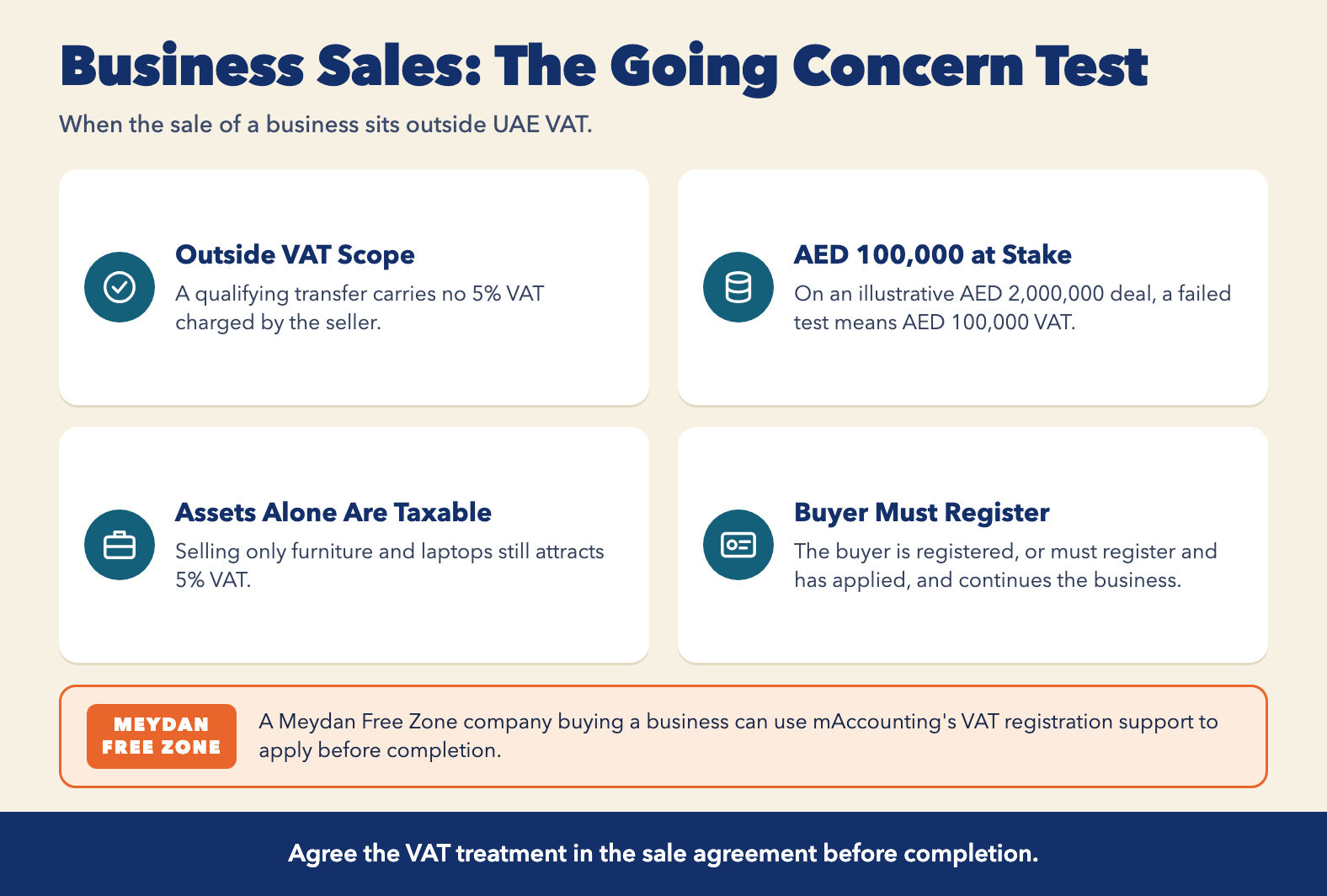
The rule decides whether VAT sits on top of the purchase price. Without it, a buyer would pay 5% on the full value, then wait to recover it. A qualifying transfer of a going concern removes that cash-flow strain and the cost of misapplying the rule.
Cash Flow Impact on Completion Day
On an illustrative AED 2,000,000 purchase, 5% VAT is AED 100,000 payable at completion if the transfer does not qualify. Recovery depends on the buyer being registered and holding a valid invoice. Outside-scope treatment avoids that timing gap.
Qualifying Transfer Versus Taxable Asset Sale
| Feature | Qualifying Going Concern Transfer | Taxable Asset Sale |
|---|---|---|
| VAT treatment of the price | Outside the scope of VAT; no 5% charged | 5% VAT charged on the price |
| Buyer registration requirement | Buyer is registered, or must register and has applied | Not a condition of the treatment |
| What passes to the buyer | Whole business or independent part | Individual assets such as stock or equipment |
| Continuity of the business | Buyer continues the same activity | No continuity required |
| Documentation to keep | Sale agreement, asset schedule, buyer's registration details | Tax invoice showing output VAT |
Risk of Treating a Transfer Incorrectly
- Charging VAT on a qualifying transfer, or skipping it on a non-qualifying one, creates an error for both parties.
- The FTA may assess tax and penalties against the party that misapplied the rule.
- A seller who skips VAT on a deal that fails the continuity test can face an assessment later.
- Agree the treatment in the sale agreement, not after completion.
Conditions a Transfer Must Meet to Stay Outside VAT
A transfer qualifies when the buyer is registered for VAT, or must register and has applied. The whole business or an independent part must transfer while it is operating, and the buyer must continue it. Confirm each condition in writing before completion, because failing one makes the sale taxable.
Step 1: Confirm the Buyer's VAT Status
- Ask for the buyer's tax registration number before signing.
- A buyer with no prior supplies may have to register because the acquired business's taxable supplies exceed AED 375,000 a year. It should apply before completion.
Step 2: Check What Is Actually Transferring
- List the assets, stock, contracts, staff arrangements and customer relationships included.
- A seller who keeps the brand and equipment but hands over only a client list has not transferred an independent part of a business.
Step 3: Prove the Business Continues
- The buyer carries on the same kind of business, not a closure or immediate change of activity.
- A buyer of a catering company keeps the activity and the same kitchen.
- Keep supplier orders and customer invoices after completion as evidence.
Step 4: Record the Treatment in Writing
- State that the sale is a transfer of a going concern outside the scope of VAT.
- Add a clause allocating any VAT assessed if the FTA disagrees.
- Retain the agreement and asset schedule. Under the VAT law, the Federal Tax Authority expects most records to be kept for at least five years.
Registration and Reporting Duties After the Transfer
After a qualifying transfer, the buyer must hold a valid VAT registration and report future taxable supplies on its returns. The seller reviews its own registration and tells the FTA if it stops making taxable supplies.
Buyer Registration and Returns
Register before or alongside completion if you aren't already. Our UAE VAT registration guide covers the mechanics. Issue compliant invoices from the first day under the new owner, and align the return period with your existing VAT calendar.
Seller Deregistration and Record Keeping
A founder who sells their only trading business and closes the entity should review deregistration. Keep the sale agreement and schedules with the tax records.
Invoicing the Transfer Correctly
The transfer document shows no output tax on the business price. The buyer's later customer invoices follow normal rules, as set out in the UAE tax invoice requirements.
Common Structuring Mistakes in Business Transfers
The most common mistakes are splitting a business into separate asset sales, selling to an unregistered buyer, and closing the business straight after completion. Each breaks the going concern conditions.
Splitting a Sale Into Separate Asset Deals
A seller who signs three agreements for stock, fixtures and goodwill risks the FTA treating them as taxable asset sales. Use one agreement for the entire business or independent part.
Mergers and Share Sales Are Not the Same Thing
Buying 100% of a company's shares changes ownership, not the business, so no business transfer takes place. A merger follows a separate legal process, covered in merging two companies in the UAE. Confirm the structure before applying the rule.
What This Means for a Founder Buying or Selling a Business
Settle the VAT treatment before signing, not after. Check the buyer's registration, define what transfers, and write the outside-scope position into the agreement.
Questions to Settle Before Signing
- Is the buyer registered or about to register?
- Does a whole business or independent part transfer?
- Will the buyer continue the same activity?
- Who bears the risk if the FTA disagrees?
How Meydan Free Zone Supports the Tax Side
mAccounting, part of Meydan Plus, covers bookkeeping, Corporate Tax support and VAT registration support. A Meydan Free Zone company that acquires a business can use it to apply for VAT registration and keep its books ready for its first return. The FTA, not the service, decides the VAT treatment.
Free Business Setup Cost Calculator
Calculate NowFinal Thoughts
The transfer of a going concern under UAE VAT turns on three facts: a registered buyer, a whole business or independent part, and continued trading. Get those right and the sale falls outside VAT. Get them wrong and the cost lands on the seller or buyer.
Before signing, document the buyer's VAT status, the assets included and the continuity of the business, then agree who carries the risk if the FTA disagrees. A Meydan Free Zone company on the buying side can use mAccounting's VAT registration support to apply before completion.
Ready to Launch Your Business in Dubai?
Let's Connect