
Table of Contents
Frequently Asked Questions
Can an employer in the UAE pay salaries onto a prepaid card instead of a bank account?
Yes. An employer can pay salaries onto a payroll card issued by a licensed financial institution, provided the payment is made through an approved channel. The card does not remove WPS obligations, so the amount credited must match the contract and be paid on time. Many employers use cards for some roles and salary transfer accounts for others.
Is a salary card the same as a debit card?
No. A salary card is prepaid and holds only the amount the employer credits. A debit card is linked to a full bank account, which usually brings wider features such as savings and credit access. Limits and fees on salary cards depend on the issuer.
Do employees need an Emirates ID to receive a salary card?
Not always. Issuers set their own identity requirements, and a passport may be accepted during onboarding while the Emirates ID is still being processed. Once the Emirates ID is issued, the employee is usually asked to update their records with the issuer.
Who issues salary cards in the UAE?
Salary cards are issued by financial institutions licensed and supervised by the Central Bank of the UAE. Employers deal with the issuer directly, not with the Central Bank. Before onboarding staff, confirm the issuer's license, compare fees and check funding cut-off times.
Does paying through a card satisfy the Wage Protection System?
A payroll card can be a channel for WPS payments when the issuer is an approved WPS agent. The employer must still pay on time and keep records that match the employment contract. For Meydan Free Zone companies, WPS applicability for free zone staff should be confirmed with the relevant authority rather than assumed from mainland rules.
Who pays the fees on a salary card?
The issuer sets the fees, which commonly include issuance, reload, maintenance, ATM and transfer charges. The employment contract or company policy should state who bears each cost. Any figures quoted by an issuer are indicative until confirmed in its current fee schedule.
What happens if an employee loses a salary card?
The employee should report the loss to the issuer immediately so the card can be blocked and replaced. Salary credited to the card stays on the account, but access is delayed until the replacement is activated. Employers should keep a clear replacement process so one lost card does not become a late-payment issue.
Can an employee move from a salary card to a bank account later?
Yes. Once an employee holds an Emirates ID and meets the bank's requirements, they can open a salary transfer account and the employer can switch the payment route. Employers should update payroll records before the next pay date and keep the payment history consistent.
Topic Summary
What a Payroll Card in the UAE Is
A payroll card in the UAE is a prepaid card, issued through a licensed financial institution, onto which an employer pays an employee's salary. Staff use it for purchases, ATM withdrawals and transfers. It suits workers without a conventional bank account, and where WPS applies, payments through it still follow WPS rules.
Who Regulates a Payroll Card in the UAE
The Central Bank of the UAE regulates the institutions that issue payroll cards and the payment systems behind them. The Ministry of Human Resources and Emiratisation (MOHRE) oversees salary payment compliance for mainland private-sector employers through WPS.
How a Payroll Card in the UAE Links to WPS
The Wage Protection System is an electronic salary transfer system that records wage payments made through approved institutions. A payroll card can be a channel for those payments when the issuer is an approved WPS agent. You still have to pay on time and keep records that match the contract.
How to Issue a Payroll Card in the UAE
Employers issue a payroll card by selecting a licensed provider, submitting company and employee details, completing identity checks, and funding the cards each pay cycle. Employees activate the card and receive salary on the agreed date. Exact documents and timelines depend on the issuer.
Costs and Risks of Running a Payroll Card in the UAE
Payroll card costs are set by the issuer and usually include issuance, reload and maintenance charges. Fees vary by issuer, so treat any quoted figure as indicative until it appears in the current fee schedule. The main risks are late funding, record mismatches and relying on cards where a bank account suits the role better.
Payroll Card vs Bank Account for Salaries
A payroll card suits workers who lack a bank account or need quick onboarding. A salary transfer account gives broader banking, credit access and savings options. Employers often use both, matching the method to the role and the employee's documentation status.
What a Payroll Card Means for a Meydan Free Zone Company
Meydan Free Zone company owners should confirm which salary payment rules apply to their workforce rather than assuming mainland MOHRE processes. WPS applicability for free zone staff must be confirmed with the relevant authority.
Salary Cards for UAE Employees: How Payroll Cards Work
Many founders assume a payroll card is a simple prepaid product that takes care of salary compliance on its own. It doesn't: the cards come from institutions the Central Bank of the UAE regulates, and salary payments may still fall under the Wage Protection System (WPS). This guide explains how payroll cards work, how they link to WPS, what issuing them involves and when a bank account suits staff better.
What a Payroll Card in the UAE Is
A payroll card in the UAE is a prepaid card, issued through a licensed financial institution, onto which an employer pays an employee's salary. Staff use it for purchases, ATM withdrawals and transfers. It suits workers without a conventional bank account, and where WPS applies, payments through it still follow WPS rules.
How a Salary Card Differs From a Debit Card
A salary card is prepaid. It holds only what the employer credits. A debit card links to a full bank account with wider features. Limits, fees and functions depend on the issuer, so ask for the schedule in writing.
Say a construction subcontractor pays site labourers through issued cards, while office staff use salary transfer accounts. Both routes work. They simply serve different people.
Who Typically Uses a Payroll Card
- Workers in labour-intensive sectors.
- New arrivals awaiting a bank account.
- Employers wanting a single payment route.
Some issuers may accept a passport while a new hire's Emirates ID is still being processed, so ask yours. Once documents arrive, many employers move that person to a bank account, as set out in this guide to opening a bank account in the UAE.
Who Regulates a Payroll Card in the UAE
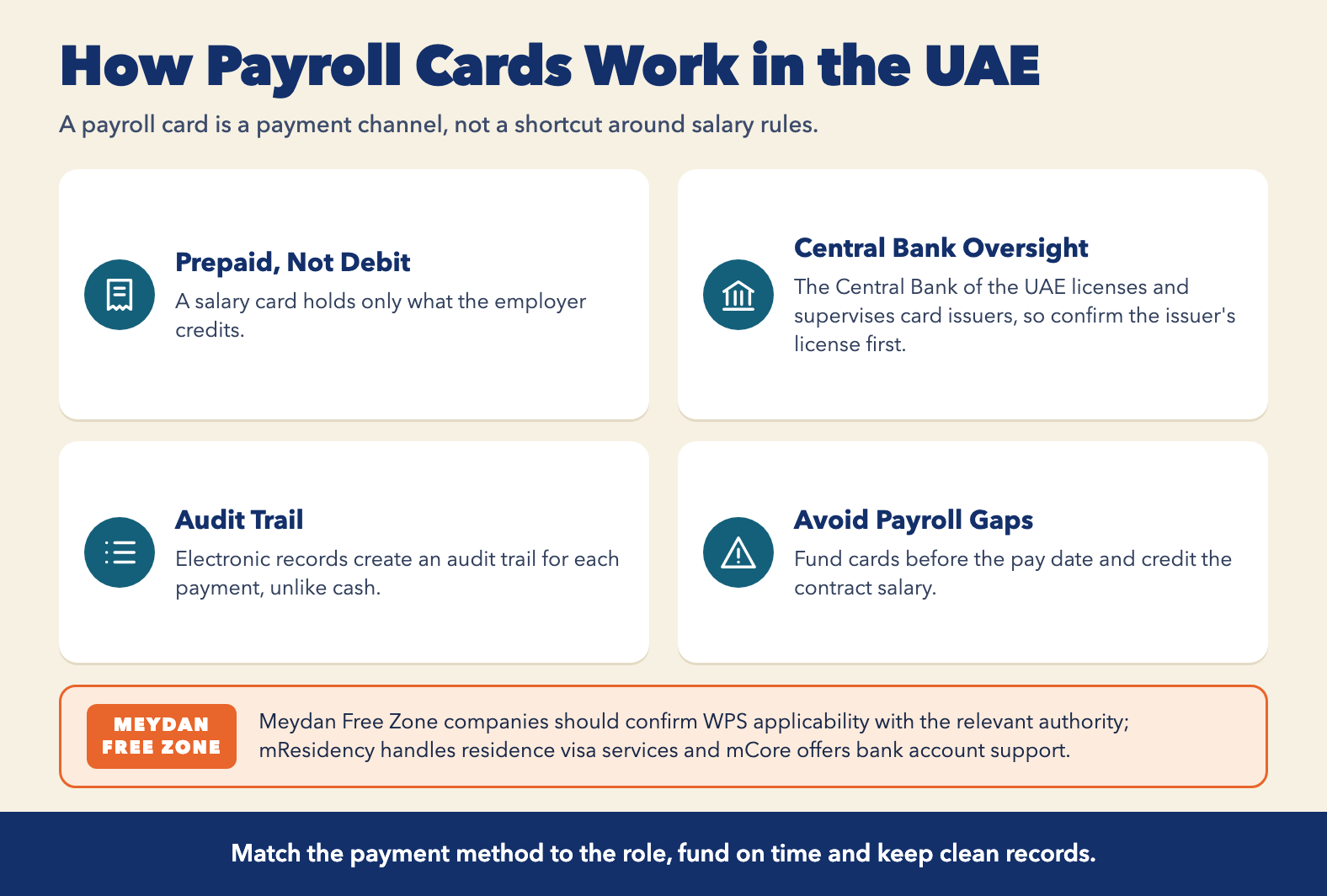
The Central Bank of the UAE regulates the institutions that issue payroll cards and the payment systems behind them. The Ministry of Human Resources and Emiratisation (MOHRE) oversees salary payment compliance for mainland private-sector employers through WPS.
The Role of the Central Bank of the UAE
The Central Bank licenses and supervises card issuers and exchange houses. It also sets the framework for stored value and payment services. You deal with the issuer, not the Central Bank directly. Confirm the issuer's license before onboarding any staff.
Where MOHRE Fits In
MOHRE administers WPS for mainland private-sector employers under Federal Decree-Law No. 33 of 2021 and its implementing resolutions. A mainland employer is checked against WPS records. Free zone employers should confirm with their free zone authority whether, and how, WPS applies. MOHRE's MOHRE salary rule on wage deadlines shows how closely payment timing is watched.
How a Payroll Card in the UAE Links to WPS
The Wage Protection System is an electronic salary transfer system that records wage payments made through approved institutions. A payroll card can be a channel for those payments when the issuer is an approved WPS agent. You still have to pay on time and keep records that match the contract.
Why Payment Records Matter
Electronic records create an audit trail for each payment. Cash leaves no verifiable trace. A trading firm facing a wage query can answer it quickly by producing the card credit record.
Common Payroll Gaps to Avoid
- Funding cards after the pay date.
- Crediting an amount that differs from the contract salary.
- Leaving cards unissued or inactive at month end.
How to Issue a Payroll Card in the UAE
Employers issue a payroll card by selecting a licensed provider, submitting company and employee details, completing identity checks, and funding the cards each pay cycle. Employees activate the card and receive salary on the agreed date. Exact documents and timelines depend on the issuer.
Step 1: Choose a Licensed Issuer
- Confirm Central Bank of the UAE licensing.
- Compare issuance fees and funding methods.
- Check funding cut-off times against your pay date.
Step 2: Submit Company and Employee Details
- Provide your trade license and signatory details.
- Add employee Emirates ID or passport copies.
- Send new hires in one batch file.
Step 3: Fund Cards and Reconcile Every Pay Cycle
- Fund before the pay date.
- Match credits to the payroll sheet.
- Close the month only after reconciliation.
Costs and Risks of Running a Payroll Card in the UAE
Payroll card costs are set by the issuer and usually include issuance, reload and maintenance charges. Fees vary by issuer, so treat any quoted figure as indicative until it appears in the current fee schedule. The main risks are late funding, record mismatches and relying on cards where a bank account suits the role better.
Fees Employers and Employees May Face
- Issuance and reload charges.
- ATM and transfer fees.
- Replacement card charges.
The contract should state who bears each cost. Review issuer fee schedules regularly.
Payroll Card vs Salary Transfer Account
| Feature | Payroll Card | Salary Transfer Account |
|---|---|---|
| Onboarding speed | Often quicker; ID requirements depend on the issuer | Slower, as the bank completes full checks |
| Banking features | Purchases, ATM withdrawals, transfers | Full account with savings and standing orders |
| Typical user | Frontline and newly arrived staff | Professional and long-term resident staff |
| Fee structure | Issuer charges for issuance and reloads | Bank charges set by the account terms |
| Credit access | Generally none, as the card is prepaid | Possible, through bank products |
Compliance and Operational Risks
Late salary is the largest exposure. Inactive or lost cards come next. A lost card delays pay for one employee, so keep a replacement process ready. Records must stay complete, as they are your evidence if a wage dispute arises.
Payroll Card vs Bank Account for Salaries
A payroll card suits workers who lack a bank account or need quick onboarding. A salary transfer account gives broader banking, credit access and savings options. Employers often use both, matching the method to the role and the employee's documentation status.
When a Card Makes Sense
- Fast onboarding of large frontline teams.
- Simple payment needs.
A logistics operator paying warehouse staff by card is a common case.
When a Salary Account Is the Better Fit
Managers and long-term residents expect credit, cards and savings. A senior hire will assume a bank-linked salary account. See your options for a UAE bank account before deciding.
What a Payroll Card Means for a Meydan Free Zone Company
Meydan Free Zone company owners should confirm which salary payment rules apply to their workforce rather than assuming mainland MOHRE processes. WPS applicability for free zone staff must be confirmed with the relevant authority.
Accounting Support Through mAccounting
mAccounting offers bookkeeping, VAT registration support and Corporate Tax support, so salary costs sit in clean books. The salary payments themselves run through your bank or card issuer, not through Meydan Free Zone.
Visas and Banking Before You Hire
mResidency covers residence visa services, including Emirates ID and medical insurance. mCore supports business bank account setup, without guaranteeing approval. The Cost Calculator helps you estimate setup costs. Plan visas, the bank account and the salary payment method before the first hire.
Free Business Setup Cost Calculator
Calculate NowPlanning Payroll Before You Hire
A payroll card is a payment channel, not a way around WPS or banking rules. Match the method to the role, fund cards on time and keep clean records. Map your hiring plan, visas, bank account and payment method, then decide which staff suit cards and which suit salary accounts. For a Meydan Free Zone company, mResidency handles residence visa services, so visas and salary planning can move together.
Ready to Launch Your Business in Dubai?
Let's Connect