

Table of Contents
Frequently Asked Questions
Who pays the Tourism Dirham in Dubai, the guest or the hotel?
The guest pays the Tourism Dirham. The hotel or licensed accommodation operator acts as the collecting party and remits it to the Department of Economy and Tourism (DET). If the operator fails to charge it, the operator carries the liability for the shortfall.
Can a hotel include the Tourism Dirham in the room rate?
Operators should show the fee as a separate line on the guest folio, apart from the room rate, service charge and VAT. Bundling it into an all-inclusive rate causes mismatches between the folio and the DET return. The remittance duty applies either way.
Is the Tourism Dirham subject to VAT?
The Tourism Dirham is an emirate-level fee administered by DET, while VAT is a federal tax administered by the Federal Tax Authority. Operators should keep the two on separate lines and configure the fee outside the VAT base unless the authority confirms otherwise.
Do holiday home operators have to charge the Tourism Dirham?
Yes. Holiday home and serviced apartment operators apply the fee on the same principle as hotels, per unit per night. The DET permit holder is accountable for collecting and remitting it, not the listing platform or the owner's tenant.
How does a hotel remit the Tourism Dirham to DET?
The operator registers the establishment with DET, reconciles collected fees against occupied room nights, submits the monthly statement through DET's system and pays the total. Payment is due by the 16th of the month after collection. Keep folios, statements and payment proof for audit.
Does a free zone-licensed hospitality company still need to collect the fee?
Yes. The fee follows the property and its DET classification, not the jurisdiction of the license. A company licensed through Meydan Free Zone that operates a DET-permitted property must collect and remit it. The DET permit is separate from the free zone license.
What happens if a hotel fails to remit the Tourism Dirham?
The operator is liable for any uncollected or unpaid amount, because the fee is owed through the establishment, not the guest. Executive Council Resolution No. 2 of 2014 sets a late-payment fine of 10% of the unpaid fee, with a minimum of AED 1,000. Monthly reconciliation of folios against statements reduces this exposure.
Topic Summary
What the Tourism Dirham Fee in Dubai Is
The Tourism Dirham is a per-room, per-night fee that DET requires hotels and other licensed accommodation operators to collect from guests. Operators add it to the bill and remit it to DET. It is separate from room rates, service charges and VAT.
Rates and Who Pays the Tourism Dirham Fee in Dubai
The guest pays the Tourism Dirham, calculated per room per night. Hotel rates run from AED 7 to AED 20 depending on classification, and the fee applies for a maximum of 30 consecutive nights per stay. The operator collects it but carries the liability if it is missed.
How Hotels Charge the Fee at Check-Out
Hotels charge the Tourism Dirham through the property management system, which posts it automatically per room per night. It appears as a separate folio line and is reported later in the operator's DET return.
How to Remit the Tourism Dirham Fee to DET
Operators pay the Tourism Dirham by recording collected fees, reconciling them against occupied room nights, submitting the monthly statement through DET's system and paying the total. Payment is due by the 16th of the month after collection, through the channels DET sets.
How Holiday Home and Serviced Apartment Operators Apply the Fee
Holiday home and serviced apartment operators charge the Tourism Dirham on the same principle as hotels: per unit, per night, collected from the guest and remitted to DET. Rates follow property type and bedroom count, and the permit holder carries responsibility.
Common Mistakes in Collecting and Remitting the Fee
The most common errors are folding the Tourism Dirham into the room rate, applying the wrong rate to a room category, missing night caps and filing late. Each leaves the operator liable for the shortfall.
What the Fee Means for Your Hospitality Business Structure
The tourism dirham fee in Dubai affects pricing, cash flow and accounting, not the choice of jurisdiction. Model it as a pass-through collected for DET, confirm the DET permit your activity needs, and keep the fee separate from revenue.
Tourism Dirham Fee in Dubai: How Hotels Charge and Remit It
Hospitality operators in Dubai collect the Tourism Dirham on every occupied room night, but the money is not theirs: it is owed to the Dubai Department of Economy and Tourism (DET). Mistakes in charging, recording or paying it leave the operator liable for the shortfall and for fines. This guide covers the rates, how the fee appears on guest bills, how and when to pay it to DET, and how to keep it out of revenue.
What the Tourism Dirham Fee in Dubai Is
The Tourism Dirham is a per-room, per-night fee that DET requires hotels and other licensed accommodation operators to collect from guests. Operators add it to the bill and remit it to DET. It is separate from room rates, service charges and VAT.
Purpose and Legal Basis
This is an emirate-level fee set by Dubai Executive Council Resolution No. 2 of 2014, not a federal tax. DET administers it, and it supports tourism promotion through channels such as Visit Dubai. VAT is different: the Federal Tax Authority (FTA) administers it nationally.
A typical guest folio shows four separate lines: room rate, service charge, Tourism Dirham and VAT. Each has a different owner and a different destination.
Tourism Dirham Responsibilities by Party
| Party | Responsibility |
|---|---|
| Guest | Pays the fee per room, per night, up to the stay cap. |
| Hotel or holiday home operator | Charges the fee, itemises it, reconciles it and remits it to DET. |
| Booking platform | Collects only where its terms say so; the operator still reconciles payouts. |
| Department of Economy and Tourism | Sets rates, receives returns and queries mismatches. |
| Property owner | Has no filing duty unless the management agreement says otherwise. |
Which Operators Fall Within Scope
- Hotels, hotel apartments, guest houses and resorts licensed in Dubai.
- Holiday homes operating under DET permits.
- Free zone and mainland operators alike, because the fee applies to hotel establishments across the emirate, including free zones.
Take a company that runs holiday homes under a DET permit. The fee applies to those units because of the permit, wherever the company itself is licensed.
Rates and Who Pays the Tourism Dirham Fee in Dubai
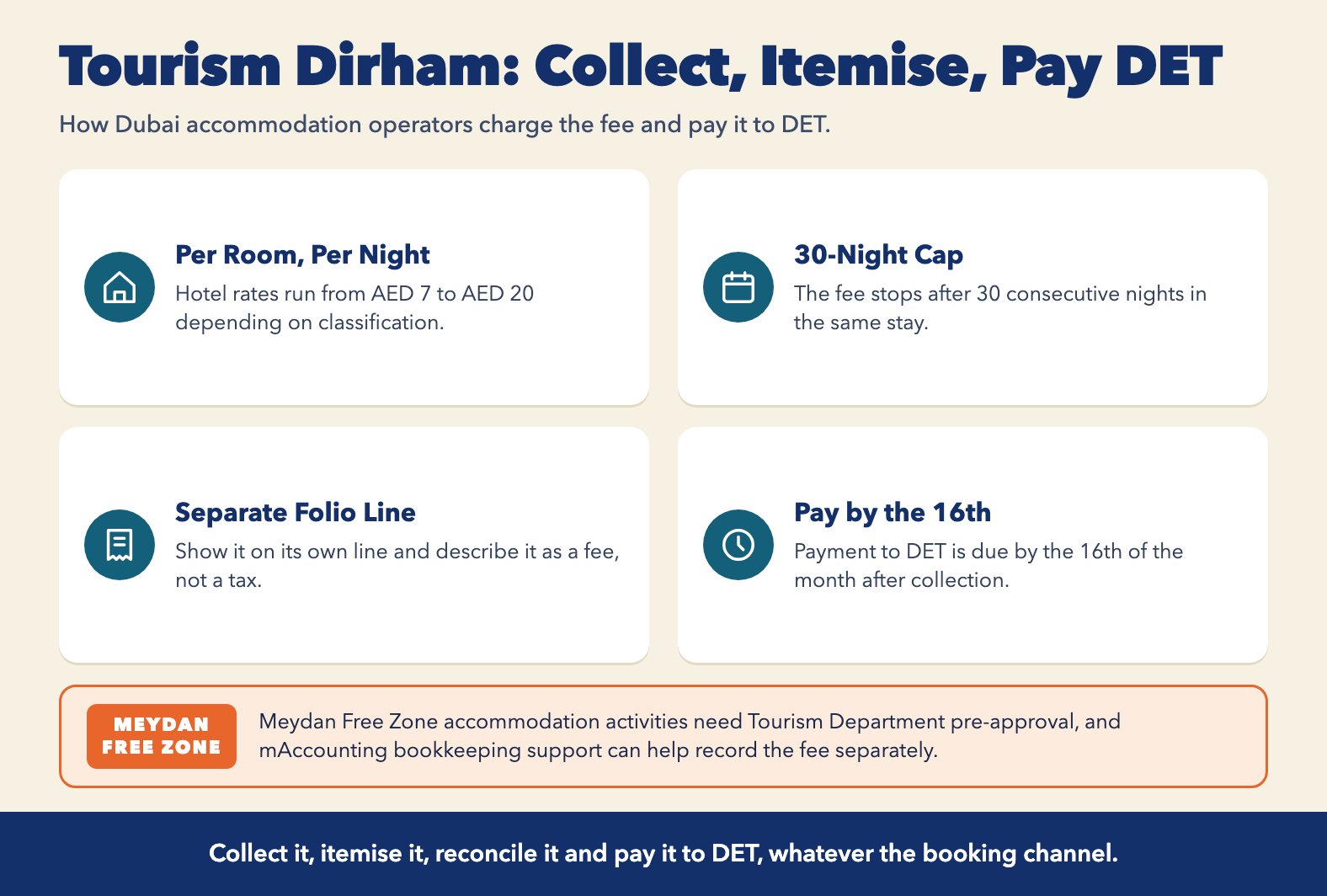
The guest pays the Tourism Dirham, calculated per room per night. Hotel rates run from AED 7 to AED 20 depending on classification, and the fee applies for a maximum of 30 consecutive nights per stay. The operator collects it but carries the liability if it is missed.
How Rates Vary by Hotel Category
The rate rises with star classification. Hotel apartments and holiday homes have their own rate bands, and in a unit with several bedrooms the fee applies to each bedroom. Confirm the current rate with DET before pricing, as rates can be revised.
Here is an illustration only. A four-star hotel with 120 rooms at 80% occupancy sells 96 rooms a night. Over a 30-night month at the four-star rate of AED 15, that is 2,880 room nights and AED 43,200 collected for DET.
Who Bears the Cost: Guest or Operator
Legally the guest pays and the operator collects. Absorbing the fee into the room rate does not remove the payment duty. Say an online travel agency (OTA) booking is quoted as all-inclusive: the operator must still record the fee separately and pay it to DET.
Night Limits and Exemptions
The fee stops after 30 consecutive nights in the same stay, so a long-stay guest's invoice stops accruing it after that point. Hotel employees and the hotel owner are exempt, with supporting documents kept on file. Apply only exemptions listed in DET's rules.
How Hotels Charge the Fee at Check-Out
Hotels charge the Tourism Dirham through the property management system, which posts it automatically per room per night. It appears as a separate folio line and is reported later in the operator's DET return.
Configuring the Property Management System
Set the fee as a distinct code per room category. Keep it out of the VAT base unless the Federal Tax Authority confirms otherwise. Test against a sample folio before opening.
A boutique hotel that maps the fee code before soft opening avoids retroactive corrections. Operators setting up a property can start with our guide to setting up a hotel business in Dubai.
Showing the Fee on Guest Invoices
- Show a separate line that describes the charge as a fee, not a tax.
- Treat direct, agent and OTA bookings the same way.
- Retain folios to support reconciliation.
One guest dispute closed in minutes because the folio itemised the fee.
How to Remit the Tourism Dirham Fee to DET
Operators pay the Tourism Dirham by recording collected fees, reconciling them against occupied room nights, submitting the monthly statement through DET's system and paying the total. Payment is due by the 16th of the month after collection, through the channels DET sets.
Step 1: Register the Establishment With DET
- Hold a valid DET classification or permit.
- Link the account to the licensed entity.
- Make a separate payment for each hotel activity type under one tourism license.
Step 2: Reconcile Collected Fees Against Room Nights
- Match system totals to occupied room nights.
- Investigate complimentary and exempt nights.
- Compare folio postings with the occupancy report at month end.
Step 3: Submit the Return and Pay
- Use the DET channel currently in force.
- Pay by the 16th of the month after collection to avoid late-payment fines.
- Keep payment confirmation with the return.
Step 4: Keep Records for Audit
- Retain folios, returns and payment proof.
- Align the file with your VAT and Corporate Tax records.
- Store the reconciliation so a DET query can be answered within a day.
How Holiday Home and Serviced Apartment Operators Apply the Fee
Holiday home and serviced apartment operators charge the Tourism Dirham on the same principle as hotels: per unit, per night, collected from the guest and remitted to DET. Rates follow property type and bedroom count, and the permit holder carries responsibility.
Permit Holder Responsibility
The licensed operator is accountable, not the property owner's tenant or the listing platform. Owners' agreements should state who collects and pays the fee. A company running ten units for separate owners still records the fee for every unit. See the guides on starting a vacation home rental business in Dubai and short-term accommodation businesses in Dubai.
Platform Bookings and Fee Handling
- Check whether the platform collects on your behalf.
- Reconcile payouts against remitted amounts.
- Look for the fee as a separate line on payout statements.
Common Mistakes in Collecting and Remitting the Fee
The most common errors are folding the Tourism Dirham into the room rate, applying the wrong rate to a room category, missing night caps and filing late. Each leaves the operator liable for the shortfall.
Pricing and Invoicing Errors
- Bundling the fee into an all-inclusive rate.
- Letting folio totals differ from the return.
- Misapplying a rate band, which forces guest refunds.
Reporting and Record-Keeping Gaps
- Filing late or incomplete returns.
- Keeping no audit trail from system to remittance.
- Rebuilding a quarter manually because records don't reconcile.
What the Fee Means for Your Hospitality Business Structure
The tourism dirham fee in Dubai affects pricing, cash flow and accounting, not the choice of jurisdiction. Model it as a pass-through collected for DET, confirm the DET permit your activity needs, and keep the fee separate from revenue.
Treating the Fee as a Pass-Through in Your Model
Exclude it from revenue and margin forecasts. Plan for the cash held between collection and remittance. A simple cash-flow line showing collected but unremitted fees at month end keeps this visible.
Licensing and Bookkeeping Through Meydan Free Zone
After registration, Meydan Free Zone issues the Business License, Certificate of Formation, Share Register and Memorandum and Articles of Association digitally. mAccounting under Meydan Plus offers bookkeeping, VAT registration support and Corporate Tax support. A founder licensed for an accommodation activity can keep fee records separate in the books from day one.
DET permits for hotel or holiday home activity are separate from the free zone license. Meydan Free Zone's activity pages note that accommodation activities need Tourism Department pre-approval before the license is issued. DET obligations follow the property and permit.
Free Business Setup Cost Calculator
Calculate NowConclusion
The Tourism Dirham is a small line with real liability attached. Operators who configure systems correctly, reconcile every month and keep the fee out of revenue rarely face problems. Execution decides the outcome.
Map the DET permit your activity needs and decide who collects and pays the fee. If you license with Meydan Free Zone, mAccounting bookkeeping support can help you record the fee separately from the first booking.
Ready to Launch Your Business in Dubai?
Let's Connect