Table of Contents
Frequently Asked Questions
How long do I have to apply for VAT deregistration after I stop trading?
A registrant that must deregister has to apply to the Federal Tax Authority within a set number of business days of the date the obligation arose. The FTA's service page currently states 30 business days, while many earlier guides cite 20, so confirm the window with the FTA. Late applications lead to an administrative penalty.
Can I deregister from VAT if my turnover falls below the threshold?
Yes. Voluntary deregistration is possible when taxable supplies over the past 12 months are above AED 187,500 but below the AED 375,000 mandatory threshold. If supplies fall below AED 187,500, deregistration becomes mandatory. Input VAT recovery stops once the registration is cancelled, and the application is made through EmaraTax.
Do I need to keep filing VAT returns while my deregistration is pending?
Yes. You must file every return that falls due, including nil returns, until the Federal Tax Authority confirms cancellation. A final return then covers the period up to the cancellation date.
What happens to my Tax Registration Number after cancellation?
The Federal Tax Authority cancels the Tax Registration Number, and the business stops charging VAT and filing returns. Cancellation does not remove earlier liabilities. The authority can still audit prior periods.
Can I cancel my trade license before cancelling my VAT registration?
You can, but it does not end your VAT obligations. License cancellation and tax cancellation are separate processes with separate authorities. The registration stays active until you apply and the Federal Tax Authority approves it, so plan both steps together.
Do I owe VAT on business assets when I deregister?
VAT may be due on goods and assets you still hold at deregistration if you recovered input VAT on them. This is treated as a deemed supply and is accounted for in the final return. Review your asset register before submitting.
Does a Meydan Free Zone company deregister through the free zone or the FTA?
VAT deregistration is a federal matter handled by the Federal Tax Authority through EmaraTax. A Meydan Free Zone company follows the same process as any other registrant. Meydan Free Zone's mAccounting service covers bookkeeping, VAT registration support, Corporate Tax support and liquidation reports, which helps keep records ready for the final return.
Topic Summary
VAT Deregistration in the UAE Explained
VAT deregistration is the formal cancellation of a business's VAT registration with the FTA. Once approved, the business stops charging VAT and filing returns, and its Tax Registration Number (TRN) is cancelled. It applies when taxable supplies stop, or when a registrant qualifies to deregister voluntarily.
Who Must or Can Deregister
Deregistration is mandatory when a registrant stops making taxable supplies. It is also mandatory when its taxable supplies over the past 12 months fall below AED 187,500 and are not expected to exceed it in the next 30 days. It is voluntary when taxable supplies sit above AED 187,500 but below the AED 375,000 mandatory registration threshold. The UAE VAT registration guide explains these thresholds in more detail.
VAT Deregistration Deadlines
A registrant that must deregister has to apply within a fixed number of business days of the date the obligation arose. The FTA reviews the request, and you keep filing returns until cancellation is confirmed. Missing the deadline leads to an administrative penalty.
VAT Deregistration Process in the UAE, Step by Step
To deregister, log in to the FTA's EmaraTax portal, select the VAT deregistration declaration, enter the cessation or threshold details, attach supporting documents and submit. File all outstanding returns, review the FTA's decision, then file a final return and settle any VAT due.
Requirements and Documents the FTA Expects
The FTA expects accurate business details, your TRN, the reason for deregistration and proof that supports it. That means closure evidence, financial records showing supplies and expenses, and a clear position on assets held. All returns must be filed and paid before approval.
Penalties and Risks of Delay
Failing to apply on time can lead to FTA administrative penalties, and unfiled returns keep accruing fines while the registration stays open. Late action also exposes you to audit for earlier periods. Acting inside the deadline limits cost and keeps the file clean.
What Deregistration Means for a Meydan Free Zone Company
VAT deregistration is a federal matter handled by the FTA, not the free zone. A Meydan Free Zone company deregisters through EmaraTax like any other registrant. Meydan Free Zone's mAccounting service covers bookkeeping, VAT registration support, Corporate Tax support and liquidation reports, which helps keep records ready for the final filing.
VAT Deregistration in the UAE: Process, Requirements and Deadlines
A company that stops trading often leaves its VAT registration open long after the business goes quiet. Yet the Federal Tax Authority (FTA) expects returns until that registration is cancelled, even after the bank account closes or the license lapses. So when must you apply to deregister, and what will the FTA ask for? This guide covers who must or can deregister, the deadlines, the EmaraTax steps and the penalties for delay.
VAT Deregistration in the UAE Explained
VAT deregistration is the formal cancellation of a business's VAT registration with the FTA. Once approved, the business stops charging VAT and filing returns, and its Tax Registration Number (TRN) is cancelled. It applies when taxable supplies stop, or when a registrant qualifies to deregister voluntarily.
What Cancellation Actually Does
The FTA cancels the TRN and ends your duty to charge VAT and file returns. It doesn't erase earlier liabilities, and the FTA can still audit prior periods. The legal basis is Federal Decree-Law No. 8 of 2017 on VAT and its Executive Regulation.
Say a consultancy stops trading in March but keeps its TRN open. Nil returns fall due every quarter, and each late one attracts a penalty.
Why a Closed License Does Not End Your VAT Duty
License cancellation and tax cancellation are separate processes with separate authorities. Your FTA registration stays active until you apply and the FTA approves. A trader who cancels the license first may later find they need to file several overdue returns. If closure is planned, read the guide on liquidating a free zone company.
Who Must or Can Deregister
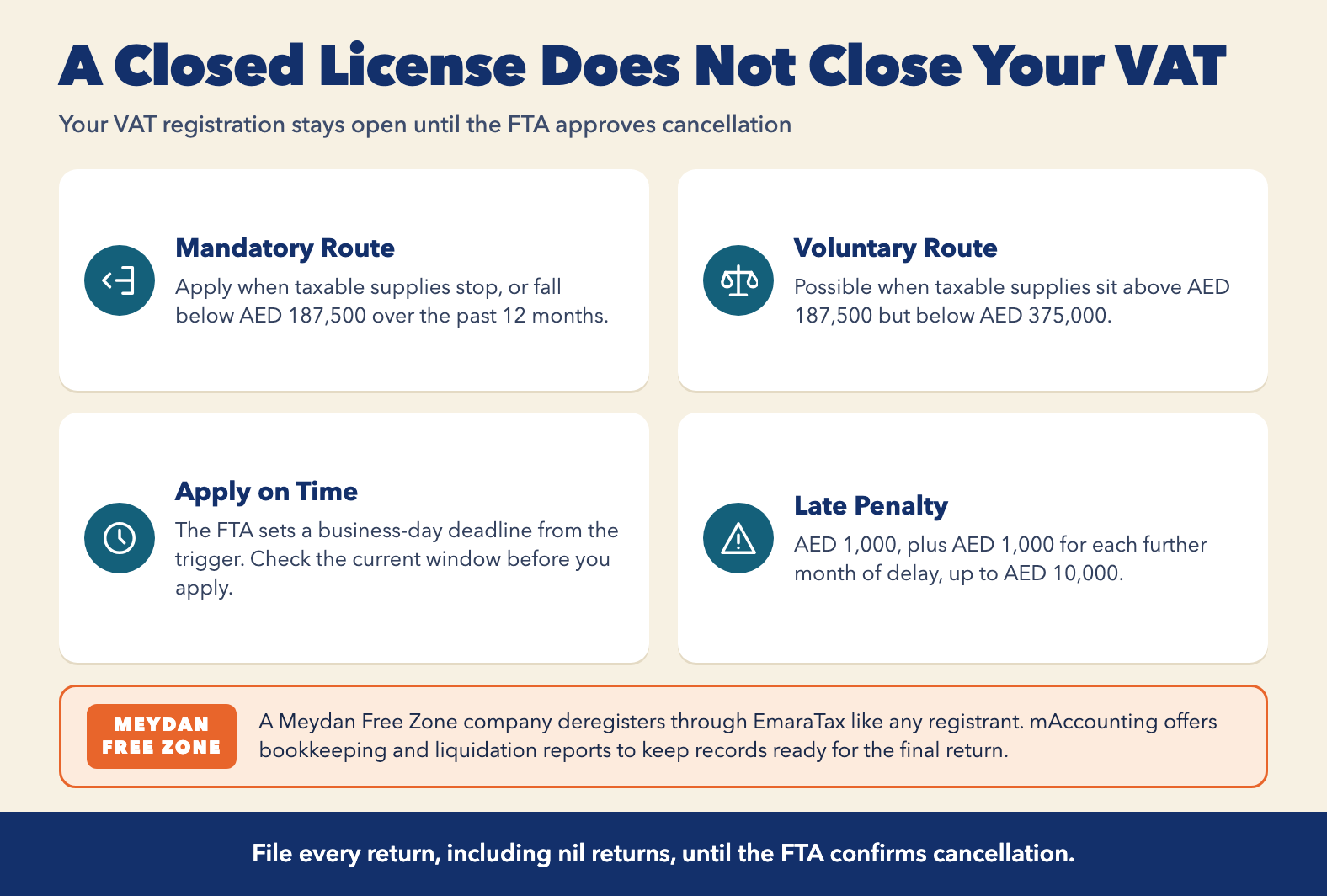
Deregistration is mandatory when a registrant stops making taxable supplies. It is also mandatory when its taxable supplies over the past 12 months fall below AED 187,500 and are not expected to exceed it in the next 30 days. It is voluntary when taxable supplies sit above AED 187,500 but below the AED 375,000 mandatory registration threshold. The UAE VAT registration guide explains these thresholds in more detail.
Mandatory Deregistration
- It is triggered when the business stops making taxable supplies, through closure or sale, or when supplies fall below AED 187,500.
- The duty to apply sits with you, so don't wait for the FTA to act.
- It covers sole establishments and companies alike.
Example: a founder sells the trading business and no longer makes taxable supplies. The obligation to apply starts that day.
Voluntary Deregistration
- It is available when taxable supplies are above AED 187,500 but below AED 375,000.
- Weigh it carefully, because input VAT recovery stops after cancellation.
- The mandatory registration threshold is AED 375,000.
A small design studio registered when turnover was higher, then saw it fall below the mandatory threshold. It could deregister, but only after weighing the input VAT it would no longer recover.
Mandatory and Voluntary Routes Compared
| Feature | Mandatory Deregistration | Voluntary Deregistration |
|---|---|---|
| Trigger | All taxable supplies stop, or supplies fall below AED 187,500 | Supplies stay below the AED 375,000 mandatory threshold |
| Threshold | Below AED 187,500 over 12 months, or no taxable supplies | Above AED 187,500 but below AED 375,000 over 12 months |
| Deadline to apply | A set number of business days from the trigger (check the FTA's current window) | No fixed deadline; you choose when to apply |
| Input VAT recovery after cancellation | Stops on cancellation | Stops on cancellation, so compare costs first |
| Main risk | Late-application penalties | Losing recovery, then re-registering if turnover rises |
VAT Deregistration Deadlines
A registrant that must deregister has to apply within a fixed number of business days of the date the obligation arose. The FTA reviews the request, and you keep filing returns until cancellation is confirmed. Missing the deadline leads to an administrative penalty.
The Application Window
The FTA's VAT deregistration service page currently gives 30 business days from the date the obligation arose. Many earlier guides cite 20 business days, so confirm the current window with the FTA and apply as early as you can. The count runs in business days, not calendar days.
Returns Continue Until Approval
Keep filing every return due, including nil returns, until the FTA confirms cancellation. The final return covers the period up to the cancellation date, and any tax due on it must be paid. Procedures change, so check current FTA requirements before you file.
VAT Deregistration Process in the UAE, Step by Step
To deregister, log in to the FTA's EmaraTax portal, select the VAT deregistration declaration, enter the cessation or threshold details, attach supporting documents and submit. File all outstanding returns, review the FTA's decision, then file a final return and settle any VAT due.
Step 1: Clear Every Outstanding Return
- File any missing returns.
- Pay unpaid VAT and penalties.
- Reconcile input and output VAT.
Step 2: Submit the Declaration on EmaraTax
- Choose the correct reason: cessation or below threshold.
- Enter the date and basis.
- Upload supporting evidence.
Step 3: Respond to FTA Queries and File the Final Return
- Answer clarification requests quickly.
- File the final return for the last period.
- Account for VAT on remaining assets.
A business that still holds stock when it stops trading may owe VAT on those goods.
Requirements and Documents the FTA Expects
The FTA expects accurate business details, your TRN, the reason for deregistration and proof that supports it. That means closure evidence, financial records showing supplies and expenses, and a clear position on assets held. All returns must be filed and paid before approval.
Supporting Evidence by Reason
- Cessation: the license cancellation or the sale agreement.
- Below threshold: turnover and expense records for the previous 12 months.
- Keep records for the legally required period after cancellation.
Treatment of Assets and Remaining VAT
Assets on which you recovered input VAT can trigger a deemed supply when you deregister. That means output VAT may be due on their value. If your final return shows a credit instead, see the guide on VAT refund for companies.
Penalties and Risks of Delay
Failing to apply on time can lead to FTA administrative penalties, and unfiled returns keep accruing fines while the registration stays open. Late action also exposes you to audit for earlier periods. Acting inside the deadline limits cost and keeps the file clean.
How Penalties Build Up
You face a late-application penalty plus a late-filing penalty on each unfiled return. Late deregistration costs AED 1,000, plus AED 1,000 for each further month of delay, up to AED 10,000. Cabinet Decision No. 129 of 2025, in force from 14 April 2026, left that penalty unchanged. Every missed return adds its own fine, and all must be cleared before cancellation.
Closure Blockers to Plan For
Unresolved FTA balances can hold up the wider closure of the company. For the broader rules, see the guide to penalties for non-compliance in the UAE.
What Deregistration Means for a Meydan Free Zone Company
VAT deregistration is a federal matter handled by the FTA, not the free zone. A Meydan Free Zone company deregisters through EmaraTax like any other registrant. Meydan Free Zone's mAccounting service covers bookkeeping, VAT registration support, Corporate Tax support and liquidation reports, which helps keep records ready for the final filing.
Plan Tax Closure Alongside License Decisions
Plan VAT closure alongside any decision to cancel or transfer the license. The FTA accepts a license cancellation certificate, a liquidation letter or a board resolution as evidence that trading stopped. Outstanding tax must be settled before deregistration is approved. Confirm the order of steps with the FTA and Meydan Free Zone before you start.
Support Available Through mAccounting
Clean books speed up the final return. mAccounting offers bookkeeping and liquidation reports, though deregistration approval stays with the FTA and isn't guaranteed.
Free Business Setup Cost Calculator
Calculate NowConclusion
Closing a VAT registration comes down to timing and clean records. Apply within the FTA's deadline once the obligation arises, file every return until approval, and settle the final return. Open registrations keep generating penalties, so confirm whether your position is mandatory or voluntary and gather your records early. For a Meydan Free Zone company, mAccounting's bookkeeping and liquidation reports can help keep the records the FTA asks for in order.
Ready to Launch Your Business in Dubai?
Let's ConnectReferences
- Federal Tax Authority (FTA), UAE, VAT deregistration guidance and EmaraTax, 2026.
- Federal Decree-Law No. 8 of 2017 on Value Added Tax, published by the Federal Tax Authority.