

Table of Contents
Frequently Asked Questions
Do software and SaaS subscriptions attract VAT in the UAE?
Yes. Software, apps, streaming, online courses and cloud services are electronically supplied services, and they are standard-rated at 5% when the place of supply is the UAE. Zero-rating applies only to qualifying exports to customers outside the UAE, and only where the VAT law's conditions are met.
Is a free zone company exempt from VAT on online services?
No. VAT is a federal tax under Federal Decree-Law No. 8 of 2017, and a free zone license does not remove it from services. A Meydan Free Zone company that sells digital services to UAE customers charges 5% VAT once it is registered with the Federal Tax Authority.
When must a digital business register for VAT in the UAE?
Registration is mandatory when taxable supplies exceed AED 375,000 over the previous 12 months, or are expected to exceed it in the next 30 days. Zero-rated supplies count towards this threshold. A business that waits too long faces back-dated liability and Federal Tax Authority penalties.
Can a business register for VAT voluntarily before reaching the threshold?
Yes. Voluntary registration is available from AED 187,500 in taxable supplies or expenses. It lets a business recover input VAT on costs such as cloud hosting, software and advertising. It also helps when B2B customers expect a valid tax invoice.
Do exports of digital services to overseas customers carry 5% VAT?
Qualifying exports of services to customers outside the UAE can be zero-rated, so no 5% VAT is charged. The supplier must keep contracts, invoices and proof of the customer's location to support the treatment. These sales still count towards the AED 375,000 registration threshold.
Does a foreign company selling apps to UAE consumers need to register?
It may need to. A non-resident supplier of digital services to UAE consumers can be required to register, and the local threshold does not apply where no one else is liable to account for the VAT. When the customer is a UAE VAT-registered business, that customer may account for the tax under the reverse charge.
What documents does the Federal Tax Authority ask for during VAT registration?
Applicants submit the application through EmaraTax with the trade license, the memorandum of association, and passport and Emirates ID copies for the owners. They also provide turnover details backed by contracts, invoices or bank statements, plus a description of the digital activities. The Federal Tax Authority issues a Tax Registration Number once it approves the application.
What happens if a digital business registers for VAT late?
The Federal Tax Authority imposes an administrative penalty for late registration. The business may also owe VAT on sales made from the date it should have registered, even if it did not charge customers. Tracking trailing 12-month supplies each month prevents this exposure.
Topic Summary
What VAT on Digital Services Means in the UAE
VAT on digital services is the 5% tax charged on electronically supplied services in the UAE, such as software, apps, streaming, online courses and digital advertising. It applies when the place of supply is the UAE. The supplier must register with the Federal Tax Authority once the thresholds are met.
Where VAT Applies to Digital Services
VAT applies when the place of supply is the UAE. For telecommunication and electronic services, that is where the service is actually used and enjoyed, to the extent it is used and enjoyed in the UAE. A UAE supplier charges 5% on local sales, and qualifying exports to customers outside the UAE can be zero-rated.
Who Must Register for VAT on Digital Services in the UAE
A business must register when taxable supplies exceed AED 375,000 over the previous 12 months, or are expected to in the next 30 days. Voluntary registration is available above AED 187,500. Non-resident suppliers with no UAE presence may need to register without a threshold in specific cases.
How VAT Registration for Digital Services Works in the UAE
To register, create an EmaraTax account with the FTA, complete the VAT registration form, upload your trade license, passport, Emirates ID copies and turnover details, then submit. The FTA issues a Tax Registration Number (TRN) once approved.
Invoicing, Returns and Record-Keeping Obligations
Registered businesses must issue tax invoices, file periodic returns and keep records. Late filing and late payment carry administrative penalties, so the routine matters more than the registration itself.
VAT on Digital Services for a Meydan Free Zone Company
A Meydan Free Zone company selling digital services follows the same federal VAT rules as any other UAE business. Free zone status does not exempt services from VAT, so the registration rules apply in full. mAccounting, part of Meydan Plus, offers VAT registration support alongside bookkeeping and Corporate Tax support.
Conclusion
VAT on digital services comes down to turnover tracking, place of supply and timely action. Review your trailing 12-month taxable supplies and where your customers use your services. Decide whether mandatory or voluntary registration applies, then set up invoicing and bookkeeping before the first return is due. For a Meydan Free Zone company, mAccounting's VAT registration support can manage the FTA application once you are ready.
VAT on Digital Services in the UAE: Rules and Registration Requirements
Founders selling software, subscriptions or online content often assume a free zone address, or customers abroad, keeps them outside UAE VAT, but it rarely does. Digital services are standard-rated at 5%, and the place of supply decides where the tax falls. So when does a digital business have to register, and how should it charge VAT? This article covers the place of supply rules, who must register and how a Meydan Free Zone company should plan for it.
What VAT on Digital Services Means in the UAE
VAT on digital services is the 5% tax charged on electronically supplied services in the UAE, such as software, apps, streaming, online courses and digital advertising. It applies when the place of supply is the UAE. The supplier must register with the Federal Tax Authority once the thresholds are met.
What Counts as a Digital Service
A digital service is delivered over the internet or an electronic network with minimal human involvement. Think SaaS subscriptions, mobile apps, online courses, cloud hosting and online advertising. A physical product ordered online is a sale of goods, not a digital service.
Take a founder selling a project-management subscription to customers in Dubai and abroad. The Dubai sales carry 5% VAT under Federal Decree-Law No. 8 of 2017. The overseas sales follow separate export rules.
VAT Treatment of Digital Service Sales by Customer Location
| Scenario | VAT Treatment |
|---|---|
| UAE-registered supplier selling to a UAE customer | Charge 5% VAT and issue a tax invoice. |
| UAE-registered supplier exporting to an overseas customer | Zero-rated if the export conditions are met. Still counts toward the threshold. |
| Non-resident supplier selling to a UAE consumer | Supplier registers and charges 5%, with no threshold. |
| Non-resident supplier selling to a UAE VAT-registered business | The customer self-accounts under the reverse charge. |
| Free zone company selling to a UAE customer | Same as any UAE supplier: 5% VAT applies. |
The Legal Basis and the Regulator
VAT is a federal tax governed by Federal Decree-Law No. 8 of 2017 and its executive regulation. The Federal Tax Authority (FTA) administers registration, returns and penalties. Customs matters sit with the customs authorities, not the FTA. For wider context, see the guide to VAT in the UAE.
Where VAT Applies to Digital Services
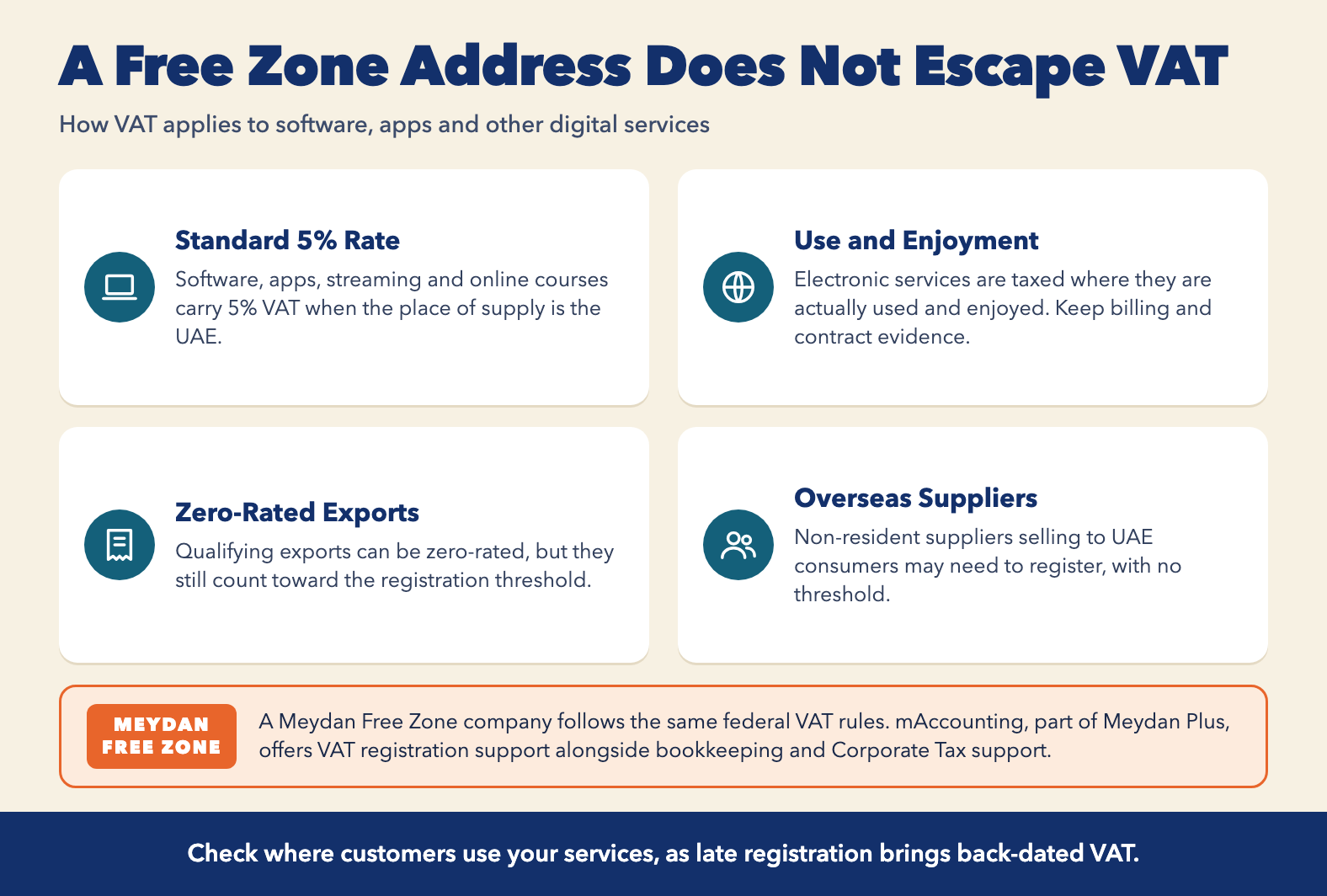
VAT applies when the place of supply is the UAE. For telecommunication and electronic services, that is where the service is actually used and enjoyed, to the extent it is used and enjoyed in the UAE. A UAE supplier charges 5% on local sales, and qualifying exports to customers outside the UAE can be zero-rated.
Place of Supply Rules for Electronic Services
Where the customer actually uses and enjoys the service drives the answer, and you need evidence for audit, such as billing address and contract details. A free zone address does not change this. A Meydan Free Zone company selling an online course to a customer in Abu Dhabi charges 5% VAT.
Zero-Rated Exports Versus Local Sales
- Qualifying service exports can be zero-rated, subject to the conditions in the VAT law.
- Zero-rated sales still count toward the registration threshold.
- Keep contracts, invoices and proof of customer location.
A UAE app developer licensing software to a European customer is the typical case.
Overseas Suppliers Selling to UAE Customers
Non-resident suppliers selling digital services to UAE consumers may need to register. No local threshold applies where nobody else is liable to account for the VAT. UAE business customers usually self-account under the UAE VAT reverse charge; since 1 January 2026, they no longer need to issue a self-invoice to do so.
Who Must Register for VAT on Digital Services in the UAE
A business must register when taxable supplies exceed AED 375,000 over the previous 12 months, or are expected to in the next 30 days. Voluntary registration is available above AED 187,500. Non-resident suppliers with no UAE presence may need to register without a threshold in specific cases.
Mandatory Registration Threshold
- The AED 375,000 test includes standard-rated and zero-rated supplies.
- The 30-day forward-looking test applies as well.
- Late registration attracts an FTA penalty.
Say a subscription business crosses the threshold in month five of trading. Liability runs from that point, so waiting for the next quarter creates exposure.
Voluntary Registration and Input Tax Recovery
You can register voluntarily from AED 187,500 in supplies or expenses. A start-up with heavy cloud and advertising spend can then recover input VAT on those costs. B2B customers also expect a tax invoice, which makes early registration useful.
Our UAE VAT registration guide covers the wider rules for new businesses.
How VAT Registration for Digital Services Works in the UAE
To register, create an EmaraTax account with the FTA, complete the VAT registration form, upload your trade license, passport, Emirates ID copies and turnover details, then submit. The FTA issues a Tax Registration Number (TRN) once approved.
Step 1: Set Up Your EmaraTax Account
- Create an account on the FTA's EmaraTax portal.
- Link the taxable person and authorised signatory details.
Step 2: Prepare Supporting Documents
- Gather the trade license, Memorandum of Association and owner identity documents.
- Back turnover with contracts, invoices or bank statements.
- Describe your digital activities and customer locations.
Step 3: Submit the Registration and Track Approval
- Complete the declaration and submit through EmaraTax.
- Answer any FTA clarification requests.
- Receive the TRN and certificate.
Step 4: Start Charging VAT and Filing Returns
- Issue tax invoices from the effective registration date.
- File returns for the period the FTA assigns.
- Keep records for the legally required period.
Invoicing, Returns and Record-Keeping Obligations
Registered businesses must issue tax invoices, file periodic returns and keep records. Late filing and late payment carry administrative penalties, so the routine matters more than the registration itself.
What a Compliant Tax Invoice Shows
- Supplier and customer details, TRN, invoice date and number.
- The VAT charged, shown in AED.
- Correct handling of recurring billing.
A monthly subscription invoiced automatically from a billing platform must carry these details every cycle. See the UAE tax invoice requirements for the full list.
Return Filing and Penalty Exposure
Returns are filed through EmaraTax. Penalties apply for late registration, late filing and late payment. Reconcile payment-platform payouts to your invoices before filing, because platform fees and currency conversions often cause mismatches.
VAT on Digital Services for a Meydan Free Zone Company
A Meydan Free Zone company selling digital services follows the same federal VAT rules as any other UAE business. Free zone status does not exempt services from VAT, so the registration rules apply in full. mAccounting, part of Meydan Plus, offers VAT registration support alongside bookkeeping and Corporate Tax support.
Why a Free Zone License Does Not Remove VAT
VAT is federal. Designated Zone treatment relates to specific goods, not digital services. A solo founder licensed through Fawri who sells templates to UAE customers should price with 5% VAT in mind.
Support Available Through mAccounting
VAT registration support is one of the mAccounting services, alongside bookkeeping and Corporate Tax support. Bookkeeping keeps turnover tracking accurate, and the registration service manages the application with the FTA. Details are on the VAT registration support page.
Free Business Setup Cost Calculator
Calculate NowConclusion
VAT on digital services comes down to turnover tracking, place of supply and timely action. Review your trailing 12-month taxable supplies and where your customers use your services. Decide whether mandatory or voluntary registration applies, then set up invoicing and bookkeeping before the first return is due. For a Meydan Free Zone company, mAccounting's VAT registration support can manage the FTA application once you are ready.
Ready to Launch Your Business in Dubai?
Let's Connect